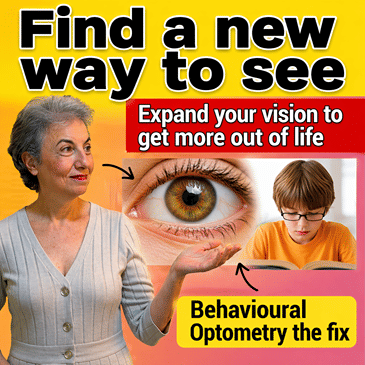
In this episode, we sit down with Dr. Kimberley Linert, a Behavioural Optometrist specializing in the complex relationship between the eyes, the brain, and physical movement. We explore the science of "Functional Vision"—how eye tracking and visual processing impact everything from reading skills to brain rehabilitation and neuroplasticity.
Dr. Kimberley Linert is the founder of the Optic Brain Fit Foundation. Her work bridges the gap between traditional optometry and neurological integration, utilizing her background in brain rehabilitation and neuroplasticity-based training to help patients achieve greater clarity and cognitive function.
IN THIS EPISODE, WE COVER: The difference between "eyesight" and "functional vision." How eye tracking issues can impact learning and daily focus. The role of neuroplasticity in vision therapy. Integrating movement and sensory awareness for brain health.
RESOURCES & LINKS: Visualizing Happiness: In Every Area of Your Life by Dr. Kimberley Linert; Self-Empowerment Reset: Entrepreneur Secrets (Co-authored)
DISCLAIMER: This video is for educational and informational purposes only and does not constitute medical advice, diagnosis, or treatment. Please note that content features US-based practices and regulations. Always seek the advice of your physician or other qualified health provider with any questions regarding a medical condition or health goals.
CONNECT WITH IDA FANELLI: Explore the Link in Bio
Please like, subscribe, and share
#BehavioralOptometry #Neuroplasticity #BrainHealth #VisionTherapy #EyeTracking #IdasIdeas #ScienceMeetsSelfCare #DrKimberleyLinert
00:00:00 --> 00:00:03 Welcome to Where Science Meets Self -Care with
00:00:03 --> 00:00:06 Ida Fanelli. With over 30 years in beauty and
00:00:06 --> 00:00:09 wellness and a background in medical science,
00:00:09 --> 00:00:12 Ida blends clinical knowledge with holistic care.
00:00:13 --> 00:00:16 Each week, she and her guests share insights
00:00:16 --> 00:00:19 to help you achieve healthier skin, balanced
00:00:19 --> 00:00:23 energy, and empowered self -care. Now, here's
00:00:23 --> 00:00:31 your host, Ida Finelli. Hello, everyone. I'm
00:00:31 --> 00:00:34 excited to say that I have Kimberly Linnert here
00:00:34 --> 00:00:38 today. She is a pioneer in behavioral optometry.
00:00:39 --> 00:00:42 While she began her education as a traditional
00:00:42 --> 00:00:46 optometrist, her journey soon led her beyond
00:00:46 --> 00:00:49 just glasses and eye charts into the deeper layers
00:00:49 --> 00:00:52 of vision where the eyes, brain, and body work
00:00:52 --> 00:00:55 together in profound and often surprising ways.
00:00:56 --> 00:01:00 Her education spans a broad spectrum from traditional
00:01:00 --> 00:01:04 optometry and brain rehabilitation to microcurrent
00:01:04 --> 00:01:08 therapy, neurolinguistic programming, Reiki,
00:01:08 --> 00:01:13 emotional healing, and neuroplasty -based intelligence
00:01:13 --> 00:01:16 training. From all this knowledge, she formed
00:01:16 --> 00:01:20 the Optic Brain Fit Foundation. This world -class
00:01:20 --> 00:01:24 therapy combines traditional vision therapy with
00:01:24 --> 00:01:27 brain and movement integration for life -changing
00:01:27 --> 00:01:30 results. She's also the author of Visualizing
00:01:30 --> 00:01:35 Happiness in Every Area of Your Life, a beautifully
00:01:35 --> 00:01:38 accessible guide that merges sensory awareness
00:01:38 --> 00:01:41 with practical goal setting, offering readers
00:01:41 --> 00:01:45 an experimental path towards greater clarity,
00:01:45 --> 00:01:48 joy, and purpose. On a personal note, Kimberly
00:01:48 --> 00:01:51 raised three children as a single mother and
00:01:51 --> 00:01:54 is now a proud grandmother. She finds joy in
00:01:54 --> 00:01:57 connecting with people, doing CrossFit and yoga,
00:01:57 --> 00:02:01 creating art and being near water, the beach,
00:02:01 --> 00:02:06 a lake, a pool, or anywhere nature calls. Welcome,
00:02:06 --> 00:02:08 Kimberly. Let's start with your journey. How
00:02:08 --> 00:02:11 did you first get into optometry and what led
00:02:11 --> 00:02:15 you to the behavioral aspect of this work? All
00:02:15 --> 00:02:17 right. Well, thank you, first of all, for having
00:02:17 --> 00:02:20 me on your show. I love it. Thank you for being
00:02:20 --> 00:02:26 here. You have. So, yeah, when you're growing
00:02:26 --> 00:02:28 up and people say, what is it you want to do
00:02:28 --> 00:02:31 when you grow, you know, when you get older?
00:02:31 --> 00:02:34 And I thought, well, I had an aunt who was a
00:02:34 --> 00:02:36 doctor and I said, I want to be a doctor like
00:02:36 --> 00:02:39 her because I admired her. And then I realized
00:02:39 --> 00:02:42 when I got to high school and I had to do biology.
00:02:43 --> 00:02:47 you know, using pigs and dissecting and everything,
00:02:47 --> 00:02:52 I decided that blood was not for me. And so I
00:02:52 --> 00:02:55 looked to see what thing I could do to help people
00:02:55 --> 00:02:59 that didn't involve a lot of blood. And about
00:02:59 --> 00:03:02 that same time, I was trying contact lenses for
00:03:02 --> 00:03:06 the first time. And I'm like, oh, this doctor
00:03:06 --> 00:03:10 helps people. And he doesn't have to deal with
00:03:10 --> 00:03:12 blood. So I'm like, that would be a good profession.
00:03:12 --> 00:03:17 So that's how I chose optometry itself. And optometry
00:03:17 --> 00:03:21 is a very left brained type of calling as far
00:03:21 --> 00:03:24 as just doing the science of everything. And
00:03:24 --> 00:03:28 I'm very right brained in that I'm very artistic.
00:03:28 --> 00:03:31 I see that. And I also love. working with people
00:03:31 --> 00:03:35 so when I got into optometry school I did a rotation
00:03:35 --> 00:03:38 in the vision therapy clinic where I worked with
00:03:38 --> 00:03:41 a young boy I'll just call him Darren and he
00:03:41 --> 00:03:43 was a nine -year -old when he came in he was
00:03:43 --> 00:03:47 very shy looking down but very friendly you know
00:03:47 --> 00:03:50 sweet kid but very shy and you could tell he
00:03:50 --> 00:03:53 kind of lacked confidence and so I started working
00:03:53 --> 00:03:56 with him doing these vision eye exercises and
00:03:56 --> 00:03:59 after about four or five weeks he'd come in and
00:03:59 --> 00:04:03 his Head was up. He was happy. He was like smiling.
00:04:03 --> 00:04:07 Hey, how are you? And I'm like, Darren, because
00:04:07 --> 00:04:09 I'm new, so I'm just doing what I was taught,
00:04:09 --> 00:04:12 right? So I said, Darren, has anything changed
00:04:12 --> 00:04:14 since I've been working with you these last few
00:04:14 --> 00:04:17 weeks? He's like, yes. I said, well, what is
00:04:17 --> 00:04:20 it? He said, well, I don't feel stupid anymore.
00:04:20 --> 00:04:24 I said, what? You don't feel stupid anymore.
00:04:25 --> 00:04:27 I said, what do you mean by that? He said, well,
00:04:27 --> 00:04:32 in the past. I couldn't read. And so when I was
00:04:32 --> 00:04:35 asked to read aloud in class, everyone would
00:04:35 --> 00:04:38 laugh at me. But now I can read and nobody laughs
00:04:38 --> 00:04:41 at me. And I'm just like, oh, that just hit my
00:04:41 --> 00:04:44 heart. And I'm like, oh, if I could just do this
00:04:44 --> 00:04:48 over and over, help people have the skills they
00:04:48 --> 00:04:51 need to have that confidence, have that self
00:04:51 --> 00:04:54 -love, the feeling like they can do things again.
00:04:54 --> 00:04:57 I'm like, that would be fulfilling enough for
00:04:57 --> 00:05:00 me for a whole life. That's what I did. I went
00:05:00 --> 00:05:03 into what's called behavioral optometry. And
00:05:03 --> 00:05:07 that's where we have therapy centers and we kind
00:05:07 --> 00:05:09 of train the eyes and the brain to work together
00:05:09 --> 00:05:13 as a team. And then as I was doing more and more
00:05:13 --> 00:05:15 work there, I realized I was doing more brain
00:05:15 --> 00:05:18 work than vision. So it flipped from... 80 %
00:05:18 --> 00:05:24 vision, 20 % brain to 80 % brain work, 20 % vision.
00:05:24 --> 00:05:27 And then I realized as I added movement to it,
00:05:27 --> 00:05:30 that would give me sustainable results where
00:05:30 --> 00:05:33 they would really stick because the body has
00:05:33 --> 00:05:36 memory from movement. We also create new brain
00:05:36 --> 00:05:39 pathways when we move. And so that's where the
00:05:39 --> 00:05:42 optic brain fit came in. As the years went on,
00:05:42 --> 00:05:45 I was just developing this new technology. Wow.
00:05:46 --> 00:05:49 It's so nice when you get feedback from people
00:05:49 --> 00:05:52 and then it inspires you to go on. You've been
00:05:52 --> 00:05:56 called a mind -body -soul whisperer. That's such
00:05:56 --> 00:06:00 a powerful phrase. How did your work evolve to
00:06:00 --> 00:06:04 blend holistic and scientific approaches? Yeah,
00:06:04 --> 00:06:07 so about the same time I was learning vision
00:06:07 --> 00:06:11 therapy and I was being mentored by Dr. David
00:06:11 --> 00:06:14 Cook, who is... one of the most famous vision
00:06:14 --> 00:06:16 therapy doctors in the world at this point. In
00:06:16 --> 00:06:19 fact, he just got a very prestigious award a
00:06:19 --> 00:06:22 couple months ago, like the highest award you
00:06:22 --> 00:06:25 can get in behavioral optometry. As I was learning
00:06:25 --> 00:06:29 from him, my children were very small, and my
00:06:29 --> 00:06:33 middle child had a nose that kept running and
00:06:33 --> 00:06:36 running, and no matter what we did, she walked
00:06:36 --> 00:06:39 around and it was horrible. She had this runny
00:06:39 --> 00:06:42 nose and I didn't know what to do. And the regular
00:06:42 --> 00:06:46 doctors weren't helping us. And so somebody said,
00:06:46 --> 00:06:49 well, take her to this doctor who does naturopathy.
00:06:49 --> 00:06:52 He's a naturopathic doctor. I'm like, okay. So
00:06:52 --> 00:06:54 I took her there. He said, well, first of all,
00:06:54 --> 00:06:57 she needs to stop eating cheese because she's
00:06:57 --> 00:07:01 allergic to dairy. And then he gave us some homeopathics
00:07:01 --> 00:07:04 and she got better. I'm like, oh, there's something
00:07:04 --> 00:07:09 to this. So then as I evolved, I integrated more
00:07:09 --> 00:07:12 and more natural medicine into it, learning energetic
00:07:12 --> 00:07:17 medicine, homeopathy, herbs, different supplements.
00:07:18 --> 00:07:21 So because when I work with people, I need to
00:07:21 --> 00:07:24 look at their nutrition as well as their mental
00:07:24 --> 00:07:26 health, as well as their emotional health, as
00:07:26 --> 00:07:28 well as just even their family structure and
00:07:28 --> 00:07:31 what's happening at home. Because if you're working
00:07:31 --> 00:07:34 with someone in a therapy center, but things
00:07:34 --> 00:07:38 at home are not positive for that person and
00:07:38 --> 00:07:40 they're going home and they're being put down
00:07:40 --> 00:07:44 or things aren't happening well, then your gains
00:07:44 --> 00:07:46 are going to keep falling apart. You're going
00:07:46 --> 00:07:48 to say, well, this person gets better and then
00:07:48 --> 00:07:49 gets worse and then gets better and then gets
00:07:49 --> 00:07:51 worse. So you have to look at everything when
00:07:51 --> 00:07:55 it comes to the person to create a customized
00:07:55 --> 00:07:58 program to help them get to the goal they want.
00:07:59 --> 00:08:03 Yeah, so for those... who are new to this space
00:08:03 --> 00:08:06 can you explain to them what exactly optic brain
00:08:06 --> 00:08:10 fit is and how does it differ from traditional
00:08:10 --> 00:08:13 vision therapy traditional vision therapy we're
00:08:13 --> 00:08:16 using a lot of lenses and prisms and doing a
00:08:16 --> 00:08:19 lot of focusing and making just the eyes work
00:08:19 --> 00:08:22 a lot and getting the eyes to coordinate together
00:08:22 --> 00:08:25 as a team eye movements things like that but
00:08:25 --> 00:08:29 the optic brain fit a large portion of it You
00:08:29 --> 00:08:31 are moving your eyes and doing certain tasks
00:08:31 --> 00:08:35 with your eyes, but it's more of the body integrated
00:08:35 --> 00:08:39 for most of the work. It puts in a lot more movement.
00:08:39 --> 00:08:43 The eyes are deeply connected to the brain, and
00:08:43 --> 00:08:45 some holistic practices even explore how eye
00:08:45 --> 00:08:49 patterns reflect systemic health. Regardless
00:08:49 --> 00:08:52 of the modality, there's no denying vision's
00:08:52 --> 00:08:54 influence on emotion, hormone balance, and motor
00:08:54 --> 00:08:58 coordination. Why do you think vision is a powerful
00:08:58 --> 00:09:01 yet often overlooked part of brain and body performance?
00:09:02 --> 00:09:06 I think part of the reasons anything is overlooked
00:09:06 --> 00:09:10 is that most traditional, I guess, Western medicine
00:09:10 --> 00:09:15 doctors are just treating parts. They're treating
00:09:15 --> 00:09:18 parts. You go to the ear, nose, and throat doctor,
00:09:18 --> 00:09:22 he's treating your ears. He's not looking at
00:09:22 --> 00:09:25 all of you. oh, why does this person have an
00:09:25 --> 00:09:30 earache? Well, if you're just treating the ear
00:09:30 --> 00:09:33 locally, what if they have an infection in their
00:09:33 --> 00:09:36 whole body, but you don't know it because you're
00:09:36 --> 00:09:38 not checking everything? So I think that's one
00:09:38 --> 00:09:41 of the reasons. And behavioral optometrists in
00:09:41 --> 00:09:45 general are going to look at the whole body.
00:09:45 --> 00:09:48 We're going to look how everything works. Many
00:09:48 --> 00:09:51 unconsciously move their neck instead of using
00:09:51 --> 00:09:54 their eyes to track movement, weakening the muscles
00:09:54 --> 00:09:57 over time. Does over -relying on head or neck
00:09:57 --> 00:10:00 movement rather than accurate eye tracking impair
00:10:00 --> 00:10:03 visual performance or disrupt brain integration?
00:10:04 --> 00:10:07 And how might this habit impact posture coordination
00:10:07 --> 00:10:10 or emotional regulation? That's a really good
00:10:10 --> 00:10:14 question. So it's really important that your
00:10:14 --> 00:10:19 eyes and your head move independently. Now, if
00:10:19 --> 00:10:22 you're going to go walk in a direction to the
00:10:22 --> 00:10:25 right, you definitely want to turn your body,
00:10:25 --> 00:10:28 turn your head and turn your eyes going in that
00:10:28 --> 00:10:31 direction. But you also want to have the ability
00:10:31 --> 00:10:33 to turn your head to the right and turn your
00:10:33 --> 00:10:37 eyes to the left because when they work together,
00:10:37 --> 00:10:40 it's very inefficient. Even a small eight or
00:10:40 --> 00:10:42 nine -year -old, if they're reading and they're,
00:10:42 --> 00:10:45 looking like a chicken pecking when they're reading,
00:10:45 --> 00:10:49 that's very inefficient. And their reading comprehension
00:10:49 --> 00:10:52 and reading speed will go down significantly.
00:10:52 --> 00:10:55 And they'll just be considered a slow reader
00:10:55 --> 00:11:00 or have difficulty with reading. Yeah. My husband
00:11:00 --> 00:11:02 had an accident that caused damage to his peripheral
00:11:02 --> 00:11:06 vision. How might that affect his navigation,
00:11:06 --> 00:11:09 perception, or emotional life experience? And
00:11:09 --> 00:11:12 what... One surprising thing about the vision
00:11:12 --> 00:11:16 system you wish more people knew? That's a two
00:11:16 --> 00:11:20 -part question. Okay. The first part is, you
00:11:20 --> 00:11:22 know, we have central and peripheral vision.
00:11:22 --> 00:11:26 Our central vision is for identifying, clarifying
00:11:26 --> 00:11:29 things, focusing. Our peripheral vision is for
00:11:29 --> 00:11:32 balance and for navigating. So if he had something
00:11:32 --> 00:11:34 that was affecting his peripheral vision, first
00:11:34 --> 00:11:38 of all, It's not as safe for him in the environment
00:11:38 --> 00:11:40 because he's not noticing what's around him.
00:11:40 --> 00:11:44 So he could easily either fall over because of
00:11:44 --> 00:11:46 balance or run into things. People who have had
00:11:46 --> 00:11:50 injuries and say, like, I keep running into the
00:11:50 --> 00:11:52 side of the door. Especially those doors where
00:11:52 --> 00:11:55 it's all glass. And they really are looking at
00:11:55 --> 00:11:57 the door and they think they see where the door
00:11:57 --> 00:11:59 is, but because they have what we call neglect
00:11:59 --> 00:12:03 on that side. they don't see it and they run
00:12:03 --> 00:12:06 right into it. So it's really important that
00:12:06 --> 00:12:08 you use your central and your peripheral vision
00:12:08 --> 00:12:12 together. And for lots of reasons, one for navigating,
00:12:12 --> 00:12:16 two, it just increases your ability to think,
00:12:16 --> 00:12:19 to make decisions, to have certainty in life,
00:12:19 --> 00:12:22 to have confidence in life. There's so many things
00:12:22 --> 00:12:25 attached to that. Most of us go around using
00:12:25 --> 00:12:27 just our central vision. Why? Because we're in
00:12:27 --> 00:12:29 front of screens all the time. But it's very
00:12:29 --> 00:12:32 important that you open up and use everything.
00:12:32 --> 00:12:35 And then the second part of the question, there's
00:12:35 --> 00:12:37 lots of things that I wish people knew about
00:12:37 --> 00:12:40 the vision, but just looking at just the physical
00:12:40 --> 00:12:43 health of the eyes. The eyes are the endpoint
00:12:43 --> 00:12:48 for everything. So if your body is sick, these
00:12:48 --> 00:12:51 are the endpoints. If you have diabetes, you
00:12:51 --> 00:12:54 could get bleeding in your eye. If you have thyroid
00:12:54 --> 00:12:56 issues, you can have problems with your eye.
00:12:57 --> 00:12:59 If you have high blood pressure problems, you're
00:12:59 --> 00:13:00 going to have problems with your eyes. So it's
00:13:00 --> 00:13:03 really important to keep care of this part of
00:13:03 --> 00:13:07 your body, the whole body. And what's important
00:13:07 --> 00:13:09 is one, breathing, which sounds funny, but we
00:13:09 --> 00:13:12 need to breathe and get good oxygen and breathe
00:13:12 --> 00:13:16 well. We need to move to keep everything circulating
00:13:16 --> 00:13:19 the way it should. And then when it comes to
00:13:19 --> 00:13:22 foods, the most important thing for eyes, is
00:13:22 --> 00:13:25 green i tell people green is good so you want
00:13:25 --> 00:13:30 to eat green spinach and collard greens and turnip
00:13:30 --> 00:13:34 greens and broccoli the darker green the better
00:13:34 --> 00:13:36 other things that are good of course carrots
00:13:36 --> 00:13:38 are famous for that there's a good for night
00:13:38 --> 00:13:41 vision some other things and then even your tomatoes
00:13:41 --> 00:13:44 and your yellow peppers your yellow and orange
00:13:44 --> 00:13:47 vegetables are very very important for eyes what
00:13:47 --> 00:13:51 is damaging to eyes in the physical realm is
00:13:51 --> 00:13:55 anything with chemicals so aspartame and eat
00:13:55 --> 00:13:57 things out of the frozen section and or in the
00:13:57 --> 00:14:00 canned section And it has those chemicals that
00:14:00 --> 00:14:05 are very damaging to the retina. Wow. I never
00:14:05 --> 00:14:07 thought about it that way. We take astaxanthin
00:14:07 --> 00:14:09 every day. We heard it was good for the eyes
00:14:09 --> 00:14:12 too. So I'm sure you're big on that as well.
00:14:13 --> 00:14:16 Okay. I'm curious. Can trauma or chronic stress
00:14:16 --> 00:14:20 manifest in the visual system and how might visual
00:14:20 --> 00:14:22 therapy support emotional or even spiritual healing?
00:14:24 --> 00:14:27 Yes. So first of all, just looking at the emotions.
00:14:28 --> 00:14:30 Regardless of how your vision is, whether you
00:14:30 --> 00:14:33 wear glasses or contacts or not, how well you
00:14:33 --> 00:14:37 see or not, when we're tired, sick, or upset,
00:14:37 --> 00:14:42 our vision doesn't work as well. It gets blurrier.
00:14:42 --> 00:14:44 We don't notice as much things. Sometimes we
00:14:44 --> 00:14:46 get tunnel vision, or we just don't feel good,
00:14:46 --> 00:14:49 or even things get kind of fuzzy in our world,
00:14:49 --> 00:14:53 and that's from the stress. Even after doing
00:14:53 --> 00:14:56 vision therapy, during those situations, tired,
00:14:56 --> 00:14:59 sick, or upset, Like, for example, if there's
00:14:59 --> 00:15:01 a person that we worked with and their eye was
00:15:01 --> 00:15:03 one eye pointing over here and one eye pointing
00:15:03 --> 00:15:05 straight, and we got them so that their eyes
00:15:05 --> 00:15:07 look straight all the time, it's called strabismus.
00:15:08 --> 00:15:11 When they're tired, sick, or upset, sometimes
00:15:11 --> 00:15:14 their eye will still go out because they don't
00:15:14 --> 00:15:16 have any resources left, if you will. But most
00:15:16 --> 00:15:18 of the time, they're going to control the eyes
00:15:18 --> 00:15:21 and look straight. But any person under stress,
00:15:21 --> 00:15:24 your vision is not going to be as good. Definitely.
00:15:26 --> 00:15:29 You also lead retreats. Can you share more about
00:15:29 --> 00:15:32 what those experiences offer and how they differ
00:15:32 --> 00:15:36 from your one -on -one work? Yes, I prefer very
00:15:36 --> 00:15:41 small groups, 8 to 12 at the most, because I
00:15:41 --> 00:15:43 like to go very deep with people because retreats
00:15:43 --> 00:15:45 are when you take someone out of their regular
00:15:45 --> 00:15:50 environment and you put them in this little safe
00:15:50 --> 00:15:54 place away from their regular life. And that's
00:15:54 --> 00:15:58 when you can really do deep work. So I'll work
00:15:58 --> 00:16:00 with them in a group, but then I'll also work
00:16:00 --> 00:16:04 with them one -on -one. And usually people are
00:16:04 --> 00:16:06 coming because they're in a transition period
00:16:06 --> 00:16:09 or they're making decisions that are not beneficial
00:16:09 --> 00:16:12 for themselves. And so we need to kind of clear
00:16:12 --> 00:16:14 some of those blind spots, some of those things,
00:16:14 --> 00:16:17 filters that are causing them to make decisions
00:16:17 --> 00:16:20 that aren't good or keeping them from making
00:16:20 --> 00:16:23 decisions that are beneficial for them. Do you
00:16:23 --> 00:16:26 see some exciting results from doing that? I
00:16:26 --> 00:16:30 love doing it. A lot of people, they've had emotional
00:16:30 --> 00:16:33 things or trauma in their life, and they might
00:16:33 --> 00:16:35 have been going, and this is not to put down
00:16:35 --> 00:16:37 any other profession, but they've been going
00:16:37 --> 00:16:40 to a counselor or a psychologist or psychiatrist
00:16:40 --> 00:16:45 for years for the same traumatic event and talking
00:16:45 --> 00:16:47 about the same traumatic event over and over
00:16:47 --> 00:16:51 for years. And guess what? They still are feeling
00:16:51 --> 00:16:54 the trauma. And it was like, okay, something's
00:16:54 --> 00:16:58 wrong. The way I work with people, we don't make
00:16:58 --> 00:17:00 them go back into the trauma and live it again
00:17:00 --> 00:17:05 or talk about it or anything. We just look from
00:17:05 --> 00:17:08 kind of a distant place, almost like a third
00:17:08 --> 00:17:11 person place, if you will. I use the example
00:17:11 --> 00:17:14 of... You're in a church in the balcony and you
00:17:14 --> 00:17:16 can see the front and you can see the people
00:17:16 --> 00:17:18 in the bottom and you're up here and the events
00:17:18 --> 00:17:20 happening down on the stage, but you're up here.
00:17:20 --> 00:17:23 So you're like looking down at it. So it's a
00:17:23 --> 00:17:26 way they can distance themselves from it. They
00:17:26 --> 00:17:28 can emotionally distance themselves from it and
00:17:28 --> 00:17:31 then just wipe it out. And it's like, okay, let's
00:17:31 --> 00:17:34 take this away as if it had never happened. At
00:17:34 --> 00:17:36 least it's not going to have any more charge
00:17:36 --> 00:17:41 over me. Oh, great. You blend science, healing,
00:17:41 --> 00:17:43 emotional wellness, and spiritual insight into
00:17:43 --> 00:17:46 your client's work. Do you follow a structure
00:17:46 --> 00:17:48 or process when guiding someone through a transformation?
00:17:52 --> 00:17:58 Yes, I have a framework, but it depends on the
00:17:58 --> 00:18:02 person I'm working with. So I will go deeply
00:18:02 --> 00:18:05 into the case history, if you will. Being a doctor,
00:18:05 --> 00:18:08 I call it a case history. I'm going deeply into,
00:18:08 --> 00:18:12 okay, where are you at right now? What's the
00:18:12 --> 00:18:16 outcome you want? From that point, I choose which
00:18:16 --> 00:18:19 tools to use because I told someone this once
00:18:19 --> 00:18:21 and they thought it was kind of funny, but I
00:18:21 --> 00:18:24 tell people, I have a shed full of tools in the
00:18:24 --> 00:18:27 back. I have a lot of tools because I had to
00:18:27 --> 00:18:30 learn so many different things because of what
00:18:30 --> 00:18:34 I did. So I see what's there. I see where you
00:18:34 --> 00:18:37 want to go. And then I pull out the... appropriate
00:18:37 --> 00:18:42 tools oh great personalize it for them then yes
00:18:42 --> 00:18:47 okay do you have daily practices to help with
00:18:47 --> 00:18:53 your own vision yes yes and there's like I'm
00:18:53 --> 00:18:55 just wondering you had trouble with your eyes
00:18:55 --> 00:18:58 have your own eyes improved oh definitely so
00:18:58 --> 00:19:05 this is a long time story so about 30 years ago
00:19:06 --> 00:19:09 I actually went through a vision therapy treatment
00:19:09 --> 00:19:13 myself and also did some things on my own as
00:19:13 --> 00:19:16 far as treating my vision. Not everybody knows
00:19:16 --> 00:19:18 what the numbers are, but I was nearsighted.
00:19:18 --> 00:19:22 My numbers were minus 3 .00. So I tell people
00:19:22 --> 00:19:26 that's in diopters. So diopters are in dollars
00:19:26 --> 00:19:29 and quarters like money. So it was a minus 3
00:19:29 --> 00:19:32 in the right and a minus 3 .00 in the left. That
00:19:32 --> 00:19:36 doesn't sound good. No, I was very nearsighted.
00:19:36 --> 00:19:39 I have trouble driving at night. I was very nearsighted.
00:19:39 --> 00:19:41 Also, when I was tired, I would see two yellow
00:19:41 --> 00:19:43 lines in the road. I would get some double vision
00:19:43 --> 00:19:46 sometimes too. And glasses didn't help you with
00:19:46 --> 00:19:50 that? No, no. It helped me clear my vision, the
00:19:50 --> 00:19:52 glasses, but it didn't get rid of the double
00:19:52 --> 00:19:56 vision. Okay. I did the vision therapy on myself.
00:19:56 --> 00:20:00 And now... My prescription is a minus 1 .25,
00:20:00 --> 00:20:04 so it was $3, but now it's $1 .25 and $1, 1 .00.
00:20:05 --> 00:20:07 And you don't see the double lines now? I don't
00:20:07 --> 00:20:10 see the double lines now, and it's been that
00:20:10 --> 00:20:13 same prescription for 30 years. That's great,
00:20:13 --> 00:20:15 you know, because usually when you get older,
00:20:15 --> 00:20:17 your eyes get worse. Right, and I'm way over
00:20:17 --> 00:20:20 40, and I need nothing for reading. which is
00:20:20 --> 00:20:23 uncommon. I'm way past 40 and I need nothing
00:20:23 --> 00:20:26 for reading. So like you're doing maintenance
00:20:26 --> 00:20:29 on yourself still is what you're saying. I think
00:20:29 --> 00:20:33 at this point I am not doing a daily like vision
00:20:33 --> 00:20:35 therapy exercises, but there's practices that
00:20:35 --> 00:20:39 I've implemented that I automatically do. So
00:20:39 --> 00:20:42 for example, if I'm driving and I see it, look
00:20:42 --> 00:20:45 at how did it assign and it looks a little bit
00:20:45 --> 00:20:48 fuzzy. I know to blink and wink my eye a certain
00:20:48 --> 00:20:51 way, like blink it open fast, and it's going
00:20:51 --> 00:20:54 to clear it because I've practiced it so much
00:20:54 --> 00:20:57 that it automatically becomes clear. Oh, great.
00:20:57 --> 00:21:00 Well, that's so exciting to hear that. Same thing
00:21:00 --> 00:21:02 as when I walk outside, you know, talking about
00:21:02 --> 00:21:05 the central peripheral vision, so many people
00:21:05 --> 00:21:08 walk around with their blinders on or the people
00:21:08 --> 00:21:10 who have attention issues, it's because they're
00:21:10 --> 00:21:12 using their peripheral and they're not focused
00:21:12 --> 00:21:15 and they just. run after everything or whatever,
00:21:15 --> 00:21:18 they can't stay focused. But I've already practiced
00:21:18 --> 00:21:21 that when I go freshly into a bigger place, it's
00:21:21 --> 00:21:24 easier to expand then, that I just automatically
00:21:24 --> 00:21:27 use my central peripheral vision together. But
00:21:27 --> 00:21:30 it's because when I was practicing it, I practiced
00:21:30 --> 00:21:33 it till it was automatic. So now the things I'm
00:21:33 --> 00:21:36 doing are automatic. And that's why my vision
00:21:36 --> 00:21:38 is staying stable and good. That's wonderful
00:21:38 --> 00:21:42 to hear that. It's inspiring. Do you ever use
00:21:42 --> 00:21:45 any of your devices that you have to help it
00:21:45 --> 00:21:48 or is it just exercises? Well, there's different
00:21:48 --> 00:21:51 things you can use because when you say devices,
00:21:51 --> 00:21:53 that just opens up a can of worms. There's so
00:21:53 --> 00:21:56 many things. So one of the things that I didn't
00:21:56 --> 00:21:59 use when I first started out doing the therapy
00:21:59 --> 00:22:02 on myself, but I incorporated it later, was syntonic
00:22:02 --> 00:22:05 light therapy. So using certain frequencies of
00:22:05 --> 00:22:08 light can be very healing, not just for vision
00:22:08 --> 00:22:12 itself, but for emotions, for the physical body.
00:22:12 --> 00:22:16 So different colors. heal different things or
00:22:16 --> 00:22:19 at least balance the body depending on what you
00:22:19 --> 00:22:22 need. So that's one thing. And there's a microcurrent
00:22:22 --> 00:22:25 you can use. The microcurrent you have, you know,
00:22:25 --> 00:22:27 you're actually putting things on the body. This
00:22:27 --> 00:22:30 one, you just hold these electrodes in your hand
00:22:30 --> 00:22:34 and it circulates through the body. And so you
00:22:34 --> 00:22:36 can self -do it. In other words, you don't have
00:22:36 --> 00:22:38 to have another person do it. You can just hold
00:22:38 --> 00:22:41 them, and then the microcurrent machine can be
00:22:41 --> 00:22:44 programmed. So mine is really just programmed
00:22:44 --> 00:22:46 for reducing stress. Like we talked about, if
00:22:46 --> 00:22:48 you have high stress, you're not going to see
00:22:48 --> 00:22:51 well. So I have mine programmed for just stress
00:22:51 --> 00:22:55 relief, but that can be programmed for all the
00:22:55 --> 00:22:57 different layers in the back of the eye and everything.
00:22:57 --> 00:23:00 They're all separate frequencies. That's exciting
00:23:00 --> 00:23:03 to hear. Yeah, I know I've watched a few YouTube
00:23:03 --> 00:23:05 videos on those devices, but nobody up here does
00:23:05 --> 00:23:09 it. Okay, so you also do keynote speaking. What
00:23:09 --> 00:23:12 message do you most love sharing from the stage?
00:23:13 --> 00:23:16 Well, let me put it this way. My mission in life,
00:23:16 --> 00:23:18 what I think my purpose is, because I'm helping
00:23:18 --> 00:23:21 other people find their purpose, right? So my
00:23:21 --> 00:23:23 purpose is to help people feel loved, important,
00:23:23 --> 00:23:28 and needed. I wrote this book, Visualizing Happiness,
00:23:28 --> 00:23:30 and every... area of your life. And it's kind
00:23:30 --> 00:23:33 of like a step by step guide to finding out who
00:23:33 --> 00:23:35 you are, what you like, what's important, and
00:23:35 --> 00:23:36 then putting it on your calendar and actually
00:23:36 --> 00:23:40 making it happen. So this is one way I can help
00:23:40 --> 00:23:42 people find their purpose or what they're supposed
00:23:42 --> 00:23:44 to be doing right now. I do it through my podcast
00:23:44 --> 00:23:46 by having all sorts of different people on there
00:23:46 --> 00:23:49 doing different things to spark people's curiosity
00:23:49 --> 00:23:52 and creativity about what they might like to
00:23:52 --> 00:23:54 do by just having different people on there.
00:23:54 --> 00:23:57 And then when I speak to people, I like to give
00:23:57 --> 00:24:00 them First of all, the message that you are enough,
00:24:00 --> 00:24:05 you're important, and give them tools to increase
00:24:05 --> 00:24:08 their confidence, increase their feeling like,
00:24:08 --> 00:24:12 hey, they can do everything. And then that therapy
00:24:12 --> 00:24:15 part of me, especially if I'm working more with
00:24:15 --> 00:24:17 people independently, if there's something they
00:24:17 --> 00:24:21 want to master, everything has basic steps. And
00:24:21 --> 00:24:24 I don't have to be a master of golf to work with
00:24:24 --> 00:24:27 a golfer. I just teach them the basic steps of
00:24:27 --> 00:24:30 mastering something to help them get to their
00:24:30 --> 00:24:34 goal. So I like to speak about finding your purpose,
00:24:34 --> 00:24:39 high performance, and just being the best version
00:24:39 --> 00:24:43 of yourself. Well, that's important because sometimes
00:24:43 --> 00:24:46 people can't see it for themselves. You know,
00:24:46 --> 00:24:49 they need to be guided. Okay, so you talked about
00:24:49 --> 00:24:52 your book, Visualizing Happiness in Every Area
00:24:52 --> 00:24:54 of Your Life, and what inspired you to write
00:24:54 --> 00:24:58 it, and why should someone pick it up? Thank
00:24:58 --> 00:25:01 you for asking that. It's a while ago now. I
00:25:01 --> 00:25:05 had a colleague who was a neurochiropractor that
00:25:05 --> 00:25:08 sometimes when I had really hard cases, I would
00:25:08 --> 00:25:10 enlist him and say, hey, I need help with this
00:25:10 --> 00:25:15 person because they have so much going on. And
00:25:15 --> 00:25:18 he was brilliant. I mean, when he was speaking
00:25:18 --> 00:25:21 and he spoke fast, half the time I couldn't keep
00:25:21 --> 00:25:23 up with him. And I was trained in brain stuff,
00:25:23 --> 00:25:26 but he was like super trained in it and just
00:25:26 --> 00:25:32 knew so much. And one day, one of our patients
00:25:32 --> 00:25:35 that we shared came in. And they said, do you
00:25:35 --> 00:25:38 know that he died a couple weeks ago? I was like,
00:25:38 --> 00:25:43 what? And he was in his late 50s. And I thought
00:25:43 --> 00:25:47 to myself. He died with all the brilliance inside
00:25:47 --> 00:25:49 him. He hadn't written a book. He hadn't written
00:25:49 --> 00:25:55 it down. And all his experience, all his information
00:25:55 --> 00:25:59 that he found or that he researched or that he
00:25:59 --> 00:26:04 learned was gone now. just gone because he wasn't
00:26:04 --> 00:26:06 here anymore. And I'm like, I don't want that
00:26:06 --> 00:26:10 to happen to me. I want to find a way to share
00:26:10 --> 00:26:14 my experience, my knowledge that I've learned
00:26:14 --> 00:26:17 over these, the time is 20 something years, and
00:26:17 --> 00:26:20 share it with people. When I leave this earth,
00:26:20 --> 00:26:22 I want to leave empty. I don't want to leave
00:26:22 --> 00:26:25 with all my knowledge inside me. So I asked somebody,
00:26:25 --> 00:26:28 well, what do you do to disseminate information
00:26:28 --> 00:26:31 to a lot of people? And they said, well, You
00:26:31 --> 00:26:34 write a book and you become a speaker. So that's
00:26:34 --> 00:26:36 what I did. And I thought about what would I
00:26:36 --> 00:26:38 want to write a book about? Because my background
00:26:38 --> 00:26:44 is about really living the best life and mastering
00:26:44 --> 00:26:47 and becoming your best self. I thought, what
00:26:47 --> 00:26:50 better than finding happiness in every area of
00:26:50 --> 00:26:53 your life? So that's why I wrote the book. The
00:26:53 --> 00:26:55 reason someone might want to pick up this book
00:26:55 --> 00:26:59 is. It's a step -by -step guide to creating a
00:26:59 --> 00:27:02 life you love. So a lot of research on happiness,
00:27:02 --> 00:27:06 like how to be happy. And then at the end of
00:27:06 --> 00:27:13 every chapter, I have questions. So like at the
00:27:13 --> 00:27:16 end of the chapter says, who am I? Then there's
00:27:16 --> 00:27:19 questions you can answer. And you want to write
00:27:19 --> 00:27:22 down these questions or type them, whatever your
00:27:22 --> 00:27:25 preference is. But you want to write them down
00:27:25 --> 00:27:28 as you go through the book. So it's kind of like
00:27:28 --> 00:27:32 a book with information, but a workbook. And
00:27:32 --> 00:27:34 as you write down the answers, you get to know
00:27:34 --> 00:27:37 yourself a little bit better. And then at the
00:27:37 --> 00:27:39 end of the book, you put it all together by actually
00:27:39 --> 00:27:42 putting it on your calendar. What is it I like?
00:27:42 --> 00:27:44 What's important to me? Who do I want to spend
00:27:44 --> 00:27:47 time with? What are my values? And then we put
00:27:47 --> 00:27:50 it all together actually on a calendar. And I
00:27:50 --> 00:27:52 tell people, you should kind of assess yourself
00:27:52 --> 00:27:55 about every quarter because things change and
00:27:55 --> 00:27:57 what's important to you during that season might
00:27:57 --> 00:28:00 be different. So that's one reason. Another reason
00:28:00 --> 00:28:03 is there's stories from different people, just
00:28:03 --> 00:28:04 like on my podcast, stories from different people
00:28:04 --> 00:28:06 about how they found happiness. So that's also
00:28:06 --> 00:28:09 in the book. The other thing is, you see, it's
00:28:09 --> 00:28:11 a nice little book. I'm a big time reader, but
00:28:11 --> 00:28:13 I like little books that are easy to read. So
00:28:13 --> 00:28:15 it's very easy to read. See, there's a lot of
00:28:15 --> 00:28:22 white space. And it's one that you can go through
00:28:22 --> 00:28:25 and actually complete it. Because, you know,
00:28:25 --> 00:28:27 what's the sense of a book if you read it and
00:28:27 --> 00:28:29 don't remember it or you never complete it? So
00:28:29 --> 00:28:34 it's easy. I tell people even a 9, 10, 11 -year
00:28:34 --> 00:28:36 -old kid could read this and get something out
00:28:36 --> 00:28:40 of it. You've designed it for all ages is what
00:28:40 --> 00:28:43 you're saying. Yeah. Well, that's good to know.
00:28:43 --> 00:28:46 It's not too complicated then. Right, right.
00:28:46 --> 00:28:49 And that's the whole idea of it. It's not like
00:28:49 --> 00:28:52 a school assignment. It's like, oh, I'm spending
00:28:52 --> 00:28:54 this few minutes to read this one chapter and
00:28:54 --> 00:28:57 then answer the questions to learn about me.
00:28:57 --> 00:29:00 Because how do we know what we want if we don't
00:29:00 --> 00:29:04 know ourselves? So it's to help you get to know
00:29:04 --> 00:29:08 yourself. Yeah, well, that's great. And you're
00:29:08 --> 00:29:12 also writing another book, right? Actually, I'm
00:29:12 --> 00:29:14 doing the second edition of this one right now,
00:29:14 --> 00:29:16 so I'm just adding to it because there's some
00:29:16 --> 00:29:19 things after I had written this, and this one
00:29:19 --> 00:29:21 took me a while because it was my first real
00:29:21 --> 00:29:25 book, if you will. It took me a while and I kept
00:29:25 --> 00:29:27 changing and morphing it. But there's more things
00:29:27 --> 00:29:30 I want to add to the book. So I'm actually going
00:29:30 --> 00:29:33 to re -release the second edition of it. So it'll
00:29:33 --> 00:29:36 still be in that same format with the workbook
00:29:36 --> 00:29:38 and everything. It's just there's some additional
00:29:38 --> 00:29:41 things I want to add to it. So if somebody bought
00:29:41 --> 00:29:42 the second book, does that mean they don't have
00:29:42 --> 00:29:44 to have the first book is what you're saying?
00:29:45 --> 00:29:49 Yeah. Yeah. Okay. It's just, yeah, we all learn
00:29:49 --> 00:29:51 and think, oh, I should have put this in. I should
00:29:51 --> 00:29:56 have put that in. So your podcast, The Incredible
00:29:56 --> 00:29:59 Life, must be very inspiring for you to meet
00:29:59 --> 00:30:03 all these different people. And what highlights
00:30:03 --> 00:30:05 do you have from doing that show? Do you have
00:30:05 --> 00:30:11 any? Yes. So first of all, deeply in my heart,
00:30:11 --> 00:30:14 I feel like. Every single person on the planet
00:30:14 --> 00:30:19 is here for a reason, for a purpose. And some
00:30:19 --> 00:30:22 people are going to do things that everyone sees,
00:30:22 --> 00:30:26 but everybody has a purpose. Even the grandmother
00:30:26 --> 00:30:30 who is now 88 in a wheelchair, she still has
00:30:30 --> 00:30:33 a purpose. Her purpose might be to hug her grandkids.
00:30:33 --> 00:30:36 So we all have a reason for being here. As long
00:30:36 --> 00:30:38 as we're breathing, we're here, we have a reason
00:30:38 --> 00:30:42 to be here. And sometimes... Our purpose at one
00:30:42 --> 00:30:44 season is different than a purpose at another
00:30:44 --> 00:30:48 season. And so I love having people from all
00:30:48 --> 00:30:51 different walks of life on the podcast. One,
00:30:51 --> 00:30:54 because I think everyone's story is valuable.
00:30:54 --> 00:30:58 You don't have to be a famous person or be in
00:30:58 --> 00:31:01 the spotlight all the time. I think of a mom
00:31:01 --> 00:31:05 of five came on and said, you know, this is how
00:31:05 --> 00:31:09 I be a good mom. That's valuable. So I think
00:31:09 --> 00:31:12 everyone has something to share. And it's really
00:31:12 --> 00:31:15 important that you not only find your purpose
00:31:15 --> 00:31:19 and do it and master it and be the best you can
00:31:19 --> 00:31:22 at what you're supposed to be doing here, but
00:31:22 --> 00:31:24 also that you share your gifts with people. Because
00:31:24 --> 00:31:27 what's the point? If you don't share your gifts,
00:31:27 --> 00:31:31 there's a hole. We all lose. The rest of society
00:31:31 --> 00:31:33 loses when someone doesn't share their gift.
00:31:34 --> 00:31:39 Oh, definitely. learns from their life experiences
00:31:39 --> 00:31:41 you don't share what you've learned it's just
00:31:41 --> 00:31:43 like someone when they start out they're starting
00:31:43 --> 00:31:48 from zero with nobody to learn from yeah so that's
00:31:48 --> 00:31:53 great how can people connect with you you can
00:31:53 --> 00:31:56 connect with me on Facebook or on LinkedIn I
00:31:56 --> 00:32:00 also have a link tree which has all my links
00:32:00 --> 00:32:03 on it I don't have a I'll put it at the end your
00:32:03 --> 00:32:06 link tree yeah But the first one, if you actually
00:32:06 --> 00:32:09 wanted to connect with me, the first one is a
00:32:09 --> 00:32:12 15 -minute connection call. So you can always
00:32:12 --> 00:32:14 sign up for that and we'll have a conversation.
00:32:15 --> 00:32:17 Other than that, my links are just all on my
00:32:17 --> 00:32:19 link tree. Anything you want to see that I'm
00:32:19 --> 00:32:22 doing, I'm a very eclectic person. Just like
00:32:22 --> 00:32:24 my book, Visualizing Happiness in Every Area
00:32:24 --> 00:32:27 of Your Life, on my link tree I have things from
00:32:27 --> 00:32:30 financial stuff to brain stuff to supplements.
00:32:31 --> 00:32:35 to, you know, vision therapy stuff. So whatever
00:32:35 --> 00:32:40 it is you're interested in. Yeah. Yeah. Well,
00:32:40 --> 00:32:42 that's good. Yeah, because I did look at your
00:32:42 --> 00:32:45 link tree. I thought, wow, that's a good idea,
00:32:45 --> 00:32:48 I thought. And on your podcast, you also incorporate,
00:32:49 --> 00:32:51 you don't just talk to other people. You have
00:32:51 --> 00:32:55 information about optometry things, right? I
00:32:55 --> 00:32:58 mostly am interviewing other people right now.
00:32:58 --> 00:33:02 I have thought about doing that. a lot recently.
00:33:02 --> 00:33:05 I did see one. You have a YouTube video on the
00:33:05 --> 00:33:08 meibomian gland dysfunction and dry eye relief.
00:33:08 --> 00:33:11 I thought that was a good one. I did that for
00:33:11 --> 00:33:15 my patients, actually. And one of the reasons
00:33:15 --> 00:33:19 I did that is when I have someone in the chair
00:33:19 --> 00:33:21 and they have dry eyes, and this was for a particular
00:33:21 --> 00:33:24 thing called meibomian gland dysfunction, which
00:33:24 --> 00:33:26 is a certain kind of dry eye, but there's a procedure
00:33:26 --> 00:33:29 that I have them go through. And there's so many
00:33:29 --> 00:33:32 people where I live in Georgia and United States
00:33:32 --> 00:33:35 that have dry eye because of allergies or being
00:33:35 --> 00:33:39 on computers and things like that, that I tell
00:33:39 --> 00:33:42 people this procedure all day long when I'm seeing
00:33:42 --> 00:33:46 patients. And a lot of times they forget or whatever.
00:33:46 --> 00:33:49 So what I do is I go through it briefly with
00:33:49 --> 00:33:52 them in the room, but then I give them the video.
00:33:52 --> 00:33:55 That saves me chair time. That gives them a video
00:33:55 --> 00:33:57 that they can watch it again and again if they
00:33:57 --> 00:34:00 need to. Yeah. So that's the reason for that.
00:34:01 --> 00:34:04 It's not part of the podcast. I just put it up
00:34:04 --> 00:34:07 to help my patients or anybody who has dry eyes.
00:34:07 --> 00:34:10 I thought it was quite informative. Is there
00:34:10 --> 00:34:14 anything else you want to say? Like you want
00:34:14 --> 00:34:16 to share and you can just be open with what you
00:34:16 --> 00:34:20 want to say. Yeah. Well, first of all, thank
00:34:20 --> 00:34:23 you for letting me be on the podcast today. And
00:34:23 --> 00:34:28 we met because you are a very famous Brains Magazine
00:34:28 --> 00:34:33 contributor. Amazing articles that you write.
00:34:34 --> 00:34:37 And I just started as a Brains Magazine contributor.
00:34:38 --> 00:34:41 Yeah. Yeah. Oh, no, no. Yeah, I've read some
00:34:41 --> 00:34:46 of yours too. And that's how I even contacted
00:34:46 --> 00:34:49 you. I'm like, I have to have her on my podcast.
00:34:51 --> 00:34:54 Well, thank you. I enjoy, like you, that's my
00:34:54 --> 00:34:57 way of leaving my legacy is giving this information.
00:34:57 --> 00:35:00 Thank you for being so kind. I really enjoyed
00:35:00 --> 00:35:03 talking to Kimberly and it was nice that we could
00:35:03 --> 00:35:06 share this time together. And hopefully we'll
00:35:06 --> 00:35:09 get to talk another day. That would be great.
00:35:09 --> 00:35:12 Thank you so much, Ida. Thank you for tuning
00:35:12 --> 00:35:15 in to Where Science Meets Self -Care with Ida
00:35:15 --> 00:35:19 Fennelly. Ida bridges clinical science with holistic
00:35:19 --> 00:35:23 wisdom, guiding you toward radiant skin, balanced
00:35:23 --> 00:35:26 energy, and lasting well-being. Don't forget
00:35:26 --> 00:35:30 to subscribe, share the show, and join us next
00:35:30 --> 00:35:32 time for more inspiration and practical tools
00:35:32 --> 00:35:36 to help you live beautifully inside and out.
00:35:36 --> 00:35:42 To connect with Ida, visit linktr.ee/idafanelli. Until
00:35:42 --> 00:35:45 then, take good care of yourself. And remember,
00:35:45 --> 00:35:48 self-care is where science and soul meet.