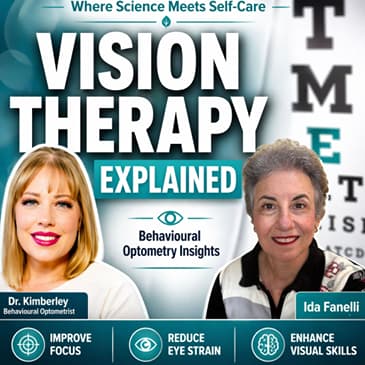
Welcome to this video with Dr. Kimberley Linert! Today, we dive into Behavioural Optometry, what it is, why it matters, and how vision therapy & eye skills training can improve you or your child’s visual performance and learning.
🔍 In this video, you’ll learn:
-The core concepts of Behavioural Optometry — beyond just seeing clearly.
-Learn how eye tracking, focus shifting, and eye coordination can benefit.
-Light therapy for the eyes
-How is microcurrent beneficial to the eyes
-How vision therapy exercises can help both children and adults.
-Real-life case studies and practical tips for improving vision skills.
-When to consult an optometrist or specialist.
🎯 This video is especially useful if you notice:
Eyes are getting tired while reading. Difficulty tracking lines of text
Trouble focusing or coordinating both eyes, or if you simply want to optimize your vision. Visualizing Happiness: In Every Area of Your Life Dr Kimberley Linert
She has another book she co-wrote with other like-minded people
Self-Empowerment Reset-Entrepreneur Secrets
Important Consumer Notice Disclaimer: The information provided on this educational page is for general informational and cosmetic purposes only. It is not intended as a substitute for professional medical advice, diagnosis, or treatment. If you suspect you have a skin disorder, chronic condition, or need specialized treatment, please consult a licensed physician or dermatologist immediately to seek professional medical guidance.
To Connect with Ida:
Link in Bio
Subscribe, like, share, listen and share the podcast
#visiontraining #ReadingSkills,#BehaviouralOptometry #EyeSkills #EyeHealth #optometry #EyeTracking #DrKimberleyLinert #ChildVisionProblems #VisionTherapy
00:00:00 --> 00:00:02 Start with your journey, how did you first get
00:00:02 --> 00:00:06 into optometry, and what led you to the behavioural
00:00:06 --> 00:00:09 aspect of this work, all right, well,l thank you
00:00:09 --> 00:00:12 first of all, for having me on your show I love
00:00:12 --> 00:00:18 it thanks you for being here, you have so um yeah
00:00:18 --> 00:00:20 when you know when you're growing up and people
00:00:20 --> 00:00:23 say what is it you want to do when you grow you
00:00:23 --> 00:00:26 know when you get older and I thought well I
00:00:26 --> 00:00:28 had an aunt who was a doctor and I said, I want
00:00:28 --> 00:00:30 to be a doctor like her because I admired her.
00:00:30 --> 00:00:34 And then I realized when I got to high school
00:00:34 --> 00:00:39 and I had to do biology and we were, you know,
00:00:39 --> 00:00:43 using pigs and dissecting and everything, I decided
00:00:43 --> 00:00:47 that blood was not for me. And so I looked to
00:00:47 --> 00:00:51 see what thing I could do to help people. with
00:00:51 --> 00:00:56 that didn't involve a lot of blood and um about
00:00:56 --> 00:00:59 that same time I was trying contact lenses for
00:00:59 --> 00:01:03 the first time and I'm like oh this doctor helps
00:01:03 --> 00:01:08 people and um he doesn't have to deal with blood
00:01:08 --> 00:01:11 so I'm like that would be a good profession so
00:01:11 --> 00:01:13 that's how I chose optometry is