According to the Canadian Mental Health Association, 92% of Canadians identify as compassionate and 76% feel a moral urge to help others who are suffering—yet only 38% took physical action to alleviate hardship over a 12-month period.
That gap between believing in compassion and acting with compassion raises a larger question: What does it truly mean to care for one another?
Few people have explored that question from a more extraordinary perspective than Dr. Subodh Verma.
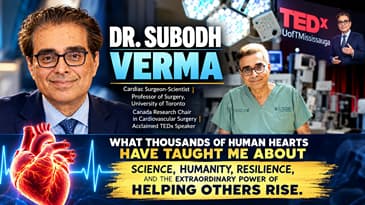
After opening more than 6,000 human chests during his career as a cardiac surgeon, Dr. Verma says one of the greatest lessons the heart has taught him has little to do with surgery. It is about what it means to be human—and why resilience, equity, compassion and interdependence are essential to our collective ability to thrive.
Dr. Verma is a cardiac surgeon, scientist and professor at the University of Toronto, a Canada Research Chair, and one of the world’s top 1% most-cited researchers. Over three decades, his work has helped advance cardiovascular medicine, including landmark global research involving heart failure and GLP-1 therapies. His contributions have also earned major honours from the Canadian Cardiovascular Society and the Canadian Society of Cardiac Surgeons.
Yet some of his most powerful lessons extend far beyond the operating room.
His TEDx message exploring what thousands of human hearts can teach us about resilience, equity, interdependence and rising together has generated more than 70 million views across Instagram and digital platforms, resonating with people far beyond the medical community.
In this episode of Let’s Have This Conversation, Dr. Verma joins Kevin McShan to explore why breakthroughs are rarely solitary, why resilience requires connection, and why equity may be more than a social ideal—it may be fundamental to how human beings survive and thrive together.
They also examine the intersection of cutting-edge medicine and humanity, the future of cardiovascular health, and what decades spent caring for the human heart have taught Dr. Verma about leadership, compassion and our responsibility to believe in one another.
Because sometimes the greatest thing we can offer another human being isn't a solution.
It's the belief that they can rise.
For more Information: https://drsubodhverma.com/
Email: subodh.verma@unityhealth.to
TedX Talk: https://www.youtube.com/watch?v=nqY9R6RGoiw&t=24s
Learn more about your ad choices. Visit megaphone.fm/adchoices
[00:00:00] According to the Canadian Mental Health Association, 92% of Canadians identify as compassionate and 76% say they have the urge to help people when they're suffering. Yet, only 38% of Canadians took physical actions to alleviate hardship over the last 12 months.
[00:00:30] The gap between believing in and acting on compassion raises a larger question. What does it truly mean to care for one another? Few people have explored that question from a more extraordinary perspective than Dr. Subodh Verma.
[00:00:53] After opening more than 6,000 human chests during his career as a cardiac surgeon, Dr. Verma says one of the greatest lessons the heart has ever taught him has little to do with surgery itself.
[00:01:12] It is about what it means to be human and the role of resilience, equity, compassion, and independence are essential to our collective ability to thrive. Dr. Verma is a cardiac surgeon, a scientist, and a professor at the University of Toronto.
[00:01:38] He is a Canadian research chair and one of the world's top 1% researchers. Over the decades, his work has helped to advance cardiovascular medicine, including landmark global research involving heart failure and GLP-1 therapies.
[00:02:04] His contributions have earned both recognition and honors from the Canadian Cardiovascular Society and the Canadian Society of Cardiac Surgeons. Yet some of his most powerful lessons extend beyond the operating room.
[00:02:29] His TEDx message explores what the human heart can teach all of us about resilience, equity, independence, and rising together. It's generated more than 70 million views across Instagram and other digital platforms, which has resonated with millions of people beyond the medical community.
[00:02:58] In this episode of Let's Have This Conversation, Dr. Verma and I sit down to explore and have a conversation about why breakthroughs are rarely solitary, why resilience requires connection, and why equity may be more than a social issue and fundamental to the way humans survive and thrive together.
[00:03:28] Dr. Verma and Dr. Verma, join me this week to tell me more. I'm Kevin McShann. Let's have this conversation.
[00:03:39] Dr. If you're ready, I'll take a moment to welcome you to the program.
[00:04:12] And I'm super excited to learn how you're changing the world through medicine. And it's great to see you and happy Monday to you, my friends. Thank you so much. It's really my pleasure to be here and join you on your podcast. Absolutely. So, Dr. I know that you have taken lessons from the operating table to societal life.
[00:04:37] And you tell me that the lessons you've learned on or in the operating room have really transcended your view of empathy, compassion, and treating others with respect. So, I'm wondering what were those lessons that you've learned on the operating table? How have you transformed them to humanity, my friend? I'm curious to get your answer there. Yeah.
[00:05:07] So, first of all, thank you for the opportunity to chat with you today. You know, there's so much outside of medicine and outside of anatomy and physiology that we learn in the operating room. And the lessons are countless.
[00:05:22] But really, some of the top ones, you know, reflecting on the last several decades of being a heart surgeon are the critical importance of teamwork and how really the surgeon is someone who often gets all of the applause. The surgeon is someone who gets a lot of the recognition saying, you know, this person was responsible for a successful heart operation. But that's really far from the truth.
[00:05:49] What we do understand is that, you know, a successful operation really is when, you know, multiple people come together. And this concept of interdependence that a surgeon with a scalpel in their hand is completely ineffective if that person is not surrounded by an entire team that really comes together.
[00:06:11] And that's really, you know, the team of anesthesiologists, the team of anesthesiologists, the team of profusionists, you know, everyone coming together to play the orchestra. As they say, you know, to go and play at an orchestra, you do need everyone. You need the conductor, you need various people playing their instruments. And that's what makes for good music.
[00:06:34] So at the end of the day, one very key message for me that I'd like to, you know, send out through your podcast is that, you know, a surgeon is not the one to be celebrated. It is the entire team and the healthcare system that is so, you know, really formidable in getting people through their tough times.
[00:06:59] You know, there are many other lessons, Kevin, but I think the one of interdependence is probably the most important one. Yeah, absolutely. You know, Dr., I also wanted to ask you, just before I asked you about your research, about the idea of healthcare equity and equality.
[00:07:18] As you know, doctors, sometimes because of economics and other life circumstances, healthcare equity and equality isn't always afforded to everyone. So I'm wondering your thoughts on how we can expand access to healthcare equality and equity for all Canadians. What are your thoughts there, my friend? Yeah.
[00:07:44] So, you know, again, you know, the heart has been such a wonderful teacher of equity for me. And I've said this many times, I think the heart is a radical teacher of equity. And the reason why I say that is that, you know, when we open the chest and we operate on the heart, the heart looks exactly the same, Kevin. It doesn't matter whether you're white or you're black or you're, you know, straight or you're gay.
[00:08:09] You know, it doesn't matter whether you're rich or you're poor, whether you're actually a CEO of a hospital or someone who actually is someone of, you know, lower socioeconomic status. The heart really does not discriminate based on any of that. It's got the same structure, the same texture, the same anatomy, the same resilience. It has the same tenacity. It has the same drive to beat.
[00:08:36] So, you know, behind sort of skin color, behind ideology, behind tribe, behind all of that is just a heart that is beating selflessly, trying to get people through, you know, the ups and downs of everyday life.
[00:08:54] And I think that's a really important core message that we're so sometimes sort of stuck up in, you know, divisiveness that all we need is to just take one step further and appreciate that at the end of the day, we're all the same inside. And therefore, we do need everyone to be treated in a fair and equitable fashion.
[00:09:18] Now, as you've correctly mentioned, despite what I just said, the inequities in medicine remain a recalcitrant problem. They remain a problem that we continue to see. Now, you know, efforts are being made to close the equity gap and to get more access to health care throughout the world. But we do understand that, you know, people still suffer from discrimination.
[00:09:48] There is still inequities in access to care. And, you know, the solutions for that are probably multifactorial. It's not one size fits all. But it all begins with acknowledging the fact that we have to do better. You know, I really when people say, well, there is no inequity. Well, that's not true. We know that that is not true.
[00:10:14] So, you know, it all begins with understanding, you know, that we have to recognize and acknowledge the inequities that exist. And as a system and as physicians, as health care leaders, you know, in your case, as a podcast host, talk about these inequities that, you know, they're not just racial inequities. They're also inequities across, you know, even gender.
[00:10:40] You know, for example, I talk a lot about how women's hearts matter. And why do I say that? Well, women are 50% of the population, yet our current understanding of the pathophysiology and how heart disease develops in women, you know, compared to men has been around for years. Yet oftentimes women are, you know, poorly represented in clinical trials.
[00:11:07] They're not adequately diagnosed with heart disease. They're often misdiagnosed with other issues.
[00:11:14] So, you know, I think that the system also needs to ensure that we don't paint everyone with the same brush, that we do recognize that there are certain groups that actually need to be prioritized, that are at higher risk of cardiovascular events, or may not necessarily present with what we call classic symptoms of heart disease.
[00:11:39] And, for example, women are one such example where their symptoms are not the classic sort of crushing chest pain, arm pain, things like that. There could be other subtle signs of heart disease in that setting. So, you know, really to answer your question, it is recognizing that at the end of the day, we're all the same inside. The body works the same way.
[00:12:06] We, you know, need to acknowledge the inequities that exist. And we need to have systems in place that allow for, you know, individualized sort of approaches to minimizing those equity gaps. Yeah, absolutely. And, Dr., I don't think you've been on the forefront of international research when it comes to heart failure and the evolution of GLP-1.
[00:12:35] So, I'm curious, what has your research taught you about the resilience of people and their health and why you want to be on the forefront of this cutting-edge research project? My friend, tell me more. Yeah. So, you know, I'm a professor at the University of Toronto.
[00:12:58] You know, in addition to being a heart surgeon, I am very actively involved in many of the sort of basic and translational research projects. And my main area of interest is really in how cardiovascular disease develops fundamentally. And also, you know, I have a strong interest, of course, in heart failure and in obesity-related treatments, as you've mentioned.
[00:13:26] Now, I've been very fortunate to have actually worked in this area that has really in many ways over the last several years completely redefined our ability to treat chronic diseases. And, you know, we're living in a world where we have a burgeoning impact of heart failure, diabetes, kidney disease, and they all seem to kind of interconnect with each other.
[00:13:53] And, you know, unfortunately, however, as medical professionals, we live in silos. You know, I'm a heart surgeon. I only do hearts. My friend is a neurosurgeon. He only does brains. And, you know, my other friend is a kidney doctor, but he only knows about kidney disease. But at the end of the day, the heart, the brain, the kidney, and the whole body is all one body that is interconnected.
[00:14:17] And therefore, understanding how the body is interconnected and really understanding the common themes that connect us all can be so instructive in how we develop solutions to these problems.
[00:14:32] And in fact, in that vein, my research and some of the work that I've been involved in when it comes to GLP-1 medicines, SGLT2 inhibitors, diabetes, obesity, have really taught us this lesson that, you know, things that we learned from diabetes are now being applied to heart failure. Things that we learned from heart failure are being applied to kidney disease.
[00:14:57] And at the end of the day, that interconnectivity between the heart, the kidneys, and diabetes has allowed us to develop therapies that are good for weight, therapies that are good for sugar, therapies that are good for heart failure. And I think that's been one of the greatest sort of privileges really of mine to be involved at that interface.
[00:15:22] Yeah, based on your work in healthcare and your view of humanity, doctor, just out of personal curiosity, I'm curious how you would view the concept of diversity, equity, and inclusion for all people. As you know, as you know, doctor, I was born with cerebral palsy.
[00:15:45] I talk to organizations all the time about the importance of, you know, valuing diversity of perspective as a core organizational pillar.
[00:15:56] So I'm curious, when you look at the concept of diversity, equity, and inclusion, coupled with the work that you've done in healthcare, how do you think the idea of DE&I has to be sort of reimagined or sort of programmed in our brains so that we give all people of all ability equal opportunity? I'm curious to get your answer there.
[00:16:25] Well, so first of all, you know, Kevin, I'm so proud of you, right? You know, and thank you for sharing your personal sort of health story as well. But at the end of the day, you know, talking about humans are defined by, you know, tenacity, they're defined by, you know, resilience, they're defined by opportunity, and by access.
[00:16:52] And, you know, at the end of the day, not everybody, unfortunately, has access to everything. And I think that's really one of the things that we think about a lot as heart surgeons, that, you know, every heart can beat and every heart can fail, but every heart can heal. And at the end of the day, every heart deserves equal care. But regrettably, that's not the case.
[00:17:17] As you know, throughout the world, there are people in different parts of the world where access to heart surgery, access to heart care is just not affordable and just not feasible. And we know that many children, for example, in the world develop rheumatic heart disease and rheumatic heart disease is something that can be easily treated sometimes just with antibiotics.
[00:17:44] And, you know, that can prevent people from developing heart disease, but even access to those types of things are not available. So, you know, equity is a core foundation upon which, you know, our entire sort of enterprise of health care is built. And for that reason, the entire societal fabric is built on that.
[00:18:09] And, you know, it's not just about striving to have equitable access, but also striving to make sure that the people we take care of, you know, as physicians, we can relate to. And many times there are sort of the cultural underpinnings of that. You know, people from various different cultures representing the society that we serve is so important.
[00:18:38] Now, universities, hospitals, and other organizations have in plan, you know, very well-structured DEI plans. And, you know, if you just take a step back to a decade ago, we are much further ahead today about recognizing, acknowledging, and trying to close the care gap. Have we done that successfully yet? Not yet. Are we moving in the right direction?
[00:19:08] For sure. But recognizing that equity and equitable access and inclusivity is what is a core fundamental health care pillar is important. And, you know, we see that sort of in our day-to-day life. You know, Canada is such a wonderful multicultural society.
[00:19:30] And therefore, a multicultural society does need its health care leaders to also be representative of the people we are going to serve. And whether that is, you know, making sure that more women are encouraged to be in leadership roles in health care,
[00:19:50] whether that is, you know, minimizing the equity gap that exists for black physicians or black students, you know, that also, of course, is an important mandate for various organizations, including the University of Toronto. I think all of those are core fundamental tenets of a successful society and things that we need to strive to continue to close. Yeah, absolutely.
[00:20:17] You know, doctor, in this digital age, you know, you've operated on more than 6,000 people throughout the course of your career. And you also said that the operating table has taught you lessons that no algorithm or piece of technology has taught you.
[00:20:40] So I'm curious, how do you think we can take a more human approach to leadership and a more human-centered approach to leadership in this digital age, my friend? What lessons or pieces of wisdom do you want to share in that regard, my friend? Yeah, so, you know, I think we are benefiting tremendously from artificial intelligence. There's no doubt about it. Now it's called superintelligence.
[00:21:11] There is definitely a lot of good that will come out of that in terms of, you know, fast-tracking medicine, diagnosis, treatment, etc. But at the end of the day, what artificial intelligence can't do is be human, right? It doesn't have the same emotionality. It doesn't have the same sentiment.
[00:21:34] And in this time and age where, you know, human connection is so valuable as well, artificial intelligence will never be able to, in my opinion, substitute for a conversation, for example, that you and I are having today, heart to heart. So there are always going to be the importance of human connection for that reason.
[00:22:02] Because as we know, you know, social isolation, loneliness, things like that are really bad when it comes to overall health risks. And where artificial intelligence can be harnessed to improve our diagnostic and treatment algorithms, artificial intelligence, in my opinion, will not be able to hold your hand and give you the courage of getting through an operation.
[00:22:30] Hold your hand and give you the comfort of someone in your family that may be going through a tough time. You know, at the end of the day, humans are defined by our humanity and our connection to each other. And I think that is something that will continue to be maintained. Yeah. And just one follow up on that, because I'm always, one of the reasons, Dr.
[00:22:55] I wanted to start this podcast six and a half years ago is because I like to dwell. And I said, there has to be more that brings us together than always working to find division. So I'm curious, based on the work that you do in health care and what you've seen out in societal life, how do you think we can all work together to sort of heal the societal divisions that exist today?
[00:23:25] How do you think we can all work as a one heartbeat community to heal the divisions that are present today in society? What are your thoughts there, my friend? Well, I think the operating room has taught me that, you know, structure is important, right? Of course, somebody does have to be in charge in the operating room, whether that's the surgeon or whether that's the anesthesiologist.
[00:23:54] There has to be a team leader that is actually helping to coordinate everything. And someone who is responsible for, at the end of the day, you know, the final outcome. But at the end of the day, you know, hierarchy is what often leads to trouble, right?
[00:24:14] And what I mean by that is that structure is important, hierarchy is important, but hierarchy should not suppress the ability of other people in the team to actually voice their opinion. And I think this is so important that in the operating room, I could be the surgeon in charge, but I may have a junior medical student who is in the operating room who sees something that they want to make a comment about.
[00:24:41] Having the ability to hear from everyone, having the ability to have everyone's voice heard is a fundamental sort of pillar of leadership. And I think what we have to acknowledge is that no group or leader is successful without empowering their team members,
[00:25:05] no matter how senior or junior they might be, they may be, to actually be able to make a comment, be heard, and help integrate that information in, you know, the next step. Sometimes the most important calls, some of the most important warning signs, some of the most important advances can come from the junior most person in the room.
[00:25:30] They don't have to come from the surgeon who's responsible for it. And as I get older and as I've done this more often, you know, I often tell my trainees and my students that this is a safe environment. There are no stupid questions. Just ask whatever's on your mind and you won't be penalized for it. And I think people need to feel that sense from leaders that their voice matters and that they are being heard.
[00:25:58] Yeah, absolutely. And I wanted to also ask you about how we can expand the usage or the importance of GLP-1 therapies. Because you make the argument that, you know, it can be used for much more than weight loss management and really has taught us some important lessons about cardiovascular disease and how we can treat the human heart, my friend.
[00:26:26] So how can GLP-1 therapies go beyond weight loss? So what do you want people to know about the importance of the evolution of GLP-1 as well? Yeah, so I think GLP-1s, in my opinion, have truly been revolutionary for cardiometabolic disease.
[00:26:49] And they treat sugar, they treat weight, and they treat many other chronic diseases on the horizon. So, for example, you know, research now shows that GLPs may have an important role in what we call alcohol use disorders. You know, it may minimize addictive behaviors and also reduce alcohol-related, you know, disorders in people.
[00:27:16] It also is being shown to have quite important roles in sleep apnea. And, you know, sleep apnea is a problem where people snore at night. It can actually lead to significant complications, including heart failure. And, you know, new data suggests that GLPs could be quite effective as therapies for sleep apnea. They're also being evaluated for osteoarthritis.
[00:27:43] And, you know, preliminary data suggests that they can reduce the disability associated with osteoarthritis. Now, the list continues. There's analyses that show it could reduce cancer risk. There's analyses that now are emerging around their potential sort of benefits on the brain. You know, a lot of this will require a lot more studying and research.
[00:28:07] But it just tells us that what a serendipitous journey this has been, Kevin. You know, we started with sugar. And from sugar, it went to weight. And from weight, it went to heart. And from heart, it went to heart failure. And from there, it's now going into different areas. Again, speaking to the fact that one solution could have such significant interconnectivity to different organ systems. Yeah. Yeah.
[00:28:36] And, Dr., I'm curious to ask you about the concept of joy, happiness, and giving people, you know, a roadmap to carve out their own identity. Because I am someone who believes that everyone's portrait of success is different. So I'm wondering, what lessons is the operating table?
[00:29:02] Talk to you about joy, working collaboratively with people. And the importance of, you know, having empathy for your fellow man or woman. What are your thoughts there, my friend? Right. So, well, what a wonderful question, Kevin. And, you know, I've thought a lot about this because I talk a lot to sort of, you know, young students often struggling to find, you know, whether or not they belong.
[00:29:32] And, you know, this is something that is a really important issue with people wondering, how do I get a seat at the table? Right. Do I belong here? How will I move forward? And, you know, I think one of the, you know, again, a core sort of principle of mine and really a core principle of success is to truly sort of hear what people have to say.
[00:29:57] Empathy and direction and mentorship are so valuable because someone helped me. And that circle of life of how we continue helping the next generation through difficult times is imperative. Now, from the heart, maybe this is the last few messages I'll give you because I do have to run after that. But I will tell you that from the heart, my messages are pretty straightforward.
[00:30:24] And that is that people and students and others should try to find their own pacemaker. What do I mean by that? Find your own pacemaker. You know, oftentimes we find that students and others are trying to beat at someone else's pace. You know, oh, my neighbor has got a car and my, you know, my other friend had got into this program and he made this much money.
[00:30:51] And you're always comparing yourself to someone else feeling like, you know, maybe, you know, I just I'm left out. But we all have to find our own pacemaker because the human heart has its own pacemaker. The pacemaker that depends on nobody. It doesn't depend on the brain. It doesn't depend on any other organ system.
[00:31:16] It's its own set of cells that defines your heart rate and defines how you beat. So one key message, Kevin, is we all need to find our own pacemaker and beat at the pace and speed that we think is right on the path that we think is appropriate.
[00:31:37] And I think the second important message for, you know, strengthening sort of confidence amongst our sort of newer generation and helping people is reminding them that, you know, detours are quite common in life. And we often look at those detours and think, oh, my God, this didn't happen. I failed.
[00:31:59] But really, a detour is not something to be too concerned about in life because, you know, sometimes we think about plans so carefully. We articulate our sort of next step. I'm going to do this and then I'm going to do that. And then from there, I'm going to be able to, you know, do the next step. But life doesn't actually follow the plans that we always have.
[00:32:27] Oftentimes, we end up in a different place. And, you know, I have to reflect back on my own life when I'm giving people advice and say, you know, now when I look back and often thought that those were setbacks, they weren't setbacks. They were just detours, detours that actually allowed me to meet people that I had to meet. Detours that allowed me to get to where I am today.
[00:32:55] So detours are really not setbacks. They are just a new direction to get to a place that you and I are destined to get to. So don't really worry about detours as being setbacks. Embrace them. Yeah. And finally, you know, I think the most important final thought for you on your show today would be that, you know, start before you're ready.
[00:33:24] And what do I mean by that? Is that you don't have to wait for some magical moment, Kevin, where you say, oh, I'm ready now. I'm totally ready. I've done this. I've done that. I've practiced an X amount. And now I'm ready to start because you're never going to be fully ready. And, you know, the heart has taught us that the heart starts beating in less than 28 days when you're in utero.
[00:33:53] The body isn't formed. The brain isn't formed. The organs aren't formed. We don't have a name. We don't have an identity. Yet the heart is already beating. The heart doesn't wait for the entire organ to be built before it starts beating. So we have to just get started. And, you know, confidence often comes after we have started our activities. Yeah, absolutely.
[00:34:22] And, Doctor, I know you have to run. So I wanted to finally ask you, if people want to get connected with you, what's the best way they can do that? And when you look at your life and your legacy, how do you want that to be defined? Yeah, so, yeah, if people wanted to reach me, I'm at the University of Toronto at St. Michael's Hospital. You know, my email is, you know, subod.verma at unityhealth.to. Welcome to drop me an email.
[00:34:51] Or you can visit the website, drsubodverma.com. But as I reflect on my life, what do I think I'd like to be known for? Well, I think I'd like to be known for most of all sort of being a good parent to my children and being a thoughtful colleague to my colleagues, particularly the ones in need.
[00:35:20] I hope I will always be regarded as someone who made time for people who actually were struggling and who, you know, was a good surgeon, well-respected for his trade, and actually did a good job taking care of patients. Yeah, absolutely.
[00:35:42] Well, doctor, I want to thank you for sharing your best insights on cardiovascular health and relationship to humanity and for joining me this afternoon. Your work and certainly time on my behalf is most appreciated. It's my pleasure, Kevin. It's really my pleasure, and congratulations to you on your podcast and all of the successes that you've had. And I'll be happy to come back anytime. Fabulous.
[00:36:11] Have a great day, and thanks for the time, okay? Thank you, Kevin. All the best to you. Bye.