What separates a brand people remember from one that sounds like everyone else?
In a world overflowing with AI-generated content, corporate jargon, sales pitches, and interchangeable marketing language, authentic storytelling has become a competitive advantage.
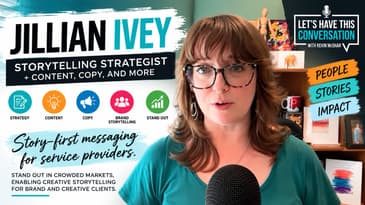
On this episode of Let’s Have This Conversation, I sit down with Jillian (Jill) Ivey, communications strategist, writer, editor, journalist, and founder of Jilletante Creative, a story-first content consultancy helping founders, executives, entrepreneurs, and organizations discover what makes their stories worth telling.
Jillian has built her practice around a simple but powerful philosophy: tell, don’t sell.
Rather than helping businesses produce more noise, she helps them communicate like humans. Her work focuses on uncovering an organization’s authentic voice, developing compelling narratives, clarifying key messages, understanding audiences, and transforming expertise into content that creates genuine connections.
With a BA in Creative Writing from the University of Pennsylvania and an MFA in Creative Writing from Rutgers University–Camden, along with years of journalism, editing, writing, and media relations experience, Jillian brings a storyteller’s eye to business communication. She has been quoted by Law360 on storytelling for lawyers and has appeared on Peter Shankman’s Faster Than Normal podcast.
Through Jilletante Creative, Jillian works with clients across the entire content lifecycle—from high-level content strategy to day-to-day copywriting and editing. Her work includes developing brand narratives, executive and organizational voices, key messaging, website copy, professional bios, editorial calendars, thought leadership articles, white papers, speeches, and social media content.
She also offers the Jilletante Creative Story Audit, a 45-minute live examination of a business’s messaging and content designed to identify what is resonating, what is missing, and where the organization's story can become stronger.
During our conversation, Jillian and I explore why so much business communication sounds the same, what authentic storytelling actually looks like, and why organizations should focus on telling their stories rather than constantly trying to sell something.
We also discuss how founders and executives can discover their unique voices, why thought leadership requires a genuine point of view, the relationship between storytelling and trust, and how organizations can create content strategies that remain consistent without sacrificing creativity or humanity.
At its core, this conversation asks an important question:
In an age when virtually everyone can create content, what will make people care about yours?
The answer may have less to do with producing more content—and much more to do with telling a better, more human story.
Join us for a conversation about authentic storytelling, brand voice, communications strategy, thought leadership, content marketing, executive communication, and the power of telling—not selling.
For more information: jilletante.com
Follow: @JillianIvey
Email: hello@jilletante.com
book a story audit on my website for $50 off using code MCSHAN.
Instagram: @jilletante
Learn more about your ad choices. Visit megaphone.fm/adchoices
[00:00:00] In a world where it's becoming increasingly easier with each passing day to create content, entrepreneurs need to be asking themselves one or two central questions which begins with, with everyone having the capability to create content, why should people care about mine? And then secondarily, what separates people?
[00:00:29] A brand which people remember versus one that sounds like everyone else? Well, in a world that's filled with AI and corporate jargon overflowing with self pitches and being inundated with interchangeable marketing language, it becomes increasingly clear that authentic
[00:00:59] storytelling is the new and sustainable competitive advantage. On this episode of Let's Have This Conversation, I sit down with my friend, Julian Jill Ivey. She's a communicator strategist, former journalist, writer, editor, and the founder of Jill Attentee Creative,
[00:01:22] which is a story first content consultancy helping founders, executives, entrepreneurs, and organizations discover what makes their stories worth telling. She built a practice around the concept and powerful philosophy of tell, don't sell.
[00:01:49] Rather than helping businesses produce more noise, Jillian is focused on helping them communicate like humans. Her work focuses on helping organizations and entrepreneurs find their authentic voice and develop compelling narratives.
[00:02:13] Clarifying key messages, clarifying key messages, understanding audiences, and transforming expertise into content, which naturally builds on genius connections.
[00:02:28] Julian holds a BA in creative writing from the University of Pennsylvania, along with an MFA in creative writing from Rutgers University at Camden, along with years of experience in journalism, editing, and writing. And meeting a relations, Julian brings a storyteller's eye to business and communication.
[00:02:58] She's been quoted by Law 360 on storytelling for lawyers, and she's also appeared on Peter Shankman's Faster Than Normal podcast. Through Jill Attentee Creative, Julian works with clients across the entire content creation cycle.
[00:03:23] From high-level content strategy, from day-to-day, copywriting and editing. Her work includes developing brand narratives, executive and organizational voices, key messaging, key messaging, website copy, professional bios, editorial calendars, thought leadership articles,
[00:03:49] white papers, speeches, and social media content. She also offers the Gillitante Creative Storytelling Audit, which is a 45-minute live examination of business messaging and content, which is designed to discover what is resonating, what is missing,
[00:04:16] and where an organizational story could become stronger. During our conversation, Julian and I explore why so much of business communication sounds the same. What authentic storytelling actually looked like in practice, and why organizations should reverse their thinking
[00:04:41] and actually tell their story instead of always trying to sell their latest merchandise or product. And Julian, join me this week to tell me more. I'm Kevin McShann. Let's have this conversation.
[00:05:00] And if you're ready, I'll take a moment to welcome you to the program.
[00:05:34] And I'm super excited to talk to you about how you integrate both storytelling and communication to make sure that entrepreneurs and organizations tell the best version of their stories. It's great to see you. And happy Tuesday to you, my friend. Happy Tuesday. Absolutely, my friend. And I know that you are a communication strategist and someone who wants to tell stories.
[00:06:03] And you tell your clients that it's important to tell and not sell stories. So I'm wondering if we could start our conversation by you drawing the distinctive line between selling and telling a story. And what's the difference between the two, my friend? Sure. So human beings are storytellers. This is the way that we have been communicating for hundreds of thousands of years.
[00:06:31] We relate to each other through stories. And when we tell stories, it actually lights up a different part of our brain than when we're just kind of giving instructions or working on more marketing-focused language, something that seems very much straightforward and very practical. And so when we are able to talk to each other as professionals but in a storytelling capacity where we are able to say not just, this is what I do, but here is who I am and here is why I do the work that I do and here's what makes me different.
[00:07:00] It allows us to use a different part of our brain to connect with each other as human beings, not just to sort of talk to each other in a transactional way. I think it's so important, especially, you know, we went through in the last decade, we went through COVID. We're seeing what's happening with AI, LLMs, kind of interrupting the way that we're used to participating in conversations as people. And so when we are able to relate to each other, communicate to each other on a one-on-one basis,
[00:07:27] it really lets us feel good about this interaction that we're having rather than feeling like we're being sold to or we're having to do the selling. Yeah, absolutely. And building on that point, I wanted your definition of what it truly means to be. An authentic storytelling.
[00:07:47] Because, you know, with the advancements of tools like ChatGPC and other do-it-for-you sort of communicating tools, people sometimes in business get lazy or unmotivated in it. They just put things into an AI system and say, spit me out information that makes me look smarter than I actually am.
[00:08:15] So I'm curious to ask you about what makes a business or an organization a truly authentic storyteller? What are your thoughts there, my friend? So I think that we haven't reached singularity yet. Computers are not interacting with us as if they are human beings. And until we are able to upload our entire consciousness into an LLM, there's only so much that that technology can do.
[00:08:42] And chiefly, you don't update or upload rather all of your experiences, all of your background, all of the things that have happened to you over the course of your life into an LLM. And so even the people who are creating custom GPTs and are uploading, you know, years worth of interviews or articles or whatever it is, they can make something that sounds approximately like them. It kind of sounds like a copy of a copy. Like there's always something that feels a little bit off about it.
[00:09:06] But what that system can't do is extract a story from your brain that helps to explain why it is that you got to the point that you are. They can interview you, right, but they're not going to necessarily be able to jump to that conclusion of what it is that's going to resonate with another human being as a person. And so that's what we're talking about when we're talking about storytelling in a professional setting.
[00:09:28] We're not talking about needing to, you know, make your memoir your product and pull your whole heart out of your chest and hold it out to your prospective clients and say, here, this is all of me. This is who I am. Do with me what you will. But to be able to relate to these people in some way, even potentially a pretty small way, can be so meaningful. It can be so resonant. And so if I'm looking for an attorney, and this actually happened to me several years ago,
[00:09:56] I needed an employment attorney for a situation that we won't even go into right now. But I needed an employment attorney. It was a somewhat complicated matter, but it was a small matter, right? Like this was not going to be something that made somebody millions of dollars in a settlement. This was something that was going to make a big impact on me and my life, but was not going to make the attorney a lot of money. So I talked to several attorneys who like turned me down basically for that reason. There wasn't really much in it for them.
[00:10:20] But as I was looking for an attorney and as I was doing my research into the matter that I had that was affecting me, I found an attorney in the Philadelphia area who has a blog or had a blog. He's now retired. But in his blog, he not only talked knowledgeably about the subject matter that affected me, he also talked about his family and he told stories about his grandkids. And so getting to see the way that not only he understood my problem, but the way that he was a real person made me say this.
[00:10:50] I think this is going to be the guy for me. You know, never mind the attorneys who I wasn't worth their time because I wasn't going to make them enough money. Never mind the attorneys who kind of understood what I was working on, but I didn't really feel like we were on the same page. We weren't simpatico as people. This was a person who, even though he was like way out in the Philly suburbs and I had to drive through heavy traffic to get out to him, I felt so good about the fact that he was in my corner, right? Like I had spent a lot of money on this guy. I had spent a lot of time with him and I had to devote a lot of my energy to him.
[00:11:17] And so to feel good about spending my time, spending my money, spending my energy, that's because we related to each other as real people. And I think that, you know, this was 15 years ago that this was happening. I think that if this were happening now and I saw that, you know, if I could tell that his blog was written by ChatGPT or by Claude, looking at that I'd be like, I don't know. This guy doesn't have the time to write for me. How do I know that he's going to have the time to work for me? You know, that's an important distinction.
[00:11:45] And just before I ask you about Jill and Tanti Creative, I want to ask you about your personal upbringing, my friend, because we've talked to each other now for less than 10 minutes and I can already tell that you are energetic, enthusiastic, and full of lies, my friend. So tell me, where does your sense of curiosity to be curious about other people come from?
[00:12:14] And why do you think you do it with such energy and enthusiasm? My friend, I'm curious to get your answer there. Well, I'm so glad that I'm coming across as energetic because I did not get a lot of sleep last night. I have a toddler and he's going through a sleep regression, which means that his brain is doing a lot of processing of information and he's waking up in the middle of the night and winding up in bed with me and kicking me and all sorts of things. So I'm glad that it seems like I have a lot of energy today
[00:12:43] because that's not always how I feel these days. So I've been a storyteller my whole life. I, you know, I'm an elder millennial. I was an 80s baby. I grew up watching Reading Rainbow with LeVar Burton. And yeah, love, love, love. And so the stories that we were getting there and with this like really trusted narrator who felt like he could be part of the family, who you just, you knew that you were going to be safe in his hands. We're getting these stories and we're starting,
[00:13:12] you know, like I'm a little kid and I'm learning how to feel and how to process things through these stories. On top of that, then my mom had been a kindergarten teacher before I was born. And so she had a lot of the teaching materials that she had used to teach kids how to read and write. And so I had this desire to be able to read stories and also to be able to tell my own stories. And so between Reading Rainbow and Sesame Street and other public television and my mom's teaching materials and my mom herself, I taught myself to read when I was about four years old.
[00:13:40] And then around five, watching Reading Rainbow, they put together, they showed you how to put together a book using a cereal box where you would cut the top one side and the bottom off and then you had like the hardcover spine of a book and you glue the pages in and then you could write your book. And so I wrote my first book when I was five years old. And I've been really interested in telling stories and not just my own story. And it's taken me a lot of different directions. Like I have two degrees in creative writing. I did my bachelor's at the University of Pennsylvania. Focus, it was an English degree, but my focus was creative writing. That's what I wrote my thesis in.
[00:14:09] And then because I wasn't a disappointment enough to my parents, I went and got an MFA in creative writing too. You know, my parents, I'm not a disappointment to my parents, but they were really concerned. What are you going to do with that? And I've been able to do a lot of things. I worked in journalism. So interviewing other people, I wasn't doing like really deep investigational reporting. I was mostly doing arts and entertainment. So I was interviewing performers, producers, people who were out there making art and finding out what it was that led them to that moment in their life.
[00:14:39] And then a lot of my writing that I've done over the years, both in journalism and personally, has been nonfiction. And so that's reporting my stories, reporting other people's stories. Because again, I think that this is the way that we connect with other people. And I love hearing other people's stories. And I think that we are able to create a connection when we are telling these stories to each other and when we're sharing them with the world that we can't do really in any other way. Yeah. And you brought up that, you have a toddler.
[00:15:07] So this might be a timely question. And, you know, I grew up watching things like Sesame Street, Arthur, Reading Rainbow, Magic School Bus, and all the rest of it. And Mr. Rogers and Mr. Dressup. And, you know, I'm 37 now. So, you know, this might be a slightly jilted question.
[00:15:33] But I think the quality of children's television has really taken a bit of a nose dive. And I'm curious to get your answer there just because I'm curious to get your answer, my friend. I think it depends on where we're getting the television from. So let's not forget, like, yeah, in the 80s and 90s, we had Mr. Rogers and Sesame Street and Reading Rainbow and Wishbone and all of these wonderful educational programming. But we also had, like, Thundercats and Teenage Mutant Ninja Turtles. And not to denigrate the quality
[00:16:03] of those programs because they're still great. But they weren't reaching kids from that educational angle. And what we've seen happen is that, you know, public television has lost a lot of funding. And the people who are producing it who might ordinarily have gone into to public television are realizing there's more money in other avenues of production. I mean, we saw Sesame Street a couple of years ago. They created an agreement with HBO where the first run of articles or first run of episodes of Sesame Street were hitting HBO
[00:16:32] before they were hitting public television. Yeah. And so money has gotten in the way here. But what I think that we're finding, too, is that technology has allowed creators to kind of fill that gap. And so that's where we have Miss Rachel. That's where we have Lori Berkner. We have all of these other people who are creating content for kids in accessible platforms. You know, I mean, Miss Rachel also is on Netflix, but she started on YouTube and she started... I mean, you see early Miss Rachel videos and she's got a green screen and, like, the grainiest camera.
[00:17:02] It's very clear it was pandemic era, right? Like, we were all recording in our basements at home. The camera's not great. But there are still really quality content sources for children out there. You just have to look for them. And the place to look for them... I mean, PBS still puts out... Arthur's still on PBS. Sesame Street is still on PBS. They're later, but they're still there. But beyond PBS, you're not going to find that stuff really on broadcast television. You're really not even going to find it on cable television. You have to start looking at streaming services
[00:17:31] and at content creators. Well, perhaps I should have framed it. There's more options now for kids that I hope still preserves the authenticity and the learning aspect of children's television because that's still important, isn't it? Absolutely. Absolutely. So let's talk about Jill and Tandy Creative,
[00:18:00] also known as your passion project. Yes. And one of the things that you're passionate about is that you offer a 45-minute story on any business's messaging and content, my friend. And I have to tell you, that seems like a very direct and innovative way they get really in the weeds of how messaging is working and how it isn't.
[00:18:30] So tell me about Jill and Tandy Creative. They audited it. What makes the company so unique, my friend? So my company is Jill and Tandy Creative. I started it, I officially started it in, I think, 2013 or 2014. But I've been doing this fully on my own since 2017. And what led me to this moment, a couple of things led me to this moment, but what led me to my focus, really, is that I had done PR and I had done journalism. And I saw the way that people who did journalism
[00:19:00] had their way of wanting to receive information from publicists. And the people who did PR had the things that they wanted journalists to do and they were often not aligned. And so having, my background was journalism first. And so I knew I would get pitches from people and be like, you know, your client seems kind of interesting, but I don't think I'm going to be able to write the story that you want me to write. Like, I will dig deep and ask questions and get answers that you might not want to hear. When I was doing, like, a lot of theater criticism, that even extended to somebody would pitch me
[00:19:29] to see a play and I'd say, yes, I'd love to see your play, but don't expect a good review just because you're giving me free tickets, right? And so when I then went from journalism to working in PR, knowing the way that journalists receive this information and how they want to be reached, you know, I didn't want anybody to call me on the phone. I just wanted an email. But when I started working in a PR agency, I was told, like, oh, no, you send the email and then immediately you follow up with a phone call. It's basically just to make sure that somebody got the email and see what they were thinking. It's like, but I emailed him five minutes ago. He might not even be
[00:19:59] at his desk. And so from that, I realized that rather than trying to convince journalists to tell my clients stories the way that my clients wanted to hear, to be told, their stories to be told, I could help my clients tell their own stories through everything from their website to if their leaders were appearing on stage to publish thought leadership bylines, op-eds, that sort of thing on other platforms. And I really, really liked the opportunity
[00:20:28] to not just help my clients tell these stories in their voices, their stories told their way, but it was a nice, fun exercise for me to kind of take on the guise of my clients and say, okay, today I'm sitting down and I'm not Jill writing this at, you know, sitting in my home in Philadelphia. Today I'm taking on the guise of a 43-year-old Indian man who started this major mobile advertising platform because that is, that is the person I'm writing on behalf of. And so it was a lot
[00:20:57] like my creative writing training, right, where you have to be able to write in the voices of other people. And also, if you're good at doing that, you're able to kind of think about what is it like to receive information as other people. And so, you know, I've been doing this for a long time and I realized often that people didn't even know where to start when it came to, to storytelling from a perspective, a professional perspective. They maybe weren't even comfortable with the idea of storytelling in general. Some people just like really don't like to talk about themselves and that's okay. That's a thing
[00:21:26] that I can help them with. But the story audits came about as a way for somebody who maybe didn't have the time or maybe didn't have the capital to invest in somebody like me coming in and overhauling their entire content strategy to at least understand whether the story that they were trying to tell aligned with the people they're saying they're trying to reach. So when we have a story audit, you book a 45-minute call with me. It's a fast process. I do zero research in advance other than making sure I know what website we're going to be looking at or sometimes we're looking
[00:21:56] at offline content. So you send it to me in advance. I get it queued up on Zoom so that we can share our screen together. And then you tell me who your ideal audience is, who that client that you really want to work with is. And I take on the guise of that person. Again, I pretend that I am them. And we go through the content together and say, okay, well, as this person, this avatar that we have agreed that I am, here's what I'm seeing or what I am not seeing. Now, I also, I can't entirely turn myself off, right? So sometimes I'm also just looking at,
[00:22:25] hey, I'm going to give you a couple of copy level notes. You misuse this apostrophe or whatever it is. I also know enough about SEO and graphic design to be dangerous to myself, really. Like, I don't, I'm not, I shouldn't do either of those things. Nobody should hire me to do those things. Maybe SEO. I've done a lot of SEO writing, but I don't do the SEO optimization. But so I might say, like, hey, you say that you are looking to reach, let's see, I had a bookkeeper who worked with veterans, people who, retired military,
[00:22:54] people who were then starting their own businesses. And so this was her ideal audience, but she didn't ever say anything in the top third of her website about the fact that these were the people that she most wanted to reach. The most hint that you got from her was that she had an American flag, like in her banner up at the top. And so it was like, okay, I can see that you are doing something that is patriotic, but you're talking about bookkeeping services. What is the disconnect? And so kind of splitting myself in half, one half of me is taking on the persona of this ideal client.
[00:23:24] The other half of me is just relying on 20 plus years of doing this sort of work to be able to have this 45 minute conversation with you. And then afterward, you get a copy of the recording and you get three to five action items that are things that we talked about, but that I think would really be quick and easy changes that you can make to your content to be able to tell your story a little bit better. Some people then say, this is great, I love it, but I don't have the time or the talent or the money or the wherewithal or whatever to do that myself.
[00:23:53] Jill, can you do it for me? Other people take it on, they do it themselves and they do it well and we never have to talk again. But I really, really enjoy this process because aside from the fact that it just allows me to help other people tell their stories, I get exposure to so many different industries because I don't need to have a major level of familiarity with the way that these services work. I need to know what it would be like to be the person on the receiving end of that, which is usually anybody. So it's been really fun. You know,
[00:24:23] I've worked with bookkeepers, I've worked with realtors, I've worked with money mindset coaches, I've worked with speech coaches. And so this is, it's just a really, really fun thing for me to do and I've set it as a kind of like pretty low cost, very low barrier to entry service so that I can help you get your story straightened out in 45 minutes of your time. Well, you know, with today's modern time constraints
[00:24:51] in terms of our ability to pay attention it's a really innovative way of thinking about it for sure and I applaud you for having such success, my friend. It sounds like you're really taking an innovative approach to storytelling and I wanted to transition to ask you about, you know, kind through the noise and the difference between being a brand strategist, a publicist, and a journalist
[00:25:21] because a lot of people hire people like you and they want instant credibility and the minute they find out that you're a journalist they may have a different slant on working with you as opposed to someone that doesn't have a journalism background. So I'm curious, when you talk about cutting through the noise and building genuine credibility
[00:25:50] knowing you have a journalism background and now that you're helping entrepreneurs, what do you think building genuine credibility actually looks like? What are your thoughts? So, I mean, it can be, we can approach this in a lot of different ways. It can be established in a lot of different ways. We have a problem with journalism right now where people are less trusting of journalists for better or for worse. I think that it's a real problem
[00:26:20] that people are not trusting journalists, but also it is a problem that some of these journalists have brought onto themselves by acquiescing to certain demands or allowing, you know, an editorial review by people outside of the publication by bringing on people who are known to have major biases to run news organizations and those people are then completely censoring what is and isn't coming out of the news organization. I'm talking about CBS News here in the U.S. So there's a problem
[00:26:49] where journalists who were so credible, thought of as so trusted for so long, I mean, even in my lifetime, people are not trusting them and there are a lot of outside factors on that, but that is unfortunately the reality of the thing, of the situation that we're in. And so, yeah, like when you do PR, your goal is to get your client into a newspaper, a magazine, a blog, whatever the outside, external,
[00:27:19] third-party media is where you truly have no control over the story with the idea that the journalist is trusted enough by their readers to be able to say like, oh, I read this article about so-and-so, seems like a cool company, I'm going to check them out. You know, maybe, maybe not. I think people who are doing business journalism, people who are doing arts journalism are a little bit less susceptible to this level of distrust that we're seeing in terms of what is real and what is not, as opposed to people who are reporting on news.
[00:27:48] That's where I think that major level of distrust is happening. But so, if you have any hesitation, though, about whether a journalist is the right person to tell my story, then you have to think about, well, how else can I get my story out there? And so, you've got owned media where it's your blog, your YouTube. Well, things get complicated with social because even though it's your channel on YouTube, it's your account on Instagram, whatever it is, because you don't actually own that platform, those platforms for you can be taken away.
[00:28:19] Like, you can have your Instagram account shut down. I hope this doesn't happen to you, but you can have your Instagram account shut down tomorrow and lose all access to all of your archives and all of your followers because somebody who works at YouTube decides to be capricious and mercurial about it today. So, owned platforms really are, like, that's your blog, that's your website, those are the things that you have 100% control over. Then we have the social media, which is kind of considered owned, but again, like, things can happen. And then we have, you know, then there's also paid opportunities
[00:28:48] where it's your SponCon, it's advertorial content in news publications, that sort of thing. What we're seeing on top of that is this kind of layering of who is, I'm sorry, my cat has just decided to come into the room and start scratching. If she comes back this way, I'll lift her out so everybody can see her. So, so we're seeing this, this layering of, you know, now with what is happening with, with AI because AI is dominating search.
[00:29:17] And so it used to be that, you know, you, you Google somebody and the top of fold was usually like their website and maybe a recent article that was written about them or, or maybe a review on Reddit or whatever it is. But now we're seeing a couple of paragraphs describing what this is and it's coming through AI and we know that, that these spiders that are crawling the web and feeding into this LLM fueled search are often looking at these third party websites. And so we're actually seeing a return to potentially having more credibility
[00:29:46] when you are reported on, written about by a journalist versus what you say about yourself. And so we have to find this balance of telling the story that you want to tell on the properties where you have control over the narrative and also thinking about where can you tell that story in other places. So if it's not working with a PR team to get you pitched and get you in a newspaper, maybe it is appearing on something like this, going on to somebody else's podcast because it's a third party platform where you are telling your story, you have less control
[00:30:15] over what is being said but it's not pointing directly back to your domain. So in the eye of these AI search bots, it actually gives you more credibility. And so we have to think about how can you tell your story, how can you refine your story in a way that is compelling to these third party creators and in a way that also is going to hit the right tone so that not only are you exciting the people you're talking to but you're exciting their audience because the rankings, the performance of these things also do affect the way that things
[00:30:44] are coming up in search. Yeah, absolutely. And I also know, Juliana, you use neuroscience when we're talking about the practical side of storytelling. So tell me, how does neuroscience fit into brand identity and creating a story that can really be communicated to the masses?
[00:31:13] What are your thoughts there, my friend? So I mentioned this a little bit at the beginning but when we tell stories, when we are on the receiving end of a story, multiple parts of our brain light up. There are like the emotional and the visual processing parts of our brain, not just the parts of our brain that hear and understand language and can process instructions. Whereas like if you're reading an instruction manual or you're reading a really straightforward pitch with specs on like you should buy this product because it does A, B, C, and D without actually tying into any sort of narrative about why it could be helpful
[00:31:43] to you, it's lighting up just really one part of your brain. And I minored in psychology but focused on cognitive neuroscience in college but I graduated college 20 years ago so my memory of exactly what parts of the brain this is are fading. But I can tell you just the kind of armchair science of it which is that when we are engaging with each other through stories, our brains are connecting to each other in a different way versus technical writing versus instructional manual
[00:32:12] versus like straight up marketing language that just is trying to constantly sell things. So if we're thinking about how do we attract people to us as potential customers or clients wouldn't like shouldn't we want to be able to to make their brains light up and to excite them and to make them think about the possibilities of collaboration rather than just getting a list of the things that you can do for them.
[00:32:42] Yeah, and based on your previous background as a journalist I'm curious to get your thoughts on this 2025 to 2026 yeah, I've reported that showed that only about 28% of Americans have full trust and favor in the state of journalism today in terms of their ability to trust media
[00:33:10] so I'm curious to get your thoughts on those findings and your thoughts on the whole overall state of the journalism industry what are your thoughts there, my friend? Right, so this is what I was saying when we were talking about like the different ways that you can get your story out in the world right, because journalists journalists work really hard really, really, really hard and there's so much pressure on them newsrooms are shrinking jobs are being eliminated and so now it's like you know you don't just
[00:33:40] have to go out and research an article and spend a lot of time writing on it you know you don't have a week to write an article anymore you have a day or maybe just a couple of hours to write an article and I came up like in the blog world right in the early aughts where sometimes I had to write five or six articles a day and so it's different because things get missed when you're writing that fast you don't have as much time to do research you don't have as much time to do editing and so some of the credibility that we're seeing disappearing
[00:34:09] is a fault not of the journalists themselves but of the changing landscape of journalism where they are not given the opportunity to do a deep dive into that research they're not given the opportunity to spend time fact checking and vetting and editing their copy once they have their first draft of the article they just have to publish it's not quite as bad as it was in the early blog days but there are still so few journalism jobs and I see you know I'll occasionally see listings for jobs
[00:34:39] where it's like we need somebody who can cover our you know our sports desk from 7pm to 2am and they also have to have video and photo editing capabilities and they also have to be able to put everything up on social media and optimize for SEO and all of these things you're looking for unicorns you're not just looking for journalists and when you're doing that you are inevitably going to find people who don't necessarily have that entire skill set but there's nobody else for them to rely on and so things fall through the
[00:35:09] cracks and it ultimately winds up reflecting poorly on the people who really need the support the journalists who don't want to be doing all of this stuff rather than the news organizations that have created this climate so that's one thing that is happening where journalists I think could be more trusted if the support structures around them still existed to give them more credibility I think other things that are happening we have we have to look at who owns a lot of these media organizations now
[00:35:38] Jeff Bezos owns the Washington Post and Jeff Bezos has a vested interest in certain things happening in this country in terms of business and taxes and technology and has let go people from the publication who maybe were pushing up against that and so that is happening we have cronyism happening in politics I mentioned CBS News earlier Barry Weiss taking over the CBS News
[00:36:08] organization where Barry Weiss is really somebody who certain politicians very much like and so we're seeing that influence where she wants to keep her politician friends happy more than she wants to produce credible fact-checked information that might potentially make her cronies look bad so I think people are not dumb they're aware that this is happening right but they don't necessarily understand where it's happening or the extent to which it's happening and so knowing that there's
[00:36:37] one crooked aspect of journalism causes people to paint with a broad brush and it's sad right because this is an industry that I love and we're seeing it denigrated and we're seeing it truly suffer at the hands of people who have an interest in taking it down yeah absolutely my friend turning back to organizational culture I'm curious to get your thoughts on the
[00:37:07] relationship between listening storytelling and how organizations can really use listening and storytelling to strengthen their leadership and communication throughout the entirety of the organization so what are your thoughts there my friend so I think one of the things that has gotten lost to us in professional culture in this kind of like workplace culture
[00:37:37] that we have is that the people that we are working with or who work for us or who we work for are people before they are anything else they are people there's an expectation in a lot of organizations that you as an employee must put the company first and that's just that's that's really not fair to to you and ultimately it's also not fair to the people that you're working for because if you don't have the opportunity to rest and recharge to get home at a reasonable hour and make
[00:38:07] yourself a nutritious dinner and get to bed at an early time a reasonably early time and spend time with your family you are going to be depressed you are going to be burned out you are going to perform poorly at work and so how do we understand that the people that we are working with are human beings it's not just by saying like hey I am a human it is by sharing a bit of ourselves in workplace so I've been my own boss for nine years now
[00:38:36] but to be able to say to somebody you know like we did when we first started talking I was up all night with my kid like I'm sorry you're not getting the best of me today I this is this is just the reality of the situation so either you have me at 50% capacity or you let me go home and take a break have a mental health
[00:39:14] to think about the deadlines that we need to make the products that we need to launch whatever it is those things come before the well-being of the people that we are
[00:39:45] on these people within your organization sure like you might need to delay your launch a little bit and that costs money it does like let's be real over
[00:40:14] time your stock rise you might have some investors or some people on your board who are saying we could be making so much more money if we just fired everybody in the company and replaced them all with bots but for the people who care the people who are buying the people who are investing the people who are potentially going to work
[00:40:44] so if we're able to start seeing these people as people and to relate to each other on that level and again do that through storytelling because it's really the only way we can do it
[00:41:14] and I found out at the age of nine that I wouldn't be able to walk without assistance because of the severity of my disability so when I graduated college as I told you before we started recording I wanted to be a sports reporter and I went on 10 detective job interviews out of college and I was denied because at the time I was told that
[00:41:44] to a newsroom so I took that experience and I became a speaker talking about the importance of hiring people with disabilities and now people apparently to tell them that story so I wanted to ask you about resilience and the importance of resilience through stories and the importance that
[00:42:14] resilience and valuing the human capital that really works for their people because when you value your people as an organization my argument is that productivity and sustainability will take care of itself if you value people so I'm curious how do you look at the concept of resilient storytelling and organizational culture my friend
[00:42:45] I think that so my story in terms of the things that might stop people from wanting to work with me are different right like aside from the fact that I'm a mom and some people are hesitant to work with moms I have ADHD and I've been very public about having ADHD and it is entirely possible that somebody would google me during you know during the process of trying to decide whether they wanted to bring me on as a consultant and see oh this person has ADHD she's not going to be able to dedicate herself fully to the work that we need her to do and so we're going to go with somebody else because
[00:43:15] we want somebody who can focus and the thing is for me if you don't google me this is an invisible issue it is something that people don't necessarily know about me because I'm a hard worker I make deadlines I have figured out over the years how to make my brain work for me but I think that the people who google me are not
[00:43:45] forward thinking enough to understand the richness that can come with working with people who are diverse in different ways whether that is their neurotypicality or their physical disabilities or their race or their class or their gender or sexual identity if we are just trying we want to work with we are losing out on the ability to
[00:44:15] get this richness of contributions this richness of life experience and the wonderful stories that can come from people from a beginning to get convinced
[00:44:44] they're given a sort of corporate communication jargon just to get through the day so when you work with high level educators or people who run high level organizations I'm curious what's the key to helping them cut through the corporate communication jargon to actually make them sound like a human to make them more relatable when they have to
[00:45:14] go through change transition or a difficult or a celebratory period so how do you help corporate executives cut through communication jargon my friend so I have taken people through this process many times sometimes as individuals sometimes as organizations it's a comprehensive story first positioning intensive where we start to look through not just what do you do but who you are
[00:45:44] and who are you doing it for and why is it that you're doing this and what voice are you going to use when you are talking about all these things right because once you realize the people who you are talking to your ideal client avatar you are going to understand that this is not a person who speaks the same corporate jargon that I speak once in a while when you're talking B2B services or B2B sales you'll find somebody who wants to show off all of their thousand dollar words and use that jargon but they
[00:46:14] speak at least parallel to each other but if you are say designing a stack of software stack that is going to help a small business better invoice its clients or better track its invoicing or better stay in touch with their clients through CRM or whatever it integrate different pieces of
[00:46:43] software that doesn't matter what matters is what is it going to do for them for the money that you are asking them to pay you and so when you start to get out of that mindset of talking to other people who do the job I do and into the mindset of talking to the other people who I can help that kind of immediately takes you away from the jargon and the acronyms of corporate speak I've worked with a lot of people who have science backgrounds one of my first PR jobs I worked with a non-profit that funded
[00:47:14] undergrad and grad students who were inventors and so I was doing media training with them and I would have to tell them when you are talking to a journalist who is asking you about your product don't use the acronyms don't try to sound like you're the smartest all of the results and sit back and talk about the why and the how it's a
[00:47:44] very different conversation so if you are somebody who's gone up the ladder in your corporate world and you maybe started as a coder you started as a programmer and so you understand the way the back end works so well and this is your language and you start managing people and the people who are
[00:48:37] starting as a communicator person and how that correlates to your legacy my friend because you know anyone who knows me knows that I'm a huge believer in the power of self-reflection and using that as proof so I'm curious for you what is your internal motivator to be a great communicator and how do you think that contributes to your
[00:49:06] overall a communicator or professional and how do you want your legacy to be defined what are your thoughts there so we kind of are at this tipping point in terms of the way that work works and the way that people who do my job you know a job like mine do that job we have everybody is thinking now that they can do all of the things because they can put in a halfway decent prompt into an LLM and so
[00:49:36] what I want to be able to show people is that you don't need to be able to do everything you don't need to be a good writer because there are good writers out there you don't need to be able to design a beautiful poster because there are good designers out there but there are also Canva templates what you need to be able to do what these systems cannot do and what they probably will never be able to do again unless we reach total singularity and we're just brains in jars is to be able to make real connections with real people even in
[00:50:06] a professional organization and so we have people who are arguing that oh no we don't need people at work anymore we have a bot that can do customer service and a bot that can do sales and all of these things cool but what is that doing to us as humans how is that affecting our humanity because we're taking away the opportunity to meet new people and have interesting conversations with new people I hate sitting on hold I don't really love having to make customer service phone calls my ADHD bells get very anxious when I have to do something like that
[00:50:35] but I've also had conversations with somebody like I had to talk to somebody at the IRS recently and we had like a really nice conversation they were in California I'm here in Philadelphia and we were talking about sports while I was waiting for something to go through the computer on their side and we're losing that I really really want is for people to remember their humanity because that is how we relate to each other and if we move toward this fully automated fully AI world I worry I mean I worry for my job let's be honest like I want people
[00:51:05] to keep wanting to work with me but I also worry about what that's going to do for us in terms of our empathy and in terms of our ability to relate and to have healthy relationships and to raise resilient children yeah absolutely my friend well I have to tell you I thoroughly enjoyed this conversation as a journalism major myself I you know anytime I can talk about storytelling I always smile my friend but tell me how can people get connected with Juliet and
[00:51:35] Tandy creative and yourself personally if they want to continue this conversation and ultimately work with you my friend what's the best way they can do that so my website is gilletante j-i-l-l-e t-a-n-t-e dot com from there you can book a story audit immediately if you want to go through a process like I was talking about that story first positioning intensive contact me I'm actually in the process of reconfiguring that offering so I'm looking for people to kind of help me through that process and I'll
[00:52:05] give you a big discount if you help me with that but if you want to stay in I do have some pictures of my son there and I want to protect him and his identity but on Instagram you can also follow gilletante everywhere else gillian ivy find me reach out to me connect with me on LinkedIn send me an email through my website whatever you would like to do but I love
[00:52:45] from this story first telling not selling approach absolutely my friend and I have to tell you motherhood hasn't aged you yet you still look fabulous and I enjoyed this conversation greatly my friend I want to thank you for being here and a engaging conversation it was great my friend I really enjoyed it thanks so much