What if the greatest competitive advantage in an increasingly automated world isn't another piece of technology—but our ability to genuinely connect with one another?
Executive coaching has increasingly become a strategic leadership investment. Benchmark research has reported returns ranging from 529% to 788%—roughly 5.3 to 7.9 times the initial investment—while research into human-centered leadership continues to highlight the importance of empathy, authenticity, communication, and meaningful connection.
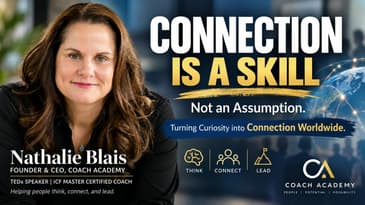
On this episode of Let’s Have This Conversation, I sit down with Nathalie Blais, Founder and CEO of Coach Academy, TEDx speaker, and ICF Master Certified Coach, to explore a powerful premise: connection is not an assumption; it is a skill.
At a time when communication can feel increasingly reactive and transactional, Nathalie challenges us to rethink how influence is built, how people create meaningful change, and why coaching skills are ultimately connection skills.
For Nathalie, coaching isn't about fixing people or simply telling them what to do. It's about creating the conditions for insight, responsibility, growth, inclusion, and meaningful exchange. Her philosophy positions coaching as a language leaders can use to deepen relationships and create sustainable change across organizations, cultures, and systems.
Nathalie brings extensive experience to this conversation, including more than 50,000 hours in facilitation, learning design, research, and education development. She has designed multiple ICF-accredited coach education programs and trained thousands of leaders and coaches around the world.
Her research explores the deeply human forces that shape how we relate to one another—including fear, motivation, grief, compassion, and connection. Her forthcoming 2027 book examines why human-centered connection may become an even more critical capability as automation and artificial intelligence reshape how we live and work.
Throughout our conversation, we explore the ROI of executive coaching, human-centered leadership, authentic influence, emotional intelligence, inclusion, organizational change, and the skills leaders will need to remain distinctly human in an AI-driven world.
If connection can be learned, strengthened, and practiced, the question for every leader becomes: How intentionally are you developing it?
For More Information: https://canadacoachacademy.com/
Listen: https://podcasts.apple.com/ca/podcast/connection-experiment-by-coach-academy/id1708030774
Learn more about your ad choices. Visit megaphone.fm/adchoices
[00:00:00] Let's Consider The Question That What If In An Increasing Automated World Your Competitive Advantage Isn't The Latest Piece Of New Technology But Rather Our Genuine Ability To Connect With One Another In Today's Day And Age Executive Leadership Coaching Has Increasingly Become A Strategic Investment That Executives
[00:00:29] Find To Be Important And Timely Considering The Times That We're Living In Today. Benchmark Research Has Reported A Return On An Investment Of Approximately 529% To 788% Respectively Which Is The Equivalent Of 5.3 To 7.9% Of The Original
[00:00:58] Investment. Meanwhile, Research Into Human Centered Leadership And Its Importance Continues To Amplify And Emphasize The Importance Of Authenticity, Empathy, Communication, And Meaningful Connection On This Episode Of Let's Have This Conversation. I Had The Privilege Of Sitting Down With My Friend, Natalie Blais,
[00:01:28] She Is The Founder Of Coach Academy, A TedX Speaker, And An ICF Master Certified Coach To Explore A Powerful Premise. Connection Is Not An Assumption, It's A Skill. At A Time When Communication Can Feel Increasingly Reactive And Transactional, Natalie Challenges,
[00:01:58] To Be Your Owned. To Be Your Owners, To Be Your Owners, To Be Your Ownership And Communication, And To Rethink How Influence Is Built, How People Can Create Meaningful Change, And Why Coaching Skills Are Ultimately Viewed As Connection Skills. For Natalie, Coaching Isn't About Fixing People Or Telling Them What To Do, It's About Creating The Conditions For Insights, For
[00:02:28] Responsibility, For Responsibility, For Growth, Inclusion, For Growth, Inclusion, And Meaningful Change, And An Exchange, And An Exchange Of Ideas. Her Philosophy Positions Leaders To View Coaching As An Opportunity To Deepen Their Understanding And Relationship Across Organizations, Cultures, Systems.
[00:02:54] Blaze Brings An Extensive Amount Of Experience, And Experience To The Conversation, Including Over 50,000 Hours Of Coaching And Facilitation, Learning Design, Research, And Education Development. She's Designed Multiple Programs For ICF Coaching And Education, Also Training Thousands Of Coaching,
[00:03:24] Coaches, And Thought Leaders, And Thought Leaders, And Thought Leaders Around The World. Her Research Explores The Deeply Human Forces Which Shape How We Relate To One Another, Including Fear, Motivation, Grief, Compassion, And Connection. Her
[00:03:53] Even More Critical Capacity, And Capability, As Automation And Artificial Intelligence Reshapes The Way We Live And Work.
[00:04:05] Throughout Our Conversation, We Explore The Oral Eye Of Executive Coaching, Human-Centered Leadership, Authentic Influence, Emotional Intelligence, Inclusion, Organizational Change, And The Skills Leaders Will Need To Stay Relevant And Connected To Their Human Instincts In This Increasingly
[00:04:35] AI Driven World. And Natalie, Join Me This Week To Tell Me More. I'm Kevin McCann. Let's Have This Conversation.
[00:05:18] Absolutely. So, Natalie, if you're ready, I'll take a moment to welcome you to the program. And I'm super excited to talk to you this morning about Connection and Communication. It's great to see you, my friend, and happy Friday to you. Happy Friday.
[00:05:34] Absolutely. So, Natalie, I wanted to start our conversation at the heart of the intersection of the work that you do. Because I know that you believe that connection is not an assumption. It is a skill, my friend. And so, I'm wondering if we can start our conversation by you explaining why you believe so deeply in that motto and why that's so important to you, my friend.
[00:06:05] Well, I think it comes from personal experience, you know, as a child growing up and feeling disconnected and realizing that connection can't really be left to assumption, which it often is. We think people know how to connect to know how to connect to each other. But really, it's a skill that isn't taught because it's left to assumption.
[00:06:31] So, we do our children first and foremost a disservice by not teaching them. And then that follows us into adulthood, into workspaces and boardrooms and relationships that we have that are just, you know, it wouldn't. I think that more marriages could be saved.
[00:06:51] I think that more jobs could be saved if we were to support the development of connection skills in people. Yeah, absolutely. I know that you run Coaching Gallery, my friend, which is approved as a partner of the International Coaching Federation, my friend.
[00:07:14] And I know that your mission is to mentor world-class coaches and mentors to really maximize their effectiveness as coaches, my friend. So, tell me about the Academy and what makes it so fabulous, my friend. Well, I think it's pretty fabulous.
[00:07:41] Coach Academy was founded in 2016. It's a kind of, I feel like it's my baby. You know, founding this company was all about multiplying the impact of coaching conversations in the world.
[00:07:59] I, you know, I think that everybody deserves to have a coach and that the next best thing really is to become a coach. It's to, and I don't mean to coach professionally necessarily, but to have the skills of a coach and the mindset of a coach.
[00:08:19] So, for me, that is definitely the opportunity is to multiply the, you know, the power of coaching conversations. Yeah, absolutely. Yeah, absolutely.
[00:08:37] You know, I know that you believe when we prioritize coaching-based connecting skills, we can build a grid of trust and enter conversations with a better sense of confidence, curiosity, and how people think more clearly because they feel heard, connected, and valued.
[00:09:01] My friend, I'm wondering if you can tell me why this is such important to you as a nucleus in terms of a sense of connection.
[00:09:10] I'm wondering if you can tell me why this is such important to me.
[00:09:41] To be present to what someone else might be feeling and to pause where I might want to share what I think, what I know, what I feel. And that pause is really all about giving someone time and space to think and speak without interruption. So, prioritizing connection is a different conversation. It sounds different than the conversations we're having. There's more space in those types of conversations.
[00:10:11] There's more questions, open-ended questions, not closed-ended questions that often revert, you know, shift back to me. So, learning these, what I call very accessible skills, skills that anybody can learn at any age, it's never too late, can really change the conversations we're having. And that is where connection lives, is when we use these skills and we apply them in conversations,
[00:10:38] it gives us an opportunity to help somebody feel seen, to feel heard, to feel like they matter. And today in our world where, you know, loneliness is truly an epidemic, the way that we outsource connection to technology is actually confusing people.
[00:11:00] They think they're connecting to AI or to, you know, social platforms where they're getting comments and likes and that's, you know, or maybe something goes viral, but that's not connection. That's not human connection. That's not, I don't think it can replace human connection. And we have to start prioritizing the development of those skills, especially in our kids, in our youth, the generation to come,
[00:11:30] because they're the ones who are being exposed to technology and AI at every corner of their lives. Like they are living a different reality than let's say I did at 52 today. You know, when I was, when I was growing up, I didn't have that, right? I didn't have social media. I didn't have AI. So these are, these are things that we need to pay attention to, I believe, as a society. Yeah, absolutely.
[00:11:58] And, you know, Natalie, one of the reasons I was so excited to talk to you this morning was, because I know that you value the value of being curious and valuing curiosity as a strategic partner in both innovation and moving organizational, you know, culture forward.
[00:12:21] So I'm curious, how can curiosity become both a strategic and tactical advantage inside the walls of today's workplace and how can leaders use it as a catalyst to, you know, spur morale and get the best out of their people? What are your thoughts there, my friend?
[00:12:44] Well, I'll start by saying communication and conversations are complex even when two people are speaking the same language. And in organizational life and culture, there's typically several, you know, a multitude of different cultural backgrounds, a multitude of complexity that exists far beyond two people having a conversation that speak the same language.
[00:13:14] So when we lead with curiosity, and we lead with, you know, inquiry versus I know, and I'm, you know, my ego, basically, it creates an opportunity for a more cohesive culture, but more importantly, more open communication. So I think the two go hand in hand. I believe that curiosity is the most generous thing you can offer someone. It's a gift.
[00:13:43] When I'm curious about you, it means that you're important to me, and I care. And I want to hear from you. I believe that you have something to share. So curiosity is a way of helping people feel valued. And in organizational and cultural life, or the culture of an organization, that can be contagious.
[00:14:09] If you're, if leaders are curious, asking open-ended questions, being the last to speak, allowing people to share the brilliance that they have within them when there's a safe space to do so, that can change an entire organization on the positive side, right? Yeah. Yeah, absolutely. And to that point, I want to talk to you about the importance of resilience in developing leaders
[00:14:38] and organizations and coaching leaders. And, you know, resilience is a tactical advantage because I'll use myself as an example. So Natalie, I was born with spastic, quadruple, and cerebral palsy. It simply means that I don't have enough oxygen in my legs to walk normally. And I found out at nine years old that I wouldn't be able to walk for the duration of my life because of the severity of my disability.
[00:15:06] I live my life through the saying that resilience is the answer to the test once adversity is striked, my friend. So tell me about the importance of resilience in organizational culture, my friend. Yeah. Well, you know, organizations and culture. And thank you, Kevin, for sharing that. I appreciate, you know, that you are incredibly resilient. And I think that organizations and cultures, they're made up of people.
[00:15:36] They're people in the end. You know, we call them organizations, but organizations don't exist without people. And so when we honor the person, the people in the space, we have an opportunity to, you know, see that people are flawed and people have stories and people have an iceberg underneath that we don't see. So when we lead with questions, when we lead with a coach approach or a coach mindset,
[00:16:05] what we're doing is really creating more space for people to show themselves and be more resourceful. Because when I ask you a question instead of giving you the answer, I'm helping you to build resilience because I'm helping you to be more resourceful and turn internally for your answers instead of externally, where we often go. And we don't give people enough time to explore that internal experience. We cut them off.
[00:16:35] We interrupt. We share what we think. We redirect. You know, this is the way often conversations are competing. Right? I talk, you talk. I talk, you talk. But rarely do we come together in a space where I'm allowing you and I'm getting even more curious as you talk instead of wanting to share my opinion and, you know, turn that conversation around back to me.
[00:17:01] So resilience is in the questions, I believe, that I know questions have supported me to become more resilient. You know, like turning the question, why is this happening to me into what is this happening for? What's the opportunity? What am I not noticing? You know, what is the possibility?
[00:17:22] So the way that we ask questions, it can either put us on trial and justification with why or, you know, like the questions that start with why. Or it can put us into curiosity and possibilities and a more connected space when we start questions with what or who or how. So just those shifts, those small little shifts can make a big difference.
[00:17:51] And I really feel that is where resilience starts. Yeah, absolutely. And Natalie, I know you work with a diverse group of people and you develop them into qualified coaches. So I'm curious to ask you, what qualities do you look for in people that tell you that they can authentically connect with others
[00:18:16] and have the potential to really meet people where they are and become effective leaders and coaches? So what qualities do you look for in people that will tell you that they'll be effective coaches? Yeah. Yeah. Yeah. Well, actually, I mean, we joke about coaching DNA as though somebody might be born a coach.
[00:18:40] But really, what I've noticed is that to be a coach or to be a great leader or to be a great partner or a great parent, what first requires is a sense of self-management. Because, you know, the word authentic, as you mentioned, you know, to be authentic, I don't think people, I don't think that's the requirement. I think it needs to be more of a genuine approach versus authentic.
[00:19:09] Because genuine implies that I can also be strategic and professional about how I show up. Because coaching to me is a skill set. It's also a profession. And that requires strategy. So showing up in a way that you are willing to be self-managed, that you are willing to allow someone else to think for themselves and not give them the answers.
[00:19:37] Or willing to create space even when you don't agree, even when your values don't align, that you are willing to sit in the space of acceptance and not agreement. So those are things that we work on as coaches. It's professional development.
[00:19:55] And so somebody who wants to be a coach, if they're willing to learn strategies, if they're willing to reflect, because self-reflection is required to understand and evoke awareness of where am I starting from, right? What am I bringing to this? And then what do I need to be a successful coach?
[00:20:18] Because I've often said in our programs and to colleagues, the difference between a good and a great coach is self-management. It's the willingness to withhold my answers and my thoughts and opinions and my experience in favor of someone else's. Yeah, absolutely.
[00:20:39] You know, now, I want to talk to you about the return on investment when it comes to human-centered leadership, authentic influence, and emotional intelligence, and how it also is around the idea of inclusion, organizational capacity, and culture, and how that all sort of ties into a bowl when we talk about executive coaching.
[00:21:07] So what I'm asking you is how do you think executive coaching can have a positive turn on investment when we talk about emotional intelligence and the ability to really meet people where they are from a professional standpoint? What are your thoughts there, my friend? Yeah, ROI, it's an interesting concept. And I think it's actually, it depends on the meaning you make of it.
[00:21:37] Some organizations or cultures will describe ROI as a financial bottom line. But what if that ROI is about people and culture and cohesiveness and empowerment? So I think that first, it depends on how we define or what we look for as success. And when we prioritize people, that's different than prioritizing financial gain.
[00:22:05] So with coaching, I think the opportunity or, you know, the or even just not just coaching, but in conversation and in community, the opportunity is to ask ourselves, like, what's most important here? And when I know what's most important, that will lead with, you know, a strategy.
[00:22:30] So if I, if I'm prioritizing people, and I'm prioritizing connection, then I will show up with curiosity. Whereas if I'm prioritizing bottom line and prioritizing financial gain, I'll probably show up with a different mindset, you know, something a little bit more advisory, perhaps, or more directive. So it really is a question. And can there be a balance? Absolutely.
[00:23:00] I think there has to be when we, when we talk about organizational success, there has to be both. But I think often the financial gain overtakes the, the humanity of an organization. And I think coaching can bring in a really nice harmony into, into those spaces. Yeah.
[00:23:22] So we can, I also wanted to ask you about the idea of effective communication and how that is tied to human centered leadership. You know, it's a buzzword in coaching and public speaking these days. But how do you think human centered leadership and effective communication are interconnected in effective leadership styles? What are your thoughts there, my friend?
[00:23:53] Yeah. I mean, again, I think the word effective can have a lot of different meanings to different people. So when I think about human centered leadership, I think about, you know, valuing the human experience. And, you know, again, that word curiosity, getting curious about other people's experiences. We're, you know, we're told in school, when you have the answer, you bring value.
[00:24:21] So no wonder people go through life answering and telling and advising. And yet the studies tell us that less than 30% of people will actually take someone else's advice, even when it's a professional, a doctor, somebody they deem to respect. So if that's true, most of us go around telling people what to do, yet less than 30% of us actually fill a prescription when a doctor tells us.
[00:24:51] How does that balance? So we have to start to reflect and say, what are we doing? What do we want to achieve? And what are we willing to shift to have a different impact? And that's, those questions can only start when we look at the human centered leadership, the leadership that prioritizes the well-being of the person. Because without that prioritization, you don't, you don't ask those questions.
[00:25:21] We don't ask those questions, right? We don't ask ourselves those questions. So I think effective leadership or human centered leadership, it just means asking better questions, being more connected to what people feel, what they think, what they want, what they're afraid of. And what's possible. Yeah, absolutely.
[00:25:43] And Natalie, I think that we share a mutual synergy, the laws of sort of motivating and getting the highest potential out of people. So I'm curious for you, would you consider the term internal passion and influence of other people, my friend?
[00:26:05] And why do you think those are such important ingredients to developing coaching candidates and people in general? So why do you think passion is so important, my friend? Hmm, that's a good question.
[00:26:27] For me, passion is purpose, you know, and purpose keeps people aligned to what they want, even when it's hard, even when they want to give up, even when it feels like it's not going to work. The passion behind purpose is what keeps us going toward our goals.
[00:26:47] So when we think about passion in terms of development in any professional endeavor, whether it's coaching or something else, it's the fuel behind what you do. So, and I also know that, well, in our community, especially one thing that really ties people together is, is passion.
[00:27:11] It's a passion for continuous learning, passion for helping others, passion for exploring new possibilities and new choices in a career, for example. A lot of people come to us in career transition. So, and I always hear people talk about their passion. People genuinely want to live their passion.
[00:27:35] And, although a lot of people don't know what the passion is and don't even, you know, they're not sure how to live their passion and still make money and still feed their families and still survive in this economy. But it's something that we're, I think, as humans all in pursuit of at varying degrees. Not everybody needs to chase their passion like building a large company, but sometimes passion is just prioritizing well-being.
[00:28:03] So, yeah, I think passion is a big part of how we make progress in life as humans. It drives us. It guides us. It even leads us sometimes. So, it's an important ingredient. Yeah. And, you know, building on that, I want to now talk to you about the idea of inclusion for folks with disabilities. And I'll use myself as an example.
[00:28:32] So, you know, outside of hosting this podcast, Natalie, I talk to organizations about the importance of hiring folks with disabilities and integrating them into organizational culture. Because it's a passion project of mine. Because when I graduated college all the way back in 2010, Natalie, I went on 10 consecutive job interviews to become a sports reporter.
[00:29:01] And nobody would hire me because they viewed my disability as a liability. And I live my life. And when I leave keynote addresses, I say that inclusion is the gateway to independence. So, I'm curious, from your perspective, what value strategically do you think people with disabilities can add to an organizational culture in terms of spurring both innovation, solving problems?
[00:29:31] Because I think people with disabilities are natural problem solvers. So, what sort of an asset do you think individuals with disabilities can be when we talk about making organizational cultural changes and implementing them into organizational culture? What are your thoughts there, my friend? I love that question.
[00:30:23] It creates innovation. That's how we make progress as a society is through the different lenses that people bring to a situation. I love that you say, you know, to be disabled is to be a problem solver. That is a beautiful reframe because it is, it's true. Like, you are seeing the world from a perspective that most people don't see it.
[00:30:48] And when we bring that into a boardroom or into an organization and we start to allow the different voices and perspectives into the room to share what they see about the same situation, that's where new ideas are born. And, and like I said, innovation, progress momentum is built. So, I think it's a really important topic you're bringing in.
[00:31:16] And I, I think that you're the work you're doing, which I mean, I can honestly say I'm not, I don't know fully all of the ways that you're impacting your cause. But I believe that what you're doing is so important for people, organizations, society. We need to be more inclusive in everything we do.
[00:31:40] And by inclusive, I really just mean considering the different perspectives that come with the different experiences that people have and the way we live our lives. Yeah. Well, I appreciate that. And I want to now follow up by asking you, because I'm naturally curious to get your answer to this question.
[00:32:02] When we talk about the role of executive coaching and how they work to, you know, help us understand the roles of societal change that we're going through, you know. So, one of the reasons that I wanted to start this podcast is because I looked at the world six and a half years ago and I said to myself,
[00:32:26] there has to be more that brings us together than always working to, to develop silos to bring us apart. So, I'm wondering your perspective on how executive coaches can play a role in sort of bridging the societal divide that we're currently under today
[00:32:48] and bring us closer to a better understanding of a common ground of both respect and difference, but also of mutual appreciation. What are your thoughts there on how coaching can help us heal our societal divisions that we face today, my friend? Yeah, well, community is one of my pillar values.
[00:33:16] And I think executive coaches have an opportunity to bring people together that, because a lot of people feel siloed, as you said. The work that I've done with executives as a coach often reveals the loneliness and isolation that CEOs feel, leaders feel.
[00:33:43] You know, the fact that they're responsible for so many people and so many decisions. And then going to operations and the people in the different departments and doing the different roles, many times are disconnected from the greater purpose of the organization or how they, the interdependence of the organization exists in the system. And organizations, just like communities, just like families, are all systems.
[00:34:12] We all work together, whether we know it or not. And so I think executive coaching or coaching in general is an opportunity to, yeah, get closer to what's really going on for people, create connection where connection doesn't exist. And helping people, because I think when someone is coached, in fact, I know when people are coached, they start to adopt coaching skills.
[00:34:41] You know, I'm coaching somebody for, let's say, three months. They will start to adopt some of the language and start asking some of the questions I'm asking them to others. They will start to model coaching, right? It's interesting. And that's one of the ways that we multiply the impact of coaching is by coaching people, they turn around and coach others. And I think that is one way that we bring people together when we change the way we show up to each other.
[00:35:10] And as you say, you know, showing up to people as they are, not with an immediate desire to change somebody or mold them into what you want, but really noticing who they are and what they feel in the moment they're in. That's what coaching does. It mirrors people. It doesn't try and change someone unless they want the change. But really, it mirrors and witnesses people. And everybody needs a witness to their life.
[00:35:40] Everybody needs a witness. Yeah, absolutely. And, you know, I've got a few questions left for you. The first of those questions is this. I'm curious to ask you about emotional intelligence and its intersection to effective communication. Because, you know, one of the things that I truly believe as leaders is that you can't be an effective leader if you think you always have the answer.
[00:36:09] It's important to empower people to have the autonomy to make decisions and choices and live with the outcome of those decisions. So how do you think leaders can have an effective intersection of emotional intelligence, trust, and communication, my friend? What are your thoughts there? Well, sorry.
[00:36:39] Can I just ask you to clarify the question? Because I'm not sure where you want me to go. Yeah. Yeah, no, I just wanted your thoughts on the importance of emotional intelligence. Emotional intelligence. Okay. Yeah. Sorry. Yeah. Okay. Yeah, I think it's important. Look, emotional intelligence. What is it? It's being aware of my emotions and how they impact a conversation and the situation I am in and then being aware of other people's emotions.
[00:37:05] And I think the more that we are aware of our own emotions, the more we see the landscape of emotions in others. So just the awareness of emotional intelligence helps us to be more connected, to be honest, in situations. How does it affect leadership?
[00:37:26] When leaders, as you said, if they're coming in with the answers and being, you know, directive, they're not really considering the other emotions in the space they're in, what people are bringing to the situation, what their perspectives might be or their experiences might be.
[00:37:43] So an emotionally intelligent leader is more effective because they are more perceptive of what people are feeling and thinking and wanting in an organization. And I also know that compassion is a big component to that.
[00:38:08] You know, having compassion means you're willing to consider someone else's experience. And I feel there is a huge correlation between emotional intelligence, compassion and effective leadership. Yeah, absolutely. Now, we've got two questions left for you. And the first of those two questions is this. So, now, I also serve on the board of directors of Habitat for Humanity in my hometown here in Windsor, Ontario, Canada.
[00:38:37] And we just had our Building Bridges Summit in Houston. And one of the major themes of the summit was all about the importance of, you know, burnout when you work in nonprofits. And I worked in nonprofits myself. And as you know, it takes a very special person to work in nonprofits because you don't go in nonprofits for the money. You go in it for the mission.
[00:39:07] So, I'm curious to ask you about working in nonprofits and, you know, developing communication habits to, you know, combat burnout and really develop great communication habits in order to be effectively, there's not only in nonprofits, but in every sector of leadership. What are your thoughts there, my friend?
[00:39:36] Yeah, it's a great question. We do a lot of work with nonprofits. And actually, a lot of the coaches who come through our programs are coming in to either establish a nonprofit or work in that area. The opportunity is to bring awareness.
[00:39:57] When you have coaching conversations in any organization, whether it's a nonprofit or otherwise, you're bringing in an opportunity to evoke awareness of not just an individual, but a team. And when you do that, you know, I think we become better problem solvers. I think we've become better, well, more resilient together.
[00:40:21] And so, like what I've seen in nonprofits is a lot of resilience because, as you said, it's not easy work. And people are there because they're passionate and they believe in something, relentlessly believe in something. And so, that alone is really a great space to be in.
[00:40:44] And when you bring coaching into that, what you bring is an opportunity for even like I've worked with nonprofits, just having brainstorming sessions on coaching questions. How can they start asking better questions to get better results for the communities they serve?
[00:41:06] And that has been a really interesting and powerful exercise because even a nonprofit will have sometimes fixed ideas and make assumptions about how they can help. And they forget to ask questions of the communities they serve. And when they start to ask questions, they start to realize that maybe if they shift or they pivot just a little, they'll have greater impact.
[00:41:33] So, yeah, I think it's all, it's a beautiful space to be in. Yeah, absolutely. Now, my final question for you this morning has to do with your own personal internal why. Why did you want people to be great executive coaches? Why you started Coaching Academy? And about your own personal and professional legacy and how you want that to be defined.
[00:42:03] So, tell me about your legacy and your internal why, my friend. What do you want people to know? Well, I hope my kids will be my best, most important legacy. But other than that, the company, the mission we're on is very much passion driven. It's all about wanting to change the conversations to change a life. And when we change a life, we have the opportunity to change a world.
[00:42:33] So, it starts with the conversation. And I think the greatest contribution I can make with both my research and my experience as a coach is to help people develop these connection skills or coaching skills to have better conversations, more connected conversations.
[00:42:58] So, the legacy is really a ripple effect, one person at a time. And when that person becomes a coach and they coach others, then that is the ripple right there. So, I am on a mission to mentor people in powerful connection skills and coaching skills. Yeah, absolutely.
[00:43:21] And finally, Natalie, if you want to get connected with you personally or a coaching gallery, what's the best way they can do that, my friend? Yeah, they can find us at coachacademy.com. And pretty much everything is right there. You can listen to us on The Connection Experiment. It's also a podcast that we have. And, yeah, pretty easy to Google for Coach Academy or Canada Coach Academy.
[00:43:50] We are based in Ottawa. So, we are proudly built in Canada for the world, I like to say. Yeah. Yeah, absolutely. So, I live in Windsor, my friend. So, very quickly. What's the best part for you about being Canadian, my friend? I'm curious. Well, best part about being Canadian is a beautiful country we live in.
[00:44:14] It's, you know, we are so privileged and we are, you know, anything is possible here. So, I love the diversity of our country. I love the seasons of our country. And, yeah, I'm proudly Canadian. Well, me too, my friend. And I love the diversity of this conversation. I want to thank you for your work in leadership and developing people to maximize their fullest potential.
[00:44:43] I want to thank you for the good work that you're doing and for agreeing to engage in conversation and answering my questions this morning. It's most appreciated, my friend. Thank you, Kevin. It was fun. I appreciate the invitation. Thank you.