Only about 26% of leaders actually practice the behaviors necessary to create a truly psychologically safe climate for their teams, according to McKinsey & Company. Meanwhile, 90% of C-suite executives believe their company actively promotes worker well-being, according to a Deloitte Workplace Well-being study reported by Fortune.
That gap raises an important question: What does it really take to create workplaces where people can thrive psychologically while performing at their best?
Dr. Ashley Smith believes it starts with learning how to master one of our most powerful—and sometimes limiting—forces: our own minds.
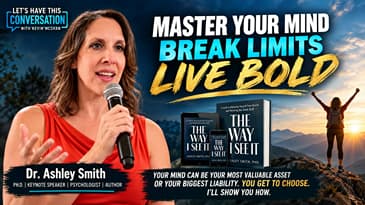
Dr. Ashley Smith is a licensed psychologist, speaker, author, and co-founder of Peak Mind: The Center for Psychological Strength. With more than 20 years of experience specializing in anxiety, mindset, and human behavior, she helps individuals, leaders, and organizations understand how our minds can deceive us, reinforce negative thinking, magnify fear, and convince us to play smaller than our potential.
Her message is simple but powerful: Your mind will hold you back—if you let it.
Dr. Ashley doesn't just study what it takes to push beyond limitations—she lives it. Born with a rare visual impairment that makes her legally and increasingly blind, she knows firsthand the difference between the limitations life gives us and the limitations our minds can create.
By combining behavioral science, brain science, storytelling, and practical strategies, Dr. Ashley teaches people how to train their minds to work for them rather than against them—developing the courage, resilience, psychological flexibility, and mental strength required to live boldly and perform at their peak.
Through Peak Mind, Dr. Ashley and her team are also challenging the traditional workplace wellness model. Rather than relying on temporary motivation or “feel-good” initiatives, they focus on building psychological strength: practical, evidence-based skills that support mental health, authentic leadership, resilience, and sustained performance.
In this episode of Let’s Have This Conversation, Dr. Ashley and Kevin McShan explore the connection between psychological safety, employee well-being, leadership, resilience, anxiety, mindset, and organizational performance. They examine why thriving people are essential to building thriving organizations—and what leaders can do to create environments where people feel safe enough to contribute, courageous enough to challenge themselves, and supported enough to reach their potential.
Because breaking through limitations isn't always about changing what's happening around us. Sometimes, it begins by changing the relationship we have with the thoughts happening within us.
For more Information: https://www.drashleysmith.com/
LinkedIn: @Dr.AshleySmith
Learn more about your ad choices. Visit megaphone.fm/adchoices
[00:00:00] Are you leading by example as a leader or do you feel you still have more work to do when you ask for common consensus around the goal, productivity, or garnering the respect you need as a leader for mutual buy-in?
[00:00:22] Well, according to my friends over at McKenzie and Company, approximately only 26% of organizational leaders actually practice the psychologically safe behaviors which translate into their employees feeling safe at work.
[00:00:48] Meanwhile, 90% of C-suite executives believe that their companies promote worker well-being according to Deloitte's Workplace Wellbeing Study which was reported by Fortune Magazine.
[00:01:08] This gap raises an interesting question for us all to consider. What does it actually take to create workplaces where people can thrive psychologically while also performing at their best?
[00:01:28] For my friend, Dr. Ashley Smith, that answer is quite clear. She believes it begins by learning how to master one of our most powerful but sometimes limiting forces, our minds.
[00:01:46] Dr. Ashley Smith is a licensed psychologist, an author, a speaker, and the co-founder of Peak Mind, the Center for Psychological Strength.
[00:02:00] With more than 20 years of experience specializing in anxiety, mindset, and human behavior, she helps individuals, leaders, and organizations understand how our minds can deceive us, reinforce negative thinking, and magnify fear,
[00:02:28] and convince us to play smaller than our potential. Her message is simple but powerful. Your mind will hold you back if you let it. Dr. Ashley Smith doesn't just study what it takes to push beyond limitations. She lives it.
[00:02:51] She was born with a rare visual impairment which makes her legally and increasingly blind. She knows firsthand about the limitations that life can give us versus the limitations that our minds have. She does not because she can be able to ask.
[00:03:13] By combining behavioral science, brain science, and storytelling, and practical strategies, she teaches people how to train their mind to work for them rather than against them, developing the courage, resilience, and psychological flexibility,
[00:03:39] and mental strength required to perform at their peak. And Dr. Smith, join me this week to tell me more. I'm Kevin McShann. Let's have this conversation.
[00:04:25] Dr. Smith, if you're ready, I'll take a moment to welcome you to the program. And I'm super excited to talk to you about how you help people get in the right mindset, both inside and outside of the office. It's great to see you, my friend. And happy Tuesday to you. Happy Tuesday. Absolutely. So, Dr. Smith, I wanted to start by asking you, why do you think it's so important for organizational leaders and employees
[00:04:54] to value their psychological safety and how they perform at work and the relationship between the two? What are your thoughts there, my friend? I have a lot of thoughts. But I think one of the biggest things is that we're people, right? We have a nervous system. We have our brain and all of our nerves. And we take it with us wherever we go. So it's not like you can just leave any stress at home and show up at the office.
[00:05:24] You're going to take it with you and vice versa. So whatever stress is happening at work, you're going to take home with you as well. So I think it's really important that we're looking at psychological strength and well-being across the board because it's going to affect how you show up at work, how you show up in your relationships, and just how you show up day-to-day, moment-to-moment in your life. So I think it's incredibly important that we think about whole person health. Yeah, absolutely.
[00:05:52] And I know that you have more than 20 years of experience in this field, specializing in things like anxiety, mindset, and human behavior, my friend. And so I'm curious if we can talk about how our minds can deceive us and reinforce negative thinking and convince us to play by another set of rules, my friend.
[00:06:17] How do you help organizations sort of shoot their mindset from that thinking, my friend? Yeah, I think the most important thing to understand is that our minds don't just reflect reality back to us. A lot of people just sort of move through life assuming that they can trust their perception of things. And that's not how it works. Our minds evolved to keep us alive. That's it.
[00:06:42] Their number one job is to help us survive, not to make us happy and not to make us successful. So everything comes back to that. How do I stay safe? How do I stay alive? And our minds want to do that while conserving energy, which means they're a little bit lazy. They take shortcuts to keep us safe. So they have to process all of the information coming in at us every second of every day, right? Everything we can see, hear, smell, taste, and touch. And they have to make sense out of everything.
[00:07:12] And to do that quickly so that they can figure out if there's going to be any danger or anything potentially bad happening to us, they take shortcuts. And when you know that, okay, my brain is going to take shortcuts, it's going to jump to conclusions, and it's going to do it in a way to keep me safe, then it's easy to understand why our minds are biased toward the negative. It means that we notice the negative more than the positive. We remember the bad over the good. And we anticipate bad over good.
[00:07:40] So I think the biggest things are knowing that, knowing that you cannot believe everything that you think, because thinking thoughts aren't facts. They're just stories that our minds are telling us to make sense out of our experience. Yeah, absolutely.
[00:07:57] You know, based on the society and climate we're sort of living in today, whether you watch the news for 10 minutes or two hours, we're often conditioned to get a picture of how society is versus our own view of society.
[00:08:21] So how do you think, you know, media influence and what we see on the news or read on the internet can sort of impact our psychological safety in the way our minds are wired? What are your thoughts there, my friend? Yeah, I think that's a really great question. And my professional advice for years has been don't watch the news. And that's a hill I will die on is do not watch the news.
[00:08:48] And the reason being, you have to think of it as what's the purpose, right? Whether it's traditional news media on TV or online or social media, it's all designed to capture our attention, right? They want our attention. And what captures our attention better than anything is fear and anger. That's just the way our nervous systems work. Something that is perceived as fear grabs our attention. Something that makes us angry grabs our attention.
[00:09:17] So the media is designed to hijack attention, which means makes us feel scared and angry. And the other thing with it is think about like your body and what you eat impacts the way that your body feels and functions, right? So if you eat nothing but Twinkies versus nothing but kale, your body is going to feel really different. And it's the same thing with our minds, only instead of what food are you taking in, it's what information and what content are you taking in.
[00:09:46] So the information that you're taking in, the stuff that you're spending time watching and reading and listening to is going to affect the quality of your mind. So if it's already biased, if it's already designed to make you feel afraid and angry, it's just going to amplify those kinds of thinking patterns. Yeah, absolutely.
[00:10:06] And, you know, I also wanted to ask you about maximizing, you know, intellectual intelligence and psychological safety. You know, I am someone who is a strong believer in self-reflection. And I think self-reflection can help elevate our intellectual performance or intellectual thinking.
[00:10:30] So I'm curious from your personal and professional perspective, how do you look at, you know, maximizing both intellectual and psychological sort of intelligence and safety? What are your thoughts there, my friend? Yeah, that's an interesting question. I think a lot of times people think of intelligence as sort of this steady trait, right? Like you're born with a certain degree of intelligence. I don't buy that.
[00:10:57] I think we can learn and we can expand and we can stretch our intelligence. I also think intelligence, there's a lot of different forms of it, right? Maybe there's verbal or math or someone who's artistic or mechanically inclined or athletically inclined. So I think it's finding the areas that you're drawn to and then challenging yourself to learn more and practice more and expand. From a psychological perspective, I think self-reflection is a really important skill.
[00:11:26] And to me, it's like I wouldn't go out in public without looking in the mirror, right? To see, is my hair sticking up crazy? Do I have spinach in my teeth? So we look at our reflection to see what's there and how might I change it? And I think we need to do the same thing psychologically. And to me, it's really about getting to know how your mind works. What are the patterns that your mind tends to follow? What are the thoughts that it tends to give you? When do those come up? What triggers it? What's helpful and unhelpful?
[00:11:56] And being able to pause and look at what was going through my mind when I said or did or felt that helps you understand your operating system. And then you're in more control to be able to develop the kind of mindset that can help with resilience and help with performance and happiness. Yeah, absolutely. And that's just what I also want to talk to you about, about the importance of mental clarity and its relationship to psychological safety.
[00:12:24] You know, we're all busy people in today's society. And we have competing demands for both our time and our attention. So I always tell people we make time for the things that we, you know, prioritize. And I know that you believe that prioritizing what's important to us is important because we can't be everywhere all the time.
[00:12:49] So talk to me about the importance of maximizing mental clarity and the importance of protecting our own mental health at the same time. What are your thoughts there, my friend? Yeah, well, it might be a little bit different in Canada versus the U.S., but in the U.S., we have this productivity is king hustle culture, right? Like how can you optimize your productivity, do more, do more, do more in less time? And I don't think it's good for us.
[00:13:18] I think we need to do exactly what you said, which is get really clear and prioritize what's important, knowing we cannot do it all. We have to be willing to let go of that idea and say, I'm going to focus my time, attention, and energy on these things that are truly important. And I think that also requires us to go back to that self-reflection piece to determine, well, what's truly important to you? It may not be what society says, right?
[00:13:46] Is it, I don't think anybody on their deathbed regrets not working more, right? They regret things like not spending time with their loved ones or not allowing themselves to be happy. And I think we have to give ourselves permission to say, I want to prioritize my health and well-being. To do that, I actually need to do less. I need to stop splitting my attention. And I need to have rest and recovery periods where we're not taking in stuff.
[00:14:14] We're not consuming, that we're allowing our mind to wander, to focus deeply, and to play a little bit. Yeah, and to that point, my next follow-up question to that is the role that, you know, organizational leaders have to play in promoting an environment of a psychologically safe workforce,
[00:14:37] you know, evaluating the demands that they put on their staff, and how it affects organizational culture. So what role do you think leaders play in creating an environment where healthy mindset, psychological safety, and performance can equally coexist? What are your thoughts there, my friend? Yeah, I think leaders play a huge role in setting culture.
[00:15:03] And culture is, it's the unspoken rules, right? And that's why I think there's a big discrepancy. People will say, our culture is, you know, work-life balance. But then if you have a leader who's sending emails at 8 p.m., the unspoken message is you should be working all the time. So those unspoken messages speak more, they're louder than whatever your words say. So actions speak louder than words. I think we have to really consider that. Like, what are you reinforcing?
[00:15:32] What are you rewarding? If you're saying we reward balance, but then people come back from taking vacation, and they have to, you know, spend two days digging out of their inbox, they actually got punished for going on vacation. So we really need to look at that. What are you reinforcing? What are you rewarding? What are you punishing? On the psychological safety side, that really means that people feel like they can show up authentically, that they can be honest, and that they can take chances without getting in trouble.
[00:16:02] And so if you're a leader and you're saying, I want innovation, well, innovative thinking requires safety, right? You cannot create. You cannot do creative problem solving if you're not in a positive mind state. So if people are feeling stressed out, if they're feeling anxious or worried about their job security, about getting in trouble, about being reprimanded, you're not going to get innovation.
[00:16:29] So, again, we have to really look at what's the unspoken message there. And leaders absolutely create that by modeling, like what are they doing with their own time, actions, words, and energy, and by what they reinforce or reward and punish with their teams. Yeah, and, you know, Dr. Smith, one of the reasons I was so excited to talk to you was because, you know,
[00:16:54] you talk a lot about pushing beyond limitations, and I know you were born with a rare visual impairment that makes you both legally and increasingly blind. And as you know, my friend, I was born with a cerebral palsy. And at the age of nine doctor, I was told that I wouldn't be able to walk without assistance because of the severity of my disability.
[00:17:19] So I'm curious about your perspective about pushing beyond limitations, but also keeping in mind our perceived and stated value within society because I believe that in life we're all human sort of a compass, and it's pointed in the direction that we want it to go. So I'm curious to ask you about pushing beyond limitations,
[00:17:47] but also really recognizing the value we hold as people. What are your thoughts there, my friend? Oh, man, that's a lot to unpack, right? I know for me, that my lived experience is, I mean, we all have our own lived experience, right? I am someone that you can't necessarily tell by looking at me that I am disabled. I don't experience the world the way other people do. I can't drive a car.
[00:18:16] I have trouble recognizing faces if I'm not close enough to touch someone. In today's world, everywhere I go, they have new screens, right? I can go to the pharmacy and they're like, enter your information in a screen, and I can't read the screen. So I don't experience the world the way other people do, but I don't have a visible marker of disability. And that's both a blessing and a curse, because it means that I get to sidestep a lot of the biases that are out there.
[00:18:45] Unfortunately, people do hold biases, right? We tend to think of different as bad instead of just different is just different, right? Like, I think of it as which is better than the beach or the mountain? Like, one's not better. They're just different, and they both have strengths. They both have weaknesses. And I think it's that way with human beings when we think about disability. But people do have those biases. They make assumptions. And I get to avoid a lot of that because people can't tell.
[00:19:13] But at the same time, it means that I get misinterpreted. And people think that I'm rude or that I'm stupid because I respond differently to environmental cues. Or I ask questions like, is this door open? Or where's the bathroom when the sign is right there? And so it's interesting to navigate. On the perceived limitations, what I can say is for me, for a very long time, I had these beliefs that I am less than, that I can't be independent, that I can't be successful,
[00:19:42] that I can't be happy, that no one will want me, especially when I stopped driving and I couldn't sort of fake being normal anymore. So I had to come out of the disability closet. And I was really terrified because I know now that those were just beliefs, but they felt so real. They felt like facts to me. And that's what I mean about pushing past perceived limits because as I started to test those out, I realized they just weren't true. At this point, my vision's worse than it's ever been,
[00:20:12] but I'm doing bigger and bolder things professionally and personally than I ever did before. And I realized that my mind was the bigger barrier than my vision ever was. And that's not to say like I don't need help. I can't, no amount of effort is going to make my retinas work better. Glasses, I wear contacts, that helps a little bit, but some of it is just there are real limitations that I face,
[00:20:40] but I like to figure out how to adapt and conquer. Like that's my personal motto. It's on a sign outside my office. This is adapt and conquer. So I think that's what we need to do. And then as a society, I think we all need a bigger dose of empathy, being willing to put ourself in someone else's shoes and understand their experience through their lens. Yeah, absolutely. And I think we'd be better. Yeah, absolutely, doctor. It does.
[00:21:05] I'm curious to see your thoughts on the concept of using resilience as a superpower because, you know, I believe that resilience is the answer to the test once we all face inevitable adversity. So I'm wondering your thoughts on how we can use resilience as a strength and a pillar of growth and prosperity. What are your thoughts there, my friend?
[00:21:32] Yeah, I think resilience is definitely something to be cultivated, right? Like maybe some people are born with more of it than others, but it is something that you build through adversity. It's a lot like going to the gym and trying to get stronger. You will not get stronger if you don't lift weights, if you don't put your muscles under stress. I don't think we build resilience unless our psyche gets stressed, right? So one, there's this mindset shift of recognizing hard isn't necessarily bad.
[00:22:02] Hard is an opportunity for growth. And I think some of us have been forced to figure that out, right? Like we just got dealt cards that maybe are less than ideal and we figure out how to play them well. But when you can see hard things or adversity as an opportunity for growth, I think we face it differently. I think we need to keep in mind that every hero ever that I can think of faced a hard thing. And through that hard thing, they develop certain strengths.
[00:22:32] Like I'm sure you have developed all kinds of strengths like resilience among them from having to move through the world with CP. Same thing for me with like, I wouldn't have chosen vision loss, but it's also forced me to figure some stuff out. I'm very grateful for. And I think resilience ultimately boils down to trusting yourself that you can handle hard things and being willing to be uncomfortable.
[00:23:01] Yeah, absolutely. And that's a thing I also wanted to ask you about your perspective on diversity, equity, and inclusion when it comes to organizational culture and giving people with disabilities an equal shot of today's workforce. Because, you know, I used to be the lead job developer at the YMCA in my own hometown. And one of the things that I always told employers was
[00:23:31] it's one thing to put for an equal opportunity employer at the end of a job description, but it's another thing to live it, my friend. So how do you think we can not transform, but re-evaluate the way that employers look at people with disabilities and the strength or competitive advantage they can offer in organizational culture?
[00:24:01] What are your thoughts, my friend? Yeah, I mean, I have a couple. I think I tend to come at things with understanding how our minds work and that we have all of these implicit biases, which are sort of built-in biases we're not even aware of, right? And there are a lot of them around identifiers like disability or gender or race or sexual orientation or things like that. I think it is, to your point, it is one thing to say you're an equal opportunity employer.
[00:24:30] It's another thing to actually walk the talk, right? And I think we need to do that. I think there's the, it's easy to kind of think about DEI and disability inclusion as like, well, this is the morally right thing to do. Cool. I'm gonna set that aside for one moment though and say research shows that diversity drives profits. So having more diverse perspectives in the room increases creativity.
[00:25:00] It increases innovation. It increases your bottom line. So as an employer, if you're not on board with just let me be empathetic, let me give people a chance, let me test my own assumptions and see, then go with profits. Diversity increases your bottom line. It certainly does, my friend. And, you know, I also wanted to get your perspective on anxiety and confidence.
[00:25:30] And I'm sure that a lot of people don't believe that that can be an intersection. But sometimes, as you said earlier, confidence means free from anxiety and the perceived limitations of what we can and cannot do. So I'm curious, what do you think the intersection of anxiety and confidence can actually be
[00:25:58] sort of a growth mindset philosophy for both organizational leaders, individuals, and employees? What are your thoughts there, my friend? Well, I think anxiety and confidence are inversely related. So the higher anxiety is, the lower the confidence, and vice versa. So when I was practicing as a psychologist, people would always come in and say, Dr. Ashley, I want more confidence. And I would say, cool, you got to go do these things. So what happens is anxiety is to keep us safe, right?
[00:26:28] Anxiety wants to keep us safe in our comfort zone. Well, if you really want confidence, you have to stretch outside of your comfort zone and you're not going to feel confident first. You have to feel anxious first, meaning you're going to feel anxious when you stretch your comfort zone. The more you do that, two things happen. One, you either realize that scary thing I thought was going to happen didn't happen. No one judged me. I didn't fail. It turned out okay. Cool.
[00:26:56] So we sort of prove anxiety wrong. So those anxiety comes down and confidence goes up. Or that scary thing does in fact happen and we realize I can handle it. Either way, confidence goes up. So to me, confidence is this trust. It's trusting that if I put myself out there, it's going to go okay. And if it doesn't go okay, I can count on me to handle it. Yeah. So I think... Mm-hmm. No, no.
[00:27:24] I was just going to follow up by asking you about the relationship to happiness, my friend. And how do you think we can use circumstances in our life experience to navigate, you know, and cultivate an atmosphere of happiness? Because I know it's a sort of a rallying cry that you use to navigate your vision loss, my friend. So tell me more. Wow.
[00:27:53] We could spend an entire day talking about the path to happiness, right? But I think there's a couple of things that people really need to know. The happiness that comes from getting what you want, right? Like I want this job. I want this promotion. I want this new sweater. I want a boyfriend. Whatever it is. Happiness that comes from getting what you want is short-term. It's going to go away. It's going to fade. Or a happiness that comes from getting rid of what you don't. I want to lose 10 pounds. I want my annoying co-worker to go quit. Whatever it is.
[00:28:23] When we look to outside sources for happiness, when we make our happiness conditional on getting what we want, it's going to be fleeting at best because things constantly change. So what we have to do is get really, really clear on what we can and can't control. Like for me, I believed for a long time there's no way to be happy with blindness. Well, guess what? There's a study that shows blind people and sighted people have similar happiness levels, right? Like that,
[00:28:52] you don't have to have sight to be happy. So we get to instead look at what can I control? I can control my attitude. So I can choose to have a good attitude even if I don't like the circumstances. I can choose what I pay attention to. So our brains are going to pay attention to the negative stuff. I can make it pay attention to the positive stuff, right? And it's not about pretending. Like never have ever been like, I'm so glad I'm losing my sight. Like I'm not happy about losing my sight.
[00:29:21] I'm happy despite it because I'm looking at all of the things that are good, all of the things that are there. And then we can control our actions. So I spent a long time wallowing on the couch, watching Netflix, just not living life because I had this belief you can't be happy with blindness. And then I started really out of desperation, a little bit of blind luck, just doing things. I started seeking out new experiences.
[00:29:49] I started talking about my disability and writing about it. I started pursuing new job things to make me more fulfilled. And all of that sort of shrank the impact that my vision has on me. So I think the short answer is we can absolutely find happiness regardless of our circumstances, but you have to reconfigure how you think about happiness and where it comes from. Yeah, absolutely. And Dr. Ashley Smith,
[00:30:18] I know that you've spent more than two decades studying psychology and human behavior. So I'm curious, what I want or a couple of things you wish people would understand about how their mind works and how understanding the principle of change is a way to approach our relationship, careers, and challenges that we face in life. What are your thoughts there, my friend? Oh, man.
[00:30:48] Okay, besides what we've already touched on, I think I would really want people to understand that thinking is just a habit. It's not truth. A thought is not true. It is not meaningful. It is not important. It doesn't have to have power. So you can treat thinking just like you treat stomach growls. Sometimes you listen to them and sometimes you don't, but you're never like, oh my gosh, I'm growling. You're like, yeah, my stomach's growling. Well, our minds think. That's just what they do. So we don't have to get rid of thoughts. We don't have to argue them.
[00:31:17] You don't have to convince yourself that those negative thoughts aren't right. You simply have to say, that's my mind and I'm going to go do this instead. So it's really almost thinking of your mind like a separate entity, like a little inner hater that's trying to hold you back. And not letting it. I think the other thing that we need to do is get comfortable being uncomfortable. I think courage is one of the biggest things that we need to cultivate. And courage isn't the absence of fear. It's being afraid
[00:31:47] and doing it anyways. So I like to take an experimental approach to life. Like, I don't know how it's going to go. My mind's telling me you're not going to like it. You're going to fail. It's not going to work. But minds are wrong all the time. So I'm a big, big fan of experiment. Test it out. I think organizations that test it out do better, right? Those are the ones that are willing to innovate or disrupt things. They're like, oh, let's try it. Individuals who can try it, that builds some psychological flexibility. And then you get to be surprised
[00:32:16] and you get to be courageous. And I think courage and curiosity would be really, really important. I wonder what's going to happen. Let me see. Yeah, absolutely. You know, Dr. Spencewell, I talk to organizations as a speaker. I always tell them that people are their most important assets because without a motivated workforce as a leader, you're really, you know, swimming upstream.
[00:32:46] So why do you make there such a disconnect between a leader's perception of culture and psychological safety at work versus their employees' perception of their workplace culture and their ability to perform? Why do you think there's a disconnect there? And how do you think leaders can close the gap, my friend? Yeah. So that is
[00:33:14] a big question, right? I think some of it is we just have these sort of cultural attitudes of short-term over long-term. Like even if you look at health, we tend to, I'm going to get a pill or I'm going to get surgery and I'm going to fix it instead of looking at lifestyle factors over the long haul that contribute to health. I think we do that same thing in business. People are like, how do I get profits? How do I get profits? Without thinking about in the long haul,
[00:33:45] your profits will be better if your people are happy. There's tons of research to support that, right? A happy, engaged workforce is actually more productive. There's less turnover. It will boost your bottom line. Some of it, I think though, are those things, right? Like psychological safety, culture, well-being. Those are harder metrics to get. They're harder to measure whereas sales is easy and whatever we measure is what we tend to focus on. So I think
[00:34:15] sometimes there's just this short-sighted desire to oversimplify things. But the bottom line is happier people are more creative. Happier people are more engaged. Happier people don't quit their jobs. So investing in your people really is like the ultimate business investment, right? Like that'll give you the highest return is taking care of your people. I think sometimes leaders aren't actually open to feedback.
[00:34:45] So they also don't get it. They don't get that feedback. They're not getting that sort of corrective information. And that's a problem and a sign of poor psychological safety, right? People don't feel like they can approach you and say, here's what's really happening. Yeah, absolutely. And so, building on that, what do you think would be a roadmap or steps that organizational leaders could follow to create the psychological safety
[00:35:13] and the ability for employees to go into a leader's office and tell them what it is and isn't working? What's your roadmap to success in that regard, my friend? Wow. I don't think it's an easy, quick, here's this one tip, go do that thing, right? And I think it sort of depends on the organization. I'm a big fan of data, but it's hard. Like, a lot of employees don't feel comfortable being honest on pulse surveys
[00:35:43] or questionnaires that are going to come out because they're afraid they're going to get in trouble for it or there'll be some sort of reprisals for a third party coming in to assess culture might be helpful. Having just a candid conversation where you can be vulnerable of I've noticed that morale seems low or there's been a lot of turnover or we're missing our goals, their stress level feels high and sort of opening the door to an actual conversation but sharing a little bit
[00:36:12] of vulnerability can help open the door for a real conversation and then as a leader, you got to really check your own ego at the door and be willing that comes back to that empathy thing of being willing to put yourself in someone else's shoes and see it from their perspective not yours and that I think it can be hard sometimes to be willing to acknowledge things aren't the way I thought they were or I had a role in this
[00:36:42] or we need to change and not get defensive or upset or down on yourself and so it's really kind of looking at what can we change to make this an environment where people actually thrive and then there are basics like people do better when they have autonomy people do better when they have a degree of control people do better when they move and when they're not in 97,000 meetings a week right we could probably do a lot less meetings and a lot less email
[00:37:11] to actually just help humans do better yeah absolutely you know Dr. Smith I've got three quick questions left for you and I do want to ask you about your book but before I do that I want to ask you about the idea of workplace empowerment and what it really means to empower your workforce and give them the intolerance of both succeed and fall my friend and how organizations can learn
[00:37:41] and grow through that process what are your thoughts then I think the best leaders are the ones who do empower and to me what that means is recognizing this person in front of me their unique talents their unique skills and their abilities it's expressing a high degree of confidence in them I know that you can do it I'm going to have high expectations here's the goal here's the requirement here's what I expect you to do in this position and I know you can do it
[00:38:10] right so I think the best leaders set high expectations with high confidence they give their people what they need to be successful so is that information is it an accommodation is it what but they're saying here's what you need to do very clear this is what success looks like I know that you can do it here are the accommodations tools environmental resources in order to do it and then I'm going to get out of your way and let you go
[00:38:41] and not micromanage and not hold you back yeah absolutely and Dr. Smith tell me about your book the way to see it my friend and what you want people to know about the book and why you wrote it my friend yeah so it's the way I see it a psychologist guide to a happier life and it is basically if your therapist and your best friend teamed up to write a book that was science backed but straight
[00:39:10] talking everything you need to know about minds and emotions and the real path to happiness this is it it's short bitable chapters you don't have to read it in order and it's just really it's it's the stuff that I wish everybody knew and I think if they did they'd be happier and it came about as my own writing journey and I started to write as a way to process my experience as a way to sort of express my mission in life which is to help
[00:39:40] people understand how their minds work and to reduce suffering and then when I decided I was going to go into speaking full time I one of the
[00:40:09] sayings that I live my life by is that inclusion is the gateway to independence and the reason I say that is because Dr. Smith when I graduated college about 20 years ago now I was rejected 10 consecutive times to become a sports reporter because at the time people viewed my disability as a liability and
[00:40:39] they told me that I was qualified but because of my disability they viewed it as a liability so now I spend my time together
[00:41:09] this afternoon I am curious how do you look at the concept of inclusion diversity and legacy building my friend and how do you apply to your own more love and
[00:41:39] more than others believe they are I think our own mind limits so much I think other people's minds limit us as well and that we are capable of so much more I hope that we could all I think the world needs to be a kinder more compassionate place I think the world needs to be a more curious place and instead of making assumptions about people based on
[00:42:05] anything, right? Instead of making assumptions of really taking the time to explore and to get curious, who is this person? What do they have to offer? What are they good at? What are their strengths? Because everybody has them. I think keeping in mind that sometimes a perceived limitation can be the catalyst for incredible strength and growth. There was, it was, Malcolm Gladwell has one of his books, I believe, where he's talking about all of these people who
[00:42:31] had some sort of hindrance like dyslexia. And that became the reason why they were later successful in business and in life. And I think that's certainly the case for me and for you and for so many people out there. And I hope that my legacy is just that I change the way people think, that I make them feel capable of pursuing more, optimistic that it's possible, happier.
[00:43:00] Yeah, absolutely. Finally, Dr. Smith, tell me if people want to get connected with you, what's the best way they can do that, my friend? My website, which is drashleysmith.com, joining my monthly newsletter. So you can join that on through my website or through Substack. And then I'm most active on LinkedIn at Dr. Ashley Smith. Well, absolutely. Well, my friend, I really want to thank you for your compassion during this
[00:43:28] conversation and your passion for the work that you do and for the insights you provided me this afternoon. And for a daily conversation, it's always great to see you. And thanks, doctor, for the time. It's most appreciated. Thank you so much. It's very thought-provoking questions. I appreciate it.