Despite the uncertain nature of today’s economy and how it will perform Entrepreneurs are putting more resources towards their marketing budgets. Especially of the small business variety.
Constant Contact’s survey found that 68% of respondents plan to increase their marketing budgets despite rising costs and uncertainty about the direction of the economy. Another 74% said they plan to invest more time in their messaging to reach larger audiences and break through a potential economic slowdown.
Furthermore, 52% of small and medium-sized businesses (SMBs) outsource their marketing efforts to an external agency, according to data from a study of U.S. SMBs conducted by vcita.
But does successful small-business marketing require bigger teams, more employees and constant expansion?
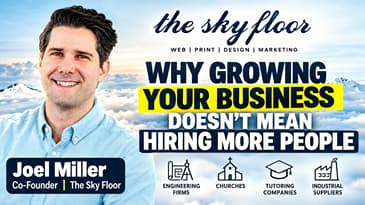
Joel Miller has spent 17 years proving there may be another way.
Joel runs boutique marketing agency The Sky Floor alongside his identical twin brother, Alan. During nearly two decades in business, they have never hired a single employee—and that isn't a weakness in their business model. It's intentional.
While entrepreneurs are frequently encouraged to scale faster, hire more people and continually chase growth, Joel and Alan have built their agency around a different philosophy: stay small on purpose, work with the right clients, create meaningful value and charge based on outcomes rather than hours.
In this episode of Let’s Have This Conversation, Joel Miller joins Kevin McShan for an in-depth discussion about the future of small-business marketing, why some companies struggle to understand their own business model, and why clarity may be one of the most valuable competitive advantages an entrepreneur can possess.
Joel explains why effective marketing isn't simply about producing more content or chasing the latest marketing trend. For organizations ranging from churches and ministries to retail brands and small businesses competing online, sustainable marketing begins with clarity of message, quality of execution and outcomes that matter.
We also explore Joel's philosophy of identifying recurring problems in your target market and finding ways to add greater value. When businesses become exceptionally good at solving the problems their customers actually care about, they can strengthen their positioning, increase the value of their services and potentially move beyond competing primarily on price.
The conversation also examines value-based pricing, boutique agency growth, marketing outsourcing, customer relationships, entrepreneurship, business-model clarity, sustainable growth and how small businesses can differentiate themselves in increasingly crowded markets.
Joel also shares lessons from nearly two decades of working alongside his identical twin brother and explains why sometimes the smartest way to grow a business isn't to become bigger—it's to become clearer about who you serve, what problems you solve and why the outcomes you create matter.
For more information: https://www.theskyfloor.com/
Discover More: https://www.theskyfloor.com/AccidentallySuccessful/
Learn more about your ad choices. Visit megaphone.fm/adchoices
[00:00:00] Despite the uncertain nature of today's economy and how it will perform, entrepreneurs are putting more resources towards their marketing budgets, especially of the small business variety. Constant Contacts survey found that 68% of respondents plan to increase their marketing budgets despite rising costs and uncertainty about the direction of the economy. Another 74% said they plan to invest more time in their messaging to reach larger audiences and break through a potential economic slowdown.
[00:00:30] Furthermore, 52% of small and medium-sized businesses, SMBs, outsource their marketing efforts to an external agency, according to data from a study of US SMBs conducted by V-Sita. But does successful small business marketing require bigger teams, more employees, and constant expansion? Joel Miller has spent 17 years proving there may be another way.
[00:00:57] Joel runs boutique marketing agency, The Sky Floor, alongside his identical twin brother, Alan. During nearly two decades in business, they have never hired a single employee. And that isn't a weakness in their business model. It's intentional. While entrepreneurs are frequently encouraged to scale faster, hire more people, and continually chase growth, Joel and Alan have built their agency around a different philosophy.
[00:01:24] Stay small on purpose. Work with the right clients. Create meaningful value and charge based on outcomes rather than ours. In this episode of Lets Have This Conversation, Joel Miller joins Kevin McShann for an in-depth discussion about the future of small business marketing. Why some companies struggle to understand their own business model. And why clarity may be one of the most valuable competitive advantages an entrepreneur can possess.
[00:01:51] Joel explains why effective marketing isn't simply about producing more content or chasing the latest marketing trend. For organizations ranging from churches and ministries to retail brands and small businesses competing online, sustainable marketing begins with clarity of message, quality of execution, and outcomes that matter. We also explore Joel's philosophy of identifying recurring problems in your target market and finding ways to add greater value.
[00:02:19] When businesses become exceptionally good at solving the problems their customers actually care about, they can strengthen their positioning, increase the value of their services, and potentially move beyond competing primarily on price. The conversation also examines value-based pricing, boutique agency growth, marketing outsourcing, customer relationships, entrepreneurship, business model clarity, sustainable growth, and how small businesses can differentiate themselves in increasingly crowded markets.
[00:02:49] Joel also shares lessons from nearly two decades of working alongside his identical twin brother and explains why sometimes the smartest way to grow a business isn't to become bigger. It's to become clearer about who you serve, what problems you solve, and why the outcomes you create matter. Joel, I'm Kevin McShann, what's this conversation?
[00:03:11] Well if you're ready I'll take a moment to welcome you to the program and I'm super excited to a lot about your journey in marketing my friend.
[00:03:50] It's great to see you and happy Wednesday morning to you. Happy Wednesday to you too, thanks for having me. So Joel, I know that we have something in common my friend, we both have an identical twin brother. That's right.
[00:04:06] And you and your brother Alan have started a marketing company that's lasted 17 years my friend, and you said that we don't always need to build up great large teams in order to be successful. So I wonder if you can tell me about your zone of genius my friend, and what makes you so fabulous?
[00:04:33] Yes, I mean we definitely don't need large teams to have a successful business, especially depending on what you define success as. So for Alan and I, for my identical twin and I, we decided that we didn't think that success was having to be in the people management business. We wanted to be in the client helping business. And so we focused on that and solving our clients problems, and we've grown by utilizing different tools and efficiencies, but keeping it just the two of us.
[00:05:03] Yeah, absolutely. And tell me, what advantages do you think working with your brother has brought you in business, my friend? Well, it's been a great advantage. Unfortunately, I can't offer this one to a listener because I don't think you can create an identical twin, at least as of yet in the world. But we have similar perspectives. We can't mind read, right? Maybe this is the same thing for you and your twin.
[00:05:31] But we've spent so much time together, we understand how the other one thinks enough that we are able to be productive in sort of a unique way together as a team, and yet offer enough perspective in sort of the safety of knowing each other for 42 years, that we can sharpen the work and the output for our clients in a way that I think maybe other partners can. Yeah.
[00:05:58] Yeah, and Joe, I'm curious to ask you about your perspective about, you know, leadership and team building and working with a dynamic group of people and really understanding their pain points and why bringing marketing to their small business needs really brings them a sense of identity. I'm curious to get your answer there, my friend. Yes, I think that it's so important.
[00:06:28] Well, it's important for small businesses to recognize in every business, right, that marketing isn't necessarily the ads you run or a set of tasks or even maybe social media or organic things. I think marketing is actually a thread that runs through the entire business. It's how you express the promise you make to your customer or client.
[00:06:50] And then it's even how you follow through with that because you'll have zero marketing impact if you can't identify your unique selling proposition, what makes your business unique, why someone should pick you over anyone else, and then follow through on those things. And so to us, when we work with a client, it's about identifying those items, pushing them to understand and articulate them, and then even pushing them to follow through with it and how they deliver their product or service.
[00:07:18] So that when we put that idea into the world, we know that it's going to be a complete marketing message. Yeah, absolutely. I'm fascinated to get your perspective on how your vision of business development has really changed considering that we have so many digital tools now to advance business forward.
[00:07:42] So I'm wondering, how has your definition of business development changed in the realm of marketing and small business development? What are your thoughts there, my friend? Yeah, business development, I think we used to get the hard part confused. So I think the gate and the barrier to entry for a lot of people seems like the outputs.
[00:08:08] And so people get focused on having the right teams to design things and having the right teams to message things and having all these things. But I think what things like AI and digital tools are doing by making the outputs a lot easier is highlighting what has always been true, which is that the hard part is the human part.
[00:08:29] The hard part is actually defining that difference, that competitive advantage, that thing that makes you unique and your business unique to hire over the next best option. And then building an audience around that. And those things have always been actually the hard part. So now it's just kind of put a flashlight on it, right?
[00:08:50] It's like, okay, if I can make anything in a few really good prompts, which we're not quite there yet, but if I could do that, then I'm still left with the same essential problem. How do I find people to care about this thing? Yeah, absolutely.
[00:09:05] And, you know, Andrew, one of the reasons I was so excited to talk to you this morning is because you say that business success doesn't have to come through chasing viral moments, reporting yourself up against another business. It's all about doing quality work one step at a time and making sure that you're working with the right people.
[00:09:29] So what do you think is the recipe to finding the right business relationship? What are your thoughts there, my friend? Yeah, maybe we should call it the slow viral moment. I don't know if that makes sense. It's a slow cooker, not a microwave. And you have to show up. And I think of Seth Godin immediately in his work and the idea that what you have to offer the world is a gift.
[00:09:55] And kind of rolling back to what I said a minute ago, we have to follow through on the promise that we're making a customer. We have to be empathetic. We have to be human in all of it, which I think is going to be a real competitive advantage as we go forward in an AI-driven world. And when you do those things thoroughly, so you identify how you want to actually interface with the world. You create something unique.
[00:10:21] So for us, it's like we say that we use digital tools to help solve our client's problems and get them to their next best goal. And so that can be pretty fuzzy, right? But that's because we do it custom for each client and we don't have a specific vertical that we are serving. But when we do that and follow through and fundamentally listen to the client and what their problems are and needs are and are curious and interested in those things,
[00:10:50] and then are able to follow through on them, they tell other people that the work speaks for itself and more people come in. So we don't have to be on social media posting three times a day trying to get that one hit in the microwave. We're actually slow cooking our success. Yeah, absolutely. Joe, so I am going to tell you a little story. So I am a professional speaker by trade in addition to hosting this podcast.
[00:11:18] And my speaking coach always tells me that we can't always solve everyone's problems at once as a speaker or a business person. So I'm wondering, how do you help your clients achieve business clarity and really get their business proposition communicated to the audiences they want to serve? My friend, what are your thoughts there?
[00:11:44] I think it's in order to get drilled down to the business clarity they need. It is asking critical questions. I mean, I think the simplest one, if you're listening to this and you're thinking, how do I find business clarity? Ask why about everything. Figure out why you are making the choices you're making. I think a lot of people do things because they think they're supposed to.
[00:12:10] So if you can't actually tie the choices you're making, the decisions you're making, the moves you're making, the money you're spending a lot of times in investing back to the actual benefit, the way that it follows through on your business promise, cut it out. Cut it away down to the thing that is your next step. Focus on one big thing at a time instead of just everything because we can't do everything. You're absolutely right.
[00:12:40] We have to be able to focus on something specific and tangible. And so what we do with our clients is often just a listening exercise. I sometimes joke that we get off of a call and I'm like, well, that was another episode of Joel Miller Business Therapy. Because we ask open questions, listen, and then a lot of times we end up uncovering something the client didn't even know they needed.
[00:13:06] But it is the next step towards their goal. And then we focus on that with them. And that oftentimes leads to their success. Yeah, absolutely. And, you know, I know that you serve as service-based businesses and you help them sort of get out of the referral-dependent revenue model. They may be excellent at, but, you know, what they do, but they don't know how to communicate their message.
[00:13:36] So, building on our previous discussion this morning, I'm wondering, how do you help clients get out of the referral-driven sort of business model and really drill down on their zone of what they really believe that they can bring business value to, my friend? What are your thoughts, things?
[00:13:58] Yeah, I think the sort of maybe shift in thinking there is not to be referral-dependent by default or on accident, but to be referral-dependent by design. So, I'm not saying necessarily that we should be anti-referral because it's how I get a lot of my business too. And it can be a very powerful mechanism. But I'm in the idea, I have this notion of people being accidentally successful.
[00:14:27] They don't know why they've been a success. They just have had it kind of come to them. And when you're in that mode, anything, any wind of the economy or business climate can come and kind of blow you over. And so, to tie that back to being referral-dependent, if you're doing it by design, then you can make intentional moves. So, what does that mean?
[00:14:54] Maybe that means that you have a feedback loop at the end of your process in what you sell that asks for referrals to other people. And you're not just sitting around waiting for people to hopefully talk about you. And then if they don't, all of a sudden you have a famine cycle. So, again, it's not about being anti-referral. It's about being intentional about the actual business model that is your success. Yeah, absolutely.
[00:15:20] And, you know, you also said that every sale and a race to increase the bottom line may not always take precedence on coming up or finding the best fit, my friend. So, tell me about the difference between racing to increase the bottom line versus finding the best fit to work with a business, my friend.
[00:15:48] Because there is a fine line between the two. Is it there? Oh, definitely. I mean, there's a bunch of different things that happen with pricing. Obviously, I think we need to get out of a cycle where there might be a race to the bottom and not increasing your bottom line, but you're competing on price alone. And if price is your only competitive advantage, that can be a business model. That's not necessarily a bad thing.
[00:16:12] But you have to ask yourself, do I want to be the Walmart of a business or do I want to be maybe, I don't know, a big, maybe Nordstrom is a fancy department store, something that's high service, high touch, but the prices are higher. I mean, for me personally, I think it's a lot easier to offer high value relationships to our clients instead of trying to sell a lot.
[00:16:34] Because the more I sell in quantity, even though I can increase my bottom line, the more fractured the work we do is going to be. And probably it's not going to be as good either. And so because our business focuses on partnership, we charge a fair amount for that. And it's going to be more expensive.
[00:16:53] You can go on Upwork and get someone to make you a website or to help optimize your contact flow to your CRM or any of these kind of tasks you can get cheaper, but they will not strategically partner with you and help you actually uncover your unique selling advantage. And then bring that to the marketplace and deliver on that promise.
[00:17:17] And so I think really any business has to look at, you don't have to be a luxury business. You don't have to be a strategy business in order to find ways you can offer more value and therefore price higher in competition with your competitors and get out of that price cycle.
[00:18:04] Yeah, absolutely. I think entrepreneurs that have sort of a skin in the game have to be reminded. So I'm wondering your perspective there, my friend. My thoughts are that we need to actually redefine work-life balance a little bit. I think even saying that balancing them kind of makes them opposed to each other. And besides sleep, we're going to spend, I think, some of the most time in our lives working.
[00:18:29] There's sleep, work, and then we usually have probably the least amount of time for some of the things that we want to do or even family life. Now that doesn't mean that's a good thing, but it means that you better at least arrange your work life in a way that you are excited about, something that you're passionate about, something that you feel like you're making the world a better place. And I think it's possible to do that in lots of different jobs. But you have to have that perspective.
[00:18:57] And then beyond that, so then zooming out because we don't want to just live to work, what other things ahead of it? You're not going to be a healthy worker or actually make a quality business if you have no personal interests, if you don't have time with your family.
[00:19:20] And so I think as a personal example, after the first 10 years or so of doing this, it's almost been 18 now, I turned off notifications on my phone after hours. So after five o'clock, I don't get email notifications on the weekends. I don't get email notifications. Now, if someone has a true emergency, they can reach me via text and they know that.
[00:19:44] But I refuse to be constantly distracted as well by things popping up into my life that are just taking attention away, even from other clients. So I think you just have to be intentional about how you build your life around your work and in your work. Yeah, absolutely.
[00:20:03] Joel, I'm not asking you to get political, but I am asking this question because it's timely and sort of contributes to the future of business. As you know, the midterm elections are coming up and, you know, the cost of living has certainly been a hot button issue around. I know that you live in Michigan, but around the state.
[00:20:33] So I'm curious, as an entrepreneur and a small business owner, how has the current state of the economy and the political, you know, are really affected the way Americans do business from a small business and marketing perspective? I'm curious to get your answer there, my friend.
[00:20:57] Yeah, I think that there's a, it can be a topic that generates a lot of fear in people. And I think as I've, I tend to be sort of a third party voter, so I'll reveal that. But I, so I don't necessarily like get as sucked in sometimes to the doom and gloom, because there's things I don't like about both the major parties.
[00:21:26] And so, and so when I, when I think about it, if I were to encourage a listener, it's, it's that there's, there's kinds of ups and downs in politics, but we can vote. And certainly that has an impact and don't lose that, the fire to try to have an impact through your vote and your voice. However, that you, you have the most influence in your day-to-day life.
[00:21:54] And so the things that you want to see changed, you probably have a chance to do some of those in your family, in your, with your friends, in your work. And so like, that's how I approach it. And so I'm not necessarily in any of the last few residencies, for example, or whoever has power in Congress,
[00:22:17] I'm always trying to say, how can I build the sphere in the world around me that I think the world should look like? And I do those things and get a little less, I try to sleep at night, soundly knowing I'm doing my part. I still go out and vote. And then obviously there can be some fear out there with clients who, but I've noticed in why I'm bringing this up as far as like your own influences,
[00:22:43] I've noticed that people lose track of their own influence because they're so worried about this bigger thing out, maybe in Washington, Washington, DC. And so they'll get really worked up sometimes. Business is the worst, depending on if you're a Republican or a Democrat, depending on who's in the White House. And I don't know, I'm not saying it's important, it's important. But maybe you should focus more on the things you can control in the day to day,
[00:23:10] and then still use your voice in a political way when it comes to your vote, and even who you support and get out and do active things with. Yeah, absolutely. And, you know, I'm curious to drill down on the current economic conditions that exist today because, you know, small business ownership is the fastest way that most people in America
[00:23:36] achieve, you know, their own version of professional and personal prosperity these days. But I'm curious to ask you about what economic questions should people ask themselves before entering the world of entrepreneurship? What are your thoughts there, my friend? Well, I mean, I think there's a couple of things you should ask yourself at the kind of smallest level.
[00:24:06] If you want to be an entrepreneur, you want to start something, and maybe you're working somewhere else, figure out what your bare minimum to survive on that work is. And by all means, have the side hustle, but have something in mind that you know is your cutoff, where you can commit to it more full-time, because it's going to be exhausting at the very least, and maybe almost impossible to long-term run your side hustle with a full-time job, for example.
[00:24:31] And then I think beyond that, we still have – I think there's a lot of opportunity still. I'm actually mentoring someone right now in Michigan. She's in Michigan. She's a college student who's about to graduate next year. And I'm walking her through registering her business as an LLC to start with, and getting her website up, and how she talks to clients.
[00:24:57] And it's still – I mean, I wouldn't call it easy, right? Because it's a lot of work and a lot of choices and a lot of things to enter into. That being said, the opportunity is there. Like, I could walk anyone through starting a business in a week. Now, it doesn't mean you're going to be successful in a week. But I think we're still – it's still pretty amazing that in 2026,
[00:25:25] the conditions exist where you can start something up and start selling. Here is a client meeting this week that is probably going to result in business. And that's beautiful. That's amazing. She's taking steps towards controlling her own future and offering something to the world that is valuable. So I don't know. I guess I would say, like, take the step because it's still possible today. The American dream, if we want to call it that, is totally available still. Yeah, absolutely.
[00:25:53] You know, I always say that we make time for the things that we prioritize, right? Yes. Yeah, exactly. Absolutely. Joe, I'm also curious to ask you about your perspective on creating authentic, organic growth versus hoping that something sticks if you want it to grow organically.
[00:26:21] So tell me your thoughts on, you know, effective organic growth strategy versus hoping, like creating something and hoping it sticks. What's the difference between the two, my friend, from your perspective? Yeah. Well, hoping isn't a strategy. Spending, just spending money as well isn't either. I think a lot of people think that the alternative to just hoping it works is just paying for ads.
[00:26:51] And it can be. But again, I got to go back to this idea of knowing your business model. You have to know the assumptions you're making and the theories you're testing and your hypothesis so that you can make future choices based on how well it's working or not and actually build something that's repeatable. And I tell this story all the time, but we once had these, there's a client who was a bestselling author of a children's or parenting book rather.
[00:27:21] And he used to go on tons of TV appearances and then stopped doing the TV appearances. Sales dropped and they brought us in to try to save the business. And believe it or not, it took multiple rounds of questions and meetings to figure out that they used to use TV appearances as their main engine for sales and growth. And they hadn't yet connected the dots. They thought that they could just hope online leads would take over. Online sales would take over.
[00:27:49] But all of a sudden, they're not in front of as many people. And so to them, they kind of made a cardinal error, which is that they started reducing marketing spending, marketing spending, immediately as things were going down because they were worried they needed to cut money somewhere, they thought. And so this ties into another idea that I have of using the investment principle of dollar cost averaging, which is where you buy shares of a, let's just call it the S&P 500. Here's some investing advice. No, it's not.
[00:28:19] Don't take investing advice from me. But you buy shares of the S&P 500 on, let's say, a monthly basis. And you buy the same amount every month, no matter what the price is doing. Your average price becomes something that's more stable long-term than trying to buy on highs and lows. And so I say you should do the same thing with your marketing spend. And have an amount of money that you're willing to put into it. Now, I'm not just saying buy ads. You have to figure out, find someone who can do the strategy with you.
[00:28:50] But commit to that. No matter if things are going up and down in the economy as a whole or your business as a whole, what you'll find is that when other people start drawing back marketing spend, there's actually opportunities for you. So if you commit, regardless of the emotional part of it, to a consistent spend or investment into that, you're going to actually carve out a little opportunity for yourself.
[00:29:15] And you won't just be hoping because you already know how it works because you came up with a strategy, you're measuring it, and you're staying consistent. Yeah, absolutely. And Joel, I also wanted to ask you about your take on AI and automation tools and their effects on small business marketing and small business in general.
[00:29:37] So do you think the technologies and the way that we use AI tools will make it easier, harder, or more confusing for people to start businesses? What's your perspective on AI's sort of influence on small business and small business marketing, my friend? AI is going to make it easier in some ways.
[00:30:04] And yet, as we kind of discussed a little bit already, it highlights that the hard part is still the hard part. And it's really the hardest thing you can do, which is actually messaging yourself and then finding people who care about it enough that they'll make a buying decision. And so I think that AI is really a multiplier. It amplifies your capabilities that you already have. You can learn new things from it for sure or learn new things and use it to amplify them.
[00:30:32] But it's not going to fundamentally make a business overnight. The average person that is going to just start churning in money because you still have to find... You can make five websites, five AI apps, five things that are pretty darn good these days and not that much time. You still got to find people who care about it and want to buy it because of that. And so it's a great tool. It can speed up the work you already do. It can speed up what you already offer.
[00:30:59] You still have to be the human filter, but it absolutely is not going to automatically make the hard part easy. Yeah, absolutely. And, you know, I wanted to ask you about your perspective on podcasting and small business growth. Because, you know, when we look at either having a book or a podcast, it seems like every small business owner is either diving into either of those two verticals.
[00:31:29] But I wanted to ask you specifically about podcasting and how it's become an increasingly powerful way or tool for entrepreneurs and business leaders to build authority, relationships, and exposure, my friend. So how do you think someone that works in business can use strategically podcasting as a competitive business tool? What are your thoughts there, my friend?
[00:31:57] But podcasting actually fundamentally solves one of the issues that I'm talking about, which is how you get people to care and follow you. It turns out to be one of the ways that people can hear your message in a way that... The idea is the parasocial relationship, right? It builds a connection to you that is almost impossible to have in other ways. Because if they can't see you or hear you, even if they're just reading words on your website,
[00:32:27] it just doesn't land the same way. And I have a great example of this. We have recently been helping a client with their podcast that they're hosting in. And it's our touring company client. And they had a parent reach out recently and say, you're famous to the owner and marketing director who are on the podcast. And he says, why? What do you mean? The podcast. I love it. I love listening to it. It's so good.
[00:32:56] And I'm sharing it. And automatically, it doesn't have tons of traction if you were to just look at raw numbers. And yet, it's already serving this purpose to personalize the brand to parents. And I guarantee you that as that is shared, it's going to become new business because it's building trust. In a way, that website on its own, just a bunch of text cannot do because it's not an innately personal thing.
[00:33:25] Yeah, absolutely. And, you know, Joel, as you know, getting to know my personal story. So I was born with cerebral palsy. And I was told at the age of nine, my friend, that I would not be able to walk because of the severity of my disability without assistance. And I now talk to entrepreneurs and organizations about the importance of hiring people with disabilities.
[00:33:54] So I'm curious, from an entrepreneurial or organizational perspective, what do you think is the value of diversity and inclusion? And how do you think people with disabilities can help business owners become natural problem solvers? What are your thoughts there, my friend? Well, I think that, and this is coming up more and more, and it should,
[00:34:22] that anytime you can serve a client base that isn't typically represented in the past, that becomes a competitive advantage for you. They don't want people to only do things because it might sell them more business. And yet, if I'm going to advise a client if they want to make their website, for example, accessible, I'm going to say you should do it regardless of if the laws apply.
[00:34:51] Because there's going to be, there's an opportunity to set yourself apart and to serve people through your business. That actually, and because we're talking about business, I'm going to tell them, hey, this is going to help your bottom line. And so again, I don't want to just say that's the only reason to do something, but since we are talking about business, I think it's worth noting that helping people almost always is a competitive advantage.
[00:35:21] Yeah, absolutely. You know, I also wanted to unpack the difference between value-based pricing and how you move from traffic clients based on the hours you work and the delivery rules you provide to moving to pricing based on value and the problem that you're solving, my friend. What do you think is the difference?
[00:35:50] And how do you know when it's the right time to move from charging by the hours versus charging by the value that you provide? Because I know that's part of your brother and your business strategy. So I'm curious to get your answer there, my friend. Yes, I would say that the right time is probably always now. If you're doing what you do, very few things actually, in my view, rely on an hourly rate.
[00:36:20] There are some, but, and certainly, obviously, if you are working as a subordinate employee at, you name it, a fast food place, let's just say, at McDonald's, you're going to be charging by the hour. You're not charging anything. It's not a business. You're just an employee there. But if you're running your own business, the sooner you can charge based on the value, the better. Now, what does that mean? Maybe you're listening to this and you think, oh, I mean, I guess that sounds good,
[00:36:49] but hourly is how it's done. What does value pricing even mean? It means that you know the economic benefit, mostly economic, it could be a lot of things, that you're providing to that client. And so, and if you can't identify that, it's going to be impossible to charge based on your value and the outcome that you're providing. So, just a hard example of this is don't be afraid to get into the business nuts and bolts of the thing,
[00:37:18] the problem you're solving, and then even ask the potential client or your client, what is that going to be worth to you in three years if this works? And sometimes that comes down to a math thing. You know, let's say that the tuition for a school is $10,000 a student. If you bring in 10 families, that's $100,000 from your work. So, now if maybe you charge $15,000 for the thing that takes you three hours to do, I don't know, you know, it's a random example,
[00:37:48] but that $15,000 may well be worth it if the business thinks that you're uniquely positioned to deliver that. Now, at that point, they're not going to care how long it took you to do. They want the outcome. They want that extra revenue. And so, it really is like figuring out positioning yourself before you price yourself, and then basing it on what the client gets from it and making it profitable then for them.
[00:38:17] And almost always, it's going to be more profitable to you than just saying you get five hours at this rate. Yeah, absolutely. And Joe, I know that you make an important distinction between a marketing project versus a marketing partnership. And I know that you talked a little bit about that earlier, but I'm wondering if we can drill down between the difference,
[00:38:41] because that's an important lesson that entrepreneurs should learn. Would you agree with that, my friend? Yes, and that is because a project ends when the deliverable ships, and a partnership ends when the results stop. So, you can have a long-term client relationship partnership when you're constantly providing more and more value.
[00:39:08] And so, like, the example I like to think of for this is a doctor's office, right? You don't... They're absolutely the expert in the room. You don't walk in and they're like, here's the surgeries and medicines you can have, and then they step back and you just pick the things that you think will work for you. That actually is a failure of their professional responsibility. And if you're in any kind of service business where you can offer an outcome that is valuable to the client,
[00:39:37] you should very well be the expert in the room who tells them, prescribes what they need to succeed. And when you do that consistently, you'll have to fight them off to not be in a partnership or a long-term business relationship because they will continue to want what you're offering. Yeah, absolutely. You know, Joel, before I ask you my last question, I'm curious to get your thoughts on the future of business,
[00:40:06] where you think it's going from a small business perspective, and the questions you think government should answer when it comes to sort of crafting how they're going to help small businesses advance in the future. What are your thoughts there, my friend? Well, I think that if we...
[00:40:31] That the government should make it still as simple as possible in economic terms to start and run a business. And I don't dive into tax policy or anything like that, but I will say that if there's a lot of push for more and more social programs to help people who can't help themselves. And again, staying out of like the, should we do that or should we not?
[00:40:58] I think an important thing to look at is when you look at Europe and the countries that people love to point to as having really good social programs, they actually oftentimes on the Freedom Index are freer economically than the US even is at this point. And so if I'm going to answer that question honestly, based on my perspective, I would say that getting more out of the way, freeing up the environment even more so that people can produce value,
[00:41:27] that it's easy for them to comply with tax law and simple to pay their taxes to contribute to the system is actually better overall for the society as a whole and actually will result in a stronger government position that allows some of those goals people have to be met. So yeah, if I would pick something, I would just say keep economics as free as possible.
[00:41:53] Don't be an adversary to the business because that's going to be the engine of growth in both socially, economically, and even from how the government helps people. Yeah, absolutely. Joe, my final question is a two-part question. I'm curious to ask you about your definition of entrepreneurial prosperity and how that definition has evolved.
[00:42:19] But I'm also wondering, after nearly 18 years in business, working alongside your great brother and serving long-term clients and developing your own philosophy on how sustainable business works, how do you want your personal and professional legacy to be defined, my friend? What are your thoughts, then? Well, I would say that I want my professional and personal legacy
[00:42:47] to be founded on this simple idea that I believe is true, that people are eternal and deals are temporary, or people are profits, I say shortly. So what does that mean? To me, I think that if I'm ever losing sight and just doing something purely for the bottom line and burning bridges to get that done, I'm failing. I don't think that's a good long-term strategy. I actually think it's going to hurt my business too. But besides that, at the end of the day, that's just money.
[00:43:17] And if I'm missing connections even with my clients, if I'm working 80-hour weeks so my kids don't know who I am and I'm a stranger to my wife, to me, that's failure ultimately. So I want to teach my kids to approach the world the same way with that same spirit and attitude. And I think the clients who stay with us a decade because of that relational perspective,
[00:43:45] working alongside my twin brother in relative peace and harmony, those things outlast any revenue number, and that's what I want my legacy to be. Yeah, absolutely. And Joe, if I want to tell me, if people want to get connected with you personally or the business, my friend, what's the best way they can do that? They can head to theskyfloor.com. And actually, if you want to go to theskyfloor.com slash accidentally successful, I have a little, it's not a quiz, but it's a little help tool to figure out
[00:44:12] if you've been an accidentally successful founder or business owner and then what you can do to get out of that cycle. Well, absolutely, my friend. And I want to thank you for bringing attention to the importance of small business, the importance of also knowing where your value proposition stands as entrepreneurs and for joining me in a conversation
[00:44:42] and whenever I can talk to another twin, my friend. It's always the victory in my book. So I want to thank you for being here this morning and thank you for engaging in conversation with me. It's most appreciated. You're welcome. Thank you so much for having me.