
78% of American workers said it was important to work for a company that values diversity, equity, and inclusion, according to the April 2021 CNBC/SurveyMonkey Workforce Happiness Survey. What does it take to turn those employee expectations into a workplace where people feel valued—and leadership delivers?
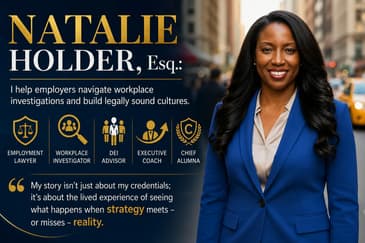
On this episode of Let’s Have This Conversation, Kevin McShan welcomes Natalie Holder, Esq., SPHR, an employment attorney, award-winning speaker, author, executive coach, and senior People and Culture leader. Drawing on experience across academia, technology, law enforcement, and highly regulated industries—including roles with Stanford University and the United States Capitol Police—Natalie brings a practical perspective on inclusive leadership, organizational culture, and HR compliance.
Natalie approaches diversity, equity, and inclusion as a leadership and accountability discipline embedded in everyday decisions. Her work connects organizational trust, legal risk, and employee performance, helping leaders build systems designed to withstand regulatory scrutiny, leadership transitions, and external pressure.
Her career results include increasing applicant flow by 82%, increasing hiring of underrepresented talent in technology by 23%, and increasing hiring of women in a law enforcement agency by 15%. She has also delivered court-ordered compliance training and built succession planning, employee relations, and performance management frameworks across industries.
In this conversation, we explore:
-
• How inclusive leadership translates into everyday workplace practices.
- • Why accountability matters when building employee trust
-
. • How organizations can connect HR compliance with a stronger workplace culture.
-
• What it takes to attract talent and develop future leaders. • How executive coaching helps turn professional potential into meaningful impact.
If you’re an executive, HR professional, people manager, or emerging leader, this episode offers a fresh perspective on building an organization where people and performance can thrive.
What’s one action leaders can take to make employees feel valued? Share your perspective in the comments, and subscribe to Let’s Have This Conversation for more conversations on leadership, inclusion, and positive change.
For more information: https://natalieholderspeaks.com/NatalieHolderSpeaks
Learn more about your ad choices. Visit megaphone.fm/adchoices
[00:00:01] Meine Zehen bringen mich um. Diese Schuhe sind viel zu eng. Trägst du immer noch diese spitzen Dinger? Ich meine, sind nicht alle Laufschuhe so geformt? Nein, du brauchst Altras. Altra? Altras sind geformt wie deine Füße mit einer fußförmigen Zehenbox. Einfach viel bequemer. Bezwinge deinen Lauf mit Hallenzehen. Okay, das klingt traumhaft. Mehr Komfort, Kraft und Dynamik. Alles durch die Passform. Altra versteht das einfach. Altra, stay out there.
[00:00:30] 78% of American workers said it's important to work for a company that values diversity, equity and inclusion, according to the 2021 CNBC Survey Monkey Workforce. Workplace Happiness Survey.
[00:00:50] The question today is how and what does it take to turn these employee expectations into a workplace that people want to work, where they feel valued, heard, and their leadership team ultimately delivers. On this episode of Let's Have This Conversation, I sit down with my friend, Nathalie Blais.
[00:01:18] She is an employment lawyer, award-winning speaker, an author, executive coach, and senior people and culture leader. Drawing on experiences across academia, technology, law enforcement, and highly regulated industries, including roles with Stanford University and the U.S. Capitol Police.
[00:01:48] Natalie brings a practical and straightforward perspective and approach to inclusive leadership, organizational culture, and HR compliance. Natalie approaches diversity, equity, and inclusion as a leadership discipline embedded in everyday decisions.
[00:02:15] Her work connects organizational trust, legal risk, and employee performance, helping leaders to build systems designed to withstand regulatory scrutiny, leadership, transitions, and external pressures.
[00:02:38] Her results of her career include increasing applicant flow by as much as 82%, increasing the hiring of underrepresented talent in technology by as much as 23%, and increasing the hiring of women in a law enforcement agency by as much as 15%.
[00:03:04] She's also delivered court-ordered compliance training and built succession planning, employee relations, and performance management frameworks across industries. In this conversation, we tackle how inclusive leadership translates to everyday work practices.
[00:03:32] Why accountability matters when building employees. Why accountability matters when building employee trust. How organizations can connect stronger HR compliance into a thriving organizational and workplace culture. What it really takes to attract talent and develop future leaders.
[00:03:55] And finally, how executive coaching can help turn professional potential into meaningful impact. And Holder, join me this week to tell me more. I'm Kevin McShann. Let's have this conversation. Kevin McShann.
[00:04:16] If you're ready, I'll take a moment to welcome you to the program.
[00:04:49] And I'm excited to talk to you about employment law and diversity, equity, and inclusion. It's great to see you, and happy Saturday to you, my friend. Happy Saturday, Kevin. Absolutely. So, definitely. I know that you're an employment lawyer and you're focused on helping people really know what when it comes to equal rights for employment as part of your Valley Wake, my friend.
[00:05:19] So, will you look at the whole concept of equal employment under the law? How do you think that concept has evolved over the years, my friend? So, there are two types of attorneys. Attorneys who represent, actually three types. There are attorneys who represent the government. There are attorneys that represent plaintiffs, meaning the employees. And there are attorneys who represent the company, the management side. And I've sat in all three chairs.
[00:05:50] I started my career with the New York City Commission on Human Rights. I worked for an employment law firm that represented only employees. And I've also served as in-house counsel. And I will tell you that, you know, our equal employment opportunity laws in the United States are the foundation upon which many of our workplace initiatives really do thrive from. They're often the place and the source for where code of conduct, you know, rules and practices are created.
[00:06:18] And so, as we've looked at the evolution of EEO, there are different protected classes that have definitely started to become recognized in a different way. So, for instance, I'd say back in the 1960s, when you thought of race, gender, national origin, religion, you weren't really so much thinking about gender in terms of protections for people, you know, from the LGBTQ plus community.
[00:06:45] You weren't so much, you know, thinking about interpretations of, and actually even back then, you didn't have the Americans with Disabilities Act. And so, I would say that, you know, every decade there has been some new progression in terms of which groups and how the groups are being brought under the umbrella of equal employment opportunity.
[00:07:06] In the 1990s, we saw the creation of the Americans with Disabilities Act, which ensured that people who have disabilities are able to be accommodated in the workplace if they are qualified for a position and a role. During the 2000s, you saw the evolution of how gender was now expanded to look at in making sure that people from the LGBTQ plus community were included in terms of their employment rights.
[00:07:33] And so, that's really how I've seen the evolution of equal employment take place in our workplaces. Absolutely. And just to follow up to that, under the, you know, the current political standing when it comes to diversity, equity and inclusion from the executive branch of the presidency in the United States,
[00:07:59] I'm curious to ask you whether from a legal perspective and a human rights perspective, what do you think we've taken a step back when it comes to the lives that people with disabilities have when it comes to employment and otherwise under this current political climate? What are your thoughts there, my friend?
[00:08:24] We saw that there was going to be a massive change and shift in how diversity, equity, inclusion, which we shorthand call DEI. We saw how these initiatives were going to be tapered and, you know, interrupted, for lack of a better term. We saw it coming well before November 2024. Prior to November 2024, there were bills put forward in Congress seeking to dismantle DEI.
[00:08:52] Throughout the United States, there were various states that were able to move forward with dismantling DEI on a state level. So now we're looking at it on a federal level in terms of how executive orders are impacting the ways in which organizations feel as though they can implement diversity, equity, inclusion. You know, I'll share with you, Kevin, you know, a thought, an idea that might not be very popular with people.
[00:09:17] But I will say that organizations that were engaged in legal diversity, equity, inclusion, which to me is nothing more than just making sure that you're following our employment laws. For instance, in the United States, it's Title VII, the Americans with Disabilities Act, the Age Discrimination and Employment Act. It's those employment acts and those employment laws that really, once again, are the foundation for many of the initiatives that became diversity, equity, inclusion initiatives.
[00:09:47] And I will say that I saw some very shoddy work taking place in the course of the last six years. You know, I remember I was a part of a membership organization and where people paid to be members of this association. And the organization felt as though, well, we want to have a diversity reception.
[00:10:08] And the criterion, and I repeat, the criterion for being a participant and an attendee at this diversity reception was that you had to be a quote unquote minority. And I sat there as an employment lawyer saying, this is not something that we should be advocating for.
[00:10:27] If we're talking about making sure that we have a diversity reception that ensures that people who care about and are willing to be allies and are, you know, invested in diversity, that should be the criteria for attending this meeting as opposed to creating, you know, an otherism. Basically saying anyone who's not a quote unquote minority cannot attend.
[00:10:50] And so at that point, you're now excluding a group of people that otherwise might have been allies to the organization's diversity mission. And so it was shoddy work like that that I saw taking place. You know, many of the people who were hired into diversity, equity, inclusion roles weren't really qualified to develop organizational development slash employment law programs in their organizations.
[00:11:17] So I'll say, Kevin, those are the ones that really were easy targets of this administration because it was really easy for this administration to see where there was favoritism, where there were violations of our employment laws and really being able to strip away that which was unlawful. However, the really good ones that really stood the test of time. They haven't been dismantled. They haven't been troubled at all.
[00:11:43] Why? Because they were really rooted in a business initiative that sought to create more and equitable access for all people. Not just simply, once again, looking at different pockets of a population, but instead saying, you know, how do we open the aperture of this organization to make sure that everyone has an equal opportunity to join our organization, to stay in our organization, and to advance in our organization.
[00:12:07] Now, there definitely have been targeted approaches to making sure that, quote unquote, there are priorities for this administration, i.e. the, you know, the chair of the Equal Employment Opportunity Commission, which really does have the regulatory ability to go after companies by way of investigations and even filing lawsuits where there have been violations of employment laws.
[00:12:34] The chair created what I call, for lack of a better term, commercial asking, and I mean, really, you know, beseeching white men to come forward with any, quote unquote, reverse discrimination claims.
[00:12:48] And so, even though that has been shown to be a priority for this administration, the reality is that this administration still has a requirement and a duty, a legal requirement to make sure that they are going after any organization that is denying people equal terms and conditions of employment based on any of their protected classes.
[00:13:12] So, we're still seeing, you know, very strong and very successful DEI programs that may have had to, you know, rename themselves, rebrand themselves, and refocus themselves in order to maintain their funding and their viability in the organizations. But I'll tell you, as someone who works with, you know, many organizations that still have their DEI programs, they are still thriving.
[00:13:39] Why? Because they were focused on ensuring that there was some sort of benefit to the organization by way of creating access and equity for all. Well, I always say, Natalie, that we make time for the things that we prioritize, don't we? Oh, all the time. And, you know, like I said, with this administration, it's very clear where their priorities are. But even with their stated priorities, they still cannot kill.
[00:14:09] They still cannot dismantle. They still cannot get rid of something that is core to, you know, most Americans, which is the whole idea of equality and fairness. Yeah, absolutely. And I want to talk to you now about workplace trauma and job insecurity, because I know that you help professionals sort of navigate through that. And that they're repeatedly passed over.
[00:14:38] So talk to me about creating an equitable path forward for those that are experiencing challenges or trauma at work. What are the keys to overcoming that and coming out the other side, my friend? Absolutely. So there were two places where I was privy to this.
[00:15:00] So I would see employees who were encountering being the candidate who wasn't chosen for a job, the person who was hired into a role in where they were not given a fair and equal chance to thrive in the organization. People who were performance managed when they engaged in behaviors and had the same conduct as other people in their organizations who were not performance managed.
[00:15:27] And people who felt as though they were terminated wrongfully or people who felt as though they were denied equal access to fairness in their organizations. And so as an employment lawyer who was representing plaintiffs, this really was where I saw it most in where people came to me as an employment lawyer.
[00:15:49] Once they feared that they were going to lose their job, they couldn't get the job or they had lost their jobs. And so, as you can imagine, your employment is tied to so much of what you can and are able to do in this life. Your employment is linked to whether or not you have health insurance most times. Your employment is linked to how and where you decide to live.
[00:16:14] It is linked to where you're able to send your children to school because, once again, where you're able to live. So employment really does hit to the heart of where many of us find our identities. I mean, think of it, Kevin. The last time you were at a cocktail party, what was one of the first five questions people asked you? What do you do for work? Right. Right. And you probably answered. Where did you answer? I host a podcast and I talk to people.
[00:16:44] So, you see, it's a part of your identity. It's a part of what we expect people to lead with. And so, when that is taken away from us, imagine you are now erasing someone's sense of who they are. You are now impacting their self-esteem, their sense of self-worth, and the beliefs that they even have in their own capabilities.
[00:17:06] And so, as an employment lawyer, my job really was to represent people in that space to make sure that they could be made whole if there was something that was unjust that was happening to them. That work, I'll admit, inspired me to actually look into coaching.
[00:17:51] Or I was able to work out some sort of financial agreement for them. But there was still that sense of loss that they had encountered. And even the experience really did kick them in a place where they really didn't feel like they could get up. And so, as the coach, it is my ability now to be able to tap into that person's sense of, okay, so this happened to you. How are we going to move forward from this?
[00:18:18] How do we get unstuck from this place of that which you didn't expect? How do we move from this place of this was not the career and this was not the professional trajectory that you expected? All right, so now how do we move on past this? And so, it's really important for people to understand, like, what was the signal that they may have missed? Or a signal that they may have wanted to overlook about how and where their workplace was no longer working for them?
[00:18:46] You know, sometimes people were working in environments in where they knew that they had outgrown the roles or they had outgrown the organization that they were in. They continued working past feeling as though they no longer felt passionate about the work that they were doing for whatever reason it might have been. And so, that's something I really ask people to tap into. What was the signal that let you know that this was no longer the workplace for you?
[00:19:13] Because that is the signal that helps you going forward to understand what is your system or what is your process for now creating a path for making sure that this doesn't happen to you the same way again. Now, I'm not going to say that, you know, you're going to go into another situation, another workplace, and that you're not going to encounter unfairness. You're not going to encounter someone who's performance managing you or someone who's going to fire you.
[00:19:40] However, people who go into the next workplace environment usually try to do things a little bit more differently if they've been paying attention to the signal. There are signals during the interview as to whether or not this is going to be a place that really does support you and wants to see you grow. There are signals.
[00:19:59] For instance, if you're interviewing with somebody who you can tell has only spent a minute looking at your resume or hasn't even looked at it at all, that pretty much gives you an indication as to whether or not this is going to be someone who is going to be obsessed with your achievement and obsessed with your advancement. If you're interviewing with someone who seems engaged, if you're interviewing with someone who seems as though they're asking the right questions to really get to know you as a person, that's a good sign.
[00:20:29] That this might be an environment in where you are going to be welcomed and made to feel as though you belong. And that you're not going to be that person who sits at a table and where no one is listening to you. And so that's why it's so important to pay attention to whatever signals there are, letting you know that this environment was not the environment for you. Yeah, absolutely.
[00:20:53] And Natalie, I wanted to ask you about, you know, when a store makes the news and I'm a news guy, so I'm going to use the Fox News and Dominion Voting Systems case as it can. So what is the story that makes the news?
[00:21:14] You often said that we often report on the breaking points, but we don't see sort of the in-between or the back and forth or behind the scenes. So what do you think people need to know when a big story makes the news?
[00:21:32] How can we help people go beyond the headline and really dig deeper into what they need to know to make an informed and educated decision of how the story is going to impact that, my friend? What are your thoughts, Dan? Obviously, whenever there is a scandal, we really want the news that is breaking. We want the quick headline.
[00:22:03] We want the above the fold synopsis of what happened. We're not going to be able to dig into the weeds. I mean, think of the last New York Times story that you read. Did you read it from start to finish or did you read it from, you know, first paragraph to maybe the second paragraph, right? Yeah. And so most news stories are not going to get into the deep, maybe long-seated issues that took place in an organization.
[00:22:27] And so oftentimes if there is a scandal, for instance, a sexual harassment claim or a dispute in where there might have been workplace violence, those are issues that are going to grab the national attention. However, oftentimes there were issues that were brewing all along. There were issues that managers saw but chose not to address.
[00:22:53] And as a result, an issue started to spiral out of control. And so as someone who has worked for, you know, three CEOs, three chief executive officers or leads of the organization that all stepped down, you know, not because they wanted to, but they stepped down because they were asked to. And they pretty much resigned, you know, during unfavorable conditions.
[00:23:20] I will share with you, they were, you know, I realized and I looked at their leadership and I realized that, you know, there are eight indicators oftentimes that let people know that this is an organization in where there is a broken and unhealthy workplace culture. Some of those indicators, I'm not going to, you know, go through all eight because obviously that's, you know, you know, something I often get pulled into organizations to do. And I'm writing a book in where if you want to see all eight indicators, I'd be glad to, you know, share it in the book.
[00:23:47] But, you know, these are early warning signals letting you know, hey, if we don't fix this, you're going to have a bigger problem. One example would be, you know, oftentimes we not only kill the messenger for bearing the news that we didn't want to hear, but we also kill the message. So under the concept of reactive devaluation, there is a concept and understanding that the more I trust someone, the more I'm going to trust what they're telling me.
[00:24:15] But the less I trust someone, the less likely I'm going to be to like their ideas or anything that they have to share with me. And so in organizations and where we do find that because you might have personal animus against someone, for whatever reason, you most likely are not going to accept their ideas. I was working for an organization in where, you know, I had a, I knew someone who pitched a really great idea.
[00:24:45] This person had researched it. This person had done all their homework and it was a solid concept. However, because the leadership team did not like this person personally, they panned this person's idea. Now, fast forward, this person's idea actually was implemented because it was seen as a really good idea.
[00:25:07] But when they implemented it, it was really done in such a sloppy and, you know, haphazard way that it was not successful. And so that's just, that's just one example of how an organization is denying itself from adopting really, and I'd even say not just adopting, but implementing really good ideas, all because of the personal animus that we might have with the person who shared the idea with us.
[00:26:00] Yeah, absolutely. economic and the fear of the fear of lambs and all the rest of it. So I'm curious, from your legal and personal perspective, how did you view sort of the Jimmy Kimmel fight with the FCC and the government at large? And Laura Bradley, what do you think about workplace cultures and how they're influenced by societal pressures? What are your thoughts there, my friend?
[00:26:31] I think that the Jimmy Kimmel dispute with the FCC was probably one of the best examples of how it is important to get your attorney on board quickly and how important it is to also have the support of your audience, the support of your customers, your clients.
[00:26:51] Because I can't tell you how many people I knew who canceled their Disney plus accounts when Jimmy Kimmel was, you know, sidelined for a few days or a few weeks. I can't remember how long it was, but I can't tell you how many articles I read about how Disney plus was losing customers and clients. You know, Jimmy Kimmel very smartly brought his lawyer into the conversation. Jimmy Kimmel has a contract.
[00:27:17] And based on the contract, the attorney was able to interpret whether or not Jimmy Kimmel was being treated fairly. And he had a good advocate on his side. I'm not in any way trying to make a commercial right now for employment lawyers because I'm no longer representing employees. But I will say in all fairness, it is so important that if you don't know the employment landscape to, you know, work with someone who does, to hire someone who's an expert in that space.
[00:27:43] And oftentimes it is the employment lawyer who's going to be in the best position to help you. You know, I'll admit, I do have this concept around, you know, having your personal board of directors. Your personal board of directors are the people who are able to help guide you in circumstances where you might not be able to see what other people are also able to perceive and understand.
[00:28:08] And so I look at it this way. If every corporation that is publicly traded in the United States is required to have a board of directors to look out for shareholder interest. If you don't have a personal board of directors, who's looking out for your interests? And so your personal board really is that group of people. And I usually say that there should be at least four seats on your personal board of directors.
[00:28:35] But these are the people who really want to see you succeed and are willing to provide you with advice and guidance based on their experiences and their perspective. Number one, your personal board director should have a CEO or someone who has served on a very senior level, someone who's a senior executive in an organization. Because that's the person who helps you to speak, not in terms of emotionality, but in terms of how businesses run.
[00:29:03] So with Jimmy Kimmel, for example, yes, there might have been a lot of emotions around his being asked to stay home and his not being able to work for a few days. However, there most likely was someone who was not making an emotional argument, but now saying to Disney, here is the business case as to why we need to keep this person. We are losing customers.
[00:29:27] We are losing the trust of our client base because of how we are treating this person and how it's perceived. Number two, you should have someone who understands trends, someone who understands where life and where business is trending. Someone who understands what the next technology might be and once again, how it's impacting life today and how it might be impacting you.
[00:29:54] You should also have someone who is a contrarian, someone who is able to hold a mirror up to your blind spots. The person who's going to ask you the question that really makes you think, all right, is this the way that I should proceed or not? And last, like I said, having an employment lawyer or a person who is in human resources, that is the perfect way to round out. And that's just my opinion, but this is my opinion to round out your personal board of directors.
[00:30:20] Because altogether, these are the people who are able to provide you with a clear sense of what you can and cannot do. Yeah, experience matters, doesn't it? It does. And, you know, look at the outcome that Jimmy Kimmel was able to achieve. Oh, well, we can also say, look at the outcome of the U.S. government without experience. No, I'm only kidding, but only slightly.
[00:30:47] But I wanted to ask you about your roles with the U.S. Capitol Police and Stanford University, my friend, because I know that those roles for you were HR compliance and leadership within those roles.
[00:31:05] So I'm curious, how did those experiences help sort of influence your definition of an equal opportunity workplace and the whole concept of a genuine workplace of inclusion and where all voices matter, my friend? So what are your thoughts there?
[00:31:30] So in those two roles, I was the chief diversity officer and I was the inaugural chief diversity officer. So I was basically the person who helped to define and to shape the role. So oftentimes there's confusion as to what does the chief executive, what does the chief diversity officer do? A lot of times it is misunderstood as the role that is merely there to advance and to champion concepts and issues for, you know,
[00:32:00] African-Americans, Hispanics, Latinos, women, LGBTQ plus population. Like it's seen as the role that only cares about different segments of the population. But it's so untrue. The role, the way I defined it, it was to find ways to advance, ensuring making, you know, advanced policies, practices and procedures that would ensure that we could recruit, retain and promote
[00:32:23] a diverse swath of highly educated and highly successful individuals who would help us become the best organization possible. And so, you know, it's interesting. I, you know, would talk to people and say, oh, I'm heading to, you know, a certain college or university to do recruiting. And they'd say, well, that's not an HBCU. And I'd say, well, HBCUs are not the only places where I'm going to find the talent that I need.
[00:32:49] And so the goal for me as a chief diversity officer was to make sure that I was opening up the aperture of the organization that existed and making sure that we were appealing to the population that may not have known about us and making sure that people understood our work and would become interested and curious about who we were. And if these were people who are incredibly talented, finding a way to say, how can we bring these people into our organization?
[00:33:19] And so when you think about, once again, equal employment opportunity law, I once again look at that as how and where do we create a level playing field for everyone? I mean, I've worked on teams in where the goal for us was to write correct or to course correct, you know, policies and practices in where it was obvious that there might have been nepotism, there might have been favoritism.
[00:33:46] And the goal is to find a way to level that playing field by way of instituting new policies and practices and really starting to develop a different language around what does it mean to, you know, have a workforce that can, you know, be capable and competent to do the job. And so within Capitol Police and within Stanford, Stanford's National Accelerator Laboratory,
[00:34:11] the goal really was to make sure that I was able to increase outreach, awareness and understanding of the work that we were doing so that we could attract, retain and promote people who could help us to become the best organizations possible. Yeah, absolutely. And just building on that, you say that when we talk about leadership and human performance and diversity at work,
[00:34:39] it goes beyond just creating a program. And it really goes into the whole idea of what separates a temporary initiative from a truly sustainable organizational system. So I'm wondering if you can make the distinction between the two and what do you think, you know, organizational executives need to know?
[00:35:08] If I'm hearing your question correctly, it's, you know, how are we distinguishing between one-offs and something that is sustainable and impactful? That's correct. Yeah. And, you know, I find that the quick and easy is often the more, you know, is usually the more transient. It's usually the more, you know, one and done kind of initiative. It's, we just had this incident.
[00:35:36] How do we create a training to show that we've done something and then move on? You know, there is a concept, a Japanese concept called kintsugi. And it is the whole idea of using gold lacquer to become like a bond when something has broken, like a ceramic bowl has broken.
[00:35:56] And so you use the gold lacquer to not hide the breaks and the seams of the bowl, but instead to really show where there are breaks and to show how the bowl is even stronger now than it was before. Because once again, you're now using gold lacquer to keep things together, to keep the bowl together. And I look at long-term and sustainable programs the same way. Many times an organization has had something that has broken.
[00:36:24] There might have been a scandal when it came to how one employee treated the other employee. There might have been systemic discrimination, harassment, retaliation. Those are organizations in where, yes, there has been something that has broken. The kintsugi model, however, doesn't say, yeah, let's just gloss this all over by doing some compliance training, get everyone to sign off that they've done it and move on and get back to work.
[00:36:51] It really is now being intentional and to slowly understand how did this incident occur? What was the culture that allowed this incident to occur? And how do we identify the root cause so that we can beat this off at the past? How do we get ahead of this and really do the deep and intentional work of making sure that we truly have created sustainable change? And so, quite honestly, it really oftentimes starts with focus groups.
[00:37:21] It starts with conducting some sort of assessment to understand how are your people experiencing the workplace? A lot of times people make decisions without having any data. Data was my best friend as the chief diversity officer. I always wanted to understand what was the data and what was the evidence that could back up the decisions that I'd make. And so, it was, yeah, starting off with collecting good data, but then also doing something with the data.
[00:37:49] So many times in organizations, they have these wonderful queries and surveys. And then what happens, Kevin? They shovel them. Nobody ever hears of what happens after the survey. There's never any implementation. And I was always an advocate. And I was always an advocate.
[00:38:10] I said, if you want people to continue telling you the truth, because there is nothing more powerful than being able to get your own internal data and understanding how are your people thinking and feeling and believing about your organization? You are going to basically ruin that currency. You're going to basically waste that currency on not doing something with that data.
[00:38:36] And so, I was really an advocate for using the data that I was able to get my hands on to understand where were their misunderstandings about what it took to get into our organization? Where were their feelings of, I need to leave this organization? What were the things that were happening that made people feel as though they no longer had a place in our organization?
[00:39:02] And, you know, really, once again, doing that deep and, you know, I would say investigative work to understand what could we possibly do to make sure that we're not just simply putting a band-aid over the issues that occurred, but instead we're building a stronger bowl. We're building a stronger organization by, once again, thinking about how do we create better systems and policies and practices and behaviors.
[00:39:31] Yeah, and building on that point, Natalie, I know that you know that I was born with cerebral palsy. And I have also worked in nonprofits. I was the lead job developer for the YMCA. And when I graduated college, I originally graduated college with a sports journalism degree. And I went on 10 consecutive job interviews.
[00:39:56] And I was rejected 10 consecutive times because at the time, now, I graduated school back in 2010. So when I graduated, news directors looked at my disability as a liability and they wouldn't hire me. So I transitioned into becoming a speaker talking about diversity, equity, and inclusion and the importance of it at work.
[00:40:21] So I'm curious from your personal experience and legal background, how do you look at the importance of hiring people with disabilities and integrating them in organizational culture? You know, I often say that people that look and work like me are natural problem solvers because people with disabilities have to solve problems each and every day.
[00:40:46] So I'm curious, what competitive advantages do you think people with disabilities can add to a workforce? I think that sometimes it is our difference that makes us our best. And that's our superpower. As you may know, I'm the mother of a child who does have a disability. And when he was initially diagnosed, I did not know what to do. I'll admit, I was disappointed.
[00:41:15] I was furious. I was scared. I didn't know how his life would turn out. However, I think it's so important that we become educated about what is the disability. So, you know, even though I was someone who practiced disability practice law, I was someone who was able to advocate for people with disabilities to be able to get the accommodations that they received.
[00:41:42] I mean, I was that attorney who was able to win people, you know, all sorts of, you know, rights in the workplace who had disabilities. But when it impacted my own life, I will admit, I had a moment of dissonance. I had a moment of, can I really do this? And so here's where I really believe that it's important. I remember years ago, I did represent a client who had sickle cell anemia and he received a job offer.
[00:42:11] However, once the company learned that he had sickle cell anemia, they withdrew the job offer. And we represented him, you know, to ensure that he was able to get his job back. Here was the irony of that situation. He was a doctor and the company that withdrew the job offer was a hospital.
[00:42:33] It was a panel of doctors who had determined that because this person had sickle cell, they assumed that he would not be able to do the job. But disabilities and medical issues show up differently in different people. And that case is a good example of how it is important to make sure that you're not making assumptions about what someone can or cannot do. And I also had to do that homework for myself.
[00:42:58] So even though my son was diagnosed, I had to really do my own homework to understand not just what was his disability, but who was he? What were his skills and capabilities? What were his strengths? Because I think that's something that a lot of times we don't automatically pair with the word disabled. We don't think that there's a strength to it. But oftentimes there is. I will tell you, I had an administrative assistant who had cerebral palsy. She spoke four different languages.
[00:43:27] Can I tell you how helpful she was whenever I needed something to be translated? Whenever I needed someone who was able to get into the room and to really see the things that I couldn't see sometimes because, you know, she might have been. For instance, she couldn't walk upstairs. And that was something that I realized, oh my gosh, as we're looking at accommodations, this is someone who can walk with me to make sure I'm really designing the work so that it really is inclusive.
[00:43:57] And so her superpower was being able to see and experience a world that I couldn't. My son's superpower was that he is someone who is able to sit there and concentrate in a way that most people cannot. And so I think that it's unfortunate that a lot of times we just lump in and we conflate the term disability with inability or inability.
[00:44:25] Instead of actually taking the time to really understand what is this person's capability and how can this actually inure to the benefit of my organization. Yeah, absolutely. And I want to ask you about the importance of language. So my brother is an assistant sports professor of sports psychology at Missouri State University.
[00:44:53] And he also teaches diversity in sports. One of the reasons I'm asking about language is because, you know, last year I also was the keynote speaker at the state of Oklahoma and their Associations for Persons with Disabilities conference.
[00:45:16] And they gave me a whole list of terms that I couldn't use during the conference, such as diversity, equity, and inclusion. They wanted me to use belonging instead of D&I because at the time the political winds down in Oklahoma weren't great when it came to diversity, equity, and inclusion.
[00:45:37] So I'm curious to ask you about sort of the shift that we've gone through in language and how that affects organizational culture and the willingness to be inclusive at work. What are your thoughts there, my friend? Language matters. Yeah. Language is our way of expressing not just what we consciously believe but also subconsciously.
[00:46:05] What are our perceptions about an issue? And so even though I'll admit I'm not that person who will malign someone and find it unforgivable if they've used a term that is outdated or a term that might no longer be, you know, favorable. So, you know, there's this whole cancel culture around people for the things that they say and do. I'll admit I don't fall into that camp because I do believe that as human beings.
[00:46:35] We are going to make mistakes from time to time. As someone who's invested in the work of equality, equity, and fairness, I also get it wrong sometimes. I recently had someone call me out on something in that, you know, something that I did or something that I said. And I'll admit I can't remember it right now. But the person called me out and I was happy that they did because I could course correct.
[00:46:59] But at the same time, to me, it was a very, it was a moment of humility for me. And where I've often said that anyone who purports themselves to be a culture expert and an expert of all cultures, you know, they're really setting themselves up for failure, quite honestly. Because we all have more to learn. So do I know a lot about our employment laws? Yes. Do I know a lot about organizational development? Absolutely. And a lot about leadership? I do.
[00:47:28] However, I still have a lot to learn when it comes to different communities and each and every person I interact with and each and every person I connect with. And so that to me is the hardest work. It's really making sure that you're using language that is comfortable for people and, you know, language that is representative of the, you know, people in person that you might be talking to.
[00:47:52] Right now, we're, at least in the United States, we're dealing with political wins in where there's actually a website of terms that cannot be used if you're working with the U.S. government right now. So, terms such as equality, terms such as maternal health, you know, these are terms that have been considered to be, the word is not banished.
[00:48:15] I can't remember exactly what they call it, but it is a word that creates higher scrutiny if and when you are working in a government contracting setting. And this will create greater scrutiny of any contract that you might be putting forward to the government. Anything that's on your website that uses these words will create a trigger and will, once again, create higher scrutiny.
[00:48:38] And so I'm noticing that there are organizations that have said, you know, look, we're not going to stop the work, but if it really comes down to the language that we're using, all right, fine. We'll play within and we'll color within the lines. And so if we can't say maternal health, instead, let's say community, you know, community health. If we can't say equality, instead, we will talk about equity and access.
[00:49:05] And so that's really how I've noticed that people have said, we're not going to allow this to trip us up. We're going to keep moving forward. And it can't, and your work can continue in this space, even if there is a list of words that you can no longer use. Yeah, absolutely. And to that point, Natalie, you know, whether you look at research from Gallup or Forbes or McKenzie and Company,
[00:49:32] they all seem to say that organizations that actually embrace inclusion are, you know, more innovative. They're also more structured in their decision-making. They make stronger decisions and they attract a more competent workforce, as you were talking about earlier.
[00:49:57] So I'm curious to ask you about the missed opportunity you think organizations are missing if they don't embrace inclusion. And then secondarily, I'm curious, you know, you help organizations create cultures that are both legally sound and sustainable. So how do you think that looks like in practice?
[00:50:23] And how do we measure the benefits of inclusion versus the culture that we're living in today? What are your thoughts there, my friend? The third answer is you've always got to look at your metrics. You always have to define your metrics and determine what does success look like before you even start the initiative.
[00:50:45] And so if I was embarking on, let's say, a recruiting initiative, I wanted to know the demographics of the organization. I also wanted to know where have we currently been conducting our outreach. I wanted to know who was a part of the outreach. Like those are some of the data points I always made sure I looked at. And then from there, I wanted to understand where was their potential for growth?
[00:51:12] You know, I wanted to look at qualitative and quantitative analyses to understand where was it possible to create inroads where there wasn't one before. And so when we talk about, you know, data that's been around for years, indicating that, yes, you know, having more diverse teams has been shown to provide more profitable outcomes for organizations.
[00:51:36] You know, as you mentioned, Gallup and McKinsey, you know, their data has been around for years now. Have there been nuances to it and some pushback? Absolutely. But I am very hard pressed to believe that you're going to make the best decisions if you have a homogeneity, if you have a homogeneous group. It's very difficult to believe that that is going to be the group that makes the best decisions.
[00:52:01] I think that when you look at recent skirmishes that became front news headlines, it's very clear that there might not have been someone in the room who would have understood the historical and the societal impacts of a decision that a company made. Think about Target.
[00:52:21] They recently had this costume in where they had an African-American boy advertising this costume that was directly, in my opinion, straight from a minstrel playbook from the 1800s. I remember that page. Yeah. And so many people asked, how could this have happened? How could this have been something that Target believed was a good product to put on the market?
[00:52:46] The question is, and I'm not a representative for Target and I do not work with Target, but the question is, who did they have in the room? And more importantly, who did they not have in the room? You know, it was interesting. I was just having lunch. So this is a congressional Black Caucus weekend in Washington, D.C. And I was talking to someone who was a former chief diversity officer, and they transitioned into a role in where they are on the business side of the organization.
[00:53:16] And the business was going to move forward with an idea that they thought was wonderful. You know, and I don't want to tell too much because I don't want to identify this person. But, you know, the business thought, oh, this is a great idea in where if we implement this, people would appreciate it. It's cool. It's savvy.
[00:53:35] But because this person had their pulse on what different communities and how different communities are impacted, she said, this is a product that is going to wind up this way with this community. If you decide to move forward with this, this is going to alienate a part of your community. And even worse, this is most likely going to show up negatively in social media for you.
[00:53:58] And so the company at least now had the diversity of thought in the room that could help them make a better informed decision. Yeah, absolutely. You actually led into my second to last question.
[00:54:13] And, you know, one of the arguments I make as a speaker when I talk to organizations about the importance of inclusion at work is, you know, a lot of executives come up to me and ask me about planning for tomorrow and how do I plan for tomorrow.
[00:54:35] And I make the argument for people with disabilities, if today never happens, they can't plan for tomorrow. And that's one of my arguments when advocating for folks with disabilities. You've got to create it today before you can create tomorrow. So, you know, one of my favorite Christmas songs, Natalie, is At This Table by Adrena Mandel. And it talks about everyone's welcome at this table.
[00:55:05] It reminds me about inclusion because I often talk about pulling out a chair. You know, you can't have a table of inclusion unless you're willing to pull out a chair for people with disabilities and other marginalized groups. So what do you think truly means to pull out a chair of inclusion for people with disabilities and other minority groups, my friend? What are your thoughts there?
[00:55:36] So the metaphor of the table is probably one of the most powerful. And it was one that came to light when I was serving as a co-chair of the diversity committee for the labor and employment section of the American, no, of the New York State Bar Association. I know that's a lot. That's a lot to get through.
[00:55:57] But, you know, imagine there is this committee for an attorney's group and where we're trying to figure out how do we create more demographic diversity within this section of the bar. And so that was a very clear mandate, right? That was something we really wanted. But we also wanted to also create more cognitive diversity as well, diversity of experiences, diversity of different practice areas. So it was very clear. We weren't just simply looking for, you know, people to bring in demographic diversity. But we wanted something.
[00:56:25] We wanted a bar association and a committee that really reflected the communities that we work with and serve. And so the first year of the committee, we created this fellowship in where we completely funded your attendance at all of our meetings. We completely, you know, we completely, you know, covered your housing at any of the meetings that we hosted.
[00:56:51] And can I tell you, we didn't retain anyone from that first year fellowship because the feedback from them was we felt as though the table was set for us. We felt as though we were asked to sit down at a table that was already set. Their feedback was we'd like to set the table with you. And so it's very powerful when we're thinking about a table and not only who do we invite to the table, but what role do they have when they're at the table?
[00:57:21] Are they simply sitting there and being spoon fed or are they able to have agency? Are they able to choose where they sit at the table? Are they able to choose their own utensils? Are they able to choose their own meal? And so metaphorically, what does that look like in the workplace?
[00:57:35] It's making sure that people with disabilities, people with, you know, other backgrounds that might not be well represented in the organization, making sure that these people are invited to meetings, making sure that these people have access to quality work assignments, making sure that these people have informal mentors. It's making sure that these people aren't bullied. It's also making sure that these people are not isolated.
[00:57:59] And so, you know, as I think about my second book, Exclusion, Strategies for Improving Diversity in Recruitment, Retention and Promotion, you know, I uncovered the 10 most common barriers that people who are historically underrepresented. What are the 10 most common barriers that they will encounter in the workplace? But more importantly, not only do you encounter them, but what strategies can you use to overcome them?
[00:58:22] And admittedly, I had to interview about 200 people in order to understand what are some of the better strategies that people can use to overcome some of these, you know, these barriers. Because the reality is, is that many times we may think, Kevin, that I'm the first person walking into this organization who's encountering this. I'm the only person in this organization who's encountering feeling like an outsider. But the reality is that more often than not, there might be other people who are also feeling like outsiders.
[00:58:51] When I interviewed those 200 people, only one person said that they never felt like an outsider. Everyone else. And I interviewed people who were historically underrepresented and people who were a part of the majority. And everyone on some basis felt as though, and I said, except for one person, everyone on some basis felt as though they had been made to feel like an outsider.
[00:59:15] And that to me is the, you know, the common denominator experience that creates an understanding of how and where we could improve our humanity to ensure that the policies and practices and procedures, and even the day-to-day encounters that we have with people,
[00:59:35] are making people, are making people feel as though they really do feel and could feel safe in our organization because we are letting them know that their work matters and that they matter. Yeah, absolutely. And, you know, Natalie, my final question for you this afternoon has to do with your own internal motivation and your own internal why.
[01:00:00] You know, I, what you may not know about me, Natalie, was I was born three months premature, and I was not supposed to live past three and a half. And I'm now 37. So, legacy of sort of putting my fingerprints into the sand of moving the needle of progress forward is important to me.
[01:00:23] And I do that through, you know, conversations like this one and conversations with executives, whether I'm serving as a keynote speaker or hosting a podcast. Yeah, so I'm curious to ask you about your own internal why and why you're internally motivated to achieve the legacy you want to achieve, my friend. Legacy is a huge word. And I'll admit.
[01:00:53] Well, that's why I left it to the end of the podcast. That's a good one. Yeah, legacy is a big word. And it's interesting. I think a lot of us, you know, want to tamp down the idea that, oh, I'm leaving a legacy or we don't like to think of our work that way. But the reality is, that's a good question, Kevin. Whatever footprints we're leaving in an organization oftentimes does create a legacy.
[01:01:19] You know, I've been, you know, I left Stanford about a year ago. And it's been interesting to hear which programs I created still exist, which initiatives, you know, are still thriving and which ones had to be, you know, redesigned. And when I say redesigned, I mean something really simple like, okay, we're just going to tweak this or tweak that there to make sure that it can continue. But the reality is that even though I've been gone for a year, that work still continues.
[01:01:49] And that technically is a legacy, right? And so in every organization, Kevin, that we've been in, we've left some sort of footprint in that organization. I think that for me, the work that I do really comes from a place of watching so many people in the trenches. And, you know, I come from a family of medical providers. And so when I decided to go to law school, that was very different for my family and for me.
[01:02:19] However, it really makes sense that I chose an area of the law that is an indicator of health. Once again, your employment impacts so many other aspects of how you live, where you live, and the decisions that you can make in your sense of agency and control in this life.
[01:02:39] And so I think that that's probably what undergirds my interest in this area, making sure that people have the ability to access the careers and making sure that leaders understand how and where they're impacting their people so that they can really create better working environments, which inevitably oftentimes creates better and more innovative organizations.
[01:03:04] I mean, I've often said to leaders, if you're losing good people, you're losing good clients. There is no organization that I know of that loses and hemorrhages people and keeps good clients. Why? Because it's your people who oftentimes interface with your clients. And they're the ones who create the experiences that clients either want or don't want.
[01:03:27] You know, I totally agree with you because I tell organizations all the time that the most important asset they'll ever have in an organization are their people, right? Mm-hmm. Absolutely. Absolutely, my friend. And finally, tell them, my friend, if people want to get connected with you or bring you into the street, what's the best way they can do that, my friend? Sure. So first off, Kevin, it was a pleasure having this conversation with you.
[01:03:57] And I look forward to keeping in touch with you and any of your listeners. You can find me at natalieholderspeaks.com. So that's my first and last name, speaks.com. Well, fabulous, my friend. I want to thank you for really being the trailblazer in the field of legal employment and equal rights, my friend. And I really enjoyed engaging in conversation with you this afternoon. I want to encourage you to keep up the good work.
[01:04:27] And I want to thank you for joining me this afternoon. It's most appreciated. Kevin, it's my pleasure as well. Thank you.