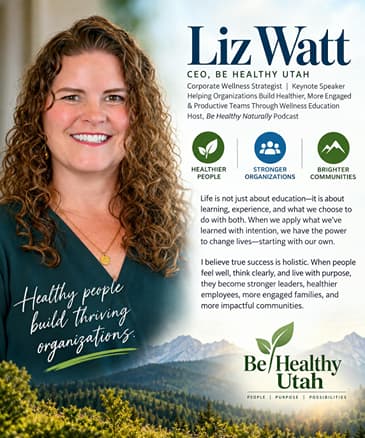
Healthy people build thriving organizations.
According to the Society for Human Resource Management (SHRM), 82% of CEOs believe workplace wellness initiatives can deliver a measurable positive return on investment, while 56% cite employee productivity as a top reason for investing in employee health and wellness.
Those numbers reinforce an important leadership conversation: employee well-being and organizational performance are interconnected.
This week on Let’s Have This Conversation, I was joined by Liz Watt, an author, speaker, holistic wellness expert, and co-founder of Be Healthy Utah.
Liz believes true success is holistic. When people feel well, think clearly, and live with purpose, they are better positioned to become stronger leaders, healthier employees, more engaged family members, and more impactful contributors to their communities.
As organizations continue to navigate burnout, stress, disengagement, and rising healthcare costs, workplace wellness can no longer simply be viewed as an employee benefit. It is also a conversation about resilience, productivity, leadership, culture, and sustainable human performance.
Liz’s work is grounded in helping people connect mind, body, and purpose. Through corporate keynotes, employee wellness workshops, executive wellness sessions, and the Be Healthy Utah Natural Health & Wellness Conference, she provides practical education designed to help people make lasting changes in their lives.
One idea from our conversation particularly resonated with me:
Life is not just about education. It is about learning, experience, and what we choose to do with both. When we intentionally apply what we have learned, we gain the opportunity to change lives—starting with our own.
Organizations can invest in technology, strategy, infrastructure, and innovation. But ultimately, people are responsible for bringing all of those investments to life.
Investing in their holistic well-being means investing in their capacity to think, contribute, adapt, lead, and thrive.
Healthy people. Stronger leaders. More resilient teams. Thriving organizations.
Liz joined me this week on Let’s Have This Conversation to tell me more.
For more information: https://www.behealthyutah.com/
Discover More: https://www.elizabethannwatt.com/
Listen: https://podcasts.apple.com/us/podcast/be-healthy-naturally/id1473357062
Learn more about your ad choices. Visit megaphone.fm/adchoices
[00:00:00] Let's level set for a moment, because the fact of the matter is, healthy people build thriving organizations. That's not an anomaly. It's a proven fact. According to my friend at the Society for Human Resources Management, 82% of today's CEOs believe workplace wellness initiatives can be a better place.
[00:00:30] Deliver a positive return on such an investment, while 56% of CEOs say they invest in employee wellness because they believe it has a direct correlation to how productive their workforce truly is.
[00:00:50] Those numbers reinforce an important leadership conversation that employee wellness and organizational performance are indeed interconnected.
[00:01:04] This week on Lets Have This Conversation, I'm joined by my friend, Liz Watt. She's an author, a speaker, holistic wellness expert, and the co-founder of Be Healthy Utah.
[00:01:20] She believes that true success is holistic when people feel better, feel well, think clearly, and live with purpose. They are better positioned to become stronger leaders, healthier employees, and more engaged family members, and make more impactful contributions to their respective communities.
[00:01:49] As organizations continue to navigate burnout, stress, and disengagement, along with higher healthcare costs, employee wellness, and workplace well-being can no longer simply be viewed as an employee benefit.
[00:02:10] It's also intrinsically connected to a conversation about resilience, productivity, leadership, culture, and sustainable human performance. Liz's work is grounded in helping people connect mind, body, and purpose, whether it's through employee keynotes or corporate wellness workshops.
[00:02:38] Executive wellness, executive wellness sessions, and the Be Healthy Utah Natural Health and Wellness Conference. She provides practical education which is designed to help people make lasting changes within their lives. Liz truly believes that life is not only about education.
[00:03:05] It's about learning and experience and what we choose to do with both. When we intentionally apply what we've learned, it opens up an opportunity to change lives, starting with our own and what. Join me this week to tell me more. I'm Kevin McShannn. Lets Have This Conversation.
[00:03:32] If you're ready, I'll take a moment to welcome you to the program.
[00:04:08] I'm super excited to learn how you take a holistic view on helping organizations be healthy and thrive. Great to see you, and happy Wednesday to you, my friend. Aw, thank you. Absolutely.
[00:04:23] Liz, I know that you're someone who believes that healthy organizations require healthy people, and you help organizations take a holistic view to organizational success. So I'm wondering if we can start our conversation by you telling me about your zone of genius, my friend, and what makes you so fabulous. Well, I like to hope that I'm fabulous, right?
[00:04:54] Absolutely, yeah. So, you know, I actually, when I got married, my husband went to chiropractic school, and we decided we wanted to live a holistic life. But life prevailed. We ended up having kids, and, you know, we did the whole, where I had my babies at home, and we chose not to vaccinate.
[00:05:21] We chose not to do medication, and we just decided to go down the whole route of trying to be as natural as we could. But as I started to have kids, there were things that were happening to me that I became sick, and it was my body. I had inflammation that was running through my body all the time, and it became really hard to be able to take care of my kids and just be the mom that I needed to be.
[00:05:51] And some days I ended up, like, I had to be in a wheelchair, and some days crutches, and, you know, some days I couldn't take care of my kids. I had to have a neighbor come and help. And so there was just a lot that was going on, and, you know, I just had this feeling that I needed to learn something new, but I first had to heal my body.
[00:06:16] And for many years I had been trying to figure out how to do that. I had gone through the whole natural route, and I went through actually the medical route, and they were just as stumped. Nobody could really help me figure this out, what was going on. And so I realized that I was asking the wrong question.
[00:06:39] I was asking everyone else how to heal my body, but I actually needed to ask my body what it needed to heal. And so every day I would just get into a meditation state and just be like, what does my body need to heal today? And as I did that, I incorporated things that just came to me, things that would help me.
[00:07:03] And at the time, my husband was also decided to, he wasn't just doing chiropractic care, but he was doing functional health. And that's where you get to the root cause of what's going on. And he was learning things, I was learning things, and I just started to incorporate everything that I had learned. And after four months, it was like these symptoms that I was dealing with started to dissipate.
[00:07:30] And I was not having these inflammation problems in my joints. I wasn't having where I was extremely exhausted. I wasn't having gut issues. And I finally felt like I had gotten my life back. So I started to teach people these principles that I had learned. And I thought, okay, this is what that feeling was that I had, that I needed to learn something to help others.
[00:07:59] And I went on to go on and do like one-on coaching with a lot of people. But then it was like, there's just more. There's more that I know that it's not just health. And so as I studied, as I started to study more, I realized that there's a huge emotional aspect that goes with our healing. And so I started to get into how our emotions affect our health.
[00:08:25] And as I went through, I started to realize that, you know, things that had gone on in the past, I never truly dealt with that. And I felt like now it was manifesting in my health. Now, I'm not saying that everything that we go through is always going to be manifesting in our health.
[00:08:47] But I felt like that that was a huge correlation because as I was striving to do things in my life, I allowed stress and anxiety to be able to build up in me, which we know stress and anxiety can correlate with our health. And it can do numerous things. And I knew that that was also a component that was going on with me.
[00:09:15] And so I dove into that and I tried to deal with the different emotional things that I was carrying for so many years. And after that, I was to a place where I felt I was healthy and I felt at peace with who I was.
[00:09:38] And then a crazy thing happened is that I had this dream that I was standing in front of thousands of people because my husband and I, we put on our own natural health conference. A few weeks before this, we had actually spoke at a conference on gut health and the microbiome. And that was something that was new.
[00:10:01] And as we were speaking, a lot of people didn't know what the microbiome was. This was in 2018. And it was just kind of like a new thing that was coming up. And so we talked about, you know, how to help your gut health and what we can do to have our bodies run better and how our bodies can run better when we focus on our gut health.
[00:10:29] And after that, people were so interested. I wrote we wrote a book and I brought like 200 copies of the book and we sold out. So people were really excited about what we had to share. And after people were coming to our booth, they would not leave because they wanted to learn more. They just knew that there was more out there for them to learn.
[00:10:53] And so when I had this dream, I was like for so many years, I lived a life that was very hard. It was here. I had six kids and it was hard to be a mom and a wife and to just do the things in life that I knew that I wanted to do.
[00:11:12] And so I would I just sat there and I thought I was like, you know, if I could create a platform where people could come and learn about how to take care of themselves. And it would be all in one place. Then they wouldn't have to live the 20 years like I did in so much pain. And so I talked to my talk to my husband. And of course, he was like, we've never done a conference before. We don't that's not what we do.
[00:11:42] I'm a chiropractor. You know, you're you're a stay at home mom. And it's like, but we figured it out and we started to find a place to have it and get speakers and vendors and started to market for it. And, you know, that was in 2019 was our very first conference that we had.
[00:12:08] We started out with only 400 people coming to that conference. But our last conference, we had over 5000 people that came. And so, you know, it's grown into something that I never really anticipated. But it's kind of like, you know, that those dreams that you have, if you build it, they will come. And so that's kind of like what it's been is like you build it and they will come.
[00:12:37] And so as of now, we have we do it in two different places. More people are understanding about how to about natural health and how to take care of themselves in a natural way. So that is me. That's how I got here. That's my story. And why I believe so much that our bodies are made to heal themselves. We just need to give them the environment that it needs to.
[00:13:04] And also that we just need to educate ourselves so that we know our options. Yeah, absolutely. And I know that you believe that healthy people, as I said, build a thriving organization. So I'm curious about asking you how you help organizational leaders really view their health from a holistic sense. How do you think that translates to organizational culture, my friend?
[00:13:35] So with for many years, you know, like I said, I was not doing well. I could not build Be Healthy Utah to what it is unless I focused on my health. And I also didn't have the thoughts and the inspiration and the clarity that I needed to build such an organization.
[00:13:55] And I really feel that this is how it translates into the culture of our organizations is that if we don't focus on the self of each employee, individual or leader, CEO, whatever is in the organization, we cannot show up the best that we can. We cannot have the clarity that we need to have. We can't have the learning and understanding.
[00:14:22] We can't have the inspiration, the constant, you know, improvement of ourselves. Why? Because we are so focused on our health and how we don't feel well and how when we show up, we are not showing up to our best self. So I call this whole self leadership where we show up as our whole self. And I live this.
[00:14:46] I know exactly what it means because when I am not feeling well, I cannot lead well. And that's really what it comes down to is we have to look at every aspect of our life, whether it is, you know, physically, emotionally, mentally, spiritually. And we have to pull that all in together and address every area of our life so that we can be at the top of our game.
[00:15:15] We can produce what we need to. We can influence others the best way that we can. And if we don't, if we don't focus on that, then we are actually not showing up at our best and be and being able to bless so many other people. Yeah, absolutely.
[00:15:34] And Liz, I want to talk to you about organizational burnout and the relationship it has to, you know, chronic stress and the overall health of an organization. Because there are so many organizations that treat, you know, employer well-being as an initiative where they focus on and they implement some policies and principles.
[00:16:02] But they don't make it sort of a overall part of their, you know, organizational cultural priorities. And I'm wondering your thoughts on how we can help leaders reduce burnout, but also make sure that organizations and their people are fully engaged in the process and their well-being is looked after. So what are your thoughts there, my friend?
[00:16:29] You know, the biggest thing that I would say is that people that work for you are not just a number. They actually come with a full package. And we have to create environments where we support these people because, you know, burnout isn't necessarily about producing more and doing more. And a lot of times people think, oh, I'm just doing too much. I can't do it. I'm burned out.
[00:16:55] But really, it's stepping back from that and addressing the person that's there. What if you were able to give them things that filled them up? What if you were able to create an environment where they were looked at as and giving them the tools that they need to succeed? Because really, people do want to succeed. They want to do their best.
[00:17:21] But often they're not giving the support system that they have to be able to do the things that they want. When my husband and I, we were going around talking to different organizations about Be Healthy Utah and how this can help. We asked the different companies, what are you doing within your business to be able to help employees? To be able to give them the support that they need to be able to succeed?
[00:17:51] And we got a variety. There was a lot of companies that didn't do anything. They didn't really feel that that was a priority. But then you went to some of these other companies and they had gyms. They had yoga studios. They did like breath work classes. They did things. They fed them healthy lunches.
[00:18:15] They did these things that helped create an environment for their employees so that they could be sustainable. And so therefore, they realized that when they did this and they came in a whole area of trying to help with creating an environment for them so that they could succeed, they actually were better employees.
[00:18:40] And so that is why I go into organizations and say, OK, you know, like how do we create an environment so that these people can succeed? And so that therefore, you know, really what a company is about is they want to they want to be successful. They want to be able to they want to be able to have profits. Right. They want to have a good margin because that's what keeps them there.
[00:19:10] And it's not a vilified thing about wanting to have a better profit. It's not. But what you have to do is that you can't just expect that to come. And if you're working with people, you need to give them an environment where they can feel supported. They can feel that they are that that they're in a safe place, that they can succeed.
[00:19:35] And then also they have a place there that they want to be able to continue to do something. So when we look at organizations, are we creating an atmosphere that these that the people that you're working with want to be able to succeed? Because a lot of it comes to our mind and how we think about things in our life.
[00:19:58] And if we feel like that we are not valued in what we do, then it is really hard to keep on pursuing and doing things within the organization. So one of the things that I created for for CEOs, leaders and things like that, that will help within your organization is I call it the thrive framework. And so what does this framework do?
[00:20:27] This framework helps these leaders and organizations to be able to get from how from where they're at to be able to have more success with their employees. And so what is that T stands for team? We need to create a team that is around that supports. So many times we feel like we can do things by ourselves, but that's not you know, we we came in families, right?
[00:20:57] We are used to being with a team, with an organization already. And we work better when we get within a team. So how can you build these teams within your organization that will help you move the needle? The next one is is H and it's harness your health. We've talked a lot about how important our health is.
[00:21:22] Like that is how I was able to create what I did, how I became, you know, the the CEO of an organization. Now that gathers thousands of people a year to make a difference is that I could not do what I did unless I focused on my on my health. And so what can we do within our organizations to bring up that health?
[00:21:44] You know, we talked a little bit about creating these atmospheres where, you know, where we nourish our bodies and we also feed our our mind and our souls and our bodies, you know. And so the next one is resilience for our and, you know, through this whole path that we have gone through with creating Be Healthy Utah.
[00:22:09] There was a lot of setbacks along the way, but it's not about the setbacks, but it's about what you're going to do with it and how you're going to build upon that. You know, we are within our organizations going to have a lot of things that happen to us. But, you know, we talk about it's not how you fall, but it's how you rise.
[00:22:29] And so when we look at resilience, it's it's finding those things to realize that there is a bigger purpose to what you're doing and that there that we can learn from what we did before to be able to move ahead. I invest in growth and invest in ourselves.
[00:22:49] For so many years after my husband, after he graduated from chiropractic school, he said that he was never going to open up a book because he did all of the learning that he needed to. But it wasn't until he opened up his mind and started to learn more that he was able to help his patients a lot more. And I think that that's exactly within our organizations.
[00:23:12] If we create a learning atmosphere where we invest in people to be able to learn and to expand and to grow, then that is money worth spent. Because the more that your employees learn and grow and know, the more that they're going to be able to bring that into their own workforce. V is value people.
[00:23:35] You know, when people feel that they are valued and loved and that they want that they're supposed to be at this organization, then they will do so much for you. So how can we in the process of being this leader and organization create a way that our employees feel like that they're valued?
[00:23:59] You know, I have a son and he worked for a company and one of the managers had said that basically it told him that if he that he could replace him with anybody else for that job. And at that moment, you know, he loved that job. And at that moment, he had a switch in his brain because he realized that he was replaceable and that what he had to offer wasn't wasn't valuable.
[00:24:29] And he started to find a look for a job the next week because we have to feel like we are valued in what we do. So we need to create this environment that these people that work for us feel like that, that they are valued and that what they bring to the table is is important. The next one is E for elevate.
[00:24:55] We have a wonderful thing within the top of our head and it's called our brain. And we need to realize that what we're doing within our organization isn't just a measly task, but it is actually building something to something better.
[00:25:12] And if if an if a leader, a CEO organization can help the employees see that, see that what they're doing is making a difference and that what they're building today is blessing other people tomorrow. Then they can see this full vision and they want to continue. They want to succeed. They want to do that.
[00:25:35] And because they are since their their thoughts and their their are being elevated, they actually feel like they have a greater purpose. And also, you know, it comes to elevating, you know, who we are and elevating, you know, how we dress and how we look at life and how we experience life. Because most of the things that we struggle with within our businesses is there are problems.
[00:26:02] But if we come to the point of realizing that there is not a problem, there's only solutions, then it's like we continue to grow and to learn and to and to realize that this is not going to stop us. There's just another another way to think about it.
[00:26:21] So this is my thrive framework that I use, that I take into companies and organizations so that they can move the needle and become more successful than they were before. Yeah, absolutely. Let's just talk to you. I'm curious to get your thoughts on, you know, your definition of authentic leadership.
[00:26:46] How do you think authentic leadership also relates to holistic health, my friend? How do you think the two are interconnected? So they are very much connected because you have your you have your holistic side and then you have your leadership side.
[00:27:08] And when you are merging these together actually brings the best leader out there. And so we have to address, like I've said, we have to address every single area of our life. We have to look at our emotional area. We have to look at our physical area. We have to look at our mental and we have to look at our spiritual. And, you know, spiritual isn't about religion.
[00:27:37] It's about realizing our purpose here in life. And so when we look at every single area like that, we want to become better. We want to be able to increase our minds. We want to increase our bodies. We want to increase our thoughts. And we want to be able to become more. I live by a theme that says live today to bless others tomorrow.
[00:28:04] And I think that that is really about in order for us to bless other people tomorrow, we have to live in a way today. Holistically. We want to be able to increase our lives. Holistically. So that we can later on. So we can tomorrow show up and be. If it's the employee. If it's the leader. If it's the CEO. Whatever it is within that organization. We can show up at our best.
[00:28:33] Yeah, absolutely. And, Liz, I'm curious to ask you about the stories that you've heard from people that have attended Be Healthy Utah and how your work has infected their lives. And, you know, really making that commitment to the holistic health lifestyle and how it's improved their overall well-being, my friend.
[00:29:00] So what are some of the stories or championship stories that you're most proud of from Be Healthy Utah, my friend? So I will tell you a story from the very first conference that we did. And it was actually one of our sponsors. And the sponsors, it was a computer company, which is kind of interesting. But they wanted to be able to have the information that we were teaching at our conference for their employees.
[00:29:30] And so they wanted to be able to send their employees there. And they wanted to get the content, all the stuff that we videoed and give it to their organization so that their employees could actually look at more of a natural health way. And so one of the guys that was there at the booth, he started to go to some of the classes.
[00:29:52] And he was diagnosed with a situation. And afterwards, we were sitting there talking. And he goes, you know, I realize that maybe it's not all about just taking this medication. But maybe I can do these other things that I learned today. Maybe I can start focusing on my gut health.
[00:30:20] Maybe I can start focusing on, you know, my mind and becoming more mentally prepared. And as he left that day, he realized that it wasn't just about a drug. But it was about looking at what else he can do in his life. And so Be Healthy Utah has three main purposes that our platform goes off with. And it's called Knowledge, Empower, and Elevate.
[00:30:49] Because we believe that the more knowledge that you have, the more you will be empowered to make the choices that you need. And because of the choices that you made, your life will be elevated. And so everyone that comes to Be Healthy Utah, we focus on giving them knowledge. Because that's the very first thing that we can have.
[00:31:15] Because when we have knowledge, that's when our options open. You know, before this guy thought that it was just about going to the doctor and getting a drug and taking that every day. But once he started to learn that there are other options out there, he realized that it's not just about the drug, right?
[00:31:37] It's about finding other ways that we can help the problems within our bodies, the symptoms that we're experiencing. And so what does that do? That empowers us to be able to make our own choices. To realize that there are other options out there. And so when we take the control away from everyone else and we bring it to ourselves,
[00:32:06] that is where we get empowered to be able to do that. And so then how do we get to elevate? Well, when we then feel like that we are in control of our own health journey, then our lives, we become realize that we are elevating ourselves, our environment, and who we are as a person.
[00:32:31] And so when somebody walks in that door, our responsibility that we feel is to provide that knowledge to people so that they could learn. And so there's so many people that I have actually ran into that have said, going to Be Healthy Utah has changed my life because we provided that knowledge.
[00:32:55] And so what I do within, I take these same principles that we do within Be Healthy Utah and take it into organizations so that they can also say, what you incorporated within our organization changed my life. And to maybe become a better person.
[00:33:17] Because that's really the bridge of Be Healthy Utah to the organizations is that this exact same thing is that these people, no matter who you are, you want to live a better life. You want to have knowledge. You want to be able to be, you want to elevate yourself and you want to be able to make a difference in the world.
[00:33:41] And so when we are healthy, when we address, like I've said multiple times, when we address all of these areas, and this is what you learn at Be Healthy Utah. This is what you learn on the stages within your organization, how to incorporate it. We then can live our best life and also build organizations that last. Yeah, absolutely.
[00:34:08] And Liz, one of the reasons I wanted to talk to you this morning is because you have two fundamental sort of intersections that your work collides. You help people reclaim their identity and what words and finding their voice. And you also help them, you know, with their own individual sort of journey in life by becoming you.
[00:34:36] So I'm curious, what does inclusive independence mean to you? What do you want people to do? So this is very personal to me. And this was the aspect, the second part of my healing that I talked about with the emotional aspect of getting into things. We all experience hard things in our lives.
[00:35:04] And there's moments within our lives that we start to feel that we are not worthy to be able to do whatever we want to. And so when I was younger, I grew up in not a traditional family. I grew up in a polygamist family and my dad had four wives. And so for so many years, I tried to hide that from people.
[00:35:30] I didn't want people to know who I was, the kind of family I was, I came from. I, you know, I ended up leaving my house, getting married, and I never talked about it. And I, I got to the point where I felt with inside of me, I needed to do more and become more. But that thought of people finding out who I was and the kind of family I came from,
[00:35:58] it, it, it was a huge struggle. And every time I thought I wanted to get out and do something, the thoughts kept on coming to me like, people are going to know who you are. They're going to find out who you are. Do you really want to be on that stage and have people listening to you? And I started to diminish my worth and who I was and realized and thought that I was an outcast.
[00:36:26] I felt like I was second best and that I was never going to be like anybody else. But it wasn't until I started to do that emotional healing and realize instead of like asking, if we get a little bit of spiritual here, but, you know, asking like, you know, like, God, why did you choose me to live in a family like this?
[00:36:49] I got to the point of why, what an honor to be able to live this way so that I can experience life in a different way. And I started to feel like this was actually an honor, that it was a gift that was given to me. And I think that that is how our becoming me, I wrote, so I ended up going on writing a memoir of my life
[00:37:18] and to where before I wanted to hide who I was to now where everyone can read the story of me and how I navigated my life growing up this way. And then coming to the realization that our lives are given to us as a blessing, that everything we go through is a path to the next level.
[00:37:40] And it's a gift that's given to us so that we can grow and learn and become the person that we are meant to be. And so I love being able to take people through that journey to be able to switch their brains, to be able to look at life in a totally different way, because we are becoming who we are every single day with every choice that we make. And what are we going to do with it?
[00:38:09] Are we going to allow the world and ourselves to beat us down and tell us that we have no worth and that we are not capable of doing these things that are within our heart? Or are we going to break that down and really see our worth that's within us? And that's what I think is the most beautiful thing is when people have that change of thought,
[00:38:33] that they are created for more and that with that, they can bless so many other people's lives. Yeah, absolutely. And Liz, I want to also ask you about the state of mental health within organizations, because, you know, research has consistently indicated that, you know,
[00:38:59] mental health and performance are linked to employee experience and well-being. So I'm curious to get your thoughts on the state of mental health in the workplace, where you think leaders are making the grade, and where you think more work still has to be done. What are your thoughts on mental health in the workplace, my friend? Well, we do struggle with mental health.
[00:39:27] And I'm not going to come out saying that I am a mental health expert here, because I'm not. But I have seen within organizations, when they support the employee, then the employee wants to become more. They want to do better within there. And so, you know, we have these leaders, and they are not mental experts either, but they can create environments within there.
[00:39:52] And it has showed with multiple studies that the more that the employee feels like they are trusted, the more that they feel like they have a place to be, that the more that they have safety within their organization, the more that they are invested in as, you know, in helping them learn and grow, and the more that they feel safe within this environment,
[00:40:21] then the better employee that they can be. The better. And so we have to look at, as leaders and organizations, we have to create these environments that people feel safe to be able to succeed. And when we do that, yes, we're going to have some people out there that take advantage of the situation, or they move on to other organizations because of things they've learned. And, you know, there's always going to be some things that we're not expecting.
[00:40:51] But the majority of people want to be able to succeed in their life. They want to be able to have a difference. They want to be able to, you know, and so when we have, when we talk about mental health, it is about addressing all of those areas emotionally, physically, mentally, spiritually, that when we, you know, when we address mental health, that's actually helping our physical health. When we address our physical health, it's helping our mental, you know, our mental health.
[00:41:19] And it's also helping our emotional health. And so as organizations, if we could just go in and create these environments where people feel that they are supported, then it helps mentally. It helps physically. It helps emotionally. And it helps spiritually with realizing they have that purpose. Yeah.
[00:41:44] And, you know, I want to talk to you about, you know, elite communication and really listening to our bodies when they tell us that we're exhausted. You know, because in work, you know, leaders are often told to maximize productivity at all costs.
[00:42:06] And some leaders take that to the extreme and some really value, you know, the mental health of leaders. So how can we help organizational leaders really push beyond the productivity metrics and also value their personal well-being as well?
[00:42:31] Because I know that you say that personality and productivity when it comes to health can also intersect. So I'm wondering your thoughts on how we can marry the two, my friend. I want to tell you a story about a tree in my backyard. Sure. Yes. Because I think this is a great analogy here.
[00:42:54] I had a nectarine tree in my backyard and it produced beautiful fruit for many years. And then the tree died. So I took it out and I went and I got another nectarine tree because we love the nectarines. I planted it and as it started to grow, you know, it takes a few years for it to grow. And as it started to grow, it wasn't a nectarine tree.
[00:43:25] It was actually a peach tree. But the problem was, is I had a peach tree already right next to it and I didn't want another peach tree. But we enjoyed the fruit for a couple of years and decided, okay, we want to take it out and we want to put in a nectarine tree because we actually really want a nectarine tree. And so we planted another nectarine tree.
[00:43:48] The tree started to grow and after a few years, it ended up to be not a nectarine tree, but another peach tree. And so we had to go out and we enjoyed the fruit for a couple more years and then took it out and put in another nectarine tree. And we will see this next year if it grows nectarines or if it's going to grow another peach, right?
[00:44:15] But I feel like this is how it is within our organizations. We try things, we bring it back. We try more things and we have to pull it out and start from scratch again. And that is what the progression is of the mental aspect of within our businesses is that we realize that it's constantly we are growing new things, seeing if it works. If it doesn't, we take it out.
[00:44:45] We start something new. We grow that, see how it is. If that doesn't work, then we take it out and we start something new. And it's not that it's a reflection of how our organization is, but it's a reflection of growing and learning.
[00:45:03] And if we look at every aspect of that within our organization, if it is the projects that we're doing down to the employees that are doing it, that it is a constant effort of just growing and learning, taking things out, starting over. And that is really how we grow in life.
[00:45:27] And if we look at it, this is where elevation comes into it, that if we look at it, this really is the pattern of growth and that we have to go through all of this so that we can better serve people. We can have a greater environment. We can have a place where people are being more productive. And we're all trying to get to that one point.
[00:45:54] But that one point, you know, I sit there and I look at a mountain and we see, we often we see a picture of a guy standing at the top of the mountain, like he finally succeeded. He got up there to the very top. But what we didn't see in that picture was the cuts and the bruises and the times he's saying, I don't want to do this anymore. And the wanting to turn around and realizing, you know, having to look at that. OK, maybe I can do this.
[00:46:23] And, you know, it's a whole process that we go through within our organizations to be able to create this environment for growth. And that does not come with obstacles along the way. Yeah, absolutely. You know, I've got two questions left for you. And the first of those two questions is this.
[00:46:44] You often also talk about leading from wholeness, my friend, and how personal experience can influence the way we lead. So how do you think personal experience and leading from wholeness can make us better leaders both emotionally, psychologically and mentally? What are your thoughts there, my friend? So, you know, I talk a lot about, you know, how I grew up.
[00:47:13] And then I also talk a lot about growing Be Healthy Utah. And, you know, whole self-leadership is looking at, is bringing all that aspect into us. And so for so many years, I tried to hide from who I was. But I tried to hide from my past. But I realized that I am my past.
[00:47:40] And I need to take those good things that came from my past and bring it to the future. And when I was growing Be Healthy Utah, you know, our very first conference, we said that we wanted to have 1,500 people come to that conference. And we had everything we did. We told the vendors. We told our speakers. We set up 1,500 chairs. We got 1,500 goodie bags to give to people.
[00:48:09] And only 400 people came. And as that day, when it happened, when people, when that day, I was devastated because I just felt like I was such a failure. But I had this thought that came to me. And it said, don't mourn the 1,100 that didn't come, but celebrate the 400 people that did come.
[00:48:33] And as I did that, I started to see the happiness on people's faces for being there. Those 400 people didn't care that 1,100 weren't there. They were excited to be able to be there and to learn. And so really, like, as we started to grow Be Healthy Utah, I look back and I say, what a blessing it was that only 400 people came that day.
[00:49:01] Because we have been able to build on something. And now our conferences, we get so many compliments from the vendors and from the speakers and the people that attend how well this is run. And so really, it's about line upon line, precept on precept, and learning things that you might think as failures, but are actually the biggest blessings.
[00:49:29] I thought that my childhood was the worst thing that could ever happen to me. But now it created an environment for me to learn to have more compassion, more love, and to be able to relate to other people. And things that even with my kids, with being a mom, I thought that 400 people coming to our very first conference was the worst thing ever.
[00:49:52] But it actually has made us be able to grow in a way that the blesses other people. If I would have had 5,000 people come to that first conference, I don't know if we would still be doing it today. Because we would not have had the experience. And so wholeness, when we talk about wholeness, it is realizing that we take the good, the bad, the negative, the positive, the things, all of it.
[00:50:21] We take it all together. And we realize that everything we do is a way for us to get to where we are going. And that we can learn from everything. We can learn from the hardest things that we go through. There are principles in there, teaching principles, that will help us to get to the next level. Yeah, absolutely.
[00:50:47] Liz, my final question for you today has to do with your own personal and professional legacy. I know you're a mom, as you said, of six kids. And I know that you do a Be Healthy Utah with your husband. And you're also combined on speaking engagements.
[00:51:06] So when you look at your life and legacy, my friend, what do you want people to remember about you partially when the conferences and the speaking engagements are over? What do you want people to say about your life and legacy, my friend? I want people to say that I lived a good life and that I was caring and that what I did made a difference in this world.
[00:51:35] You know, we didn't have a natural health conference place before where people could just go and learn from doctors and educators. And, you know, it has not been easy. There's been so many times where my husband, especially going through the COVID stage, where we wanted to give up and we didn't want to. My husband did not want to do it anymore. He's like, we have been stringing people along.
[00:52:05] We had canceled three conferences. And, you know, it was such a hard test of trying to see if you're going to be able to sustain this through that time, just like so many other businesses that struggled during that time. And we were definitely one of them. But you know what? It was a greater purpose for us. And we knew that we needed to keep on going.
[00:52:33] So after this is done, I want people to look back and say, you made a difference. Your sacrifice that you did brought so much education to all of our lives that now our lives are better. And I think that that really comes down to every business owner out there is that they want to make a difference in people's lives.
[00:53:02] They want to create a better community. They want to create a better place where people can live better. And, you know, a place that's more joyful and happy. And, you know, what I created helps people live a better life so that they can enjoy their families more. They can be better employees. And so I really want to walk away that it was like you fought the hard fight.
[00:53:31] You did what you were asked to do. And that you made this world a better place. Yeah, absolutely. Well, Liz, I want to applaud you for all the great work that you've done in holistic health and growing, being healthy Utah. I want to applaud you for all the time. And if people want to get in touch with you personally or get involved with Be Healthy Utah, what's the best way they can do that, my friend?
[00:54:01] So if they want to learn more about Be Healthy Utah, we actually, for people that don't live in Utah, we professionally record every presentation. And we have it on our website that people can go on and purchase the package to be able to listen to it. So even if you're not in Utah, we have many people all around the world that purchase our presentation so that they can learn. And you can go to Be Healthy Utah dot com, find out more about the conference and how you can become involved.
[00:54:31] If you want me to be able to come and speak to your organizations, you can get on. You can find me on Be Healthy Utah, but you can also go to ElizabethAnnWatt dot com. And you can find more about me and my present and how about my presentations. You can also we have a podcast that we do called Be Healthy Naturally. We put out weekly and people can come on a week.
[00:54:59] We interview doctors and educators all about natural health. And that is a weekly episode that people can continue to learn. That's free, that they can come on and just be educated on how to take care of themselves. Because the better that we take care of ourselves, the more that we can truly bless others. Yeah, absolutely.
[00:55:21] And Liz, I want to thank you for moving the needle of progress forward when it comes to holistic health and all you do to help organizations and people live healthier and a more calmer and clearer life. It was great to talk to you this morning. And I want to thank you for being here, my friend. Well, thank you, Kevin, for having me on today.