What if sustainable leadership transformation begins not with strategy, systems, or titles—but with connection?
In this episode of Let’s Have This Conversation, Melissa Swonger, known as the Architect of Connection-Centered Leadership™, explores the invisible architecture beneath effective leadership: the beliefs, relationships, behavioral patterns, and cultural dynamics that shape how people lead themselves, influence others, navigate change, and build organizations where people can flourish.
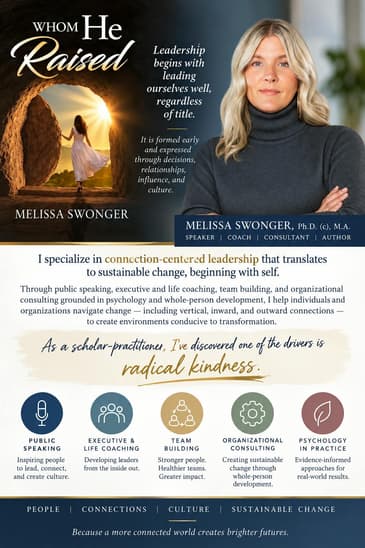
Melissa is a scholar-practitioner, change theorist, international bestselling author, keynote speaker, executive coach, and organizational culture advisor. Her work bridges psychology, leadership development, organizational culture, change theory, human behavior, and whole-person development to help leaders move beyond surface-level solutions and create sustainable transformation.
According to Gartner research, 90% of HR leaders believe that focusing on the human aspects of leadership is necessary for success in today's workplace. Yet recognizing the importance of human-centered leadership and consistently putting it into practice are two very different things.
Melissa's work addresses that gap through Connection-Centered Leadership™ and her Integrative Transformation Blueprint™, a research-informed approach built around three stages:
Awareness → Connection → Movement
The framework challenges leaders to examine not only what they are building, but what they are building on. Sustainable organizational change requires understanding the underlying beliefs, relationships, behaviors, and informal systems influencing how people communicate, collaborate, make decisions, and respond to change.
Throughout our conversation, we explore why leadership begins long before someone receives a title, how self-awareness influences organizational culture, and why meaningful connection can become a catalyst for stronger leadership and sustainable change.
We also examine Melissa's concept of radical kindness and why kindness, connection, and human-centered leadership should not be confused with avoiding accountability. Instead, they can help create the conditions for trust, honest communication, meaningful relationships, and transformational performance.
Melissa shares insights from her work across executive advisory, leadership and culture consulting, speaking, workshops, retreats, and author development through The Muse & The Method™.
In This Conversation, We Explore:
At its core, this conversation asks leaders to consider a powerful question: What are you building—and what are you building it on?
For executives, HR professionals, people leaders, entrepreneurs, organizational development professionals, and anyone interested in the future of work, this episode offers a deeper examination of how connection-centered and human-centered leadership can create sustainable transformation from the inside out.
For more information: https://www.thesagehillproject.com/
Learn more about your ad choices. Visit megaphone.fm/adchoices
[00:00:00] Have you ever considered the fact, what if sustainable leadership didn't come with systems or strategy but it started with connection? In this episode of Lets Have This Conversation, my friend Melissa Swonger, known as the architect of Connection-Centered Leadership, explores the invisible architecture beneath
[00:00:29] effective leadership. The beliefs, relationships and behavioral patterns and cultural dynamics which shape the way people lean themselves, influence others and navigate change and ultimately build organizations where people can thrive based on their authentic and noteworthy vision which is a
[00:00:59] self-cultivated. Melissa is a Scholar Practitioner, Change Theorist, Executive Coach, Keynote Speaker, International Best-Selling Author and Organizational Cultural Advisor. Her work bridges psychology, leadership development, cultural and organizational change, theory, human behavior and
[00:01:28] whole-person development to help leaders move beyond surface level connections and solutions in favor of transforming and cultivating real transformational change according to my friend over at Garner. Research indicates that approximately 90% of HR leaders believe that focusing on the human aspect of the human aspect of the human
[00:01:58] leadership is necessary for success is necessary for success in today's workplace. However, recognizing the importance of human-centered leadership and consistently putting it into practice are two very different things. Melissa's work addresses that gap through human-centered leadership and her integrative transformational blueprint.
[00:02:27] A research-informed approach which is built around three stages. Awareness, connection and movement. The framework challenges leaders to examine not only what they're building but what they are building on because at the end of the day, sustainable leadership and organizational change requires understanding the underlying
[00:02:56] beliefs, relationship and behavioral changes and informal systems which influence the way people communicate, collaborate, make decisions and respond to change throughout our conversation. We explore why leadership begins long before anyone receives any title of significance.
[00:03:24] How self-awareness influences organizational change and culture and why meaningful change can become a catalyst for stronger leadership and sustainable change. We also explore Melissa's concept of radical kindness and why kindness, connection and humor
[00:03:54] human-centered leadership should not be confused with avoiding accountability. Instead, it can help create conditions for honest conversations, meaningful relationships and transformational performance and swonger. Join me this week to tell me more. I'm Kevin McShann. Lets Have This Conversation.
[00:04:53] Melissa, Melissa, if you're ready. I'll take a moment to welcome you to the program, my friend. I'm super excited to learn how you take your zone of genius. In fact, people, it's great to see you, my friend. Happy Monday to you. Thank you. Thank you. Happy Monday to you. I'm thrilled to be here.
[00:05:12] Absolutely. So, Melissa, I wanted to start by asking you about, you know, making a difference in the world. I know that you are someone who believes heavily that everyone has potential and they have to sort of cultivate their own vision of how to do it.
[00:05:35] So, I'm wondering if I can start by asking you about cultivating potential and what that means to you, my friend. Well, potential is one of my favorite topics because you're right, everybody has it. Some people realize it and some people don't. But it's what is the spark that lights the flame, that catalyst to kinetic energy, right? Everybody has potential, but how do we get it into realized energy?
[00:06:03] And I think it's learning, you know, it's getting connected and learning what is our unique footprint? How are we uniquely wired? What do we have to bring to this situation? What do we have to bring generally? And then kind of creating a framework in our mind where we can apply that in specifics.
[00:06:24] Yeah, absolutely. And Melissa, I don't know. You're the founder of the Sage Hill Project, my friend, which is an ecosystem devoted to mobilizing radical kindness and restoring human connected as a foundation for leadership, culture, and, you know, sustainable transformation, my friend. So, tell me all about it and what makes the project so fabulous, my friend.
[00:06:53] Well, the Sage Hill Project is kind of my baby that's evolved. I didn't even know where we were going, but it started with consulting. So, way back, if I could take you even back further, my undergrad is in journalism. And so, in journalism, I really learned how to ask powerful questions and developed a spirit of curiosity.
[00:07:19] And at the foundation for everything we do at the Sage Hill Project is that spirit of curiosity. I'd say that's one of the hallmarks. So, understanding, you know, being able to ask the question, why do we do what we do? Even if we have differing opinions, even if it's a case of conflict resolution, no matter what, as a Sage Hill consulting part, we want to be curious about why each person coming to the table is doing what they're doing.
[00:07:48] And then as my own career and life evolved, I began asking questions about my own self. So, this started with my own journey. And we don't know what we don't know. And I remember not knowing much. So, when I, the first day, you know, I was kind of didn't have this mindset of leaving a positive footprint.
[00:08:11] I was kind of born into trauma. And in my 20s, I was the epitome of part of the system, which is more competition than collaboration. And success was defined more by status and titles and what you could achieve. And holding my daughter for the first time, I realized, left to my own devices, I'm going to screw this up.
[00:08:40] I knew 105 ways not to parent and never seen one right way to do it. So, I began this journey of asking questions of myself. And through that, and then begging God for wisdom and having him put people in my life to give me that wisdom in true James 1.5 fashion, I began this transformational journey of myself to turn my own potential into kinetic energy and how it started manifesting.
[00:09:07] And then went and got the education, my master's in leadership from Gordon-Conwell Theological Seminary, and then a year of evidence-based coaching at Fielding University, and then PhD psychology Adler University to create the education to create these spaces where other people could flip that switch themselves. And what we learned has developed into this framework that's the basis of the Sage Hill Project, which is the integration transformation blueprint,
[00:09:36] and how whether it's not narrow, which is the challenge, it's believing that everyone really can lead themselves well, and that leadership is role-based, title-based, but that's not all it is, that we're leading ourselves well. We can be informal leaders or leaders in every situation we step into, and we can learn how to create cultures or environments where people flourish together.
[00:10:06] Yeah, absolutely. Well, also, just because you brought it up, and I'm naturally curious to see your answer about the future of journalism, based on your background in the profession, and where you think the industry is headed. I'm curious to ask you about your perspective, your perspective, rather, on the future health of the industry, my friend. What are your thoughts there?
[00:10:34] Well, I have a different perspective maybe than modern journalists, because I'm older. But if I had produced the journalism that often is published today, we would have failed. Because our professor said if we knew, if he could tell which side of a topic we were on, then we would fail. It wasn't to be op-eds. Those belong in a certain section.
[00:11:03] But it was to be able to tell fact-based, not opinion-based news. And today what sells is more sensationalism. And how can we tell the story? Because we have so much. We didn't have access to the internet. We didn't have access to the constant feed of information. And so our brains have shifted into expecting these little micro bites of information that keep our interest quick.
[00:11:32] And so the challenge of journalism is to produce these bite-sized, sensationalized topics to keep people interested. And I think there's positives and negatives to that. That we don't always get all the facts. So how can we trust it? And then having our mind conditioned to be desensitized to things we've grown used to and require greater sensationalism to keep our interest. Yeah, absolutely.
[00:12:01] Based on your very first answer you gave me, you talked about the intersection of faith and education. And I know it's a very important dimension to your work. And you said that it's important to you to create a space rooted in both transformation for other people.
[00:12:25] And I'm curious, what does the intersection, what fascinates you about the intersection of learning and human connection which creates the conditions for meaningful human connection and change? What are your thoughts there, my friend? My thoughts on the intersection of faith and... It's connection? Yeah, it's connection to like learning and human connection.
[00:12:55] What are your thoughts there, my friend? Learning and human connection is... We have to have the right environment for our brains to continue, develop, grow, and feel safe. You're talking about here now like psychological safety, which leads to psychological agency. And so we do know... One of the areas I focus on is change.
[00:13:21] And so we do know that all humans require certain conditions for positive change to take hold. So if we have an environment that gives... It's given to like fear-based or shame-based or judgment-based change. That change may happen, but it would be short-term change. You're basically white knuckling it until you fail. And you have a fear of failing in that environment.
[00:13:48] But if we keep people in a positive emotional attractor space... So there's negative emotional attractor space and a positive emotional attractor space. And things that put us on the defensive are in the negative emotional attractor space. And change isn't possible. No brain is going to have long-term or transformative change in that environment.
[00:14:06] But when we develop environments where it is safe, it's perceived as safe, we feel the environment, we feel the connections is safe to fail forward, to voice opinions that may contrast with the majority. When we feel we can be authentic in asking questions or not have to shrink to make other people feel comfortable.
[00:14:33] When we develop diverse teams that together form an environment that may be different and still have conflict. Conflict is inherent in diverse teams, which produce the greatest results. Then when we have a framework to navigate those kind of challenges together where we feel safe, then we're naturally going to have the agency to influence and take responsibility and build more together.
[00:15:00] Yeah, I'm going to follow up by asking you about, you know, the importance of delegation of authority within organizations. Because I always make the argument that no matter how many degrees a leader or an executive has on a wall, it's important that they also give their employees the autonomy of choice.
[00:15:29] And the importance of empowering them to make decisions that affect the entire organization. So I'm curious to ask you about organizational culture transformation and the idea of the delegation of authority to generate innovative ideas. What are your thoughts there, my friend? Yeah, well, you've really hit on an important part to me.
[00:15:56] So, yes, everyone has a voice and not everyone has a vote. There are people who are tasked with the actual role of leadership. And we're not trying to diminish that. What we're trying to do is equip leaders to recognize the informal leaders within the group and leverage that. So change happens when one of the main roles of leaders is to be scanning the horizon, look for the blip and be able to adjust the sales.
[00:16:25] Well, people naturally are resistant to change and they often have command avoidance. And leaders have a gap sometimes in the decisions they make and the impact that it has for those who are implementing the change or directive. When they have a boots on the ground approach that makes them participate and be curious, I'm thinking about doing this. How will that impact you? And listen with a spirit of curiosity.
[00:16:53] They may make the best decision first rather than having to continue to adjust along the way. When they find out why did morale take a dip? Why don't we have buy in from this? There are things we can do in that process to make people feel seen, heard, and valued in a way that create a sense of belonging. And so even when it's uncomfortable, you have greater buy-in for what you're trying to implement based on the way people feel in the team we've created. Yeah, absolutely.
[00:17:24] Melissa, as you mentioned, you're garing the completion of your PhD in psychology at Adler University, which also adds another layer and dimension to your work, my friend, as a leadership practitioner. So I'm wondering how has your academic theory influenced the way you think about human behavior,
[00:17:44] connected dignity, and evidence-based approaches to cultivating consensus and creating connected leaders? What are your thoughts there, my friend? Well, the education aspect really created a deeper dive for the framework. So we have other thought leaders in the space to build on and look for the gaps in the research they've provided.
[00:18:12] How am I entering the conversation is the challenge for a scholar practitioner. And so I think my work focuses on actually what you had on is narrowing that gap. So my research, my dissertation focuses on leveraging informal leadership and how the stated leadership of formal culture, there's a gap between then the informal culture, the lived experience that people in general experience based on what leaders have created.
[00:18:41] And how do we narrow that gap, especially for marginalized groups? And my framework and being around the giants in the conversation have helped shape and inform what reality is. As we've worked with organizations and have to study case studies, we see what's implemented both in generalities and then we see specifics that we don't, wouldn't otherwise have a chance to study. And what that does is tell us a lot of ways of what doesn't work.
[00:19:11] We learn things, what does work. And then we have a collective voice and a collective knowledge base to then apply generally and to become thought leaders in ways that impact masses rather than just individuals. Yeah, absolutely. I want to talk about your memoir, which you've entitled Whom You Raised, my friend.
[00:19:35] It's a deeply personal and spiritually grounded memoir born during a period in your life where it was a serious accident that which left you lying with a broken back, my friend, which separated you from the urgency of productivity
[00:19:59] and really had you sort of rethink the way you think about performance in life in general. So tell me about the memoir, my friend, and what you want people to get from it, my friend. Well, that was the story I didn't want to write. I had really put off writing it for quite a few years. I really felt my first accident, which was in 2009, that put me in the wheelchair for four years.
[00:20:29] I kind of heard the beginning of write your story. And because I'd come from a place of trauma in my childhood and already overcame that, it wasn't, you know, those are the chapters we wish weren't written, that we try to hide stuff down. And that creates the disconnection that I talk about a lot in working with individuals and leaders is that we have these chapters that in a work story we don't want to write.
[00:20:58] And we put them under lock and key and try to pretend they're not there. And what happens when they don't stay neatly in there, in that space we've tried to delegate it to. So after learning to walk again, after four years, three physical therapists said, you're delusional, you'll never learn to walk again without assistance. They wanted to amputate my leg. I didn't. I not only relearned how to walk after working physical therapy like a full-time job, I ran and then summited mountains.
[00:21:28] And then worked on, I had this framework in my head for what does that look like to really physically recover and mentally recover as well. And all of this time, I'm going through my own transformational journey in mind and spirit and now body. Fast forward to my second freak accident. I had just left my nieces, who I lived with for a few months while her youngest was diagnosed with a terminal illness.
[00:21:56] And I'd stayed six weeks after he passed. And the coach and psychologist in me had made a great plan of recovery on my four and a half hour drive back home. Before I could even get into the house, I fell through a trap door. A storm shelter built into the garage floor, broke my back in two places, had a pelvic avulsion fracture, tore all the hamstrings of my left leg that used to be my good leg. And so sitting there, I could barely sit up.
[00:22:26] I was lying there flat on my back. And I asked God, what do you want me to do with this? And he said, I already told you, right? Write your story. So as soon as I could incline enough to use my computer, I began writing. I've always been a writer. I love writing. But I finally wrote the story I didn't want to tell. What I found in that was the arc of my own transformation mirrored those I had worked with.
[00:22:51] And the catalyst, the spark that lights the flame at every major milestone in transformation is radical kindness. It's the radical kindness of others who walk in when the rest of the world walks out. It's the people who stay and create this space of safety and kindness, even when social norms would say they don't have to.
[00:23:13] And those people are what allows the world to change or what facilitate legacy changers or what can create potential to kinetic and create this sense of belonging. Everybody wants to belong. That happened in my own life through a woman named Laura Casper. And I've seen it happen in other people's lives, too. So part of our message is mobilizing radical kindness.
[00:23:43] Yeah, absolutely. I also wanted to ask you about the hidden or invisible architecture that shapes organizational culture. And how your connected and leadership will look like for organizations to follow, my friend.
[00:24:03] So what do you want organizations or executives to know about the invisible architecture about shaping the culture they want to organize organizations to embody, my friend? What are your thoughts there? Yeah. Yeah. So it's interesting. I love metaphors. Dr. Rodney Cooper from Gordon-Conwell during my master's really taught me the importance of metaphors, among other things he taught me.
[00:24:32] And I love the the I realized we were building. And so the natural metaphor of architecture, sometimes I use bridges, but generally I use like skyscrapers even because before we can expand and rise. What they do is dig deeper. And if you look at when you want to build something and you see just a vacant lot, let's say, and you before they can build anything up, they dig deeper.
[00:25:02] And that is a metaphor for what we have to do, whether it's leading ourselves well, leading our families well or having title based leadership. We have to dig deeper and really find out what is still serving us in that foundation. What is our foundation anchored on? And do we have to expand that foundation and shore it up before we can rise and expand to what's visible?
[00:25:27] So the hidden architecture of connection centered leadership begins with awareness and then connection and movement that moves in three parts. But the connection part is vertical, inward and outward. And so that foundational element, even if even if your faith isn't. So for me, that's God. But secular psychology even agrees that we do best when we realize we belongs to something greater than ourselves.
[00:25:53] So that vertical connection for some may just be take kind of taking that 30,000 foot view after awareness and realizing we belong to something bigger than ourselves. It's not so much tunnel vision. And when we anchor to a bigger area, we're able to then rise higher from that effort. Yeah, absolutely.
[00:26:15] And, you know, building on your own last answer, I want to ask you about moving beyond surface level leadership solutions and how stronger human connection can influence things like trust, collaboration, culture, and an event will change, my friends. So how do we go beyond surface level leadership solutions based on that framework? What are your thoughts there, my friends?
[00:26:44] I think this is just the niche that this conversation kind of fills in that gap. So there's a lot of leadership, great leadership works out there that talk about what to do, even now with psychological safety and belonging and connection. But where I'm kind of entering that conversation is where we talk about the patterns, the conditioning, and how we got here.
[00:27:12] It's kind of like when the leaders receive 360 feedback and part of that isn't great or they think, for instance, there's a study done where they asked executives who thought they had implemented kindness initiatives. And they're overwhelmingly, yes, that's been great and success and effective. And then less than half of the employees agreed with that. And so it's thinking, why do I keep doing the things I don't want to do?
[00:27:37] Why, when I've done all of this work in leadership coaching or therapy, am I not realizing the outcomes I want? And I know what to do. It's not a knowledge gap, but it is something's missing. And when we start looking deeper, so this is a process of looking a little deeper, and we find out, well, we have neural pathways that are formed through conditioning and patterns. And sometimes they're even hidden to us about the origins of that.
[00:28:04] And it doesn't have to be, it can be a deep dive, but sometimes it's not as deep as you think it might be. And it's just revealing what the start of those patterns and conditions are, and how do we interrupt them so we can apply the principles that we've been working on having and enjoying the outcomes we want. And at that point is where I often intersect people who are saying, I've been doing all of this work. I know all of these things. Here's the written down plan of what I want to implement.
[00:28:33] And it's not working. And I look as a strategist and I say, well, hey, you have a great plan to get from point A to point B, but you're starting at point D. And so that's why you're frustrated. Or you've put all this tools in your toolbox for a great adventure. And so this is another metaphor. So now we're on a great adventure and you've prepared for an exploring trip, you know, a river rafting trip. You've got your fleet together.
[00:29:02] You've put all of the equipment to navigate the rivers or the oceans. And then you come across the mountains. Well, you have to ditch the canoes, right? And so we keep the plan was for a river rafting trip. And now you're up against the mountains. And so you keep jamming the boats against the mountain wondering why you're not having success. Well, because at this next chapter, what was serving you then may not be serving you now. It's not wasted. We're leaving it for the next person who's coming down the mountain and traversing the rivers.
[00:29:30] We take with us what we're going to need for the next segment. We evaluate what's missing for this next segment. And it's a constant of thinking we haven't arrived. We're always planning and evaluating and assessing what stays, what goes.
[00:29:48] And how do I need to adjust the sales for the team I have right now, for the relationships I have right now, for the next venture or segment that is happening in this phase of the business or in this phase of my relationship. And through that assessment process, we built the framework, much like when I already had a framework for recovery. Once we have the framework, it's easy to apply to the next segment that we encounter. It's not having to go back and start it all over again. We already have the framework built.
[00:30:17] We're just going to apply it continuously and keep evolving forward. Yeah, absolutely. And building on what you just said, you challenge leaders with one fundamentally powerful question. That says, also ask, what are you building? But the second part of that question is, what are you building on?
[00:30:42] And I wanted to ask you about the idea of leadership vision and having the cultures to have a collaborative view or approach to leadership.
[00:30:56] So when you pose that question to leaders, what sort of a roadmap or checklist or an idea set do you want them to have in their head as they're working through that question, my friend? Well, most leaders already have down the rudimentaries of the business.
[00:31:19] They've already decided, done their due diligence, done the SWOT analysis and figured out, hey, this is a venture we want to go for. It makes sense on the books and paper. And so rather than stopping there, I think we, okay, this looks great on paper. How are you going to execute it at a high level? Well, in order to do that, you have to have buy-in.
[00:31:42] You need to know not just how great is it theoretically you're on paper or among the upper level key stakeholders. You need to know how is it at the boots on the ground, people who are going to implement this impact. And when it's taking that spirit of curiosity and asking them, hey, this is what I'm thinking. Sometimes they, the people who are implementing don't know until it's happening that it is even going to happen. That's a bad time to create buy-in.
[00:32:11] So when you take a minute and you have part of your change management team, you can have someone whose job it is to, A, start with your informal leaders. You can form committees with them and have them who are boots on the ground at all levels have an informal leader that is part of a committee, a change committee. It can be in general that you keep all the time or it can be for this one project.
[00:32:35] And have them weigh in on how for their team or their system or their group, what is that going to, what's the actual real lived experience going to be? And how can we make it better collaboratively? That's going to keep you from having to adjust so much during the middle. And when you invite people to weigh in, they have greater buy-in. They feel like they are going to work harder to make it successful because they had a say in it.
[00:33:04] They're excited about it. They've been included. People like to belong and feel included. So rather that it be a surprise when you have intentional committees that say, hey, I care about what you think. I care about how you think this is going to succeed or fail and what input do you have? Again, give people a voice without giving everybody a vote.
[00:33:30] And then even if it doesn't go the way some people want, you can say, hey, I heard you and here's how we're going to overcome that. Or I heard your suggestion or your complaint or how this may negatively impact you. We have to go ahead with it this way. And it's going to positively impact our organization or the majority of teams. Here's why we're going to do it anyway. How can I make this change more palatable for how it was negatively going to impact you?
[00:33:58] That means that, hey, you still care. Or they may say, hey, I understand, but we have to do it this way. And at least they feel heard and seen that this is going to negatively impact me. And I'm not just, well, collateral damage. You care. Sometimes life has to go this way anyway. But they have a way to weigh in and impact and influence their journey.
[00:34:24] They have a little bit of agency and feel seen, heard, and valued. So they belong. Yeah, absolutely. And to that point, Melissa, as you know, I have cerebral palsy. And I talk to organizations about the importance of hiring folks with disabilities. And I make the argument because one of the questions that I always have to answer when I give speeches is, how much is this going to cost me?
[00:34:52] And I refer to the argument to executives that it's not about cost. It's about contribution. And I wanted to ask you the context of, you know, inclusion at work and its connection to a radical kindness. And when we hire folks with disabilities, it's not charity, as I make the argument. It's a part of the contribution to the solution.
[00:35:20] So I'm curious to ask you about your thoughts on integrating folks with disabilities into the workforce and how that will help boost morale, kindness, as an overall productivity at work. What are your thoughts there, my friend? Well, I think the research is pretty clear that hiring people with disabilities overwhelmingly, positively impacts productivity and the bottom line.
[00:35:48] The reason it does is because there's kind of two sides of this coin. The reason that it works and also the reason why it's a challenge. So people inherently have like me bias. We like to pick groups of people that look and think like us. Well, that may be our norm or the default network we operate in,
[00:36:15] but it's also a really bad way to have high level productivity, because it may seem like you have this harmony and this peace, but actually growth happens when we're challenged. And the only people you've restricted yourself, if you're creating people, teams of people that are like you or similar enough to you that there's not a lot of challenge or different ways of thinking or doing things,
[00:36:41] then guess who you're going to attract as a clientele or who's going to, you're going to create a product or whatever your service is. You're going to make it for the people who are just like you. And that's not the majority of the world. So having a diverse team, including people with disabilities, I don't have to tell you, I know from being just in a wheelchair for four years that our perspectives change and are different from those who haven't had the same challenges. Yeah. Yeah. Go ahead.
[00:37:11] No, no, please continue. Yeah. Well, so even not, so as someone who was, who was able-bodied and then trying to navigate the world from a wheelchair, nothing had happened but my leg. So for me, nothing had happened but my leg. And people would, you know, treat me like I wasn't the same mentally, just,
[00:37:37] just the visual of the wheelchair all of a sudden changed how some people related to me or how people who didn't know me perceived my ability. Mm-hmm. And it was, it was quite an eye-opening experience for me because I thought, wow, people, people who have disabilities all the time, especially if they're physical. And there's many people who are neurodivergent, who, who, who perform at a high level, who, who have similar things, but they, but they're able-bodied. So,
[00:38:08] it's amazing to me firsthand, the experience of nothing changed for me, but being put in a wheelchair and people thinking all of a sudden I can perform at a lower level or I'm less intelligent or they need to speak differently or I couldn't possibly have just a normal conversation the way I could when I was standing. And I know that that experience really grew my mind for what people in disabilities,
[00:38:37] even though I acknowledge that it's different because mine was a shorter term, but like I had a greater understanding for an advocate for just, just being treated with a sense of belonging, being seen and heard and valued in a way that creates a sense of belonging and not diminishing the contribution as you attribute it to. Because what it does, if you allow them to speak into your space,
[00:39:05] it may challenge you and what you think you know, but the contribution and their differing perspective increases what is possible. And that's true for not just people with, your question was to people with disabilities, but I'll even expand it further to people who just aren't like us, just aren't like you.
[00:39:29] Like it's when we put ourselves in rooms where it's a little uncomfortable because so many differing, whether they don't look like me, think like me, having the same culture as me, have the same abilities as me. We want to put together, one of the things I do is help people put, help companies put together teams that are going to, for projects or for services for, to launch the greatest impact.
[00:39:57] In order to optimize your team, it needs to be diverse so that we, we're hitting all a broad spectrum of boxes. And now inherent in that is the challenge, right? So there's going to be some friction. That's okay. If, if it's a healthy environment, that's, what's going to allow you to grow that wrestling with each other and try to base it on a spirit of curiosity.
[00:40:24] When you put the components together with a healthy functional framework, it works to the advantage of everyone. And it's not charity, especially going back to your thing of disability. It's not charity. It's helping your organization grow and thrive beyond what you thought was possible. Yeah, absolutely. And well, listen, everyone that knows me knows that I'm a huge believer in self-reflection. You know,
[00:40:52] I always tell people that the only standard of expectations you have to meet are your own, because if you don't have your own individual baseline of expectations, it's hard to raise to the level of everybody else's. but that's what it has to do with, you know, the, the idea of taking self accountability for leadership,
[00:41:18] because I know that one of the arguments you make is that before leaders can transform themselves, they really have to take their own level of, excuse me, before leaders can transform an organization, they have to really take, you know, self accountability for their own actions and behaviors.
[00:41:41] So talk to me about the importance of self reflected and self accountability for leaders and what your philosophy is there. Yeah, well, I think not just for leaders, but everybody's a leader leading themselves. Well, so for everybody, I advocate your practice of self reflection, however, that manifests in their life, where it's the good, the bad, and the ugly. And it's understanding that none of us arrive.
[00:42:10] It's progress over perfection. It's grace. It's, it's, it's giving ourselves a break in other people, but good leaders are ones that are, that are even harder on themselves than they are other people as far as holding themselves accountable. And it's been said that good leaders, you know, the credit goes to the team, the blame goes to me. And I, I ascribe to that somewhat in a, in a share up,
[00:42:37] care down kind of paradigm where leaders are, are creating opportunity. They're creating a culture where people can flourish. And in that part, because people spend a lot of time at work. So in that environment, and it could be family, it doesn't have to be work, but leaders are creating the environment where people can flourish. And it's their responsibility to check in with themselves to make sure,
[00:43:05] are they anchored? Are they doing the work of progressing forward, even though we never arrive? Are they able to take accountability? Are they able to make amends when they, their words that carry weight may not have been said in the way they wanted them to, when they made an assumption, when they've created anything that creates more of a hostile or negative environment, how quick are they to rectify that themselves?
[00:43:34] And so when we have somebody who's, and really we're talking about humility and humility, humility isn't thinking more or less of yourself than you are. It's not, it's not, not understand it. To me, humility is understanding who you are and what you have to contribute and offer your strengths, your weaknesses, and we all have them. And leadership is one of those gifts, even though we all lead ourselves, there are people who have a gift of leadership. And leadership should be a neutral gift.
[00:44:03] We often over promote people outside of their gifting because of what they have put in. They've been loyal. They're, they're good at being this part of their job. And so we over promote them to leadership because that is a reward in some systems. And I disagree with that notion because while leadership can be developed, the people you want at the home are those who understand the humility of their gift
[00:44:29] and what it is to be a servant leader in creating that space where everyone can thrive and not just your name on the window. Yeah, absolutely. And Melissa, I've got two questions left for you. And the first of those two questions are really combined because they're interconnected. So according to a staff industry analysis, and they found,
[00:44:52] they found when they did an analysis about leadership and kindness at work, 74% of executives believe that the organization, who embrace kindness are significantly more productive when it comes to getting people to embrace the idea of buying,
[00:45:18] while also only 54% of employees believe that their organizations promote kindness and the idea of compassionate leadership. So I'm curious to get your thoughts on the idea of compassionate leadership.
[00:45:41] And then Lincoln also has research that highlights the idea of the importance of compassionate leadership when it comes to really wanting to progress an organizational, you know, blueprint forward. So I'm curious to get your thoughts on the idea of compassionate leadership, kindness,
[00:46:08] and the idea of preserving the bottom line or also humanizing leadership. So you can take that question in any direction you wish, my friend. I know what you're talking about, that those stats and that study that was done. And I think it really just highlights, it's just, it's just one study. This one was about kindness,
[00:46:33] but it's just one study that emphasizes part of what we've been talking about, this gap between decision makers and those who implement the decisions. So the misconception is thinking that the implementation has been successful. We would call this the formal culture, a policies made. You see this in, well, that would be a tangent, but just really quickly,
[00:47:01] you would see that in like EEOC. And when civil rights entered the workplace, and everyone made a mandate that said, not everyone, but many, many organizations made a mandate that said, we're an equal opportunity employer. We don't tolerate discrimination. And so because the formal culture, the policies, the structure, it was implemented. It's in writing. Everybody signs it.
[00:47:25] They make the assumption erroneously that the lived experience of experience, and that's the informal culture, right? That's part of the informal culture, not totality, but that's part of the informal culture is, is this lived experience of others. And so even applying it to the kindness initiative, the, the executives who think, no, we made a decision that we are going to embrace kindness. So yes, I think we can see that they've put the slogans up,
[00:47:55] they've done the swag, they had the, the pep rally for it. So from their mindset, well, of course it's working, but there's a, there's a gap, right? There's some, there's some incongruency in the narratives and I like storytelling, right? So there's an internal negative or an internal narrative. And then there's an external narrative. And so what the front facing public sees and experiences may be one thing.
[00:48:22] And that may be intentional by design from the marketing team. And, and it may even be curated in their customer service forward facing interactions. This is how you have to engage with our clients. And they may even affirm the executives mindset that we went through this kindness initiative, the customers, when you pull them and do surveys, they're like, yes, we think that this is improved or yes, it was our experience that you're kind. And so they take those numbers and say, look,
[00:48:51] this is our proof that this has worked. We have done this. What a successful campaign. But then there's a gap between the external narrative and the internal narrative. Because if you pull the implementers of such design, they're like, we, we aren't experiencing that at the same level. Or you might have some teams who do and some teams who don't. So it's having this seamless implementation track where those at the top are understanding, again, the lived experience of those at the bottom.
[00:49:21] And, and to me, when you, I mentioned earlier about the, the committees having changed committees. If you have people represented from every group, on them, you might hear more along the way about how successful or not the implementation of anything, including kindnesses. What I would also say though, when we're talking about the implementation of kindness outside of the study is there is a connotation about compassion. You'd mentioned compassion,
[00:49:51] not just kindness, even though the study was kindness, you mentioned compassionate leadership. And, and we decided as a society that there's, certain hard skills of leadership, and there are certain soft skills of leadership. And some even go so far as to label them masculine and feminine traits, even though they can be used by either gender.
[00:50:14] I don't appreciate those delineations because I think it leads to narratives in our brain about terms like compassion that aren't true. So then we start to associate compassion with lacking a competitive edge. We start having negative connotations about such soft skills. And in reality, when we create an environment,
[00:50:43] it doesn't mean that at all. We're not giving up accountability to be compassionate. We're not giving up, nor is anyone saying we should. We're not giving up the competitive edge. We're not saying that it is just all Kumbaya hold hands. We're saying if we have certain elements in an environment that includes psychological safety that leads to agency, your bottom line, we know is going to improve. We're sure of it.
[00:51:08] Because what you have is people who are willing to take greater risks in their job. Engagement increases, turnover decreases, and burnout decreases. We have increased creativity. We have increased productivity. And we have increased collaboration. We know that this is true. Research shows that. So when we create an environment that includes things like compassion and other elements for being seen, heard, and valued in a way that creates a sense of belonging,
[00:51:37] their bottom line will increase. And I guess part of the footprint that we want to leave is creating those environments where people in companies can flourish. And that's connection-centered leadership. Yeah, absolutely. And, you know, my final question for you this afternoon has to do with thinking about tomorrow. I'm someone who went to all of my podcasts, as you know,
[00:52:03] talking about legacy and how you want it to be defined. And I'm curious. You know, we're all human, a certain shelf life on this earth. But when we think about the idea and concept of tomorrow, what sort of legacy do you want to leave, my friend? I love that because I think a lot about tomorrow as well. And I'm here for such a time as this.
[00:52:33] And what I hope my legacy is, is being a thought leader in ways that have a positive impact on people being connected to vertically, inwardly, and outwardly in a way that leaves a positive footprint. We have two hands. Another metaphor. And when I'm reaching up to be mentored,
[00:53:02] discipled, and grown into, right? Because I never run, no matter how much I know, I never know it all. And that's true for all of us. And then we have the other hand. And so wherever I've been, right, there's somebody right behind me. And I can pour into, leave the door open, also guide, disciple, and mentor. And when both hands are outstretched, we have balance. But if we're reaching too far in one hand, pouring out, or too much just to be fed all the time, then we're off balance. And eventually we'll topple over.
[00:53:32] So I hope I, my legacy is defined by creating space where people can flourish and realize that we really are better together. Yeah, that's certainly powerful and transformational for sure. And Melissa, Father, tell me if people want to get connected with you, what's the best way they can do that, my friend? They can go to my website,
[00:53:58] www.thesagehillproject.com. And you can contact me there, find out ways to work with me, and read my upcoming book, What Are You Building On? The Hidden Architecture of Connection-Centered Leadership. Fabulous. Well, my friend, no pun intended, but I feel better connected to you. And I'm certainly glad we had this conversation about human centered and connected leadership, human behavior,
[00:54:28] and development. I want to thank you for your work in the space, and for engaging in conversation with me this afternoon. It was great to meet you, my friend, have a great conversation with you. I want to encourage you to keep up the good work, and thank you again for joining me. It's most appreciated, my friend. Thank you so much, Kevin. The pleasure was all mine. Thank you,