Is Hollywood truly embracing diversity and inclusion, or are we witnessing a retreat from meaningful representation both on screen and behind the camera?
Despite progress in recent years, significant disparities remain in the American film industry. According to the 2026 UCLA Hollywood Diversity Report, Hollywood has experienced what researchers describe as a “relapse into colorblind complacency,” raising important questions about the industry's commitment to authentic representation, equitable opportunities, and inclusive storytelling.
But what happens when filmmakers intentionally challenge these barriers and create stories that celebrate the experiences, talents, and aspirations of people too often overlooked?
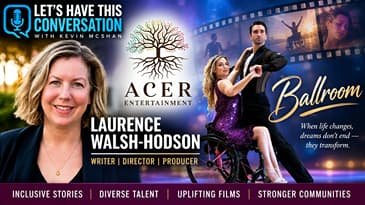
Laurence Walsh-Hodson is a writer, director, and producer with 25 years of experience in film and television. She is also the founder of Acer Entertainment, a nonprofit production company dedicated to creating inclusive, uplifting stories that inspire audiences, challenge perceptions, and promote healing.
Her latest feature film, Ballroom, brings that mission to life.
The film follows a young wheelchair dancer pursuing her dream of becoming a professional performer. Through authentic casting of actors with disabilities, Ballroom explores perseverance, self-love, resilience, and the transformative power of dance.
For Laurence, storytelling is about more than entertainment. It's about recognizing our shared humanity, celebrating possibilities, and reminding audiences that life's challenges do not have to define the limits of our potential.
How can authentic representation in filmmaking challenge societal perceptions of disability and create greater opportunities for inclusion, both in front of and behind the camera?
This week on Let's Have This Conversation, Laurence joins me for an inspiring discussion about inclusive filmmaking, the power of authentic storytelling, and why everyone deserves the opportunity to see their experiences represented on screen.
Instagram: @acer.entertainment
For More information: https://tv.apple.com/us/movie/ballroom/umc.cmc.3zlvtr08ntgn6h1wwe9o1384d
Learn more about your ad choices. Visit megaphone.fm/adchoices
[00:00:00] Are Hollywood Movers and Shakers really embracing diversity, equity, and inclusion? Or are we witnessing a real retreat of true representation both on screen and behind the camera?
[00:00:19] Despite significant progress in recent years, significant disparities remain in the American film industry according to the 2026 UCLA Diversity Hollywood Report.
[00:00:37] Hollywood has experienced what researchers are calling a relapse in colorblind competencies, raising important questions about the industry's commitment to authentic and inclusive representation, equitable opportunities, and inclusive storytelling.
[00:01:02] But what happens when filmmakers intentionally challenge those barriers and create stories and narratives which celebrate the experiences, talents, and aspirations of people all too often who are overlooked?
[00:01:24] Lawrence Walsh Hodson is a writer, director, and producer with over 25 years of experience in the film and television industry. She is also the founder of Acer Entertainment which is a non-profit production company dedicated to creating inclusive, uplifting, and creative stories,
[00:01:53] which cause audiences to be inspired, challenge assumptions, and perceptions, and promote the power of healing. Her latest feature film, Ballroom, brings that mission to life.
[00:02:14] The film follows a young wheelchair dancer who is pursuing her dream of becoming a professional performer through authentic casting of actors with disabilities. Ballroom explores perseverance, resilience, and the transformative power of dance.
[00:02:39] For Lawrence, storytelling holds more than the power of entertainment. It's about recognizing our shared humanity, celebrating the promise of possibilities, and reminding audiences that life challenges do not have to define the limits or bounds of our collective and portion of the world.
[00:03:09] How can authentic representation in filmmaking challenge societal perceptions of disabilities capabilities and create greater opportunities for inclusion both in front of and behind the camera?
[00:03:32] This week on Let's Have This Conversation, Lawrence joins me for an inspiring discussion about inclusive filmmaking, the power of authentic storytelling, and why everyone deserves an opportunity to see experiences represented on screen. I'm Kevin McChann. I'm Kevin McShan.
[00:04:00] Let's Have This Conversation.
[00:04:34] Lawrence, if you're ready, I'll take a moment to welcome you to the program. And I'm super excited to learn about Ballroom and your commitment to diversity, equity, and inclusion in entertainment. It's great to see you, and happy Saturday to you, my friend. Yes, yes, yes, I'm ready. Absolutely.
[00:04:54] So Lawrence, I know that Ballroom is a project that is near and dear to your heart, and it started with a unique inspiration three years ago. So I'm wondering if you could tell me about that inspiration and how it led to the production of Ballroom, my friend. Thank you, Kevin. Thank you, Kevin. Yeah.
[00:05:19] So many years ago, I saw Mia Shokowitz dancing the Paso Doble, and she uses a wheelchair for mobility. She has paraplegia since she was 17. And when I saw her dancing, I thought, wow, that's a movie right there. That's so beautiful.
[00:05:39] And then I also have been looking for a long time for how I could connect my life story and of healing from depression. So it made a lot of sense because when I talked to Mia, she also went through a depression and recovery period. Obviously, when she became paraplegic, she was previously a swim athlete. And it was really hard for a teenager to make this adjustment.
[00:06:08] But watching her on the other side, seeing how she recovered, knowing how I recovered, I really wanted to combine these stories and tell people that hard things happen. And really tragic things can happen in life.
[00:06:28] But you can overcome it with will, not willpower, but with persistence, tending to yourself, feeling your feelings, finding a new goal or a related goal and accepting life and learning to love yourself. So those are just a few of the things I put into this movie. Yeah, absolutely.
[00:06:54] And, you know, Laura, to bring up the idea of hope and healing and the concept of that can mean something different for so many different people. And, you know, I'm a huge believer in the idea of self-reflection. And I'm wondering if you see the correlation between hope, healing and self-reflection and what your thoughts are in that regard, my friend.
[00:07:22] Yeah, it's I'm happy that, you know, after 20 years of breath work, EFT, family constellation, feeling my feelings, I'm over the depression. But every day I have challenges, you know, I have mom challenges and I have life challenges. And so it's a it's a constant refocusing, right?
[00:07:50] I have to process my feelings as they come up, pay attention to myself, pay attention to my inner and my inner children and my outer children as well. And then and then I find myself restored to that hopeful state.
[00:08:06] So it's it's a constant process, I would say, even though I'm finished with the with the heavy weight of the depression, I still need to, like, cleanse my cleanse my spirit and check in with myself and be true and honest to myself every single day. So that's to me where the hope, the hope comes in.
[00:08:31] The hope is natural, like inside our bodies is joy, I think, or I believe. And like once you get past all the upsets and the triggers and the core wounds, then you just naturally feel the joy. So that's that's the great, the great part. Yeah, absolutely.
[00:08:51] And Lawrence, you know, I am fascinated to ask you about diversity, equity and inclusion in Hollywood because, you know, if we look at the numbers, you know, people with disabilities are historically underrepresented when it comes to, you know, their place in Hollywood, whether they're an actor or in a leading role.
[00:09:21] And I think that's a lot of people behind the scenes when we're talking about, you know, Hollywood production. So I'm curious to ask you about increasing diversity, equity and inclusion in Hollywood based on your experience in the field and where you think we've made progress and where you still think we need to go. Yeah, I mean, thank you for that question.
[00:09:50] It's it is we still have places to go. We I mean, just beyond disabilities, you know, female inclusion, you know, is still inequitable in the industry. Age inclusion is still inequitable. I felt like ballroom was really important because we we cast authentic casting Madeline Delp as the lead.
[00:10:20] And then we redid the first 15 pages with a body double because she's standing when she meets her love interest before the car accident in the movie. Um, so I was I was really glad that we got to bring in that perspective, right, of Madeline because she's lived this experience. And so she could really guide the script. She could guide the moments.
[00:10:49] She brought this really compelling vulnerability to the role of Violet that that is very moving. And she also shows what people that are differently abled can do. Like she swims the length of a pool, like a really long length of a pool paralyzed.
[00:11:14] And and like this movie just shows like what what someone who is differently abled can do. She she learned five Latin dances, six Latin dances, actually, in three months, which is is so amazing. It's challenging for a standing able bodied person.
[00:11:36] But for a person in a wheelchair, you know, they they can sometimes need more recovery time and they have more physical issues that they need to pay attention to. So for me, it was a really big learning experience. I was really happy that we had Chelsea Rush on set. We had Donika Witsit on set. Mia Shokowitz was plays O.T.
[00:12:02] Stacy, and she did an amazing job as like as a representative of the person who is in a wheelchair but has a full life, is really happy and healthy and joyful. And that's how Mia Shockowitz is in real life as well. So I was happy to have the different representations, someone in recovery, someone who has recovered and is healthy and happy.
[00:12:29] But as far as the industry is concerned, there are more movies coming out. You know, there's several disability movies coming out right now. So I think that's fantastic. I think the more we can be authentic and inclusive, the better, the better for society. Because, for example, my daughter is ADHD and I find her, you know, people don't understand it at all.
[00:12:58] People don't understand neurodiversity. Even I didn't understand it. So I'm like having to learn all these new ways to work with my daughter based on a totally different way of thinking. So the more we can do inclusive projects, diverse projects, I think the better because we're all human beings, right, Kevin? Yeah, absolutely. And, Lawrence, as you may know, I also have a disability.
[00:13:27] I was born with a cerebral palsy. And I believe that there's real strength in vulnerability. And, you know, one of the things that I live or one of the things that I live my life by is that resilience is the answer to the test once adversity strikes.
[00:13:47] And I'm curious, based on your professional and personal experience, and I know this was one of the driving forces for Ballroom, about the whole concept of embracing vulnerability, resilience, and shared humanity. And I'm wondering your thoughts on those concepts and why they were so important in the creation of Ballroom, my friend.
[00:14:17] And also just in general as well. What are your thoughts, my friend? Thank you, Kevin. Yeah, I think resilience can be hard when you're first healing because you just want to do nothing and you kind of want to give up. And that is where you are and that's understandable.
[00:14:41] And hopefully you have something inside that says you got to keep trying or you have a mentor or a guide or a parent who can support you. For me, I was very depressed as a teenager and tried to hurt myself, tried to harm myself.
[00:15:05] And it took a number of years to find out that I didn't have to live that way. It took me a long time to realize I could change the way that I was feeling. And depression and mental health, I mean, some people can change, some people can't. But what I discovered was that using all of these healing techniques that I put in Ballroom,
[00:15:33] I actually was able to lift the pain and resolve the pain, resolve the anxiety, resolve the self-hatred. And so, yeah, I don't know where the resilience came from in me. For me, I was always trying to make my mother happy, feel better. And so I think there's a part of me that always wanted to bring that to the world.
[00:16:00] You know, with my mom, it was like, if I fix her, if I make her happy, then she can love me. And I think with the world, it's like, I just don't want to see people in pain. I really, it really, it hurts me to see people, especially if it's a pain that can be healed or helped or changed.
[00:16:24] So some, some pains I understand are chronic, but others can be healed through different techniques. And that's what I really wanted people to understand. Yeah, absolutely. And Lawrence, I want to talk to you about the idea of inclusion.
[00:16:45] And how it can really become a meaningful part of empowerment and contribute to authentic perspective. So as a filmmaker and a storyteller, I'm curious, how did you define the concept of inclusive creativity?
[00:17:09] And what does it look like in practice when developing characters or coming up with collaborations with people with disabilities? So it's a long way of asking you, how do you define inclusive creativity, my friend? Thank you. Well, my production company is new, Acer Entertainment.
[00:17:38] And it is focused on diversity and inclusion. And for Ballroom, I did a lot of research and I had Mia Shokowitz as a consultant on the movie. I also had a physical therapist as a consultant on the movie. And then also, as I mentioned, Madeline gave several rounds of notes.
[00:17:59] And we also had Dimitri Chaplin, who gave us notes on the ballroom aspect, which was a different aspect of the movie. But inclusion to me means seeing everyone as equal. And sometimes people need accommodations in that equality. So we all have different needs. Every single person has different needs.
[00:18:27] I, as a teacher, have different needs. I went after I had my baby. I had fibromyalgia for two years. I could not drive. Like it really hurt my back to drive. So I needed accommodations for that.
[00:18:40] And so being inclusive to me means treating people with respect, treating everyone with respect, and listening to their perspective, and seeing how it can shape what we're creating. Yeah, absolutely.
[00:19:00] And, you know, the power of dance, Lawrence, can also bring a better understanding that sometimes words, they fail or have a more difficult time of conveying. So I'm curious about how you view how dance can help us communicate emotions, feelings, and meaningful connection.
[00:19:29] What are your thoughts there, my friend? Thank you. I'm actually getting kind of teary with your comment. I think it's really insightful. I do agree. Words cannot describe how people feel and what people go through and the emotions people go through. And dance itself is an incredible way to express yourself creatively.
[00:19:58] You know, whatever that dance looks like for you. You know, when I was writing the movie, I danced with the roulettes on a video call. And every single time I dance, I feel closer to myself. I feel a release. You know, obviously you get the serotonin and the dopamine from moving. But I feel like more self-expressed.
[00:20:24] And I really think Ballroom brought that beauty of, you know, not only the physical self-expression, but the love of dance. The lead, Petro, and the lead, Violet, they really connected over this learning and love of dance. And he's teaching her these five Latin dances for an audition.
[00:20:53] And, you know, their progress is basically like really how you heal. At first it feels awkward and it feels horrible and you doubt yourself. And then you start to gain confidence and you get more serotonin and you connect with someone, which, you know, connecting with people is so important, right? And in dance, you can really connect. Physically, you can, you know, especially ballroom dancing, you have a partner.
[00:21:22] So that connection with another person is integral to healing, right? We're built on connection, human beings. And we need that, we need those hugs, if you will. So, yeah, absolutely.
[00:21:42] And, you know, I want to talk about your production company, Acer Entertainment, because I have to commend you because I know the mission of the company is to create, uplifting, and empowering stories that are all focused around diversity, equity, and inclusion.
[00:22:01] So, tell me about the process of forming your production company, why it's so personally important to you, and the types of films that you want to produce, my friend. Thank you. Yeah, so Acer was created to support ballroom, but it also really comes to my heart of what I care about in filmmaking.
[00:22:26] I've been a filmmaker for 25 years, and I really want to see more uplifting films, right? I mean, Hallmark films are fantastic for romance, but it's different from like an uplifting film that gives you faith in humanity and faith in yourself and connects you to the truth of life, which is that you are a divinely created person. And you have value in that you were born, right? Every single person has value.
[00:22:57] So, Acer was created in order to accept tax-deductible donations to the movie. So, we were able to give, we were able to do a lot of fundraising through Acer because it was nonprofit. And that helped to make the movie, get the movie made.
[00:23:17] What it means, what we're looking at in the future is we have a trans writer who has created a beautiful film about her story of her parents not wanting to believe that she was, she's a girl. So, that to me is, speaks to diversity. I feel like these people need voices.
[00:23:46] It's underdog stories, you know, they need voices. And I have another story that we're working on.
[00:23:54] It's an animated story that, it brings a lot of comedy, but it shows how racism is baked into us from our parents and how racism doesn't, you know, if you get, if you're in a different state of mind, if you're, if you actually know people, you know, of color, that it does, it's kind of irrelevant, right?
[00:24:20] When you, when you, when you get to know a person, you stop having this preconceived idea and this discriminatory idea. So, that's what the other project's about. And, yeah, I really just, I want to look at projects that help people heal, whatever that looks like, and, and represents different, different niches that don't have, that are underrepresented in our industry. Yeah, absolutely.
[00:24:51] And, to that point, Lawrence, as you mentioned before, you've spent more than 25 years in the industry and you've really seen the, what I call the equity of opportunity. Because, you know, equity and equality can be ideal statements for people that want to really invest into it. But the real transformation comes from the offered opportunities.
[00:25:21] So, I'm curious, what have you seen over the years when it comes to ways that we can strengthen equity of opportunity and equality of opportunity in Hollywood? What are, what do you want people to know about the roadblock that still exists and the progress that we've made? What are your thoughts there, my friend? Yeah, pretty much my entire career, people told me I couldn't do what I was about to do.
[00:25:51] So, they told me I couldn't, I couldn't, I didn't know anyone in the industry. I couldn't work in the industry. So, I became an electrician and started working. They told me I couldn't be a grip. So, I became a grip. Told me I couldn't move into camera. They told me I couldn't be a writer. So, I became a writer. I was, you know, one of 12 writers. There's all, every other writer was male, white, white male on one show.
[00:26:18] So, I think there are programs and groups like in the WGA, they have Latino groups. They have veteran groups. They have disability groups.
[00:26:35] And I feel like joining one of those groups is really helpful for people to make contacts and connections to other people, showrunners who actually care about representation. So, that's what I would recommend to people is, you know, don't let other people tell you what you can do. Right now, you know, TikTok is so big and you're doing it, you're doing it, Kevin.
[00:27:02] You know, podcasting is, podcasts can become TV shows. TikTok can become a TV show. You know, there are smaller ways to produce material. And I really believe in independent productions because we cannot, we cannot get validated by Paramount, you know, this conglomeration. We have to validate ourselves. And it's just like that in life. We have to love ourselves before other people are going to love us.
[00:27:30] We have to validate our work before other people are going to validate it. Yeah, absolutely. And I want to talk to you about influence because, you know, when we see things on screen, you know, I'll give you an example.
[00:27:45] One of my favorite Christmas songs is At This Table by Adrena Menzel because it talks about no matter what abilities or circumstances you have in life, everyone is welcomed at a table. So I'm curious, when we talk about influence and the things that we've seen on screen,
[00:28:10] what are you the things you can tell us about how we can understand people's experience that may not be similar to our own? And how can we learn, grow, and prosper from those experiences? What are your thoughts, my friend? I think we have to be present in ourselves.
[00:28:34] You know, many people are concerned about the future or concerned about the past or troubled by the past. In order to really see people and see their different perspective, we need to spend time and listen. You have to be present in yourself enough to understand that there's a different perspective than yours. And that's what's so amazing.
[00:29:02] That's what I love about writing is that it's all about different perspectives. Every single person has a different life story. And listening, paying attention, trying to filter it through your perspective is challenging. And, you know, even I joke with my husband. We've been married 13 years, but we still have misunderstandings.
[00:29:29] So I still don't totally understand his perspective. So it's a learning process, right? You have to pay attention and listen and hear what's going on for the person and accept. Accept them for who they are, right? Judgment does not help. You know, judging people, it just limits you, right?
[00:29:56] You can't, if you're judging someone, you can't get beyond yourself. You have to stop the judgment because you don't know anything about that person's life or what they've gone through or what they've, you know, what they're feeling at that moment. We really have to release the judgment, come to, you know, seeing the value and treating everyone as valuable. Yeah, absolutely.
[00:30:22] And, you know, Lawrence, when we talk about the concept of entrepreneurship, it's often measured in, you know, the innovation or the financial success of building a business. But it can also signal a powerful vehicle for things like social change or societal change.
[00:30:45] So through your work with Acer Entertainment and your experience in the industry in general, I'm curious about your perspective on how entrepreneurship can be a powerful vehicle for social and societal change. What are your thoughts there, my friend? That is a very great question.
[00:31:12] And I, we just are out on Amazon Prime and Apple TV. So we're going to be experiencing our entrepreneurship. We're currently experiencing it to see how the movie does. You know, I think it's a balance between art and business. It's always been that way. You always have to pay attention to the business.
[00:31:38] You can't just do the art, which they don't teach you really in art school or, you know, in screenwriting class. I, I'm always trying to help my students understand branding and understand that, that it has to fit, you know, with commercialism.
[00:31:56] Even though we're telling our, we're telling our own stories and there are, there are different ways to tell stories, but there are, you need to know the formula that you need, that is successful to begin with, right? Before you can veer from that formula. So entrepreneurship, I, I'm still, I'm still mastering that. I'm still working on that.
[00:32:23] And we did a lot of things for Ballroom. We had product placement for a 10s diapers. We had, we had so many companies that came on as partners because they believed in what we were doing. Um, Capizio came on, um, colors, wheelchairs came on, um, dance mobility, uh, you know, was amazing.
[00:32:49] So we had a lot of support and that is part of the business aspect of it. Like we had to raise money, right? Um, we had to, we had to make it sellable, but at the same time, I wanted to be true to my vision of, of making this a healing movie. So we'll, we'll see how it goes. I'll have to answer. I'll have to text you that, um, answer. A work in progress. We'll put that that way. Okay. Yeah. Yes.
[00:33:18] You know, I'm also curious to ask you because, you know, one of the most powerful aspects of sharing our own personal stories is the possibility that somebody else could find hope, understanding, healing or a sense of connection through someone else's story.
[00:33:40] So I'm curious, drawing on or drawing from your experiences with depression, mental health challenges, and your own personal and personal health journey, what do you think, what lessons have you learned about the importance and power of self-compassion, seeking support and recovering and finding joy?
[00:34:10] What do you want people to know about that, my friend? Yeah. Yeah. Yeah. Um, I feel like, I mean, I've heard from a few people that they, um, did feel uplifted by ballroom and my story.
[00:34:25] I, ballroom is kind of a lighter take on, um, cause I did try to kill myself and, uh, and I really want people to know that they don't have to act on that suicidal ideation, right? When, when things are bad in your life, you want to act on it and take away the pain. But what people don't realize is that there's other ways to take away the pain.
[00:34:50] For example, screaming, crying, releasing, writing it down, um, talking to the pain in your body. There's all of these, there's hundreds and hundreds of healing methods, you know, equine therapy, working with horses, working with goats, you know, there's so many different ways to heal.
[00:35:11] And, um, so it's, it was really important in sharing, um, sharing my story that, uh, that I convey this because I, I am so heartbroken by those people who like Robin Williams, like, how did he, how was he not given the resources to heal from his depression? Like why, you know, he's got so much money.
[00:35:36] How can he not have people, you know, telling him or teaching him all these different methods? You know, there's, there's tapping EFT, there's breath work, there's yoga. Um, I do a kind of yoga called Kundalini yoga, which is, um, chanting and it's very, you know, you can do it in a chair. Um, Kundalini yoga, um, and dancing, as you brought up before, dancing can be so healing, you know?
[00:36:05] Um, so I, I really hope that ballroom can help people who are in that state of contraction, who are in that pain and are like, what do I do? I, I can't take it anymore. I can't take that pain. And I want them to know these are things you can do, you know, you can reach out, you know, I called suicide hotline three times when I was in my thirties. Um, there are things you can do. There are steps you can take.
[00:36:35] You need to tell someone, right? You need to tell a friend, you need to talk about it. I'm really against this, like, you're a tattletale thing. I really think people need to talk about their secrets. It's like, let's engage with the shadow side. Let's talk about what's actually going on because otherwise you just get that repression and that repression turns into, you know, really dark thoughts.
[00:37:00] So, um, I'm really hoping that this can start a conversation for people and start, start the healing path. Yeah, absolutely. And my friend, I've got two questions left for you. And the first of these two questions is this. We talked, talked a little bit earlier about women in filmmaking and women in these roles and increasing representation of women in these roles.
[00:37:25] So, I'm curious to ask you about, you know, the extraordinary progress that women have made in the, uh, uh, industry of filmmaking and storytelling. Yet, barriers to leadership and finding their own creative controlling in the industry, uh, you know, the influence still remains.
[00:37:49] So, as someone, as a woman building your own production company and with direct and meaningful stories, I'm curious what experiences have shaped your passion for this work? And what specific steps do you think the industry can take to have more women represented in the film, in the field rather of filmmaking?
[00:38:18] What are your thoughts there, my friend? Um, yeah, we definitely have made some strides. There are a lot of powerful female showrunners that have proven that they can write fantastic shows that go on for decades. Um, I think, I think you really have to have, um, uh, you have to have diversity in a room.
[00:38:42] You, you just have to insist on it because otherwise, if people are just hiring their friends, it will usually be non-diverse. And, um, it, it, you have to put effort into it, um, because there are fantastic, fabulous female writers and directors and directors of photography. Um, and I think it needs to be a choice. You know, you need to, um, be aware of how, of, uh, how many, how many people are you representing?
[00:39:12] What perspective are you representing with all these white guys? What perspective are you representing with, you know, our one Indian dude? What perspective are you representing with our one African-American female? You know, like that's, that's basically the diversity that, that I came up with. Like there's one Indian dude, there's one African-American female. You know, it's like, uh, what, you know, we need the equality. We need, we need the diverse picture.
[00:39:42] And sometimes it's, it's more awkward for people because they're not used to, you know, dealing with, you know, different perspectives. So it's like, as we, um, raise up our consciousness, we're going to be more open and we're going to be, have greater perspective. And we're going to want those different voices in the room. And I think that will make for better television and better films. Yeah, absolutely.
[00:40:10] And by fact, my final question for you today has to do with your own personal and professional legacy and how you want that to be defined. Oh, thanks. Um, legacy. That's, that's a big word. Uh, I, I, I write, um, to help people. If I help someone, I'm happy. I have heard from a few people who have been helped by this film.
[00:40:40] I'm, I'm, I'm grateful for that. I, I, I write to make a living. I, I don't, I don't, um, I'd love to have a legacy if it happens. I, I think, um, what's important to me is that, uh, I get, I get more views on, on ballroom and it, it reaches who it needs to reach. So I'm just praying that the people who it can help get to see it. Yeah, absolutely.
[00:41:10] And Father, Lord, tell me if people want to connect with you or watch ballroom, what's the best way they can do that? Yeah, thank you. Um, it's on Apple TV, as I said, and Amazon Prime. And if they want to connect with me, I'm on Instagram, Acer Entertainment. Um, make sure you find ballroom on Acer Entertainment because there's a lot of Ace Entertainment.
[00:41:35] But Acer Entertainment on, um, on Instagram is a great way to reach out to me. We're also on TikTok and I'm, I'm on LinkedIn, um, as Lawrence Walsh on TikTok. I think it's Acer Entertainment. Um, so any of those ways. Oh, well, fabulous.
[00:41:55] As, you know, as a diversity, equity, and inclusion advocate myself, I really want to apply to all the good and noble work you're doing to extend the inclusion conversation. And make sure that we're all represented and have a chance to be seen in the, uh, field of filmmaking. Thank you, my friend.
[00:42:21] I want to wish you all the best of luck with ballroom and all the best of luck with your continued creative and inclusive ideas, my friend. And it was really great to engage in conversation with you. And I want to thank you for being here on this Saturday. It's most appreciated, my friend. And I also thank you, Kevin, for the work that you do. It's really amazing what you're doing. And I really think your questions were so fantastic. And I am so grateful for this time with you.