Employees with high adaptability are 2.5 times more likely to demonstrate high job performance and contribute meaningfully to organizational success, according to ETS, a global education and talent solutions organization focused on enabling lifelong learners to become future-ready.
As artificial intelligence rapidly transforms the workplace, perhaps we're asking the wrong question.
Instead of asking, “Which jobs will AI make redundant?” should we be asking, “Which tasks can AI make redundant—and how can humans continuously adapt to create new value?”
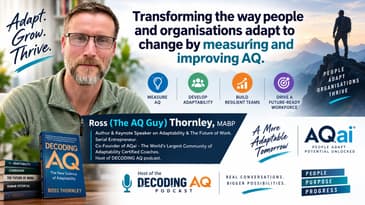
In this thought-provoking episode of Let’s Have This Conversation, Ross Thornley, entrepreneur, author, international keynote speaker, and pioneer of the Adaptability Quotient (AQ), joins us to explore why adaptability may become one of the most important competitive advantages for individuals, leaders, teams, and organizations navigating the age of AI.
As Co-Founder and CEO of AQai, Ross has helped build an AI-powered platform designed to help people, teams, and organizations measure and strengthen their adaptability so they can thrive through accelerating change. A graduate of the Singularity University Executive Program, Ross has worked with leadership teams across Fortune 500 companies, governments, and UN agencies.
He is also the host of the DECODING AQ podcast, where he explores adaptability, emerging technology, leadership, and what it takes to remain valuable in an increasingly unpredictable world.
Ross brings an experimental, curious, and optimistic perspective to the future. His Massive Transformational Purpose is ambitious: “To unite, inspire and accelerate the best of all humanity.”
At the heart of our conversation is a provocative idea: It’s time to shift the conversation from making people redundant to making tasks redundant in the age of AI.
As AI begins reshaping the individual building blocks of work, our professional identities may need to evolve beyond protecting job titles. The future could belong to people who understand how to continuously learn, reinvent themselves, solve new problems, and rebuild the value they bring to an organization.
Ross argues that there may be no completely “safe” jobs—but there can be adaptable people.
So, what separates someone who merely survives disruption from someone who thrives because of it? Can adaptability be measured and intentionally developed? What exactly is the Adaptability Quotient? How should leaders prepare their teams for exponential technological change without allowing fear to dominate the conversation? And as AI takes over more tasks, which distinctly human capabilities become even more valuable?
Drawing on his background in innovation, branding, technology, entrepreneurship, and leadership, Ross contextualizes complex ideas while challenging us to think differently about AI, adaptability, organizational change, lifelong learning, human potential, and the future of work.
The question is no longer simply whether your job will change.
The more important question may be: How prepared are you to change with it?
For more information: https://www.aqai.io/
LinkedIn: @Ross (The AQ Guy) Thornley
Learn more about your ad choices. Visit megaphone.fm/adchoices
[00:00:00] Are You Adaptable At Work? Because the answer to that question could directly correlate to your success rate while at the office. Employees with higher adaptability are two and a half times more likely to demonstrate higher job performance and contribute to meaningful organizational change and success.
[00:00:29] According to ETS, which is a global education and talent solutions platform and organization focused on enabling lifelong learners to become future ready.
[00:00:48] There's no denying the fact that artificial intelligence is rapidly transforming the world of work and perhaps we're asking the wrong question instead of asking, Which jobs will AI make redundant? Should we be asking, What task can AI make redundant and
[00:01:14] How can humans continuously adapt to create new value? In this thought-provoking episode of Let's Have This Conversation, I sit down with my friend Logan Johnson.
[00:01:28] He's an entrepreneur, author, international keynote speaker and the pioneer of the adaptability quotient to explore why adaptability may be one of the most important competitive advantages offered to individuals, leaders, teams and organizations who are adapting to and navigating through the world.
[00:01:58] In this world of AI. As the co-founder of AQAI, Ross has built an AI-powered platform which has helped people, teams and organizations measure the true capability of their adaptability, helping them thrive through a world of accelerated organizational change.
[00:02:23] He's a graduate of the singularity university executive program. He's worked with leadership teams across Fortune 500 companies, governments and UN agencies.
[00:02:40] He's also the host of DCODING AQ podcast where he explores adaptability, emerging technology, leadership, and what it takes to remain valuable in an increasingly unpredictable world. He brings an experimental, curious, and optimistic perspective to the future.
[00:03:06] He says his massive transformational purpose is powerful, yet simple to unite, inspire, and accelerate the best in all of humanity. At the heart of this conversation is a provocative idea. It's time to shift the conversation from making people redundant to making tasks redundant.
[00:03:34] In the age of AI, as AI begins to reshape the individual building blocks of work, our professional identities may need to evolve past protecting job titles. The future of work could belong to people who know and understand the need to continuously reinvent themselves
[00:04:04] and learn, solve new problems, rebuild their value to organizations. Thorley argues that there may not be any completely safe jobs, but there can be adaptable people. And he joined me this week to tell me more about how the future of AI and human adaptability
[00:04:33] can coexist in the world of work. So without further delay, I'm Kevin McShann. Let's have this conversation.
[00:05:15] Adaptability intelligence, also known as adaptability quotient, is the mental capacity to unlearn old habits, adjust your behavior, and thrive when you're facing uncertain conditions. Unlike fixed IQ or traditional knowledge,
[00:05:39] adaptability quotient or AQ is a dynamic skill focused on continual learning. And to start my conversation with Thorley, I asked Tim to put that concept and definition in context. Logan, tell me about adaptability intelligence, because it's an interesting term,
[00:06:08] and it's something that I think not a lot of people get exposed to on a daily basis. So tell me about the concept of adaptability intelligence and how it works, my friend. Yeah, it's an interesting one. You hit the nail on the head in terms of a lot of people haven't been exposed to it, yet everybody has. They just didn't know about it.
[00:06:36] So we've had for many decades emotional intelligence, which is looking at how do we regulate our emotions and behaviors of ourself and with others. Well, our adaptability is very much happening for everybody as we go through life. It is things like our resilience, our mindset, our mental flexibility, our ability to unlearn an old way of doing things and find new ways.
[00:07:02] And so we've been working in this field now for just over eight years to help people figure out how do I deal with change? How do I navigate it? And how do I make sure that the people around me and my teams and organizations can stay valuable and relevant? And it's been a fascinating journey to understand the science and the behavioral science behind how and why people adapt
[00:07:29] and then helping them develop the tools and activities to navigate life with smiles and joy, when often it's hard when we get these setbacks and things that don't quite go the way that we planned. Yeah, absolutely. And, Logan, I've never heard of your work since at the intersection of adaptability and the human side of AI.
[00:07:56] And, you know, with the emergence of AI, sometimes, you know, we get lost in the weeds of the importance of human intelligence. And, you know, I want your perspective on how adaptability, AI, and human performance can all blend together. What are your thoughts there, my friend? Well, we find it quite interesting.
[00:08:22] A lot of the teams and organizations we're working with are experimenting with AI. There's often mandates that come in. They write the checks for the licenses. They get the software in and they run these pilots and experiments. But the real challenge is the human side of it. Is somebody actually able to use it, wanting to use it? Are they fearful of it? And it's our adaptability that is often the multiplier
[00:08:51] to an AI initiative actually landing. And so we find, for example, I mentioned unlearning. Unlearning. Now, that whole concept is, can I appreciate a different way of doing something? And can I let go of a past way that was previously successful? Now, we saw this a lot when, you know, we had different software, different technological solutions came in that said, oh, I can now have a conversation with Kevin via Zoom.
[00:09:20] I don't have to get on a plane and travel to where he is to have the conversation. And we can unlearn. Ah, we can only meet and have conversation in person or on a telephone. Or now we have video calls and Zoom that we can connect with. Now, with AI, there's a lot of fear of it. Oh, will it take my role? Will it take my job? And our adaptability to figure out which tasks do I want it to take?
[00:09:49] And which tasks do I want to keep? And are uniquely how I show up. And that's different for each person and different along the journey of the maturity of the AI tools and what they're working with. So I think it is fundamental. And it's why we say AQ before AI. So it's our adaptability intelligence that unlocks any kind of AI implementation. Yeah, absolutely.
[00:10:16] And, Marissa, I'm curious to get your take on how adaptability intelligence can also be transferred to organizational culture. Because in today's business world, you know, if you don't adapt, you're dying, right? So how do you think adaptability intelligence can transform an organizational culture where,
[00:10:40] you know, people are valued more for, you know, their ability to adapt and their emotional intelligence as well? Because I think organizational cultures go beyond productivity standards. Would you agree with that? I would. And I think it's interesting because we often assess and look at people as individuals. And we'll look at their past, their experience, their LinkedIn profile, their CV, what they've
[00:11:10] done and try to figure out, ah, will they be good for the next thing, the next project, the next promotion? And we often look at the isolation of an individual. Now, when you mentioned about culture and organizations, we don't operate in a vacuum. We operate in teams and around a structure of an organizational culture. So we measure the environment as well. So I might have certain adaptability skills. I might have certain adaptability characteristics.
[00:11:40] But what environment do I operate in? Do I feel psychologically safe? Do I feel really stressed at work? All of these things, and there's five sub-dimensions of our environment, will impact my ability to adapt. There'll either be a lot of friction or there'll be some flow. And so that's where it blends into organizational culture. And an adaptive culture is, you know, much quicker at innovating, staying relevant.
[00:12:09] And there is a lot of studies now, Kevin, that is linking that to financial performance of organizations, the more adaptable that they are as teams and within their marketplace, and also mental health. So our ability to deal with often setbacks, our resilience. The environmental culture really plays a part to that. So, for example, we know in our data that team support acts as a buffer to somebody's individual resilience.
[00:12:39] So I might be depleted from lots of setbacks. But if I'm supported by my team, I can still perform. And then the opposite is true. So if my team isn't very supportive and I have a few setbacks, it can really affect my performance and that of my team and my organization.
[00:12:56] So it's all interlinked and interwoven within our assessment of the individual and the environment factor that then helps to build an organizational capability around how they adapt. Absolutely. And, Logan, I'm personally curious for your answer. You know, Logan, I talk a lot about the importance of inclusion and, you know, the ability to adapt within the work.
[00:13:25] Well, workplace for folks with disabilities because I was born with a spastic quadriplegic cerebral palsy. And I found out at the age of nine that I wouldn't be able to walk for the rest of my life without assistance because of the severity of my cerebral palsy. So this is a timely and interesting question for me to ask someone like you, my friend.
[00:13:50] And I'm wondering if you think adaptability, intelligence and the inclusion of different perspectives, particularly those with people with disabilities in the workplace, can help move an organization forward. So what are your thoughts on the intersection of inclusion, people with disabilities and adaptability intelligence?
[00:14:19] I think as a society and race, we have often reverted to boxes and labels. And we will label people by certain characteristics. Now, whether that is their cognitive intelligence, their physical capabilities, their network. And with countless for centuries wanted to place people in boxes and labels, classes.
[00:14:49] Maybe some of this was about where you were born or how you were born that can show up. And I think our adaptability intelligence is to do two things. One, it's about accepting what is true and then also figuring out. So what now what? What do I need to change? What do I want to change? Do I want to change a system around me? I.e. Ah, they're not allowing access for me to show up, to contribute.
[00:15:16] So what do I want the system to now allow me to do? And vice versa. I'm this way. The system's that way. How do I contribute in the best way that might mean I need to adapt and change and find new tools, new areas, new ways to show up? And you touched on a really interesting point around diversity and around inclusion is that we started, Kevin, because we wanted to make sure no one was left behind.
[00:15:42] So as the future of work changes, as the way in which we show up shifts, how do you make sure everyone has a valuable future relevant to themselves of what that is? And so that's an important one to know that our adaptability is a muscle. We can improve it. We can shift it. We can change it. And we contribute to an environment by the way we show up.
[00:16:07] And we've seen some of the best organizations in terms of their performance, all metrics of success, whether that's net promoter scores, customer satisfaction, shareholder price. There is a direct correlation to how adaptable they are and how inclusive they are from different perspective and voices. So we echo just how important that is.
[00:16:31] And what gets often uncovered is people are, when they get their adaptability profile, surprised by, ah, my label was my role. I'm an accountant. I'm a journalist. I'm this type of person based on my current role. Well, as soon as they get this profile, they see a whole new pathway open up that perhaps wasn't the normal linear flow of,
[00:16:56] ah, someone goes from this role to this role, from management to directors, to leadership, to execs in a particular path. Always been in finance. If we understand the core adaptability of what's their mental flexibility, how resilient are they? They can go to different departments, different areas of showing up much easier once they understand the underpinnings of behavioral change and how humans can show up in different ways.
[00:17:23] So we've seen it unlock incredible new futures for people that they never thought was possible. Yeah, absolutely. And now, Logan, I don't like you describe yourself as someone that's deeply curious about emerging technologies and human potential as well. And, you know, one of the reasons I'm as excited to talk to you is because I don't think you're an internal optimist
[00:17:51] and you're championing the idea of abundance, my friend. So I'm curious to ask you what made this a priority to collaborate with others in this mission towards abundance and putting that towards a growth mindset when we're talking to organizational or entrepreneurial leaders.
[00:18:15] What are your thoughts on the idea of, you know, abundance as a mindset and why is it so important to you to be naturally curious, my friend? I'm fascinated to get your answer there. Well, Kevin, I've got a few thoughts on that. The first one about curiosity, I think to remain curious allows you fundamentally to be adaptable
[00:18:42] because we might anchor something as the best known knowledge at this point, right? At some point, everybody thought the world was flat until we realized and got new knowledge and it's round. So we're curious enough and there's probably still some people who live today who might still think the world is flat. Now, being curious allows us to question what we know is true today that might shift tomorrow with new information, new intelligence, new discoveries.
[00:19:12] And I think that's an exciting way to live, right? To to find that it's also quite fearful, right? Because I thought I knew the answer and now there's a new one that's come along. So you have to be secure in your own skin of that. The second part about abundance, I've certainly drink from that Kool-Aid of believing in humanity's best versions.
[00:19:40] Yes, there's lots of darkness in the world and there's a lot of fear, a lot of scarcity, a lot of polarization happening. I choose to be an optimist. I choose to feed my mind with an abundance because, frankly, you know, there's data out there that says, oh, optimists live longer, etc. Now, whether that's true or not, I'd rather live my life that way.
[00:20:05] I'd rather live my life in a way that is looking for the good, trying to find ways to collaborate and feeling abundant. And I really feel that that is both a filter for those that you surround yourself with and a magnet that attracts other like minded people within that.
[00:20:26] And I think that gives society the best shot of a utopian type of future than a dystopian type of future, despite what Hollywood and sci-fi want us to believe of a dystopian future. A lot of us, you know, that sells a lot. Fear sells a lot.
[00:20:47] I subscribe to the view of I believe we can leave it better for the next generation by desire and intent. Yeah, absolutely. Now, my friend, I know that your work has been recognized by such publications as the Wall Street Journal and Forbes and the Financial Times and all.
[00:21:11] And there's a way particularly around, you know, adaptability, innovation and the future of work. So as someone who spends so much of your time studying change and what keeps you curious and committed to your own growth mindset,
[00:21:34] so I'm curious, what keeps you partially curious to your own growth mindset to learn more about adaptability and change and how it affects human behavior? So what keeps you internally motivated from a personal perspective, my friend? I think that's really interesting around, you know, why do any of us do what we do? And I think it's mixed.
[00:22:00] You know, when you talk about motivation, there's intrinsic and extrinsic. We actually, within our motivation style, are looking at regulatory focus. So do we do something to gain something new? You know, do you play to win or do you do something to protect what you already have? Play not to lose. I think for me, what keeps me this way is part habit. It's part of my identity to seek out new information.
[00:22:30] I've built the neural nets that enjoy the discovery, enjoy reading, enjoy having conversations, enjoy going to different cultures, different places and speaking and listening to speakers. And that kind of intentional choice is now self-fulfilling prophecy in that I'm in that zone.
[00:22:54] You know, I'm in my happy place when I'm meeting new people, when I'm learning new things because I've designed my system that way. I think underneath it, it was probably people around me that I was inspired by and influenced by. So from my parents who were both teachers, Kevin, and seeking knowledge and information and sharing it was part of their value set.
[00:23:22] So I have embodied some of that, you know, I take complex subjects and try to digest them and then repurpose them in different ways, in different thinking models, in training, in coaching and technological platforms and services and things.
[00:23:39] And the other part is then, you know, the applause, the applause that I get when I reflect in a meditation at the end of the day of did I make progress today? Did I help someone see something that they couldn't see? Did I help someone through a difficult conversation or a challenge or to see a future that was better? And at the same time, is that applause coming from people that I admire?
[00:24:09] My wife, does she show up and say, oh, I'm growing, I'm improving as a human. You know, I show up better with the grandkids. I think all of that is mixed in with it, Kevin, is the future Ross somebody that I'd be proud of.
[00:24:26] And that's what keeps me going to be remain ambitious, to keep learning, to keep finding out new things and, you know, to be an endless student. You bring up the idea of being an endless student, my friend. And as you know, it's back to school season all across the world, my friend.
[00:24:52] And I'm interested to get your thoughts on the importance of curiosity and nurturing curiosity in the next generation. As teachers go back to the classroom, I often say that teachers have the empowerment to change and reshape the world. Because they're the stewards of the next generation.
[00:25:19] So, out of personal and professional curiosity, I'm curious to ask you about the importance of nurturing curiosity in children and the role that educators play in shaping the next generation of leaders. What are your thoughts there, my friend? I'd actually flip it, Kevin.
[00:25:44] Instead of nurturing it, I would think about it as not stifling it and not crushing it out of children. There's some studies done. In fact, Dr. Diane Hamilton, who focuses a lot on curiosity, she wrote The Curiosity Code. And some of the work pointed to the fact that we're the most curious at age five.
[00:26:09] And what then happens is we get bashed along the way and we form these, you know, horse racing blinkers on and we go into our echo chamber from, oh, don't look over there because they're not like you or don't go over there because they don't believe the same things you believe. Or don't read that news channel because that's not to your persuasion.
[00:26:30] And over time, education, society and work actually bashes out our curiosity. And I feel the opportunity is the opposite, is to allow it to remain, to face each day with childlike eyes, you know, with our inner five-year-old that was just in awe of the world rather than, oh, been there, done that.
[00:27:00] And I shortcut it. You know, how many times have we travelled somewhere that we or do something that we do every day, brush the teeth, make a meal and we're just on autopilot? We're not looking at the beauty of, wow, if it was the first time we were cutting that tomato and we'd be so amazed by its colour, its smell, its texture. And we'd poke it and prod it like a five-year-old would.
[00:27:26] I like to think of the education is to allow that playful child that is inside all of us that has these fresh new eyes on everything. And that, I think, is the unlock, especially when we're faced with a future that's so uncertain. We're not following in the footsteps of what was yesterday. Ah, just rinse and repeat and I get the result.
[00:27:54] We're entering in a world where it's so uncertain, technology, political issues, blind to. The blind spots that are just in the room that we're in, let alone outside of our echo chambers. So that, for me, I think is one of unlocking the playful child rather than nurturing curiosity. It's not allowing it to be depleted is kind of my view on that, Kevin.
[00:28:24] Yeah, well, you know, it's an interesting distinction. I'm glad you made it. And, you know, I think teachers and children have a very unique partnership. And it's important to announce the day for curiosity, isn't it? Yeah, it is. And it's the dare to dream.
[00:28:45] And I think we've almost entered this magical moment in history where the only barrier to creativity is our imagination. In one of my first books, I wrote about entering into the imagination economy. And we've previously been operating in the knowledge economy.
[00:29:04] And now where that knowledge is so accessible across the board at a rate that is both speed and price that has democratized it. Now the opportunity is as wild as our imagination of what we may be able to create a future of.
[00:29:29] So nurturing imagination around optimism and abundance, I think, is the role and job of parents and educators. And to view things in that way, I think, is the beauty that we are on the precipice of, Kevin. Yeah, absolutely. And, Ross, I'm curious to get your thoughts on this.
[00:29:56] Because when we talk about, you know, communication at work, there seems to be a significant communication gap when it comes to organizations as they navigate change.
[00:30:10] And this is buster's by the fact that according to the change tipping report, 99% of leaders believe that their communication change and the way that they communicate change is effective.
[00:30:29] But only 25% of today's employees agree that their leadership or bosses effectively communicate organizational change. So the question to you is, how do you think we've got so inadequate in communicating that, you know, the organizational change gap?
[00:30:55] And how do you think that we can invest the people that were in charge of leading in making some of those changes?
[00:31:06] Because I firmly believe if you invest in making sure that your people are a part of making decisions, their, you know, their morale and willingness to go along with changes are more adapt if they have a, you know, a stake in the process.
[00:31:27] So how do you think we can get employees and leadership on the same page when it comes to organizational and communication changes, my friend? What are your thoughts? It's an interesting one where you talk about this ineffective communication and the gap. And I think a few things showed up for me, Kevin.
[00:31:50] The first one was the very real challenge is the volume of change that's happening that used to be episodic and a project and a program to now compounding that's coming out of companies like ProSci and others, you know, six to 10 very meaty change programs going on in parallel. So that's one underlying challenge we have in communication.
[00:32:20] The second part is the complexity of the communication when you've got multiple changes happening that it can either both be diluted. I could be disconnected from why is this happening? Do I want it to happen? Do I know how to deal with it? And that then links to change uncertainty. If I don't know why it's happening, how it will affect me and what do I do about it? I'm then in limbo.
[00:32:48] I then don't act and I often disengage. So I think it's about connecting not only with how the leaders respond to, oh, if I communicate it this way, that's how I would then respond to change. And I'd go from friction to flow, but actually understanding each individual's profile and communication that's required in order for them not to just change through compliance.
[00:33:15] Because you told me so and you were my boss, but change because I actively have been involved in it. I understand where I show up and how I can contribute to that. It's not easy. And we often have to communicate way more than we would want to. I remember a politician talking about a change activity and he said, you know, internally we're so done with this communication of this change we're doing.
[00:33:45] And he said, just when you've communicated it so many times that internally you're sick of it, do you only touch the outer skin of your audience to have heard what that change is about?
[00:33:57] So I think that just disconnect of how much we need to communicate, how we need to communicate clearly within alignment of what will shift that person and to recognize that change is happening five or six times at the same time for somebody. How do we pause a moment? How do you create a little bit of space for the nervous system to actually hear that message?
[00:34:24] Because most of the time it's just hitting and bouncing off me because I'm rabbit in the headlights. I'm stressed out. I don't hear what's going on. So how do we just calm the nervous system slightly to be able to even hear a message? So I think it's difficult. It's complex, but it's not impossible when we understand the neuroscience and behavior behind it.
[00:34:48] Leaders, together with some of the data that we provide, can really create communications programs that are effective and do land. Absolutely. And it's important to listen to the people that you're in charge of leading, isn't it? Because some of the most important innovation changes come from the people on the front lines, doesn't it? A hundred percent.
[00:35:15] Yeah, we need to open that opportunity for the adaptation and implementation to come regardless of hierarchy, of work tenure, of any other traditional stakeholders who have budget or further weight behind their idea is to provide an environment and a system that allows that creativity to flourish wherever it comes from. Yeah, absolutely.
[00:35:41] And Raj, you make the argument that it's time to shift the conversation from making people redundant to making tasks redundant in a world of, like we said, the AI revolution, which represents a very different way of thinking about the way of automation and innovation.
[00:36:03] So what does the distinction mean to you making sure that people are not redundant? But Tastosh, I'm wondering if you could make some distinctions between the two for me, my friend. Yeah, I think when we've designed organizations and the structure around family of roles, you know, so we have the finance roles and then we have a job role and a job title.
[00:36:31] When we break those down, there are a collection of tasks, tasks within elements of responsibility. And if we think about a person as our will make the let's say customer service people redundant and that role redundant. Well, there are elements within those tasks. Let's say they do 100 different tasks. Some of that is busy work, just keeping them busy.
[00:36:55] That is better done through software or technology or processes or things like that. And if we collect those out, that might make up anywhere between 100 and one of those tasks that would be better done at that busy work that's put out.
[00:37:11] And I think if we decouple somebody from their role, I am an accountant, I am a journalist and therefore the fear of I've got to hold on to that role, which is a collection of tasks. We get these barriers of my roles being made redundant and therefore I hold on to it. I put the friction in and things take a long time. And then all of a sudden, you know, an FD or someone with a line will go, right, we'll remove those out of the business.
[00:37:42] If we're more open to restructure and think of all of those tasks as Lego bricks, children are great at looking at those Lego bricks and creating. Yes, here's the picture on the box. I can create that. But there are a thousand other things that I could create with those same blocks. And what we've been limited to is the picture on the box of those tasks, that those tasks make up this job role.
[00:38:06] What we can unlock now is go, right, let's make some of those tasks redundant and then let's recreate a new role, a new kind of position, a new kind of way I can show value with those tasks structured in a different way. And I think that's the reinvention we're going through at the moment.
[00:38:26] And therefore, I feel that that is a very honest perspective that, yes, some tasks need to shift to another way of production. You know, we've seen this in different ages where, you know, we've had technology come along in farming and people's roles shifted to machines. We've had it in factories where people's roles shifted to machines.
[00:38:51] Now it's knowledge workers of their tasks shifting to machines, algorithms or humanoid robots in the next couple of years. So what we now need to do is remodel those tasks into new roles, new definitions and remain flexible around them. And we can morph around projects and how we show up with different skill sets and different tasks that are required.
[00:39:15] So I think that's a more grown up and honest conversation that we should be having. Yeah, absolutely. You know, I know that for nearly a decade, you've worked on focusing on understanding and measuring and improving, you know, adaptability at scale.
[00:39:39] And I know that AQAI has accumulated more than 2 million adaptability intelligence data points and trained over 500 certified AQ partners across more than 40 countries. So with that in mind, I'm curious to ask you about the global experience that this has created.
[00:40:06] And what have you learned about what actually makes someone or an organization adaptable? And what misconceptions about adaptability have you sort of seen the data challenged, my friend? So what are your thoughts there? It's interesting. We often have these various idioms and sayings, things like, oh, you can't teach an old dog new tricks, for example.
[00:40:35] And actually, we've got the data that shows that, yes, you can. People can unlearn. And we see this across different age demographics, for example, and work tenures that in learning, unlearning can increase. For example, our grit. For example, our grit. So our passion and perseverance increases with age globally. We also see that things like middle managers are some of the most stressed.
[00:41:04] They report work stress as the highest across all work levels. So we start to see these areas of some of these sub dimensions show up based on certain demographics. So that could be locations or work types. Or, you know, we often think, ah, women can multitask. Men can't. You know, all these various myths and sayings of mental flexibility.
[00:41:33] And actually, there's not a huge distinction between male and female's ability to have cognitive flexibility. So it's what we call mental flexibility. Hold two opposing thoughts at the same time. So this could be one route of solving something and so could this. Or is it? No, it's only my route. Only this way. This is the only way that I could solve it.
[00:41:54] So I think it's interesting as we've now built, as you mentioned, one of, if not the largest data set in the world around adaptability intelligence, is we're now able to start to benchmark, benchmark industries, benchmark countries. And we're starting to be able to use that to help organizations see where they fit and lead others.
[00:42:21] So I think what makes them good is a desire to be, you know, an intentionality. Most of the organizations we're working with that do well have identified themselves just how important adaptability is. So it'll exist in part of their values. It'll exist in part of their strategy. It'll exist in part of their leadership development programs. And they come to us because we're the most credible in the space.
[00:42:50] We've got the science behind us. And we now, as you mentioned, we've got a huge network of certified partners that can support in the debriefing, in the coaching, in the training, in what to do once you've got these measurements to get the kind of performance outcomes that you want. So I think it's, you know, a fascinating time in history where, you know, you've mentioned emotional intelligence a few times.
[00:43:17] That's sort of two, three decades on. And it's a common language for companies of how they operate and function in humans. My desire is, Kevin, is that AQ, our adaptability quotient, is what will help us navigate this very uncertain period in our lives to be able to ensure that companies do survive. And you said it best, you know, adapt or die.
[00:43:43] The companies and people that aren't able to adapt are the ones that won't exist. And so rather do that intentionally. Yeah, absolutely. To your point, Ross, we're speaking more and more leaders of organizations. Identify adaptability is their number one skill that they want to strengthen, develop, or improve.
[00:44:06] So I'm curious to ask you about, as we see, you know, AI and technology expectations continuing to evolve in the workplace. I'm curious to think of, as we see, what do you think is the new modern definition of, you know, adaptability at work?
[00:44:33] And how can we make sure that we still create human-centered workplaces while embracing adaptability? So what's your definition of successfully, you know, integrating adaptability into today's workforce? I think one of the other misconceptions that you've just made me think of when you asked that question was,
[00:45:02] when we ask people, what does adaptability mean to you? All of the words and all of the phrases are all linked to change. Change, change, flexibility, resilience, you know, something that has to change. Now, part of our adaptability intelligence is, what do we not want to change? What do we want to keep stable? Maybe I don't want to change how I show up.
[00:45:29] Maybe I don't want to change my core values of connection, of love, of belonging. So there's certain parts in adaptability of knowing what are our stable things. What are things that are our non-negotiables? And that's different for each person, different for each team, different for each organization to understand what do they want to stay true to.
[00:45:55] What we often find is the friction comes when they're staying true to hows, not whys. So what I mean by that is, ah, the way that we show up in the world is with renting VHS cassettes. We're blockbusters, for example. And we're committed to that. We're not going to change that. We get a lot of our income from late fees that people don't bring them back.
[00:46:23] Now, if what they were passionate about and gritty about was telling stories and connecting stories to people, they might have been more open to different hows. Ah, well, that can be, you know, postal DVD rentals to streaming. And they could have shown up in different ways throughout that journey if what they wanted was a higher order and able to then allow different hows to come in.
[00:46:53] So the other part that you mentioned in your question there, I think, is coming down to as people go through changes, it is unnerving. It is often faced with fear and we need the support of other people around us to help us through that. And we go through it at different speeds, in different ways and different journeys.
[00:47:22] And allowing for that is really important. We will have society that are connected with, you know, chips in our heads. Even in my lifetime, we'll have lots of humanoid robots. We've got, you know, Tesla cyber cabs now happening in Austin and various places. So these things become accessible. It's still in our choice of how do we want to show up within that?
[00:47:50] And that, I think, is part of judgment. And our own judgment and then not to impose that judgment on others is a challenge. But allowing people to make informed decisions and informed choices around adaptability. So for me, adaptability is very personal. And the meaning and sense for work should be personal around it. And it should be holistic.
[00:48:18] So it looks at the whole person and the whole system so that we have an operating system that functions, that is fit for each environment that we evolve into. Yeah, and, you know, Ross, I'm curious to ask you, you know, through your podcast, which is entitled Decoding AQ Podcast, and your book.
[00:48:44] You've created different vehicles for helping people understand adaptability as they prepare for training. So I'm curious, what conversations do you hope that your work sparks long after you're gone about adaptability? And when you look at your own life and your own legacy, how do you want that to be defined?
[00:49:13] Wow, what a deep question, Kevin. And I think as we go through various phases in our lives, that reflection question around legacy is an interesting one. I've been daily meditating, Kevin, now for over 800 days. And it's really interesting what shows up in that practice.
[00:49:38] And I've actually been thinking a lot, not in a morbid way, but in, you know, what am I leaving behind? And we used to, in any engagement, in any event, as I used to, we still do, we do three things. What do I want them to know? What do I want them to feel? And what do I want them to do? And when you define those things, it then boils down to this, you know, lasting impression.
[00:50:07] What will they do as a result of it afterwards? So to come to your question of what do I hope people will take on long after I've gone? I think fundamentally the belief that the future for each individual is bigger than their past.
[00:50:26] Whether they are 90 years old or 10 years old, that if we remain in that optimism and the idea that I have a future, then you will have one. So for me, that adaptation that we can all fit, we can all belong. We that doesn't make everybody the same. You know, I love the beauty that we have such diverse ways people show up.
[00:50:56] The inclusion of, you know, my wife, for example, Kevin, her hierarchy is our pet dogs, our rescue chickens, all other animals than me. So I'm first human, which is good. But her way she shows up in the world is such compassion for animals. It's just beautiful to witness.
[00:51:21] So my legacy I want to inspire people to be around is that, yes, our adaptability is life. That is the way in which we can live well and live well with others is to understand our intentional adaptations that we make and the choices that we make. Yeah. Our family, our community, and as a species.
[00:51:51] Yeah, absolutely. Ross, I've got a few extra minutes I didn't think I was going to have. So I'm going to sneak one more question with you, my friend. I'm curious to ask you about being a natural problem solver and adaptability because I think people with disabilities, going back to that for just a second,
[00:52:15] I often say that people like myself and others with disabilities are natural problem solvers and their ability to adapt to change more readily than their non-disabled counterparts. So I'm curious to get your thoughts on the connection between adaptability, problem solving and those with disabilities.
[00:52:42] What do you think their non-disabled counterparts can learn from them, my friend? What are your thoughts? It's interesting what showed up when you were setting that up, Kevin. And what was coming to my mind was that the challenges are often the spark to creativity when we're faced with challenges.
[00:53:08] Now, for somebody who has a form of disability, whatever that may be, or reach a point at which their life changes, a diagnosis, a health condition, going through a life event from, you know, having a family member pass on, whatever it may be that forces us in a challenge to creatively solve something.
[00:53:34] And my coach, I remember years ago when we were talking about creativity and challenges and things, and he made a distinction around, well, if you can write a check to solve that, what you've got is a project, not creativity.
[00:53:55] So when whatever resource it is to solve it doesn't exist, we implore our creativity and innovation. So I think not being disabled myself, I can only speak from what I've witnessed and observed of others, is when the resources to solve something has been removed, creativity comes in and shows, how will I find a way?
[00:54:22] How might I find a way to do something? And I've seen incredible things come as a result of that. I remember interviewing somebody who had very young early onset Parkinson's on my podcast and how that inspired such a season of creativity for them in their lives that perhaps may never have shown up.
[00:54:47] So these opportunities that we can learn from people that have faced challenges, whatever challenge it is that they've faced, that have been creative, that have looked for ways of how do they solve things when the normal pathways don't exist for them. We see a lot of entrepreneurs do that when they're creating a new way of doing something and they bootstrap and they find new solutions to problems that previously might not have been solved.
[00:55:17] I think it's by storytelling. It's by listening. It's by championing and applauding those stories. And often they're hidden. And certainly the culture in countries like the UK, for example, we tend to not want to blow our own trumpets. Oh, look what I've managed to overcome. In other countries, they celebrate a lot of that.
[00:55:43] Look what I've overcome. Look what I've achieved. And for that to be not judged, but to be applauded and to inspire others. I know you do a lot of motivational talks and speaking, and that's exactly that, right? To inspire others to whatever challenges they're facing, to know that there are solutions. They're lurking just around the corner, maybe in their mind, maybe in a story, maybe in a conversation.
[00:56:13] Yeah, absolutely. Well, Ross, I have to tell you, this has been a dynamically wonderful and thought-provoking conversation about adaptability change and how it affects the workplace, my friend. So if people want to continue the conversation with you, what's the best way they can get in contact with you, my friend? Thank you, Kevin. Before I answer that, I just want to say how joyful this conversation has been.
[00:56:41] Your questions have really allowed me to reflect and think and articulate things in different ways than I have before. So I want to just acknowledge how you have managed to frame things that help clarify my own thinking in communication. So thank you for that. If people do want to get in touch and hang out and find out what we're up to and what we do, a couple of places.
[00:57:05] So I'm on LinkedIn as Ross Thornley on LinkedIn. Do get in touch with me that way. If you're interested in some of our work, our organization is AQ, as in adaptability quotient, AQAI.io. And you can check out some of our ways in which we show up. So I'm easy to find on LinkedIn. Check us out online. And Kevin, it's been a real blast.
[00:57:30] Well, Ross, I want to thank you for your time, your clear expertise in this subject and for agreeing to engage in conversation with me, my friend. Your time on my behalf and your expertise, energy and enthusiasm for this conversation is most appreciated. And I want to thank you for being here, my friend. Much love. Thank you, Kevin.