
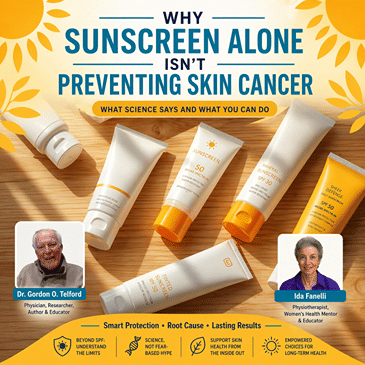
Is your sunscreen giving you a false sense of security?
Most of us have been taught that sun protection starts and ends with a bottle of SPF. However, as a clinical biochemist and holistic aesthetician, I know that the "Sunscreen Only" narrative is missing a massive piece of the biological puzzle.
In this episode of Where Science Meets Self-Care, Dr. Gordon O Telford (Dermatologist) and I explore why skin cancer rates continue to rise despite widespread sunscreen use. We dive into the deeper biological story: how oxidative stress, immunosuppression, and nutritional deficiencies (specifically Vitamin A and B3) leave the skin vulnerable, regardless of how much cream you apply.
What We Explore in This Discussion: The SPF Paradox: Why surface-level protection isn't stopping the rise of non-melanoma skin cancer. Oxidative Stress & DNA Repair: How free radicals drive damage even when the skin isn't "burned." Vitamin A (Retinyl Palmitate): The critical role of Vitamin A in cellular repair and structural defence. Immune Health:
How your skin's local immune system acts as a "security guard" against carcinogenesis. Niacinamide & Vitamin D: Understanding the biochemical pathways that support skin resilience from the inside out. It’s time to stop just "blocking" the sun and start "building" the skin.
For Educational Purposes Only: This interview reflects the clinical observations and professional opinions of Dr. Gordon O. Telford. The scientific concepts discussed—including photobiology and physiology-based approaches—are intended for academic discussion and do not constitute medical advice.
Cosmetic Status: Cloud Vitamin Cream products are registered in Canada strictly as cosmetics. Under Health Canada regulations, they are designed to moisturize, beautify, and improve the skin's appearance. They are not drugs or Natural Health Products (NHPs), and they are not approved to prevent, treat, or cure skin cancer, actinic keratoses, or any other medical condition.
The Formulator: Dr. Telford formulates Cloud Vitamin Cream, a line of topical vitamin cosmetics. The Formulation: These products are vegan-friendly, suitable for all skin types, and crafted in a clean, pharmaceutical-grade base. The Limit: Cloud Vitamin Cream products are registered strictly as cosmetics to hydrate and improve the appearance of dry, aging, or sun-damaged skin. They do not contain active sunscreen filters and do not replace conventional sun protection.
Connect with Ida Fanelli
Link in Bio.
Is there a more biological way to protect our skin from the sun? Dr. Gordon O. Telford, MD, FRCPC (Dermatology & Internal Medicine), FAAD, Private Practice (retired), Nova Scotia, Canada, retails these products on his website
#SkinCancerPrevention #SunscreenScience #OxidativeStress #VitaminA #ImmuneHealth #HolisticDermatology #IdaFanelli #WhereScienceMeetsSelfCare #Niacinamide #SkinRepair #BiochemistryOfBeauty #PreventativeHealth
00:00:00 --> 00:00:03 Welcome to Where Science Meets Self -Care with
00:00:03 --> 00:00:06 Ida Fanelli. With over 30 years in beauty and
00:00:06 --> 00:00:09 wellness and a background in medical science,
00:00:09 --> 00:00:12 Ida blends clinical knowledge with holistic care.
00:00:13 --> 00:00:16 Each week, she and her guests share insights
00:00:16 --> 00:00:19 to help you achieve healthier skin, balanced
00:00:19 --> 00:00:23 energy, and empowered self -care. Now, here's
00:00:23 --> 00:00:31 your host, Ida Finelli. Today, I have the pleasure
00:00:31 --> 00:00:36 of speaking with Gordon O. Telford, MD, FRCPC,
00:00:36 --> 00:00:41 Dermatology and Internal Medicine, FAAD, a Canadian
00:00:41 --> 00:00:45 physician with dual specialist training in dermatology
00:00:45 --> 00:00:49 and internal medicine. Dr. Telford has investigated
00:00:49 --> 00:00:52 a vitamin -based approach to sun protection grounded
00:00:52 --> 00:00:56 in cutaneous physiology. In this conversation,
00:00:56 --> 00:00:58 we will examine that work and explore where our
00:00:58 --> 00:01:01 perspectives align and where they thoughtfully
00:01:01 --> 00:01:05 differ on strategies for skin cancer prevention.
00:01:06 --> 00:01:09 If you are someone at increased risk for skin
00:01:09 --> 00:01:12 cancer, we invite you to stay with us as we explore
00:01:12 --> 00:01:15 evidence -based strategies that may help inform
00:01:15 --> 00:01:19 prevention based on this article. Non -melanoma
00:01:19 --> 00:01:23 skin cancer is... potentially preventable disease.
00:01:24 --> 00:01:26 Now we'll discuss his background and clinical
00:01:26 --> 00:01:30 experience. Dr. Telford practiced medicine for
00:01:30 --> 00:01:33 over four decades with a clinical focus on non
00:01:33 --> 00:01:36 -melanoma skin cancer, photoaging and preventative
00:01:36 --> 00:01:40 dermatology and is now retired from private practice
00:01:40 --> 00:01:43 in Nova Scotia, Canada. He completed specialist
00:01:43 --> 00:01:46 training in internal medicine and dermatology,
00:01:46 --> 00:01:50 earning fellowship in the Royal College of Physicians
00:01:50 --> 00:01:55 of Canada, FRCPC in internal medicine in 1977
00:01:55 --> 00:02:00 and in dermatology in 1979. He has also been
00:02:00 --> 00:02:03 a fellow of the American Academy of Dermatology,
00:02:03 --> 00:02:09 FAAD, since 1981. Throughout his career, Dr.
00:02:09 --> 00:02:12 Telford demonstrated a strong commitment to clinical
00:02:12 --> 00:02:15 research, medical education, and patient -centered
00:02:15 --> 00:02:18 prevention, alongside leadership in nonprofit
00:02:18 --> 00:02:23 and professional organizations. His work integrates
00:02:23 --> 00:02:27 insights from photobiology, cutaneous immunology,
00:02:27 --> 00:02:31 and nutritional biochemistry, emphasizing long
00:02:31 --> 00:02:34 -term skin health rather than short -term cosmetic
00:02:34 --> 00:02:38 outcomes. Beginning in the late 1970s, Dr. Telford
00:02:38 --> 00:02:41 followed high -risk patients longitudinally and
00:02:41 --> 00:02:45 explored the role of topical vitamins. and antioxidants
00:02:45 --> 00:02:49 as adjuncts to conventional sun protection. His
00:02:49 --> 00:02:52 open labeled perspective clinical experience
00:02:52 --> 00:02:55 informed a prevention model centered on immune
00:02:55 --> 00:02:58 preservation, reduction of oxidative stress,
00:02:58 --> 00:03:01 and protection beyond ultraviolet radiation alone.
00:03:02 --> 00:03:04 In addition to his clinical work, Dr. Telford
00:03:04 --> 00:03:08 served for 30 years as a medical expert and commentator
00:03:08 --> 00:03:14 on CFAX radio. where he translated complex medical
00:03:14 --> 00:03:17 topics for the public and contributed to community
00:03:17 --> 00:03:21 health education. Welcome, Dr. Telford. Thank
00:03:21 --> 00:03:24 you very much, Ida. That's a very nice introduction.
00:03:25 --> 00:03:27 You're welcome, and I'm so glad that you're here.
00:03:27 --> 00:03:31 Absolutely. Dermatology organizations describe
00:03:31 --> 00:03:35 non -melanoma skin cancer as an epidemic with
00:03:35 --> 00:03:39 over 6 million procedures annually in the U .S.
00:03:39 --> 00:03:42 Despite decades of public education and widespread
00:03:42 --> 00:03:47 sunscreen use, incidence continues to rise. From
00:03:47 --> 00:03:49 your perspective, why has prevention failed to
00:03:49 --> 00:03:51 keep pace? What we're going to do just for a
00:03:51 --> 00:03:53 moment is we're going to go back and say, what
00:03:53 --> 00:03:56 were the basis of which people made decisions
00:03:56 --> 00:04:00 in the old days, okay? back when I was first
00:04:00 --> 00:04:04 starting my practice. Scientifically, ultraviolet
00:04:04 --> 00:04:08 light, sunburn specifically, was a complete carcinogen,
00:04:08 --> 00:04:13 so that the development of sunscreens all occurred
00:04:13 --> 00:04:16 saying we need to prevent sunburns, therefore
00:04:16 --> 00:04:21 we need to block UVB. Over time, and this is
00:04:21 --> 00:04:25 where I come in too, As I watched my patients,
00:04:25 --> 00:04:28 right? These are guys who have multiple skin
00:04:28 --> 00:04:30 cancers. I see them every two or three months.
00:04:30 --> 00:04:33 They come in with a new skin cancer. And you
00:04:33 --> 00:04:36 say, you know, these sunscreens you're wearing
00:04:36 --> 00:04:39 don't seem to work. You're still getting skin
00:04:39 --> 00:04:44 cancer. So that's the background. So we saw clinically
00:04:44 --> 00:04:50 that improvement in SPF protection did not translate
00:04:50 --> 00:04:55 into cancer prevention. Now we have SPFs of over
00:04:55 --> 00:05:00 100. We have added UVA, so we've broadened the
00:05:00 --> 00:05:04 spectrum of protection to include UVA. And we
00:05:04 --> 00:05:08 still see the same thing. These sunscreens are
00:05:08 --> 00:05:12 not preventing skin cancer. If you look at why,
00:05:13 --> 00:05:16 what have we done wrong? What we're failing to
00:05:16 --> 00:05:19 realize is that sunscreens are designed to block
00:05:19 --> 00:05:24 UVA and UVB. which is only 7 % of the light that
00:05:24 --> 00:05:27 strikes your skin when you walk outside. The
00:05:27 --> 00:05:32 other 93%, 43 % of it, is visible light, so what
00:05:32 --> 00:05:36 you see. The big one is infrared, and infrared
00:05:36 --> 00:05:39 you experience as heat when you walk outside.
00:05:39 --> 00:05:44 That infrared, in fact, is 50 % of the sun's
00:05:44 --> 00:05:48 energy. So we've taken a little tiny narrow spectrum,
00:05:49 --> 00:05:53 focused on that and missed the big picture, okay?
00:05:53 --> 00:05:57 I don't mean it as fault and blame. You know,
00:05:57 --> 00:06:00 this is the evolution of science or medicine,
00:06:00 --> 00:06:05 right? So now we're at a point where we're going
00:06:05 --> 00:06:08 to talk about this over the course of the next
00:06:08 --> 00:06:12 hour. Oh, I start out, oh, I'm noticing that
00:06:12 --> 00:06:15 my patients aren't getting better. So what can
00:06:15 --> 00:06:18 I do? to improve the effectiveness of sunscreens.
00:06:19 --> 00:06:23 That's where this whole game starts. Your article
00:06:23 --> 00:06:28 emphasizes epidemiological differences between
00:06:28 --> 00:06:31 basal cell carcinoma and squamous cell carcinoma.
00:06:31 --> 00:06:35 Why is that distinction important? Way back,
00:06:35 --> 00:06:39 40 years ago, there's a study called the Helios
00:06:39 --> 00:06:42 study. And what the Helios study did is it looked
00:06:42 --> 00:06:46 at the frequency of skin cancer. and plotted
00:06:46 --> 00:06:49 against the amount of accumulated sun exposure
00:06:49 --> 00:06:53 you've had. And what you see is that for squamous
00:06:53 --> 00:06:57 cell carcinoma, the least common, you see a dramatic
00:06:57 --> 00:07:01 rise. It goes from almost zero to a thousand
00:07:01 --> 00:07:05 as soon as you hit a certain number of 100
00:07:05 --> 00:07:09 hours of exposure. So we conclude, oh, squamous
00:07:09 --> 00:07:13 cell carcinoma is a product of total accumulated
00:07:13 --> 00:07:16 sun exposure. Now, if you look at basal cells,
00:07:17 --> 00:07:20 you see there doesn't seem to be make any difference
00:07:20 --> 00:07:24 how much sun you've had. Oh, therefore, the cause
00:07:24 --> 00:07:29 is not accumulated sun exposure. You certainly
00:07:29 --> 00:07:33 need sun exposure to get a basal cell. But those
00:07:33 --> 00:07:37 are two totally different animals to deal with.
00:07:37 --> 00:07:41 And the mistake that we continue to make is that
00:07:41 --> 00:07:44 we lump them together. Say, oh, they're all the
00:07:44 --> 00:07:47 same thing. No, they're not. If being born with
00:07:47 --> 00:07:52 a Y chromosome makes me a boy and lack of Y makes
00:07:52 --> 00:07:56 you a girl, we're not the same. Fundamentally,
00:07:56 --> 00:07:59 there's a profound difference. Okay? That make
00:07:59 --> 00:08:03 sense? Definitely. The NAMBERS study is often
00:08:03 --> 00:08:06 cited as definitive evidence for sunscreen efficacy.
00:08:07 --> 00:08:10 While it demonstrated benefits for... squamous
00:08:10 --> 00:08:12 cell carcinoma, it failed to show a significant
00:08:12 --> 00:08:15 reduction in basal cell carcinoma incidents.
00:08:15 --> 00:08:18 What clinical lessons should dermatologists take
00:08:18 --> 00:08:23 from this? The NAMBOR study is very important
00:08:23 --> 00:08:26 from a number of different aspects. First, it's
00:08:26 --> 00:08:29 a double -blind prospective trial. That's what
00:08:29 --> 00:08:33 we should be doing, right? All new treatments
00:08:33 --> 00:08:36 should be submitted to this kind of investigation.
00:08:37 --> 00:08:40 The fact is, Nambour's study was done by a bunch
00:08:40 --> 00:08:44 of derms in Australia who are highly interested
00:08:44 --> 00:08:48 in something. It's never been repeated. It should
00:08:48 --> 00:08:51 be repeated all the time. So here's what happened
00:08:51 --> 00:08:53 in the Nambour's study and why it's so important.
00:08:53 --> 00:08:57 They said, okay, we're going to conduct a double
00:08:57 --> 00:09:00 -blind trial. That means nobody knows what the
00:09:00 --> 00:09:03 answer is as you go along. They took half the
00:09:03 --> 00:09:06 patients and they treated those Patients with
00:09:06 --> 00:09:10 a sunscreen with a SPF of 16. So that's half.
00:09:10 --> 00:09:15 The other half got whatever they use. So they
00:09:15 --> 00:09:18 watched them for three years. So they gave them
00:09:18 --> 00:09:20 sunscreens for three years. And then they watched
00:09:20 --> 00:09:24 the results for 10 years. That's unbelievably
00:09:24 --> 00:09:28 good information for us. And what they saw is,
00:09:28 --> 00:09:32 yeah, you could reduce the cancer that's due
00:09:32 --> 00:09:36 to the accumulated sun exposure. You can. But
00:09:36 --> 00:09:40 it's the little one. The big one, it was useless.
00:09:41 --> 00:09:44 Absolutely useless. Well, that's a total shock
00:09:44 --> 00:09:48 to all of us, right? We were prescribing sunscreens
00:09:48 --> 00:09:51 to our patients, use these, blah, blah, blah.
00:09:51 --> 00:09:53 And here comes a little bit of science that says,
00:09:54 --> 00:09:56 guess what? Your thinking is completely wrong.
00:09:57 --> 00:09:59 And your advice is therefore wrong, which is
00:09:59 --> 00:10:03 very hurtful. It's simply true. So this type
00:10:03 --> 00:10:07 of study needs to be done much, much more frequently,
00:10:07 --> 00:10:11 and it needs to be supported by industry. Much
00:10:11 --> 00:10:14 of skin cancer prevention has focused on ultraviolet
00:10:14 --> 00:10:18 radiation. Can you put that in context with respect
00:10:18 --> 00:10:20 to the full spectrum of sunlight that reaches
00:10:20 --> 00:10:25 the skin? Absolutely. Very, very important stuff
00:10:25 --> 00:10:28 to understand. When you walk out in the sun,
00:10:28 --> 00:10:31 you say, oh, okay, I'm outside in the sun getting
00:10:31 --> 00:10:35 sun exposure. What's in the sun? Well, the answer
00:10:35 --> 00:10:40 is only 7 % of it is ultraviolet light, 43 %
00:10:40 --> 00:10:44 is visible light, and 50 % is infrared. So most
00:10:44 --> 00:10:47 of the people who are listening to us today,
00:10:47 --> 00:10:49 they're scratching their heads saying, what's
00:10:49 --> 00:10:52 this infrared stuff? Well, when you go outside
00:10:52 --> 00:10:57 and it feels warm, that's infrared. okay and
00:10:57 --> 00:11:01 that is 50 of the energy of the sun occurs in
00:11:01 --> 00:11:06 infrared it's been totally ignored so our focus
00:11:06 --> 00:11:10 has been on the seven percent that is uva uvb
00:11:10 --> 00:11:15 and the rest of it oh well you know uh -huh that's
00:11:15 --> 00:11:18 the key isn't that as soon as you start ignoring
00:11:18 --> 00:11:20 something then some guy like me is going to come
00:11:20 --> 00:11:24 along and say how can we ignore that so We found
00:11:24 --> 00:11:27 out infrared, in fact, is deeply penetrating.
00:11:28 --> 00:11:31 It goes right through skin into fat. Nothing
00:11:31 --> 00:11:36 else does. Number two, when you expose animals
00:11:36 --> 00:11:40 experimentally to infrared, you can exactly duplicate
00:11:40 --> 00:11:44 premature aging. So you can make those poor mice
00:11:44 --> 00:11:48 look old by just giving them infrared alone.
00:11:48 --> 00:11:53 So that means, oh, you and I, spend our days
00:11:53 --> 00:11:57 treating and focused on people who have chronic
00:11:57 --> 00:12:01 sun damage. That's the common feature of cosmetic
00:12:01 --> 00:12:05 practices, etc, etc. So we see chronic sun damage
00:12:05 --> 00:12:10 is caused by, yes, UV, but mostly it's caused
00:12:10 --> 00:12:13 by infrared. That's the secret. So the others,
00:12:13 --> 00:12:16 and the way we learn this is from a guy called
00:12:16 --> 00:12:20 Kruppman. So we also know antioxidants those
00:12:20 --> 00:12:23 vitamins that are in the cream what do they do
00:12:23 --> 00:12:29 they prevent that injury so they neutralize free
00:12:29 --> 00:12:32 radicals which we'll talk about in a minute but
00:12:32 --> 00:12:35 they do it to protect you so your natural protection
00:12:35 --> 00:12:39 in skin automatically is these vitamins that
00:12:39 --> 00:12:43 we use zinc oxide and titanium dioxide are often
00:12:43 --> 00:12:45 described as the gold standards for sun protection
00:12:47 --> 00:12:49 Do mineral sunscreens prevent skin cancer beyond
00:12:49 --> 00:12:53 their effects on ultraviolet radiation? I think
00:12:53 --> 00:12:55 if you stop with the question I just said, do
00:12:55 --> 00:12:59 either zinc or titanium, have they been demonstrated
00:12:59 --> 00:13:02 in appropriate studies to reduce the frequency
00:13:02 --> 00:13:04 of skin cancer? The answer is absolutely not.
00:13:04 --> 00:13:09 The way, and this is very unfortunate, but it's
00:13:09 --> 00:13:13 reality. The way the US FDA works is they approve
00:13:13 --> 00:13:17 something. They allow everybody to use it, but
00:13:17 --> 00:13:20 nobody's ever tested it. So you and I think,
00:13:20 --> 00:13:23 oh, it's approved by the US FDA. That means it's
00:13:23 --> 00:13:27 safe, and that means that it has efficacy. No.
00:13:28 --> 00:13:31 No, no, they're way more a political process.
00:13:32 --> 00:13:37 So the US FDA had 16 agents that they approved,
00:13:37 --> 00:13:41 and they took away approval of 14 of them. They
00:13:41 --> 00:13:45 just, oh, they're no longer approved. But they
00:13:45 --> 00:13:47 didn't stop you from using them. They just didn't
00:13:47 --> 00:13:52 approve them anymore. Well, some of us who have
00:13:52 --> 00:13:54 been prescribing and recommending sunscreens
00:13:54 --> 00:13:58 all our lives, we're kind of a little bit upset.
00:13:58 --> 00:14:01 You know, here we're recommending treatments
00:14:01 --> 00:14:06 that nobody's ever proven. The second is, when
00:14:06 --> 00:14:09 you look at zinc and titanium, zinc has a very
00:14:09 --> 00:14:13 interesting history. zinc is the most widely
00:14:13 --> 00:14:17 used molecule in the world for skin so if you're
00:14:17 --> 00:14:20 going to pick one molecule of zinc but guess
00:14:20 --> 00:14:24 what when you micronize it it's a different molecule
00:14:24 --> 00:14:28 when you do the same thing with titanium and
00:14:28 --> 00:14:31 it turns out when you micronize it you lose its
00:14:31 --> 00:14:35 effectiveness and it's micronized by being contained
00:14:35 --> 00:14:40 in something called nanoparticles so a nanoparticle
00:14:40 --> 00:14:45 means tiny tiny tiny it's so tiny it enters your
00:14:45 --> 00:14:48 skin you say well oh okay what does that mean
00:14:48 --> 00:14:53 nobody has any idea this is the world the health
00:14:53 --> 00:14:56 of the world and you're saying you have no idea
00:14:56 --> 00:15:01 what it does well they don't right those are
00:15:01 --> 00:15:05 not acceptable words but they are what's here
00:15:05 --> 00:15:09 so at the moment we say oh if you can't get our
00:15:10 --> 00:15:15 types of creams use zinc or titanium why uh we
00:15:15 --> 00:15:18 really don't like them they are environmentally
00:15:18 --> 00:15:21 toxic in the same way that other sunscreens are
00:15:21 --> 00:15:24 environmentally toxic but what choice does the
00:15:24 --> 00:15:28 consumer have so they should choose the best
00:15:28 --> 00:15:31 of what's here but everybody should recognize
00:15:31 --> 00:15:35 the profound shortcomings of statements from
00:15:35 --> 00:15:38 the usfda on safety and efficacy because they
00:15:38 --> 00:15:42 don't have any Sad, eh? Yeah, it is sad. Now
00:15:42 --> 00:15:45 we'll take time for a commercial break. Welcome
00:15:45 --> 00:15:48 back. We know that ultraviolet B radiation is
00:15:48 --> 00:15:50 required for vitamin D synthesis in the skin.
00:15:51 --> 00:15:54 How do you reconcile the need for UBB with concerns
00:15:54 --> 00:15:56 about sun exposure and skin cancer prevention?
00:15:57 --> 00:16:01 What happens in simple terms is that when you
00:16:01 --> 00:16:06 read an SPF, you're also reading how much it
00:16:06 --> 00:16:09 prevents vitamin D production. So the higher
00:16:09 --> 00:16:14 the SPF number, the lower the allow, the more
00:16:14 --> 00:16:18 resistant your skin is to creating vitamin D.
00:16:18 --> 00:16:21 So as they made sunscreen stronger and stronger,
00:16:22 --> 00:16:26 guess what? You produce a profound vitamin deficiency.
00:16:26 --> 00:16:30 So that's the first thing to realize. The second
00:16:30 --> 00:16:32 is there's a very important piece of research
00:16:32 --> 00:16:36 that came out maybe 20 years ago. and they studied
00:16:36 --> 00:16:41 what happens. You and I know that in summer there's
00:16:41 --> 00:16:44 lots of vitamin D. What happens in wintertime?
00:16:44 --> 00:16:48 So they monitored the blood levels of vitamin
00:16:48 --> 00:16:52 D in patients and they saw that if you live in
00:16:52 --> 00:16:56 an area like Edmonton, you produce no vitamin
00:16:56 --> 00:17:02 D at all for at least four months a year. What
00:17:02 --> 00:17:04 does that mean? It means everybody in Edmonton
00:17:04 --> 00:17:07 is deficient in vitamin D for four months a year.
00:17:07 --> 00:17:10 And if you live in Ontario or southern Ontario
00:17:10 --> 00:17:14 or you live here in Nova Scotia, same kinds of
00:17:14 --> 00:17:17 numbers. Oh, so we literally make no vitamin
00:17:17 --> 00:17:20 D at all. So what are we going to do? Oh, we're
00:17:20 --> 00:17:24 going to put a sunscreen on it. You've gone from
00:17:24 --> 00:17:26 making none to making it impossible to make any.
00:17:26 --> 00:17:30 What we have done is we said, oh, okay. You can
00:17:30 --> 00:17:35 make people deficient in vitamins by giving them
00:17:35 --> 00:17:39 too potent a sunscreen. Our sunscreens work entirely
00:17:39 --> 00:17:43 differently. They don't rely on this sort of
00:17:43 --> 00:17:50 blanket. No UVB. Rather, they're vitamin A, which
00:17:50 --> 00:17:53 protects from here to here. Vitamin C, here to
00:17:53 --> 00:17:57 here. Vitamin D, here to here. You can design
00:17:57 --> 00:18:01 it. so that you don't block UVB. And the other
00:18:01 --> 00:18:03 is to know when you're out in the sun, what you
00:18:03 --> 00:18:07 really do is you destroy the molecules that protect
00:18:07 --> 00:18:10 you. That's the way they protect you. They basically
00:18:10 --> 00:18:15 commit harry -carry. They are suicidal. Oh, okay,
00:18:15 --> 00:18:18 that reduces the level, right? And when you reduce
00:18:18 --> 00:18:22 the level, you reduce the inhibition. So vitamin
00:18:22 --> 00:18:26 A, when you go out in the sun, Within two hours,
00:18:26 --> 00:18:29 you've depleted 50 % of your vitamin A supply.
00:18:30 --> 00:18:33 Isn't that kind of profound? You have to respect
00:18:33 --> 00:18:36 the vitamin A because it gave itself to protect
00:18:36 --> 00:18:40 you, right? But now there's a recognized state
00:18:40 --> 00:18:44 of vitamin A deficiency that's induced by normal
00:18:44 --> 00:18:47 sun exposure. Normal. Oh, go out in the sun for
00:18:47 --> 00:18:50 a couple of hours at noon. Boom, no vitamin A.
00:18:50 --> 00:18:54 Isn't that interesting? It is. You've emphasized
00:18:54 --> 00:18:58 reducing sun -induced damage, but sunlight also
00:18:58 --> 00:19:01 has important physiological benefits. Can completely
00:19:01 --> 00:19:04 removing sun exposure have unintended consequences?
00:19:05 --> 00:19:09 Absolutely. Not what anybody's recommended. I
00:19:09 --> 00:19:13 think there's a profound impact. We're at the
00:19:13 --> 00:19:17 beginning of understanding. If you haven't realized
00:19:17 --> 00:19:21 that over 90 % of the sun you've ignored, You
00:19:21 --> 00:19:24 surely don't know a lot about the health benefits,
00:19:24 --> 00:19:29 do you? So, yes, I think it's absolutely correct.
00:19:29 --> 00:19:32 I don't believe that any of us want to completely
00:19:32 --> 00:19:34 eliminate sun exposure. That would be completely
00:19:34 --> 00:19:39 wrong. Good. We agree there. You argue that sun
00:19:39 --> 00:19:41 -emitted visible light and infrared radiation
00:19:41 --> 00:19:44 deserve greater attention. What does the literature
00:19:44 --> 00:19:47 show about their effects on skin biology, and
00:19:47 --> 00:19:50 how should we distinguish those effects from
00:19:50 --> 00:19:53 the safety profile of medical devices that use
00:19:53 --> 00:19:56 visible or near -infrared light, such as LED
00:19:56 --> 00:20:00 therapy, IPL, low -level light therapy, LLLT,
00:20:00 --> 00:20:04 and lasers? So first, each device has its own
00:20:04 --> 00:20:08 specifications, right? So if I'm doing laser,
00:20:08 --> 00:20:11 then I'm dealing with this set. If I'm doing
00:20:11 --> 00:20:14 a lower -level light therapy, a different set
00:20:14 --> 00:20:19 of rules. So that's technology, right? There's
00:20:19 --> 00:20:23 technical guys that measure this. What's really
00:20:23 --> 00:20:26 important is you and me. So where you want to
00:20:26 --> 00:20:30 think is, say, I'm really reassured by knowing
00:20:30 --> 00:20:34 that the procedure is carefully studied, and
00:20:34 --> 00:20:39 it is. The treatment is extremely short. So if
00:20:39 --> 00:20:43 I'm... giving you laser treatments, then literally
00:20:43 --> 00:20:49 we talk about microseconds, right? That's a thousandth
00:20:49 --> 00:20:52 of a second where I'm giving that little piece
00:20:52 --> 00:20:56 of skin an impulse, okay? It destroys it on purpose,
00:20:57 --> 00:21:02 right? But it's only a tiny, tiny portion. Most
00:21:02 --> 00:21:07 of the skin is sloughed off. So we see the destroyed
00:21:07 --> 00:21:12 tissue is gone. So the impact, although we don't
00:21:12 --> 00:21:15 know exactly, is not likely to be significant.
00:21:16 --> 00:21:19 How does the free radical model help explain
00:21:19 --> 00:21:24 photoaging and carcinogenesis? Very important
00:21:24 --> 00:21:28 stuff. Very complicated, but very important stuff.
00:21:28 --> 00:21:31 So what happens is when I go out in the sun,
00:21:31 --> 00:21:36 I create injury. Do you know that? Because I,
00:21:36 --> 00:21:40 super white guy, I get a sunburn. Injury, right?
00:21:41 --> 00:21:45 So the free radical hypothesis says, how do we
00:21:45 --> 00:21:47 understand this? How can we deal with the fact
00:21:47 --> 00:21:50 that there's an amount of injury that occurs
00:21:50 --> 00:21:54 from sun exposure? So what it does, the free
00:21:54 --> 00:21:57 radical theory says, if I'm out in the sun and
00:21:57 --> 00:22:01 I receive one photon of light, which is this
00:22:01 --> 00:22:05 immeasurably small unit of light, what does it
00:22:05 --> 00:22:08 do? Well, it in fact creates a chemical reaction
00:22:08 --> 00:22:12 inside the cell. Or it might be on the surface
00:22:12 --> 00:22:15 of the cell, or it might interact with DNA. But
00:22:15 --> 00:22:20 that releases that chemical injury, releases
00:22:20 --> 00:22:24 or creates a chemistry, which results in the
00:22:24 --> 00:22:28 release of a free radical. And a free radical
00:22:28 --> 00:22:31 is, boy, am I ever excited. I'm really free.
00:22:31 --> 00:22:35 I can attack anything. And the answer is, it
00:22:35 --> 00:22:39 does. So it attacks its neighbors. If your neighbor's
00:22:39 --> 00:22:43 DNA and RNA, now you're saying, oh, I can create
00:22:43 --> 00:22:47 genetic change. You surely can. If it's on collagen,
00:22:48 --> 00:22:51 I keep damaging collagen by hitting it with all
00:22:51 --> 00:22:54 these free radicals. Eventually, the collagen
00:22:54 --> 00:22:58 falls apart, and I therefore look old, right?
00:22:58 --> 00:23:03 If it's pigmentation, oh. The free radical makes
00:23:03 --> 00:23:08 my body create more pigment. Therefore, I have
00:23:08 --> 00:23:10 little persistent brown patches on the back of
00:23:10 --> 00:23:15 my hand, product of free radical injury. So it's
00:23:15 --> 00:23:19 an attempt to deal with our understanding of
00:23:19 --> 00:23:22 why injury occurs when we're in the sun. You
00:23:22 --> 00:23:25 place significant emphasis on sun -induced immune
00:23:25 --> 00:23:27 suppression. Why is this central to your approach?
00:23:28 --> 00:23:32 This is a very, very important area. So what
00:23:32 --> 00:23:36 happened is, a real bright guy, an American,
00:23:36 --> 00:23:40 by the name of Straleen, did a whole series of
00:23:40 --> 00:23:43 experiments. He devoted his whole life to this
00:23:43 --> 00:23:46 series of experiments. And what he saw, he did
00:23:46 --> 00:23:48 all of his experiments first in mice and then
00:23:48 --> 00:23:52 in men. So he saw that when you stick mice or
00:23:52 --> 00:23:58 men in light, 40 % of people... turn off their
00:23:58 --> 00:24:02 immune system. Well, isn't that bizarre? Okay,
00:24:02 --> 00:24:06 so six people out of 10, they just carry on like
00:24:06 --> 00:24:11 normal. Four out of 10, no, no, they turn off
00:24:11 --> 00:24:13 their immune system. And when you turn off your
00:24:13 --> 00:24:18 immune system, you now can't see, right? Your
00:24:18 --> 00:24:22 immune system's turned off. So for example, if
00:24:22 --> 00:24:25 you and I were going to Hawaii today, and that
00:24:25 --> 00:24:28 happened to be the day that you produce the breast
00:24:28 --> 00:24:33 cancer cell okay your body's whole immune function
00:24:33 --> 00:24:37 is to recognize that that's a cancer and get
00:24:37 --> 00:24:40 rid of it if you have some induced immunosuppression
00:24:40 --> 00:24:45 you can't see it your body says no no no this
00:24:45 --> 00:24:48 breast cancer cell is normal and because it's
00:24:48 --> 00:24:52 normal i should feed it and that's what you do
00:24:52 --> 00:24:58 right so his concept or his description is phenomenally
00:24:58 --> 00:25:04 important. So 93 % of skin cancers occur in people
00:25:04 --> 00:25:07 who have sun -induced immunosuppression. So that
00:25:07 --> 00:25:10 says, oh, it's just a little group. It's a little
00:25:10 --> 00:25:13 group that's big, but it's a little group. It's
00:25:13 --> 00:25:17 a defined group. And half of them become energic.
00:25:17 --> 00:25:22 So that means, oh, two years later, I still can't
00:25:22 --> 00:25:26 see my breast cancer cell. I don't get over it,
00:25:26 --> 00:25:29 right? No, no. I've created a permanent memory.
00:25:29 --> 00:25:35 So to me, this is the key of cancer. The sun
00:25:35 --> 00:25:37 -induced immunosuppression is the most important
00:25:37 --> 00:25:42 predisposing factor to cancer. Because I'm a
00:25:42 --> 00:25:45 skin guy, I'm going to stay in skin, right? I
00:25:45 --> 00:25:47 happen to believe otherwise. I happen to believe
00:25:47 --> 00:25:50 it's more important than that. But that's enough.
00:25:50 --> 00:25:55 Skin cancer is half of cancer. So my job is to
00:25:55 --> 00:25:58 fix skin cancer. That's why you and I are here.
00:25:59 --> 00:26:02 Definitely. Your observations include clinical
00:26:02 --> 00:26:05 patients across the full range of skin phototypes,
00:26:05 --> 00:26:09 including darker skin tones. How does melanin
00:26:09 --> 00:26:12 mediated photo protection factor into your prevention
00:26:12 --> 00:26:17 model? First of all, it's clear. If you're Italian,
00:26:17 --> 00:26:20 which I assume Fenelli might be, you probably
00:26:20 --> 00:26:23 have a much lower risk than I do because I'm
00:26:23 --> 00:26:25 a super white guy. You sure have a much lower
00:26:25 --> 00:26:30 risk of sunburn. So we know that melanin is protective.
00:26:30 --> 00:26:34 The difference between an Italian and English
00:26:34 --> 00:26:38 guy is the amount of melanin in our skin. So
00:26:38 --> 00:26:40 we think, really, what are we doing suggesting
00:26:40 --> 00:26:44 sunscreens on black guys? So here's the hooker.
00:26:45 --> 00:26:48 The hooker is what Straleen found is he said,
00:26:48 --> 00:26:53 no, this occurs in all races. So, yes, the frequency
00:26:53 --> 00:26:56 of the black guy is lower or an Italian is is
00:26:56 --> 00:27:00 higher than me for sure. But it isn't very much
00:27:00 --> 00:27:06 higher. So his explanation throws a spanner in
00:27:06 --> 00:27:09 my thinking. OK, but that's why I'm glad you
00:27:09 --> 00:27:12 pointed it out for me. So what do we do? We say.
00:27:13 --> 00:27:17 If you're darker, and I don't think Italians,
00:27:17 --> 00:27:19 you're not saying an Italian is dark enough.
00:27:19 --> 00:27:23 If you're darker than an Italian, then you say,
00:27:23 --> 00:27:25 if you have a family history of skin cancer,
00:27:25 --> 00:27:28 you should be using a type of photo protection.
00:27:28 --> 00:27:31 Otherwise, you shouldn't. Does that make sense?
00:27:32 --> 00:27:35 Your prevention strategies rely heavily on vitamins.
00:27:36 --> 00:27:39 Why take this physiological approach? So I'll
00:27:39 --> 00:27:42 tell you a story. How did all this happen? Well,
00:27:42 --> 00:27:45 it all happened when Gord was watching his patients
00:27:45 --> 00:27:49 back in Victoria many, 40 years ago and seeing,
00:27:49 --> 00:27:52 oh, they're not getting cancer prevention, right?
00:27:53 --> 00:27:58 They're not. Oh, what can I add to their prevention
00:27:58 --> 00:28:01 that makes it more effective? So at the time,
00:28:02 --> 00:28:05 vitamin A was really big. This is the era when
00:28:05 --> 00:28:08 vitamin A was first introduced. I was at the
00:28:08 --> 00:28:10 lecture when it was first introduced. I'm that
00:28:10 --> 00:28:13 old. I'm really old. You look good for your age.
00:28:13 --> 00:28:17 Exactly. So we said, oh, okay, what about this
00:28:17 --> 00:28:20 vitamin A stuff? So I did a big study on vitamin
00:28:20 --> 00:28:23 A and learned a lot. But what I learned was it's
00:28:23 --> 00:28:27 very irritating. Oh, so then I went back to drawing
00:28:27 --> 00:28:30 boards in the academic papers, and you see, oh,
00:28:30 --> 00:28:33 one of them isn't irritating at all. Oh, I think
00:28:33 --> 00:28:37 I'll pick that one. Of course, right? It makes
00:28:37 --> 00:28:41 sense, right? It just makes sense. Oh, so now
00:28:41 --> 00:28:44 we did vitamin A, retinol palmitate, for almost
00:28:44 --> 00:28:48 10 years, and then we said, okay, yeah, the guys
00:28:48 --> 00:28:50 are better for sure, and they like their treatments.
00:28:50 --> 00:28:54 Can we make it better? Yeah, at that point, vitamin
00:28:54 --> 00:28:58 C and vitamin E were really evolving as therapies.
00:28:58 --> 00:29:02 Oh, let's add these guys. Not... I wasn't looking
00:29:02 --> 00:29:06 for a vitamin to add. I'm looking for molecules
00:29:06 --> 00:29:09 that are naturally protective. Oh, and here it
00:29:09 --> 00:29:13 long comes. Burke is the world's authority on
00:29:13 --> 00:29:16 vitamin E. She's saying, Burt, if I use vitamin
00:29:16 --> 00:29:20 E, then blah, blah, blah. Another one, Pinel,
00:29:20 --> 00:29:22 vitamin C. But he says, oh, if you use that,
00:29:22 --> 00:29:24 we can grow collagen. We could do this. We can
00:29:24 --> 00:29:27 do that. So I add them to the creams, right?
00:29:27 --> 00:29:30 So now I have vitamin A. vitamin C and vitamin
00:29:30 --> 00:29:34 E, and I am winning. When I have that combination,
00:29:34 --> 00:29:37 it's obvious that patients are walking in looking
00:29:37 --> 00:29:40 healthy, feeling good, and have a significant
00:29:40 --> 00:29:43 reduction in their skin cancer. So I wasn't looking
00:29:43 --> 00:29:46 for a vitamin. I was looking for something that
00:29:46 --> 00:29:50 would aid me in what I was trying to do. Subsequently,
00:29:50 --> 00:29:54 two more were added. Niacinamide. Niacinamide
00:29:54 --> 00:29:58 is Damien. an Australian women researcher. She
00:29:58 --> 00:30:03 says, hey, you know, if you use vitamin B3, guess
00:30:03 --> 00:30:06 what you'll do? You'll reduce the frequency of
00:30:06 --> 00:30:10 skin cancer. She's the first one who's done what
00:30:10 --> 00:30:14 I'm doing. Only she was much more the explorer
00:30:14 --> 00:30:17 than I. I just grabbed what she did and I put
00:30:17 --> 00:30:19 it in the crate. You see, everybody's better.
00:30:20 --> 00:30:23 Now we'll take time for a commercial break. Welcome
00:30:23 --> 00:30:28 back. So the next one was research with Crutman.
00:30:28 --> 00:30:31 So Crutman is a world expert on infrared light.
00:30:31 --> 00:30:34 Go to Crutman and he said, can you measure how
00:30:34 --> 00:30:38 effective my vitamin creams are in preventing
00:30:38 --> 00:30:41 injury from infrared? So he measures it and he
00:30:41 --> 00:30:45 says, Gordon, they're pretty good, 80 % coverage.
00:30:46 --> 00:30:49 And I, of course, am saying, you know, I want
00:30:49 --> 00:30:52 100. He says, why don't you add carnosine? Nobody's
00:30:52 --> 00:30:55 ever heard of this molecule before. It's been
00:30:55 --> 00:30:58 used primarily as an adjuvant therapy in athletes.
00:30:59 --> 00:31:01 Well, that doesn't describe skin cancer, does
00:31:01 --> 00:31:04 it? So he said, no, we're going to add this.
00:31:04 --> 00:31:08 He did. Guess what? 100 % blockage of IR. So
00:31:08 --> 00:31:11 if you want to block IR, and this is one of the
00:31:11 --> 00:31:14 biggest secrets in what I do, you simply add
00:31:14 --> 00:31:18 carnosine. Oh, isn't that neat? Well, that's
00:31:18 --> 00:31:22 what you learn when you inquire, right? Yeah,
00:31:22 --> 00:31:26 that's great. Well, I learned from you that retinol
00:31:26 --> 00:31:29 palmitate is secreted from the sebaceous glands.
00:31:29 --> 00:31:32 I thought that was pretty interesting. And so
00:31:32 --> 00:31:34 you're basically giving the skin what it already
00:31:34 --> 00:31:38 has, right? Correct. And retinoids are often
00:31:38 --> 00:31:41 recommended for nighttime use due to concerns
00:31:41 --> 00:31:44 about photosensitivity. Does this apply to retinol
00:31:44 --> 00:31:49 palmitate in your protocol? Okay. First, retinoids
00:31:49 --> 00:31:52 are the mainstay of therapy. Now, you and I,
00:31:52 --> 00:31:54 if we want to reverse aging, blah, blah, blah,
00:31:54 --> 00:31:57 we're going to use a retinoid, okay? And there's
00:31:57 --> 00:32:01 a whole bunch of them. So this is synthetic ones,
00:32:01 --> 00:32:05 and you know that as retin -A when it was originally
00:32:05 --> 00:32:08 introduced. That's a synthetic molecule. When
00:32:08 --> 00:32:10 you use it, it irritates the hell out of your
00:32:10 --> 00:32:14 skin. We did prospective trials. We proved that
00:32:14 --> 00:32:18 every single patient reacted to retin -A. If
00:32:18 --> 00:32:20 you made the strength high enough, they reacted.
00:32:20 --> 00:32:23 The ones that are innocent are the ones that
00:32:23 --> 00:32:27 occur naturally. Well, nothing's more natural
00:32:27 --> 00:32:29 than retinol palmitate. Retinol palmitate is
00:32:29 --> 00:32:32 in your bloodstream, it's in your liver, it's
00:32:32 --> 00:32:35 the way your body absorbs vitamin A, and then
00:32:35 --> 00:32:39 it's in your skin. You apply it, there are no
00:32:39 --> 00:32:43 side effects. And I mean zero. It's unbelievable
00:32:43 --> 00:32:46 health. Little side effects there are. So these
00:32:46 --> 00:32:50 are legitimate concerns for sure. For sure legitimate.
00:32:50 --> 00:32:54 And unless you're using ours, a retinol, the
00:32:54 --> 00:32:58 irritation from retinol or the photosensitivity
00:32:58 --> 00:33:02 of retinol is really low. It isn't as low as
00:33:02 --> 00:33:05 retinol palmitate, which is zero. Retinol is,
00:33:05 --> 00:33:09 say, 1%, right? Natural molecules applied to
00:33:09 --> 00:33:13 skin don't irritate it. If you put... chemical
00:33:13 --> 00:33:17 junk on your skin, are you surprised that it
00:33:17 --> 00:33:21 gets irritated? Not really, right? Makes sense,
00:33:21 --> 00:33:26 right? Definitely. We see when you apply vitamin
00:33:26 --> 00:33:28 A to your skin, what happens when you put rennyl
00:33:28 --> 00:33:33 palmitate on? Your body loves it. It eats it.
00:33:33 --> 00:33:37 It says, give me more. It raises your skin levels
00:33:37 --> 00:33:43 50 times. That's unbelievable. If you put vitamin
00:33:43 --> 00:33:47 C in your skin, raises it 40 times. Vitamin E,
00:33:47 --> 00:33:50 17 times. These are massive increases, okay?
00:33:52 --> 00:33:55 But it doesn't bother the skin. It says, oh,
00:33:56 --> 00:33:59 this is lunch. I'd like a little second course,
00:33:59 --> 00:34:03 right? Once you get it in there, you say, what
00:34:03 --> 00:34:05 happens to it? Vitamin A and E, oh, they last
00:34:05 --> 00:34:10 17 days. They just sit there. If you don't use
00:34:10 --> 00:34:13 them, They set. They're persistent for 17 days.
00:34:13 --> 00:34:17 C and B3 are different numbers. We don't need
00:34:17 --> 00:34:20 to go through it all. But the idea is once it's
00:34:20 --> 00:34:24 there, it persists. Each one has a location.
00:34:25 --> 00:34:27 So retinyl palmitate is active around the nucleus
00:34:27 --> 00:34:31 of the cell. Who cares? It just technically is
00:34:31 --> 00:34:33 there. It's a piece of knowledge. It's important.
00:34:34 --> 00:34:37 Vitamin C and vitamin E live in the water phase
00:34:37 --> 00:34:40 of the cell. Therefore, they're... much more
00:34:40 --> 00:34:43 rapid in movement. So the function of vitamin
00:34:43 --> 00:34:47 E in part is to restore C. Why? Because C is
00:34:47 --> 00:34:51 so important. Make sense? Yeah. So the retinol
00:34:51 --> 00:34:54 palmitate that you use, that's the same as what
00:34:54 --> 00:34:57 they put in the vitamins that we take, right?
00:34:57 --> 00:35:03 If it says on the label retinol palmitate, you
00:35:03 --> 00:35:07 know it is. That's just a name of a chemical.
00:35:08 --> 00:35:10 That is, retinol palmitate is blah, blah, blah,
00:35:10 --> 00:35:15 right? If it doesn't say, you don't know. And
00:35:15 --> 00:35:19 most commercial products do not use retinol palmitate.
00:35:20 --> 00:35:22 Why? We'll come to it in a minute. Because of
00:35:22 --> 00:35:27 the EWG. Most are not, but you sure don't know
00:35:27 --> 00:35:30 unless you can read a label. So vitamin A and
00:35:30 --> 00:35:33 D share nuclear receptor pathways. Is there concern
00:35:33 --> 00:35:36 that topical retinal palmitate could interfere
00:35:36 --> 00:35:39 with vitamin D signaling or immune function?
00:35:39 --> 00:35:43 There sure could be, right? Naturally, intellectually,
00:35:43 --> 00:35:46 you ask the question because you're saying, could
00:35:46 --> 00:35:50 it be? But the truth is, they're synergistic.
00:35:51 --> 00:35:55 That is, the presence of one creates a better
00:35:55 --> 00:35:58 reaction for the other. That's what's called
00:35:58 --> 00:36:02 synergy. If I combine this and this, one and
00:36:02 --> 00:36:05 one makes two, no, it makes three. If it makes
00:36:05 --> 00:36:08 three, that's synergy. So there's documented
00:36:08 --> 00:36:12 synergy between these molecules, okay? But that
00:36:12 --> 00:36:14 doesn't mean you should stop thinking about this,
00:36:15 --> 00:36:18 right? You watch your patients, right? Oh, as
00:36:18 --> 00:36:21 I treat a person, I need to be aware of it. But
00:36:21 --> 00:36:25 has it happened? No, the opposite. The Environmental
00:36:25 --> 00:36:28 Working Group has raised precautionary concerns
00:36:28 --> 00:36:31 about topical retinol palmitate, citing animal
00:36:31 --> 00:36:33 studies and the broader context of vitamin A
00:36:33 --> 00:36:36 over exposure from fortified foods and supplements
00:36:36 --> 00:36:39 in North America. How should clinicians interpret
00:36:39 --> 00:36:42 these findings and how does topical use differ
00:36:42 --> 00:36:45 from systemic vitamin A exposure both within
00:36:45 --> 00:36:49 and outside North America? So what happens is
00:36:49 --> 00:36:53 every year the EWG publishes a list. of what
00:36:53 --> 00:36:59 it calls dangerous ingredients. And the top most
00:36:59 --> 00:37:01 dangerous ingredient in the whole world, according
00:37:01 --> 00:37:06 to EWG, is retinol palmitate. You say, hold it.
00:37:06 --> 00:37:11 This doesn't make any sense. How can a molecule
00:37:11 --> 00:37:14 that's naturally in your skin be that dangerous?
00:37:14 --> 00:37:19 So there have been at least five reviews of retinol
00:37:19 --> 00:37:24 palmitate. Every one of which is concluded, oh,
00:37:24 --> 00:37:28 not only is it safe, there's no evidence of injury,
00:37:28 --> 00:37:32 none. But it probably gives you this photo protection
00:37:32 --> 00:37:36 that might be really important. So I've written
00:37:36 --> 00:37:40 the EWG. Medical authors have written the EWG.
00:37:40 --> 00:37:44 We publish articles. They don't change. They
00:37:44 --> 00:37:47 refuse to learn. Well, if you refuse to learn,
00:37:47 --> 00:37:52 I stop listening to you. But if you refuse to
00:37:52 --> 00:37:56 listen to the more authoritative voices who present,
00:37:56 --> 00:37:59 you've presented the problem. Here's the research
00:37:59 --> 00:38:04 we've done. They won't listen. They won't change.
00:38:04 --> 00:38:07 Well, as soon as you're like that, you lost me.
00:38:07 --> 00:38:11 I'm gone. I have nothing to do with you. So I
00:38:11 --> 00:38:16 appreciate that there is this concern about fortified
00:38:16 --> 00:38:21 foods, etc. It comes from the EWG. I won't even
00:38:21 --> 00:38:26 read it. Why would I read something from a person
00:38:26 --> 00:38:31 that I don't respect? I disrespect them. I almost
00:38:31 --> 00:38:37 hate them. It's injured people. By warning people
00:38:37 --> 00:38:40 not to use a molecule that I'm seeing is perfectly
00:38:40 --> 00:38:43 safe, and here's the literature, blah, blah,
00:38:43 --> 00:38:47 blah. You're preventing people from using things
00:38:47 --> 00:38:53 that are good for them. Well, grow up. We have
00:38:53 --> 00:38:57 two different trains of thought here. You can
00:38:57 --> 00:38:59 see I'm not happy with these guys. I know you're
00:38:59 --> 00:39:02 not happy with them for telling me your viewpoint.
00:39:02 --> 00:39:05 I apologize for spilling that emotion. But the
00:39:05 --> 00:39:11 truth is, you can't do that. Okay, let's talk
00:39:11 --> 00:39:15 about L -carnosine. It's a naturally occurring
00:39:15 --> 00:39:18 dipeptide found predominantly in animal tissues.
00:39:18 --> 00:39:22 Its dietary origin raises questions about applicability
00:39:22 --> 00:39:25 for vegetarians and vegans. Well, you sort of
00:39:25 --> 00:39:27 discussed what prompted you to put it into your
00:39:27 --> 00:39:30 prevention strategy, but can you address if it's
00:39:30 --> 00:39:34 vegan or vegetarian friendly? Absolutely, it's
00:39:34 --> 00:39:39 vegetarian friendly. So, yes, there are concerns
00:39:39 --> 00:39:45 that people have. this molecule is new. So to
00:39:45 --> 00:39:48 my knowledge, I'm the only guy who says, oh,
00:39:48 --> 00:39:50 this is the one that protects you from infrared.
00:39:50 --> 00:39:53 There must be other people that say that, right?
00:39:53 --> 00:39:56 But I'm not aware of it. I'm the only guy that
00:39:56 --> 00:39:59 uses it that way. Oh, so then about two years
00:39:59 --> 00:40:03 ago, Krutman, same guy, wrote another article.
00:40:03 --> 00:40:06 And he said, rather than using minute strengths,
00:40:07 --> 00:40:10 let's increase the strength. So he did. by about
00:40:10 --> 00:40:13 a thousand times. And guess what? When he did,
00:40:13 --> 00:40:16 he showed that you can prevent the accumulation
00:40:16 --> 00:40:21 of injury in skin that is characteristic of aging.
00:40:22 --> 00:40:26 Also today, if you go on the net or whatever,
00:40:26 --> 00:40:29 you know, these guys, and you type in carnosine,
00:40:29 --> 00:40:34 you're going to get thousands of hits because
00:40:34 --> 00:40:38 it's the big new molecule in cosmetics. Now,
00:40:39 --> 00:40:43 Should it be? It sure should. This preventing
00:40:43 --> 00:40:46 aging is profoundly important. So what we do
00:40:46 --> 00:40:50 is we just put it in our crank. Oh, so for me,
00:40:50 --> 00:40:52 phone the formulator, can we increase the strength
00:40:52 --> 00:40:55 from this to this? Sure. Oh, there you go. So
00:40:55 --> 00:41:00 it's in it. Okay. But does the world know? Nope.
00:41:00 --> 00:41:03 That's why you're here. Help the world know.
00:41:03 --> 00:41:06 Thank you. Okay, your product is pharmaceutical
00:41:06 --> 00:41:10 grade and environmentally friendly. Are the vitamins
00:41:10 --> 00:41:12 used in your formulations made in the laboratory
00:41:12 --> 00:41:15 and how are they formulated? Yes, they're made
00:41:15 --> 00:41:18 in the lab and they're made this way. We say,
00:41:18 --> 00:41:22 oh, the form of vitamin C that the body likes
00:41:22 --> 00:41:24 the most is called the L form. So you remember
00:41:24 --> 00:41:27 when you were in chemistry and you... You may
00:41:27 --> 00:41:30 or may not love chemistry, but you remember,
00:41:30 --> 00:41:34 oh, there's a dextro and a levo, so there's an
00:41:34 --> 00:41:37 L and a D. So it says, oh, the one that your
00:41:37 --> 00:41:41 body likes is L -ascorbic acid. Therefore, the
00:41:41 --> 00:41:45 one we formulate with is L -ascorbic acid. Vitamin
00:41:45 --> 00:41:50 E, there's 16 forms of vitamin E in your diet,
00:41:50 --> 00:41:54 but there's only one that works. That's D -alpha
00:41:54 --> 00:41:57 -tacofarol. We know that from Burke, this lady
00:41:57 --> 00:42:00 who is very smart. So Burke says, oh, no, let's
00:42:00 --> 00:42:02 use this one. Well, that's the only one we use.
00:42:03 --> 00:42:06 We don't put the other 15 in. No, no, we separate
00:42:06 --> 00:42:10 them. So you go to your formulator and you say,
00:42:10 --> 00:42:14 I want you to formulate with retinol palmitate,
00:42:14 --> 00:42:17 vitamin C, vitamin E, vitamin E, blah, blah,
00:42:17 --> 00:42:22 blah. His job, what he's an expert at, and I'm
00:42:22 --> 00:42:24 not, It's, oh, when you put all these together,
00:42:24 --> 00:42:28 what happens? How do you create something that
00:42:28 --> 00:42:32 isn't crazy goop that you'd hate using? So that's
00:42:32 --> 00:42:35 what a formulator does. I say I want this and
00:42:35 --> 00:42:37 this and this. And he says, oh, we're going to
00:42:37 --> 00:42:40 do it this way. And away they go. Are there situations
00:42:40 --> 00:42:43 where retinol palminate in combination with your
00:42:43 --> 00:42:47 other vitamin products should be paused, such
00:42:47 --> 00:42:50 as cosmetic procedures? Right. The answer is
00:42:50 --> 00:42:55 the opposite. My experience, I did lasers. I
00:42:55 --> 00:42:58 did some of these other procedures. And what
00:42:58 --> 00:43:03 we did is we pre -treated people for two to three
00:43:03 --> 00:43:07 weeks with the creams and said, oh, we're going
00:43:07 --> 00:43:10 to increase your body stores. Because when I
00:43:10 --> 00:43:14 injure you, I need you to be able to repair fast,
00:43:14 --> 00:43:20 right? So rather than run away, no, no, we go.
00:43:20 --> 00:43:23 Bang. And does it work? Yes. They get better
00:43:23 --> 00:43:27 much faster. They're much more comfortable. If
00:43:27 --> 00:43:29 you listen to patients, they'll tell you, oh,
00:43:29 --> 00:43:32 I like this stuff. It's really helped. So that's
00:43:32 --> 00:43:37 where we come from. Okay. Some patients report
00:43:37 --> 00:43:39 improved sun tolerance with oral antioxidants
00:43:39 --> 00:43:43 such as astaxanthin. How do you view these agents
00:43:43 --> 00:43:47 in the context of skin cancer prevention? I thank
00:43:47 --> 00:43:50 you very much for teaching me about this molecule.
00:43:50 --> 00:43:53 So I looked it up. It is potentially profoundly
00:43:53 --> 00:43:57 beneficial. So let's go where we really are.
00:43:57 --> 00:44:01 We, at this moment, you and I are saying to the
00:44:01 --> 00:44:04 world, we can prevent skin cancer. That's brand
00:44:04 --> 00:44:10 new. So agents like this, which are in relative
00:44:10 --> 00:44:13 terms, relatively unknown, blah, blah, blah,
00:44:13 --> 00:44:18 right? They don't get a place until after 10
00:44:18 --> 00:44:21 or 20 years, the knowledge is sufficient where
00:44:21 --> 00:44:25 you're picking it, right? I certainly read a
00:44:25 --> 00:44:28 bit of, I read a review article or two about
00:44:28 --> 00:44:31 this. I thought, boy, you know, we're going to
00:44:31 --> 00:44:34 do our clinical trials. And if we see they're
00:44:34 --> 00:44:38 not 100%, guess what? I'm going to add something
00:44:38 --> 00:44:41 to make them 100, aren't I? Because I'm that
00:44:41 --> 00:44:45 stubborn, you know. I want 100. I don't want
00:44:45 --> 00:44:49 98. I want 100. So I sure am aware of this molecule
00:44:49 --> 00:44:52 because you got me to, and I'm very pleased you
00:44:52 --> 00:44:56 did. I'm certain that many, many of these molecules
00:44:56 --> 00:45:00 will become important, right? And some of the
00:45:00 --> 00:45:03 world's authority, the guy I keep quoting is
00:45:03 --> 00:45:06 Krugman. Krugman just wrote an article, oh, two
00:45:06 --> 00:45:12 years ago, on the role of oral vitamins. In preventing
00:45:12 --> 00:45:15 skin cancer. Well, it turns out it isn't anywhere
00:45:15 --> 00:45:19 near as good. And it's simple. You can't possibly
00:45:19 --> 00:45:25 raise your skin vitamin A by eating it. Not possible.
00:45:25 --> 00:45:31 You'll kill yourself first. It turns out applying
00:45:31 --> 00:45:34 it is simply the most efficient method known
00:45:34 --> 00:45:38 in man. But subject to change over time, of course.
00:45:38 --> 00:45:41 But that's why we do what we do. We put in a
00:45:41 --> 00:45:46 cream, apply it, and we see there isn't a limit
00:45:46 --> 00:45:50 so far. But with this, I am sure that we won't
00:45:50 --> 00:45:55 be 100%. I'm sure of it. 93 is the figure I would
00:45:55 --> 00:45:58 use for different reasons. But then you're going
00:45:58 --> 00:46:01 to start formulating with these molecules. That
00:46:01 --> 00:46:05 make sense? Yeah. Now we'll take time for a commercial
00:46:05 --> 00:46:09 break. Welcome back. Many naturally pigmented
00:46:09 --> 00:46:11 foods are thought to provide some degree of sun
00:46:11 --> 00:46:13 protection. What are your thoughts on diets rich
00:46:13 --> 00:46:15 in colorful foods and their role in reducing
00:46:15 --> 00:46:23 sun damage? Again, this is in the last five years,
00:46:23 --> 00:46:27 maybe eight years. I've seen a whole number of
00:46:27 --> 00:46:31 articles like this. So that means a single researcher
00:46:31 --> 00:46:35 has got involved enough. that he does a trial
00:46:35 --> 00:46:40 or writes this or blah blah so it's sure the
00:46:40 --> 00:46:44 future it sure is the future isn't here because
00:46:44 --> 00:46:48 we're still way back here we're uh come on let's
00:46:48 --> 00:46:52 you know uh in it i have been going to the american
00:46:52 --> 00:46:56 academy of derm meetings since 1979 at no point
00:46:56 --> 00:46:59 except when i get up and talk does anybody talk
00:46:59 --> 00:47:02 about preventing skin cancer it's unheard of
00:47:02 --> 00:47:06 so First, we've got to get through this. We've
00:47:06 --> 00:47:09 got to get the public to see, no, no, it's feasible,
00:47:09 --> 00:47:13 reasonable, easy, and rational. Let's do it.
00:47:13 --> 00:47:17 Then you start looking at what's the effect.
00:47:17 --> 00:47:20 Well, I am certain that there's value in it.
00:47:20 --> 00:47:24 Oh, that's good to hear. Oh, yeah. For one, they're
00:47:24 --> 00:47:30 carotenoids. The color is produced by a carotenoid.
00:47:30 --> 00:47:33 That's a character, a group of chemicals. Guess
00:47:33 --> 00:47:35 what? They're all the precursors of vitamin A.
00:47:35 --> 00:47:40 Yeah, yeah. And I'm a big mycorrhinoid. Oh, absolutely.
00:47:40 --> 00:47:43 So you might prefer to eat it. But at the moment,
00:47:43 --> 00:47:46 I can't tell you how much green pepper you have
00:47:46 --> 00:47:50 to eat to equal mine. Probably pretty high. But
00:47:50 --> 00:47:54 hey, absolutely. Huge area of medical research.
00:47:54 --> 00:47:57 Some have suggested that changes in the global
00:47:57 --> 00:47:59 environment, such as ozone depletion or climate
00:47:59 --> 00:48:02 change, may be responsible for rising rates of
00:48:02 --> 00:48:05 non -melanoma skin cancer. Can we assume that
00:48:05 --> 00:48:08 ozone reduction or the mitigation of global warming
00:48:08 --> 00:48:11 is the primary cause of this increase? Absolutely
00:48:11 --> 00:48:16 not. So you and I discussed the fact that when
00:48:16 --> 00:48:19 you look at the common form of skin cancer, it
00:48:19 --> 00:48:22 isn't due to chronic sun exposure, right? We
00:48:22 --> 00:48:25 said, oh, squamous cell carcinoma is. It's accumulated
00:48:25 --> 00:48:29 sun exposure. So there's other stuff in humans
00:48:29 --> 00:48:33 that's more important. And the other stuff is
00:48:33 --> 00:48:36 straline. Straline says, no, no, you've got skin
00:48:36 --> 00:48:39 cancer because you've inherited abnormality in
00:48:39 --> 00:48:43 the way you react to the sun. That's the reason.
00:48:44 --> 00:48:48 That make sense? So we all recognize ozone depletion
00:48:48 --> 00:48:52 as occurring in the last 15, 20 years. We can
00:48:52 --> 00:48:55 identify where it occurs, and you can measure
00:48:55 --> 00:48:59 what effect it has. It ain't raising cancer rates
00:48:59 --> 00:49:02 that are identifiable. I'm sure they're there,
00:49:02 --> 00:49:06 but we can't identify them yet. Later on, we
00:49:06 --> 00:49:10 will. A global warming? We all believe that global
00:49:10 --> 00:49:13 warming is a product of human activity. We're
00:49:13 --> 00:49:17 idiots. I can't believe what we allow. We'd rather
00:49:17 --> 00:49:21 suffer the side effects. So, yes, we're in the
00:49:21 --> 00:49:23 middle of global warming, and you and I see it
00:49:23 --> 00:49:27 every day. Are we going to change it? I don't
00:49:27 --> 00:49:30 think so. Given a slow natural history of non
00:49:30 --> 00:49:33 -melanoma skin cancer, over what time frame did
00:49:33 --> 00:49:36 you begin to observe meaningful reductions in
00:49:36 --> 00:49:39 new lesions? It's a very interesting question
00:49:39 --> 00:49:43 because you're designing a research study, right?
00:49:43 --> 00:49:45 You're saying, oh, okay, we're going to follow
00:49:45 --> 00:49:48 these guys on treatment. And what we're going
00:49:48 --> 00:49:50 to use is the index is the frequency of basal
00:49:50 --> 00:49:54 cell. That's the key. Oh, what happens if it
00:49:54 --> 00:49:58 occurs within a week of starting therapy or if
00:49:58 --> 00:50:01 it occurs within three months? What do you say?
00:50:01 --> 00:50:05 So you have to make a decision in your own mind.
00:50:05 --> 00:50:08 You say, oh, I'll go for three months. So any
00:50:08 --> 00:50:10 cancer that appears in the first three months,
00:50:10 --> 00:50:15 we call a previous cancer that's being made apparent.
00:50:16 --> 00:50:19 Okay. Is it correct? No, you could sit there
00:50:19 --> 00:50:22 and argue with me for hours. It wouldn't do any
00:50:22 --> 00:50:25 good, but you could, right? Reasonably, you could
00:50:25 --> 00:50:28 say, maybe it should be six months. We don't
00:50:28 --> 00:50:31 have that level of knowledge. We don't. So yeah,
00:50:32 --> 00:50:34 but your question is correct. That one, did you
00:50:34 --> 00:50:37 see in your patients? Oh, that's a huge one.
00:50:38 --> 00:50:41 And it's really, really important. So you're
00:50:41 --> 00:50:44 treating people every day, right? And they come
00:50:44 --> 00:50:48 see you every... Six weeks, roughly. And what
00:50:48 --> 00:50:51 did they say? They say, Gord, my skin looks so
00:50:51 --> 00:50:55 good. My wife says, my brown spots are going
00:50:55 --> 00:50:59 away. The patients were enamored, and I mean
00:50:59 --> 00:51:03 enamored, with the benefits they saw in the quality
00:51:03 --> 00:51:07 of their skin. Yep, over time, they would see
00:51:07 --> 00:51:09 a reduction in the frequency of skin cancer,
00:51:09 --> 00:51:13 but that's very hard for you as a person to detect.
00:51:13 --> 00:51:17 So what they said to me is, Gord, look at this.
00:51:17 --> 00:51:21 Look at my colors evening. My skin feels really
00:51:21 --> 00:51:25 healthy. That's what we saw. Yeah, I read your
00:51:25 --> 00:51:27 testimonials. I saw a lot of positive reviews
00:51:27 --> 00:51:33 on it. Yes, it was fabulous. So that got me really
00:51:33 --> 00:51:35 excited about another area that we're not going
00:51:35 --> 00:51:39 to discuss much. But it's your area. Oh, improved
00:51:39 --> 00:51:44 appearance. Unbelievable. Unbelievable. Okay,
00:51:44 --> 00:51:46 so now we're going to start talking about your
00:51:46 --> 00:51:50 product. You stated that your product lasts 100
00:51:50 --> 00:51:54 days and it's only a 30 mil size. How is that
00:51:54 --> 00:51:58 possible? Two reasons. First, you say, how do
00:51:58 --> 00:52:01 you deliver the treatment? The answer is an airless
00:52:01 --> 00:52:05 pump. So an airless pump prevents any contamination
00:52:05 --> 00:52:09 that normally occurs when you reach into a jar.
00:52:09 --> 00:52:13 So when you manufacture the airless pump, you
00:52:13 --> 00:52:18 say to the guy, oh, I want to deliver 1 % per
00:52:18 --> 00:52:24 day. So he sets the amount that comes out in
00:52:24 --> 00:52:30 a single pump as 1 % a day. And it is. So literally,
00:52:31 --> 00:52:34 So that's the first thing to know is I set that.
00:52:34 --> 00:52:38 The second thing to know is if you leave skin
00:52:38 --> 00:52:42 wet, what happens is it forms this little thin
00:52:42 --> 00:52:46 layer that spreads it. So you can make a cream
00:52:46 --> 00:52:49 last five times longer by putting it on wet skin.
00:52:49 --> 00:52:53 Great. You indicate that your vitamin A formulations
00:52:53 --> 00:52:55 are considered safe for use during pregnancy.
00:52:55 --> 00:53:00 How should this be understood? This is very,
00:53:00 --> 00:53:06 very important stuff. Okay, very. So when Accutane
00:53:06 --> 00:53:08 first came out, I wouldn't prescribe it to women
00:53:08 --> 00:53:11 until it was proven safe, because we know it's
00:53:11 --> 00:53:14 toxic. So there's an environment that says any
00:53:14 --> 00:53:18 vitamin A molecule is potentially toxic. So what
00:53:18 --> 00:53:22 guys have done, and I'm literally reading a study
00:53:22 --> 00:53:27 in which they took young women, they gave them
00:53:27 --> 00:53:31 topical Retinol palmitate every day. And then
00:53:31 --> 00:53:35 they measured their bloodstream. So they took
00:53:35 --> 00:53:39 a sample of blood and they said, does anything
00:53:39 --> 00:53:43 go from the epidermis and dermis into the bloodstream?
00:53:43 --> 00:53:49 The answer is zero. So it's consumed within the
00:53:49 --> 00:53:54 skin. Therefore, it's entirely safe, right? That's
00:53:54 --> 00:53:58 why I say that. I don't believe it will take
00:53:58 --> 00:54:03 a long time for women to be confident using it.
00:54:03 --> 00:54:09 But the medical facts are absolutely clear. There
00:54:09 --> 00:54:11 have been numbers of studies like this. That's
00:54:11 --> 00:54:14 just the clearest one. So they did an interesting
00:54:14 --> 00:54:16 thing at the end of the study. They gave them
00:54:16 --> 00:54:21 oral therapy just to prove. that their system
00:54:21 --> 00:54:23 worked. Yeah, they spiked their levels all right.
00:54:24 --> 00:54:28 So topical therapy, no absorption whatsoever.
00:54:28 --> 00:54:31 My advice is safe in pregnancy and safe in children.
00:54:32 --> 00:54:35 You emphasize that your approach is not intended
00:54:35 --> 00:54:38 to replace all other sun protection. Do you recommend
00:54:38 --> 00:54:40 that people still use a conventional sunscreen
00:54:40 --> 00:54:43 if they anticipate prolonged outdoor exposure?
00:54:44 --> 00:54:48 When I wrote this article, right? I hadn't done
00:54:48 --> 00:54:50 the next article, which you and I will review
00:54:50 --> 00:54:53 shortly, which is the toxicity of sunscreens.
00:54:54 --> 00:54:57 I no longer believe that sunscreens have any
00:54:57 --> 00:55:00 value whatsoever, and I think they're environmentally
00:55:00 --> 00:55:04 toxic. So my honest suggestion is, oh, you should
00:55:04 --> 00:55:08 use our cream twice a day. Remember we said,
00:55:08 --> 00:55:12 oh, the sun destroys vitamin A? You're reloading
00:55:12 --> 00:55:17 vitamin A, right? So yes. The statement I made,
00:55:17 --> 00:55:21 I would now retract it. It was an old video that
00:55:21 --> 00:55:24 I saw that went in. What are the limitations
00:55:24 --> 00:55:26 of your work and what research is still needed?
00:55:28 --> 00:55:31 It's a very good question. So what happens is
00:55:31 --> 00:55:34 this is an open label study. An open label study
00:55:34 --> 00:55:38 says, gee, George, I know you're 86. Would you
00:55:38 --> 00:55:41 undertake a study with me? And George says, great.
00:55:42 --> 00:55:44 Oh good, put this cream on and we'll measure
00:55:44 --> 00:55:48 your frequency of skin cancer. Well, he got sick
00:55:48 --> 00:55:50 when he was going to come and follow up, right?
00:55:50 --> 00:55:53 Or he went to Hawaii or he did something else,
00:55:53 --> 00:55:57 right? So these are normal people. I don't pay
00:55:57 --> 00:56:00 them. I even charged them for the cream because
00:56:00 --> 00:56:02 I didn't have any financial support whatsoever.
00:56:03 --> 00:56:06 That's not the proper way to conduct a study.
00:56:06 --> 00:56:09 The proper way is called double blind prospective
00:56:09 --> 00:56:14 trial. which you should now perform, except I
00:56:14 --> 00:56:17 don't have that kind of money, but 200 patients,
00:56:17 --> 00:56:21 half on treatment, half not, for three years,
00:56:21 --> 00:56:24 followed by seven years of observation. Well,
00:56:24 --> 00:56:28 you could guess I'm now, what, 78? So if I was
00:56:28 --> 00:56:31 doing that one, now I've got to be 88 before
00:56:31 --> 00:56:34 I'm finished. That's what needs to happen. Oh,
00:56:34 --> 00:56:36 okay, Gork, you've said it reduces the frequency
00:56:36 --> 00:56:41 by 50%. What does that mean? Oh, it means exactly
00:56:41 --> 00:56:44 this. We don't know exactly what that means.
00:56:44 --> 00:56:48 So that's one of our big limitations in what
00:56:48 --> 00:56:51 we've done. The same thing. There's a massive
00:56:51 --> 00:56:54 field of the cosmetic improvement of patients
00:56:54 --> 00:56:58 on treatment. I've studied it. I've written it,
00:56:58 --> 00:57:02 but it isn't known. Should be the same, right?
00:57:02 --> 00:57:05 Double blind prospective trial, 200 patients
00:57:05 --> 00:57:07 over three years of treatment and seven years
00:57:07 --> 00:57:11 of whatever. You understand the idea. So that
00:57:11 --> 00:57:16 formality must occur so that Ida can say, you
00:57:16 --> 00:57:20 know what? He proved that. And when it's proven,
00:57:21 --> 00:57:24 you feel confident. If it isn't proven, it's
00:57:24 --> 00:57:29 a great idea. Limitations of inexactitude? Well,
00:57:29 --> 00:57:32 I knew that when I started. But now? No, no,
00:57:32 --> 00:57:36 now it'll be done. It won't be me. I'm too old.
00:57:36 --> 00:57:38 What? Other guys are going to come along and
00:57:38 --> 00:57:40 say, oh, I think maybe you're not telling the
00:57:40 --> 00:57:43 truth. Let's test it. That's exactly what you
00:57:43 --> 00:57:47 want them to say. Make sense? Yeah. Okay, we're
00:57:47 --> 00:57:50 getting near the end. So I have to say this interview
00:57:50 --> 00:57:53 reflects the clinical experience and interventions
00:57:53 --> 00:57:56 of Dr. Telford. It is intended to stimulate scientific
00:57:56 --> 00:57:58 discussion and encourage further investigation
00:57:58 --> 00:58:02 into physiological -based prevention strategies
00:58:02 --> 00:58:06 for non -melanoma skin cancer. Disclosure. affiliation.
00:58:06 --> 00:58:09 Dr. Telford is the formulator of the commercially
00:58:09 --> 00:58:12 available pharmaceutical grade topical vitamin
00:58:12 --> 00:58:14 preparation, which is safe for the environment
00:58:14 --> 00:58:18 and all skin types and is vegan friendly. For
00:58:18 --> 00:58:21 further information, I'll put the link below
00:58:21 --> 00:58:24 in the description section. This interview focuses
00:58:24 --> 00:58:27 on clinical reasoning. mechanistic evidence and
00:58:27 --> 00:58:30 published literature rather than product -specific
00:58:30 --> 00:58:33 claims. I've added links which include other
00:58:33 --> 00:58:35 related information in the description section.
00:58:36 --> 00:58:39 You can retail or wholesale these products on
00:58:39 --> 00:58:45 this website, www .cloudvitamincream .com. And
00:58:45 --> 00:58:48 thank you so much, Dr. Telford, for being here
00:58:48 --> 00:58:51 today. I really enjoyed. talking to you and learning
00:58:51 --> 00:58:53 from you. I learned such a great deal from you
00:58:53 --> 00:58:59 today. I'm so pleased, Kit. That's really nice.
00:58:59 --> 00:59:02 So the important message is skin cancer, which
00:59:02 --> 00:59:06 is the most common cancer of all, is now preventable.
00:59:07 --> 00:59:10 That's what I want the world to know. And that's
00:59:10 --> 00:59:14 an important message. Absolutely. Thank you for
00:59:14 --> 00:59:17 your interest. Okay, thank you. Thank you for
00:59:17 --> 00:59:20 tuning in to Where Science Meets Self -Care with
00:59:20 --> 00:59:23 Ida Fennelly. Ida bridges clinical science with
00:59:23 --> 00:59:27 holistic wisdom, guiding you toward radiant skin,
00:59:27 --> 00:59:31 balanced energy and lasting well-being. Don't
00:59:31 --> 00:59:34 forget to subscribe, share the show, and join
00:59:34 --> 00:59:37 us next time for more inspiration and practical
00:59:37 --> 00:59:40 tools to help you live beautifully inside and
00:59:40 --> 00:59:44 out. To connect with Ida, visit linktr.ee/idafanelli.
00:59:46 --> 00:59:50 Until then, take good care of yourself. And remember,
00:59:50 --> 00:59:53 Self-care is where science and soul meet.