
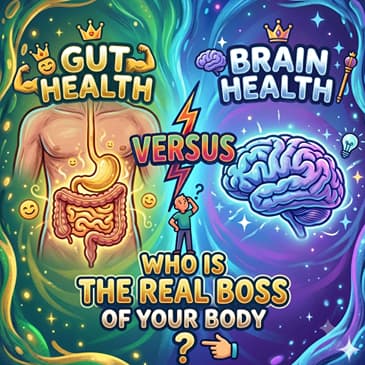
Is your gut controlling your mind, or is your mind controlling your gut?
The answer lies in a bidirectional superhighway called the gut-brain-immune axis. In this video, we break down the clinical science of the Enteric Nervous System (ENS) and the Vagus Nerve. Discover why 80% of vagal nerve fibres are sensory—meaning your brain is constantly listening to status updates from your gut microbes regarding nutrient levels and cellular inflammation.
What You Will Learn: The Biological Hardware:
How the ENS acts as an autonomous second brain containing hundreds of millions of neurons. The Message Couriers:
How short-chain fatty acids (SCFAs), cytokines, and neurotransmitter precursors like tryptophan alter your brain chemistry.
The Parasite Myth: The real circadian biology behind why stomach discomfort, itching, and hives flare up at 2:00 AM (hint: it's your cortisol drop, not rogue parasites).
The Probiotic Reality Check: Why most over-the-counter probiotics have transient effects and fail to permanently colonize your GI tract. If you want an evidence-based approach to metabolic health, mood regulation, and physical resilience, this comprehensive guide is for you.
Important Consumer Notice Disclaimer:
The information provided on this educational page is for general informational and cosmetic purposes only. It is not intended as a substitute for professional medical advice, diagnosis, or treatment. If you suspect you have a skin disorder, chronic condition, or need specialized treatment, please consult a licensed physician or dermatologist immediately to seek professional medical guidance.
Like, share, and subscribe to the Channel for more episodes
Connect with Ida Fanelli
Link in BIO
#ScienceCommunication #GutBrainAxis #MicrobiomeResearch #NervousSystem #VagusNerve #ImmuneSystem #HealthSEO #BiomedicalScience
00:00:00 --> 00:00:03 Welcome to where science meets self-care with
00:00:03 --> 00:00:06 Ida Fanelli. With over 30 years in beauty and
00:00:06 --> 00:00:09 wellness and a background in medical science,
00:00:10 --> 00:00:13 Ida blends clinical knowledge with holistic care.
00:00:13 --> 00:00:16 Each week, she and her guests share insights
00:00:16 --> 00:00:19 to help you achieve healthier skin, balanced
00:00:19 --> 00:00:24 energy, and empowered self-care. Now, here's
00:00:24 --> 00:00:32 your host, Ida Fanelli. Imagine for a second
00:00:32 --> 00:00:35 that you're standing in the winks just seconds
00:00:35 --> 00:00:38 away from walking onto a stage for the biggest
00:00:38 --> 00:00:41 presentation of your career. Or maybe you're
00:00:41 --> 00:00:46 sitting at your desk, finger poised above that
00:00:46 --> 00:00:49 send button on an email that might change your
00:00:49 --> 00:00:53 life. In that exact moment, before you even had
00:00:53 --> 00:00:56 a chance to logically process the stakes you
00:00:56 --> 00:01:00 feel it, that unmistakable fluttering twist in
00:01:00 --> 00:01:03 the pit of your stomach. It's a physical sensation
00:01:03 --> 00:01:07 that appears like it has an agenda of its own.
00:01:07 --> 00:01:11 A flood of nervous excitement or heavy expectation
00:01:11 --> 00:01:14 that seems to arrive before the thought even
00:01:14 --> 00:01:18 forms in your mind. For a long time we were taught
00:01:18 --> 00:01:22 to ignore these sensations or dismiss them as
00:01:22 --> 00:01:25 mere butterflies. We were told the gut was just
00:01:25 --> 00:01:29 a digestive machine. biological plumbing system
00:01:29 --> 00:01:32 designed to process food and remove waste from
00:01:32 --> 00:01:36 the body. But what if I told you that flutter
00:01:36 --> 00:01:38 you feel isn't just a side effect of your thoughts?
00:01:39 --> 00:01:43 What if that sensation is actually a data transmission?
00:01:43 --> 00:01:46 New research shows that The gut is far more than
00:01:46 --> 00:01:50 a digestive tract. It is a major hub of intelligence
00:01:50 --> 00:01:54 that silently shapes your mood, stress levels,
00:01:54 --> 00:01:58 and your entire biological balance. Tuning into
00:01:58 --> 00:02:01 these gut sensations can help you feel smarter,
00:02:01 --> 00:02:05 healthier choices in real time before your conscious
00:02:05 --> 00:02:09 mind even catches up. We often say trust your
00:02:09 --> 00:02:13 gut as a bit of poetic advice. But as we're going
00:02:13 --> 00:02:15 to explore today, that phrase is rooted in some
00:02:15 --> 00:02:19 of the most complex biology in the human body.
00:02:19 --> 00:02:23 Your brain is often the very last to know what
00:02:23 --> 00:02:26 your gut is already thinking. Today we are tearing
00:02:26 --> 00:02:31 up the old blueprint of human biology. For decades
00:02:31 --> 00:02:34 the traditional view of the body was a top -down
00:02:34 --> 00:02:38 hierarchy. The brain was the CEO and every other
00:02:38 --> 00:02:41 organ was just a loyal employee following orders.
00:02:42 --> 00:02:46 But that model is dead. We are entering the area
00:02:46 --> 00:02:50 of the gut -brain immune axis. This isn't just
00:02:50 --> 00:02:53 a fancy scientific term. It's a description of
00:02:53 --> 00:02:57 a continuous high -speed communication loop in
00:02:57 --> 00:02:59 which chemicals, immune cells, and nerves are
00:02:59 --> 00:03:03 constantly in 24 -7 chatter. Unless the axis
00:03:03 --> 00:03:06 is the key to answering some of the most frustrating
00:03:06 --> 00:03:10 questions about our health. We do feel brain
00:03:10 --> 00:03:14 fog even when we've had enough sleep. Why does
00:03:14 --> 00:03:17 stress sometimes feel like a heavy load in our
00:03:17 --> 00:03:21 chest or a knot in our stomach? And why do we
00:03:21 --> 00:03:24 get those nighttime flare -ups of restlessness
00:03:24 --> 00:03:28 or discomfort? The reason these matter, the reason
00:03:28 --> 00:03:31 we are spending thousands of words on these today
00:03:31 --> 00:03:34 is because your gut is essentially sending updates
00:03:34 --> 00:03:38 about the internal weather of your body before
00:03:38 --> 00:03:41 you are even consciously aware of it. It's guiding
00:03:41 --> 00:03:45 how you feel, how you react to stress, and even
00:03:45 --> 00:03:49 your personality long before the big brain in
00:03:49 --> 00:03:53 your skull has a chance to weigh in. By the time
00:03:53 --> 00:03:56 you notice you're in a bad mood, Your gut has
00:03:56 --> 00:03:59 likely been talking about it for hours. Today,
00:03:59 --> 00:04:02 we're going to learn how to listen to that conversation.
00:04:03 --> 00:04:07 We aren't looking for hacks or quick fixes. We're
00:04:07 --> 00:04:10 looking to understand an ecosystem. We're going
00:04:10 --> 00:04:12 to explore the hardware of your second brain,
00:04:13 --> 00:04:17 the 80 -20 information highway, the vagus nerve,
00:04:17 --> 00:04:20 and why your immune system is actually a diplomat,
00:04:20 --> 00:04:24 not merely a soldier. Communication network.
00:04:25 --> 00:04:28 To understand why your gut has such a massive
00:04:28 --> 00:04:31 influence on your mind, we have to look at the
00:04:31 --> 00:04:34 hardware. If the gut -brain immune axis is a
00:04:34 --> 00:04:37 communication network, then the hardware of that
00:04:37 --> 00:04:40 network is a literal wonder of biological engineering.
00:04:41 --> 00:04:44 I'm talking about the enteric nervous system,
00:04:44 --> 00:04:49 or the ENS. Consider this. Your gut contains
00:04:49 --> 00:04:52 about 500 million neurons, about as many as you'll
00:04:52 --> 00:04:57 find in the brain. of a domestic cat. That is
00:04:57 --> 00:05:00 the sheer scale of the second brain wired into
00:05:00 --> 00:05:03 your digestive tract. You've probably heard people
00:05:03 --> 00:05:06 call the gut the second brain. While that sounds
00:05:06 --> 00:05:09 like something you'd see on a clickbait headline
00:05:09 --> 00:05:14 in the scientific world, it is very literal technical
00:05:14 --> 00:05:18 description. Your gut is home to hundreds of
00:05:18 --> 00:05:21 millions of neurons. To put that in perspective,
00:05:21 --> 00:05:24 the density of the nerve cell in your gut actually
00:05:24 --> 00:05:28 exceeds the number of neurons found in your spinal
00:05:28 --> 00:05:31 cord. It is an incredibly sophisticated self
00:05:31 --> 00:05:34 -contained processing center that lives right
00:05:34 --> 00:05:37 inside your digestive tract. Now here's the part
00:05:37 --> 00:05:41 that usually blows people's minds. The ANS is
00:05:41 --> 00:05:44 so advanced that it is the only part of the peripheral
00:05:44 --> 00:05:46 nervous system that can operate independently
00:05:46 --> 00:05:49 from your conscious thought. It doesn't need
00:05:49 --> 00:05:52 your brain to tell it what to do. Back in the
00:05:52 --> 00:05:56 late 90s, scientists like Michael Gerson began
00:05:56 --> 00:06:00 documenting how the second brain manages this
00:06:00 --> 00:06:03 staggering intricacy of life below the surface.
00:06:04 --> 00:06:06 While you're sitting here listening, your second
00:06:06 --> 00:06:10 brain is hard at work. It runs a massive multi
00:06:10 --> 00:06:12 -stage operation without a single instruction
00:06:12 --> 00:06:17 from your skull. It regulates gut motility, Those
00:06:17 --> 00:06:20 are regular contractions called peristalsis,
00:06:20 --> 00:06:24 which move things along the track. It manages
00:06:24 --> 00:06:27 the time secretion of enzymes and acids acting
00:06:27 --> 00:06:31 at exactly the right moment. It controls local
00:06:31 --> 00:06:34 blood flow to make sure nutrients are absorbed.
00:06:34 --> 00:06:37 Even more, it oversees local immune response
00:06:37 --> 00:06:40 within the intestinal wall. Let that sink in.
00:06:41 --> 00:06:43 Your gut is a command center that acts in real
00:06:43 --> 00:06:46 time, always one step ahead of your conscious
00:06:46 --> 00:06:49 mind. But why would we have a second brain down
00:06:49 --> 00:06:52 there? Why not just let the main brain handle
00:06:52 --> 00:06:55 everything? The answer lies in the gut's unique
00:06:55 --> 00:06:59 position in the body. Think about this. The gut
00:06:59 --> 00:07:02 is technically a tube that runs through us. That
00:07:02 --> 00:07:05 means the lining of your gut is actually an internal
00:07:05 --> 00:07:09 surface, just like your skin. It is the primary
00:07:09 --> 00:07:12 place where the outside world, the food you eat,
00:07:12 --> 00:07:16 the bacteria you encounter, the toxins in your
00:07:16 --> 00:07:21 environment meets your internal biology. As a
00:07:21 --> 00:07:24 result, your ENS serves as a primary sensor for
00:07:24 --> 00:07:27 the outside world. It's your first to know when
00:07:27 --> 00:07:30 you've encountered a new pathogen or beneficial
00:07:30 --> 00:07:34 new fiber. It processes that data on the ground
00:07:34 --> 00:07:37 floor and then sends a report upstairs to the
00:07:37 --> 00:07:41 brain. This is why the gut feeling is often very
00:07:41 --> 00:07:45 first warning sign of danger or our first signal
00:07:45 --> 00:07:48 of safety. Let's pause for a quick gut check.
00:07:49 --> 00:07:52 Take a slow deep breath and let it travel all
00:07:52 --> 00:07:56 the way into your belly. Notice what you feel
00:07:56 --> 00:07:59 not just in your lungs but lower down in your
00:07:59 --> 00:08:04 core. Does your stomach soften? Tighten? Do you
00:08:04 --> 00:08:08 notice a flutter warmth or even? just a delicate
00:08:08 --> 00:08:11 shift. Even this brief 10 -second experiment
00:08:11 --> 00:08:16 can give you a glimpse of your gut's live communication.
00:08:17 --> 00:08:20 These sensations are your ENS sending status
00:08:20 --> 00:08:25 updates straight to your awareness. The abstract
00:08:25 --> 00:08:28 suddenly becomes real and you can begin to recognize
00:08:28 --> 00:08:32 that gut language for yourself. For a long time
00:08:32 --> 00:08:34 we thought that the brain was the boss and the
00:08:34 --> 00:08:37 gut was just a subordinate following the orders.
00:08:38 --> 00:08:41 But the hardware tells a different story. The
00:08:41 --> 00:08:44 gut isn't just responding to the brain, it's
00:08:44 --> 00:08:47 actively starting the conversation. It acts as
00:08:47 --> 00:08:50 a listener, a processor, and a broadcaster all
00:08:50 --> 00:08:55 at once. It manages the complex frequent functions
00:08:55 --> 00:08:58 of life and conscious mind cannot handle. It
00:08:58 --> 00:09:01 is the forgotten brain that forms the very foundation
00:09:01 --> 00:09:05 of how you feel every single day. Pause for a
00:09:05 --> 00:09:09 second and just check in with yourself. Notice
00:09:09 --> 00:09:12 your breath and then try to sense your belly.
00:09:13 --> 00:09:17 What data is sending right now is reporting a
00:09:17 --> 00:09:20 state of rest and digest, or is it signaling
00:09:20 --> 00:09:23 tension? Most of us have spent our lives ignoring
00:09:23 --> 00:09:26 these signals. But once you realize that your
00:09:26 --> 00:09:29 gut is a sophisticated processing center with
00:09:29 --> 00:09:32 its own independent intelligence, you realize
00:09:32 --> 00:09:35 that those gurgles and flutters aren't just digestion,
00:09:35 --> 00:09:39 they are the language of your second brain. The
00:09:39 --> 00:09:42 biggest takeaway here is that you need to stop
00:09:42 --> 00:09:44 viewing your gut as a simple tool for digestion
00:09:44 --> 00:09:47 and start seeing as a partner in communication.
00:09:48 --> 00:09:51 Your enteric nervous system is the second brain
00:09:51 --> 00:09:54 that operates with a level of independence and
00:09:54 --> 00:09:57 complexity that rivals your central nervous system.
00:09:58 --> 00:10:00 It is the primary sensor of your environment,
00:10:00 --> 00:10:03 the first to detect threats and rewards, and
00:10:03 --> 00:10:06 the entity that initiates the conversation that
00:10:06 --> 00:10:09 ultimately shapes your emotions and energy levels.
00:10:10 --> 00:10:13 You aren't just a brain in a jar. You are a living
00:10:13 --> 00:10:16 network where the ground floor frequently dictates
00:10:16 --> 00:10:21 the top floor. The vagus nerve, the body's information
00:10:21 --> 00:10:24 superhighway. Now that we've established that
00:10:24 --> 00:10:28 your gut is essentially a second brain with its
00:10:28 --> 00:10:30 own sophisticated hardware, we have to look at
00:10:30 --> 00:10:33 how that hardware stays connected to the big
00:10:33 --> 00:10:37 brain in your skull. If the gut -brain connection
00:10:37 --> 00:10:41 is a conversation, then the vagus nerve is the
00:10:41 --> 00:10:44 high -speed fiber optic cable that makes the
00:10:44 --> 00:10:48 entire dialogue possible. The word Vegas actually
00:10:48 --> 00:10:51 comes from the Latin word for wandering and it
00:10:51 --> 00:10:54 is for perfectly fitting name for this biological
00:10:54 --> 00:10:57 wonder. This nerve is the longest cranial nerve
00:10:57 --> 00:11:00 in your entire body. It starts at the very base
00:11:00 --> 00:11:04 of your brain, in your brain stem, and then it
00:11:04 --> 00:11:08 literally waters down through your neck into
00:11:08 --> 00:11:11 your chest and deep into your abdomen. It doesn't
00:11:11 --> 00:11:14 just go to the gut. It branches out like a vast
00:11:14 --> 00:11:17 living tree. touching your heart, your lungs,
00:11:17 --> 00:11:20 and virtually every organ in your digestive tract.
00:11:21 --> 00:11:25 In the word of anatomy, the vagus nerve is the
00:11:25 --> 00:11:28 crown jewel of your parasympathetic nervous system,
00:11:28 --> 00:11:31 what we comically call the rest and digest system.
00:11:32 --> 00:11:34 When your vagus nerve is active and healthy,
00:11:35 --> 00:11:38 it acts as the ultimate calming influence. It
00:11:38 --> 00:11:41 helps slow your heart rate, lowers your blood
00:11:41 --> 00:11:44 pressure, and signals your digestive system to
00:11:44 --> 00:11:46 begin secreting the enzymes and acid needed to
00:11:46 --> 00:11:49 break down your dinner. Essentially, a healthy
00:11:49 --> 00:11:53 vagus nerve creates a biological state of safety.
00:11:54 --> 00:11:56 And now we'll take time for a commercial break.
00:11:57 --> 00:12:01 Welcome back! But here's the discovery that completely
00:12:01 --> 00:12:03 flipped the script for modern neuroscience for
00:12:03 --> 00:12:07 a long time. We thought The vagus nerve is mostly
00:12:07 --> 00:12:10 a one -way street, a set of instructions being
00:12:10 --> 00:12:13 set down from the brain to the body. We were
00:12:13 --> 00:12:17 wrong. We now know that roughly 80 % of the vagal
00:12:17 --> 00:12:20 nerve fibers are sensory. To visualize this,
00:12:20 --> 00:12:23 imagine a massive five -lane highway connecting
00:12:23 --> 00:12:26 your gut and your brain. In the old model, we
00:12:26 --> 00:12:29 thought three or four of those lanes carried
00:12:29 --> 00:12:33 traffic from the brain to the gut. In reality,
00:12:33 --> 00:12:36 it's the exact opposite. Four of those five lanes
00:12:36 --> 00:12:40 carries signals from the gut to the brain. This
00:12:40 --> 00:12:43 means that the vast majority of traffic on this
00:12:43 --> 00:12:46 highway consists of the gut reporting its status
00:12:46 --> 00:12:50 to headquarters. It is reporting on nutrient
00:12:50 --> 00:12:53 availability, the mechanical movement of your
00:12:53 --> 00:12:55 intestines, and most importantly, the activity
00:12:55 --> 00:12:58 of your microbes and any inflammatory signals
00:12:58 --> 00:13:03 that might be present. This 80 -20 split is why
00:13:03 --> 00:13:06 your emotions commonly reflect what is happening
00:13:06 --> 00:13:09 inside us like our nutrient levels or movement
00:13:09 --> 00:13:13 in our microbial population long before we logically
00:13:13 --> 00:13:16 understand why we feel a certain way. Your vagus
00:13:16 --> 00:13:19 nerve translates the biological state of your
00:13:19 --> 00:13:22 digestion into a feeling that shapes your emotional
00:13:22 --> 00:13:25 strength. That brings us to a concept you might
00:13:25 --> 00:13:28 have heard of called vagal tone. You can think
00:13:28 --> 00:13:31 of vagal tone almost like a muscle. When you
00:13:31 --> 00:13:34 have a high vagal tone, your nervous system is
00:13:34 --> 00:13:37 flexible and resilient. If something stressful
00:13:37 --> 00:13:41 happens, such as someone cutting you off in traffic,
00:13:41 --> 00:13:44 your body naturally returns to a state of calm.
00:13:45 --> 00:13:48 On the flip side, when vagal signaling is impaired
00:13:48 --> 00:13:51 by chronic stress or inflammation, your system
00:13:51 --> 00:13:54 can get stuck in a state of high alert. You may
00:13:54 --> 00:13:58 have seen a flood of hacks. online promising
00:13:58 --> 00:14:01 to instantly activate your vagus nerve from ice
00:14:01 --> 00:14:05 backs to extreme exercises. While some quick
00:14:05 --> 00:14:08 fixes might make headlines, science shows a more
00:14:08 --> 00:14:12 empowering path. One where you experience and
00:14:12 --> 00:14:16 listen to your own biology. Evidence back practices
00:14:16 --> 00:14:19 like slow deep breathing, humming or singing
00:14:19 --> 00:14:21 along to your favorite song are simple ways to
00:14:21 --> 00:14:24 encourage healthy nervous system regulation in
00:14:24 --> 00:14:28 daily life. Instead of chasing a miracle shortcut,
00:14:29 --> 00:14:32 consider trying a week of slow breathing exercises
00:14:32 --> 00:14:35 and noticing how your body responds. Treat it
00:14:35 --> 00:14:38 as a personal experiment, an opportunity to tune
00:14:38 --> 00:14:41 into your own signals and build resilience from
00:14:41 --> 00:14:44 the inside out. How microbes send messages, the
00:14:44 --> 00:14:49 three pathways. So if we process this incredible
00:14:49 --> 00:14:52 second brain and this high -speed Vegas highway,
00:14:52 --> 00:14:55 the next logical question is who is actually
00:14:55 --> 00:14:57 doing the talking? This is where trillions of
00:14:57 --> 00:15:00 your microbial residents, your microbiome take
00:15:00 --> 00:15:03 center stage. These microbes don't have to leave
00:15:03 --> 00:15:06 your gut to change how you think or feel. They
00:15:06 --> 00:15:09 don't travel to your brain. Instead, they send
00:15:09 --> 00:15:12 their messages through three primary career services.
00:15:13 --> 00:15:16 The first pathway is through chemical signals
00:15:16 --> 00:15:20 or what scientists call metabolites. To see this
00:15:20 --> 00:15:24 in action, imagine yourself at your kitchen table
00:15:24 --> 00:15:27 with a bowl of warm oats topped with a handful
00:15:27 --> 00:15:31 of fresh berries and chia seeds. As you enjoy
00:15:31 --> 00:15:33 this breakfast, the fibers from the oats and
00:15:33 --> 00:15:36 berries travel all the way down to your colon,
00:15:36 --> 00:15:40 mostly undigested. This is where your gut microbes
00:15:40 --> 00:15:43 step in, acting like industrial messengers who
00:15:43 --> 00:15:46 look at the menu you've delivered. They get to
00:15:46 --> 00:15:49 work fermenting those fibers, breaking them down
00:15:49 --> 00:15:52 into tiny molecules called short -chain fatty
00:15:52 --> 00:15:58 acids or SCFAs. Think of these SCFAs as cheerful
00:15:58 --> 00:16:01 handwritten postcards from your microbes. They
00:16:01 --> 00:16:04 help to strengthen your gut barrier and reduce
00:16:04 --> 00:16:07 inflammation throughout your body. These chemical
00:16:07 --> 00:16:11 postcards do not linger in your gut. They slip
00:16:11 --> 00:16:14 into your bloodstream and circulate eventually
00:16:14 --> 00:16:18 reaching the brain. In subtle but tangible ways,
00:16:18 --> 00:16:21 they help you feel calmer and think more clearly
00:16:21 --> 00:16:25 after your meal. translating the chemistry of
00:16:25 --> 00:16:27 fiber into the lived experience of focus and
00:16:27 --> 00:16:31 well -being. The second pathway is nerve stimulation.
00:16:32 --> 00:16:35 Your microbes can actually directly stimulate
00:16:35 --> 00:16:38 the sensory nerve ends of that second brain,
00:16:38 --> 00:16:42 the ENS, we discussed earlier. These neurons
00:16:42 --> 00:16:45 then relay that information through the 80 %
00:16:45 --> 00:16:49 sensory portion of the vagus nerve, straight
00:16:49 --> 00:16:52 to the brain stem. It is nearly instantaneous
00:16:52 --> 00:16:57 electrical way for your microbiome to tell your
00:16:57 --> 00:16:59 brain exactly what is happening on the ground
00:16:59 --> 00:17:03 floor of your body. The third pathway is perhaps
00:17:03 --> 00:17:06 the most powerful and often the quietest immune
00:17:06 --> 00:17:10 signaling. Remember about 70 % of your entire
00:17:10 --> 00:17:13 immune system lives right there in your gut lining.
00:17:13 --> 00:17:17 Your microbes are in a constant 24 -7 dialogue
00:17:17 --> 00:17:20 with these immune cells. When the microbiome
00:17:20 --> 00:17:23 is balanced, it sends all clear signals, but
00:17:23 --> 00:17:26 when things are out of whack due to a pure diet,
00:17:27 --> 00:17:30 chronic stress, or a hidden infection, those
00:17:30 --> 00:17:32 immune cells can release inflammatory messengers
00:17:32 --> 00:17:37 called cytokines. These cytokines travel through
00:17:37 --> 00:17:40 your blood and signal to the brain that your
00:17:40 --> 00:17:43 body is under threat. These messages don't just
00:17:43 --> 00:17:46 land anywhere. They specifically influence regions
00:17:46 --> 00:17:49 of the brain involved in stress regulation, emotional
00:17:49 --> 00:17:52 processing, and your sense of motivation. This
00:17:52 --> 00:17:55 is a major change in how we view mental health.
00:17:56 --> 00:17:59 Research by pioneers like Kryan and Dian has
00:17:59 --> 00:18:02 shown that when these microbial signals change,
00:18:03 --> 00:18:07 our behavior often follows suit. If your brain
00:18:07 --> 00:18:09 receives a constant stream of threat signals
00:18:09 --> 00:18:12 from the gut, it might move into what scientists
00:18:12 --> 00:18:16 call sickness behavior. This is an ancient brilliant
00:18:16 --> 00:18:19 survival program that favors energy conservation
00:18:19 --> 00:18:23 over social engagement. You feel fatigued, your
00:18:23 --> 00:18:27 mood drops, and you have brain fog. And you just
00:18:27 --> 00:18:31 want to withdraw from the world. In the short
00:18:31 --> 00:18:34 term, this helps you recover from a cold, but
00:18:34 --> 00:18:36 if your gut is chronically sending these signals,
00:18:37 --> 00:18:39 that sickness behavior can start to feel like
00:18:39 --> 00:18:43 your permanent personality. Take an instant to
00:18:43 --> 00:18:46 check in with yourself. When was the last time
00:18:46 --> 00:18:48 you noticed this kind of low mood or withdrawal
00:18:48 --> 00:18:53 after a stressful event, a big deadline, or a
00:18:53 --> 00:18:56 stretch of poor sleep? Can you link that foggy
00:18:56 --> 00:19:00 depleted feeling to a physical sensation in your
00:19:00 --> 00:19:03 gut or to something you ate? These kinds of questions
00:19:03 --> 00:19:06 can disclose patterns between your biology and
00:19:06 --> 00:19:10 your day -to -day feelings, shifting your perception
00:19:10 --> 00:19:13 from passive symptoms to active self -awareness.
00:19:14 --> 00:19:19 The serotonin myth, location versus access. While
00:19:19 --> 00:19:21 we're on the topic of brain chemicals, we have
00:19:21 --> 00:19:24 to address one of the big myths in the wellness
00:19:24 --> 00:19:28 world. If you spent any time on social media,
00:19:28 --> 00:19:31 you've likely seen a headline claiming that 95
00:19:31 --> 00:19:35 % of your serotonin is made in your gut. It's
00:19:35 --> 00:19:37 a catchy statistic often used to suggest that
00:19:37 --> 00:19:40 the gut is the true source of our happiness.
00:19:41 --> 00:19:44 But the truth is a little more subtle. While
00:19:44 --> 00:19:47 it's scientifically true that the vast majority
00:19:47 --> 00:19:49 of the body's serotonin is produced in the gut
00:19:49 --> 00:19:53 lining, there is a major catch. The serotonin
00:19:53 --> 00:19:56 does not travel directly into the brain. Your
00:19:56 --> 00:19:59 brain is protected by the blood brain barrier,
00:19:59 --> 00:20:02 a high security system that decides exactly what
00:20:02 --> 00:20:06 gets into the central nervous system. Serotonin
00:20:06 --> 00:20:09 is a relatively large molecule and the serotonin
00:20:09 --> 00:20:12 produced in your intestines simply cannot cross
00:20:12 --> 00:20:17 the gate. So what is all this gut serotonin actually
00:20:17 --> 00:20:20 doing? It's working hard on the local level.
00:20:20 --> 00:20:23 It regulates your digestion by managing the movement
00:20:23 --> 00:20:26 of your intestines. It communicates with your
00:20:26 --> 00:20:28 immune cells, helping them to stay balanced.
00:20:29 --> 00:20:32 And it signals through those sensory nerve endings
00:20:32 --> 00:20:36 that talk to the brain. Instead of thinking of
00:20:36 --> 00:20:39 gut serotonin in a direct mood chemical, it's
00:20:39 --> 00:20:42 better to think of it as a local coordinator.
00:20:42 --> 00:20:45 It influences the pathways that talk to the brain.
00:20:45 --> 00:20:48 However, the gut does modify brain chemistry
00:20:48 --> 00:20:51 regulating the supply of building blocks such
00:20:51 --> 00:20:56 as the amino acid tryptophan. Specific gut bacteria
00:20:56 --> 00:20:59 are essential for regulating the body's production
00:20:59 --> 00:21:03 of these substances. The gut basically decides
00:21:03 --> 00:21:06 whether tryptophan is turned into serotonin for
00:21:06 --> 00:21:09 the brain or sent down other pathways. A great
00:21:09 --> 00:21:12 way to think about this is the piano analogy.
00:21:13 --> 00:21:17 Supporting your gut is like tuning a piano. You
00:21:17 --> 00:21:19 can be the most talented pianist in the world,
00:21:20 --> 00:21:23 meaning you have the best therapy, the best mindset,
00:21:23 --> 00:21:27 and the best psychological tools. But if the
00:21:27 --> 00:21:29 piano is out of tune, the music will still sound
00:21:29 --> 00:21:33 off. Gut health creates a biological environment,
00:21:34 --> 00:21:37 the tuned state that allows your mental and emotional
00:21:37 --> 00:21:40 health tactics to work more effectively. The
00:21:40 --> 00:21:42 big takeaway from this section of our journey
00:21:42 --> 00:21:45 is that your gut and brain are connected by a
00:21:45 --> 00:21:49 massive 80 % sensory information superhighway
00:21:49 --> 00:21:52 called the vagus nerve. Your microbes communicate
00:21:52 --> 00:21:55 through this highway using chemicals, direct
00:21:55 --> 00:21:58 signals, and immune messages that can actually
00:21:58 --> 00:22:01 trigger sickness, behavior, and brain fog if
00:22:01 --> 00:22:03 the system is out of balance. While your gut
00:22:03 --> 00:22:06 isn't sending happiness directly to your brain
00:22:06 --> 00:22:09 in the form of serotonin, it is the master tuner
00:22:09 --> 00:22:13 of your biological environment, providing all
00:22:13 --> 00:22:15 the raw materials and all the clear signals your
00:22:15 --> 00:22:18 brain needs to function at its best. And now
00:22:18 --> 00:22:21 we'll take time for a commercial break. Welcome
00:22:21 --> 00:22:26 back. Stress is a two -way street, the feedback
00:22:26 --> 00:22:30 loop. We've all experienced it, that sudden drop.
00:22:30 --> 00:22:34 in the stomach when you hear bad news or those
00:22:34 --> 00:22:36 frantic digestive butterflies before a make or
00:22:36 --> 00:22:40 break meeting. We often say I'm so stressed it's
00:22:40 --> 00:22:42 making me sick but we need to look much more
00:22:42 --> 00:22:46 closely at that loop because stress doesn't just
00:22:46 --> 00:22:49 live in your mind it is a physical biological
00:22:49 --> 00:22:51 event which reshapes your intestinal terrain.
00:22:52 --> 00:22:55 In the old way of thinking, stress was something
00:22:55 --> 00:22:59 that happened in the brain, and the gut had to
00:22:59 --> 00:23:02 suffer with the consequences. But modern research,
00:23:02 --> 00:23:06 particularly the work of Emoryn Meyer, has documented
00:23:06 --> 00:23:10 an intense bidirectional feedback loop. When
00:23:10 --> 00:23:13 you experience chronic stress, your brain sends
00:23:13 --> 00:23:16 signals down that signal command lane of the
00:23:16 --> 00:23:20 vagus nerve we mentioned earlier. These signals
00:23:20 --> 00:23:23 physically alter the environment of your gut.
00:23:24 --> 00:23:27 They can change how fast food moves through you,
00:23:27 --> 00:23:30 alter the types of microbes that can survive
00:23:30 --> 00:23:33 in your system, and even increase inflammatory
00:23:33 --> 00:23:37 signaling. Here is where it gets tricky. Once
00:23:37 --> 00:23:40 the gut environment changes, it starts sending
00:23:40 --> 00:23:43 threat signals back to your brain. Those changes
00:23:43 --> 00:23:46 in your gut flora and the resulting low -grade
00:23:46 --> 00:23:48 inflammation make your brain more sensitive to
00:23:48 --> 00:23:51 stress. You essentially get locked in. You aren't
00:23:51 --> 00:23:54 just stressed because of your job or your life.
00:23:54 --> 00:23:57 You are stressed because your gut is now reporting
00:23:57 --> 00:24:00 a biological state of emergency to your brain
00:24:00 --> 00:24:04 24 -7. Understanding this loop is the first step
00:24:04 --> 00:24:07 towards breaking it, not by ignoring the stress,
00:24:07 --> 00:24:10 but by supporting the gut's physical train so
00:24:10 --> 00:24:14 it can stop sending those alarm signals. Intestinal
00:24:14 --> 00:24:18 permeability, real science versus hype. One of
00:24:18 --> 00:24:20 the most talked about parts of the stress loop
00:24:20 --> 00:24:23 is a concept that you've likely heard of leaky
00:24:23 --> 00:24:27 gut. Now I want to be very careful here because
00:24:27 --> 00:24:31 the term is frequently exaggerated in wellness
00:24:31 --> 00:24:34 circles to sell cleanses and miracle cures. However,
00:24:34 --> 00:24:37 in mainstream medicine, it is recognized as a
00:24:37 --> 00:24:41 real physiological phenomenon known as intestinal
00:24:41 --> 00:24:45 permeability. Think of your gut lining as a high
00:24:45 --> 00:24:48 -security border. It's meant to be a selective
00:24:48 --> 00:24:51 barrier letting vital nutrients in while keeping
00:24:51 --> 00:24:55 toxins and bacteria out. This barrier is held
00:24:55 --> 00:24:58 together by tight junctions, but things like
00:24:58 --> 00:25:01 chronic stress, poor diet, or hidden infections
00:25:01 --> 00:25:05 can weaken these links. When the barrier is compromised,
00:25:05 --> 00:25:09 small microbial fragments such as lipopolysaccharides
00:25:09 --> 00:25:13 can slip into your bloodstream. Your immune system
00:25:13 --> 00:25:15 sees these fragments as invaders and sounds the
00:25:15 --> 00:25:18 alarm. This triggers low -grade inflammation
00:25:18 --> 00:25:21 that can travel through your body and reach your
00:25:21 --> 00:25:24 brain. This is often the biological root of the
00:25:24 --> 00:25:28 persistent brain fog or the elevated anxiety
00:25:28 --> 00:25:31 that seems to come from nowhere. As researcher
00:25:31 --> 00:25:36 Bischoff has pointed out, This barrier dysfunction
00:25:36 --> 00:25:39 is a key link between your gut health and your
00:25:39 --> 00:25:42 whole body symptoms. It isn't that you aren't
00:25:42 --> 00:25:45 strong enough to handle your life. It may be
00:25:45 --> 00:25:47 that your biological communication system is
00:25:47 --> 00:25:50 stuck in a cycle of reporting a threat because
00:25:50 --> 00:25:55 your border has been breached. The immune system,
00:25:55 --> 00:25:59 the quiet diplomat. If the vagus nerve is the
00:25:59 --> 00:26:01 highway and the enteric nervous system is the
00:26:01 --> 00:26:04 second brain, then the immune system is the quiet
00:26:04 --> 00:26:07 middle messenger. It is the bridge between the
00:26:07 --> 00:26:11 two. It is absolutely staggering to realize that
00:26:11 --> 00:26:16 about 70 % of your entire immune system is located
00:26:16 --> 00:26:19 right there in your gut. We often think of the
00:26:19 --> 00:26:21 immune system as a military force whose only
00:26:21 --> 00:26:25 job is to seek and destroy. But in the gut, the
00:26:25 --> 00:26:27 immune system acts much more like a diplomat
00:26:27 --> 00:26:31 or a gardener. Its primary goal isn't always
00:26:31 --> 00:26:34 total destruction. It's a balance and containment.
00:26:35 --> 00:26:38 Your gut microbes are in constant 24 -7 dialogue
00:26:38 --> 00:26:42 with these immune cells. In a healthy state,
00:26:42 --> 00:26:44 your immune system remains flexible and calm,
00:26:45 --> 00:26:48 recognizing your beneficial bacteria as friends.
00:26:48 --> 00:26:52 But when this relationship is disrupted by diet,
00:26:52 --> 00:26:55 stress, or a pathogen, the immune system can
00:26:55 --> 00:26:57 shift into a state of low -grade chronic inflammation.
00:26:58 --> 00:27:02 This is different from a fever. In many cases,
00:27:02 --> 00:27:05 the immune system decides that total elimination
00:27:05 --> 00:27:08 of a problem is too expensive in terms of energy.
00:27:09 --> 00:27:11 Instead, it chooses a strategy of containment,
00:27:12 --> 00:27:15 keeping the intruder in a check, but never fully
00:27:15 --> 00:27:18 eliminating it. This is a brilliant survival
00:27:18 --> 00:27:22 strategy, but it comes with a hidden cost. It
00:27:22 --> 00:27:25 means your immune system is always on, releasing
00:27:25 --> 00:27:28 a steady stream of inflammatory messages called
00:27:28 --> 00:27:32 cytokines into your blood. These cytokines circulate
00:27:32 --> 00:27:35 and can alter your brain chemistry, affecting
00:27:35 --> 00:27:39 your energy levels and your mood. This is why
00:27:39 --> 00:27:41 when people finally address a long -standing
00:27:41 --> 00:27:44 gut issue, they frequently describe a sudden
00:27:44 --> 00:27:47 lifting of a mental weight. They aren't just
00:27:47 --> 00:27:50 digesting better. Their immune system has finally
00:27:50 --> 00:27:54 been able to stand down from high alert. Parasites
00:27:54 --> 00:27:58 and rogue microbes, an objective view. We have
00:27:58 --> 00:28:01 to address the elephant in the room or the microscopic
00:28:01 --> 00:28:05 invader. Parasites. In recent years, the internet
00:28:05 --> 00:28:09 has become obsessed with parasite cleanses, promising
00:28:09 --> 00:28:11 to rid your body of hidden invaders responsible
00:28:11 --> 00:28:15 for everything from sugar cravings to bad moods.
00:28:15 --> 00:28:18 But the actual science is far more subtle and
00:28:18 --> 00:28:22 far less frightening than the marketing suggests.
00:28:22 --> 00:28:26 Not all microbes are our friends. Pathogenic
00:28:26 --> 00:28:30 bacteria and parasites can and do disrupt the
00:28:30 --> 00:28:33 gut -brain -immune axis. However, they don't
00:28:33 --> 00:28:36 do this by controlling your thoughts. Like a
00:28:36 --> 00:28:38 science fiction plot, instead they influence
00:28:38 --> 00:28:41 the brain indirectly by hijacking your body's
00:28:41 --> 00:28:44 present communication systems, mainly through
00:28:44 --> 00:28:49 inflammation. When your gut detects a genuine
00:28:49 --> 00:28:52 threat, immune cells released by cytokines, we
00:28:52 --> 00:28:56 just discussed, your brain responds by moving
00:28:56 --> 00:28:59 into a state of sickness behavior. This is ancient,
00:29:00 --> 00:29:03 brilliant survival program that focuses on energy
00:29:03 --> 00:29:07 conservation. You feel fatigue, your mood drops,
00:29:07 --> 00:29:10 and you have brain fog because your body is trying
00:29:10 --> 00:29:13 to force you to slow down so it can fight the
00:29:13 --> 00:29:16 intruder. The reason some parasites are tricky
00:29:16 --> 00:29:19 is that they are evolutionary masters of staying
00:29:19 --> 00:29:23 under the radar. As researcher Mayl Zell has
00:29:23 --> 00:29:27 shown, many parasites survive by dialing down
00:29:27 --> 00:29:31 the body's alarm system, avoiding massive explosion
00:29:31 --> 00:29:34 of inflammation and instead creating a state
00:29:34 --> 00:29:37 of low -grade chronic activation. Over time,
00:29:38 --> 00:29:41 this quiet activity can appear to be burnout
00:29:41 --> 00:29:44 or chronic stress, but this is a very big but.
00:29:45 --> 00:29:49 We need a dose of reality. Exposure does not
00:29:49 --> 00:29:52 equal infection. We encounter potentially harmful
00:29:52 --> 00:29:55 microbes every day. In most cases, a healthy
00:29:55 --> 00:29:59 immune system and a diverse microbiome. Clear
00:29:59 --> 00:30:03 these contacts without ever knowing. Most importantly,
00:30:03 --> 00:30:07 the cleanses you see on social media lack scientific
00:30:07 --> 00:30:10 evidence. Parasites are not general toxins that
00:30:10 --> 00:30:13 can be flushed out with a juice vase. They are
00:30:13 --> 00:30:16 specific biological problems that require medical
00:30:16 --> 00:30:20 precision, not unproven supplements. The nighttime
00:30:20 --> 00:30:23 flare -up. If you've ever been lying awake at
00:30:23 --> 00:30:26 2 a .m., suddenly hyper aware of every gurgle
00:30:26 --> 00:30:29 in your stomach or every itch in your skin, you're
00:30:29 --> 00:30:32 probably wondering, why is this always worse
00:30:32 --> 00:30:35 at night? There is a common myth that parasites
00:30:35 --> 00:30:38 wake up or become more active at night, but the
00:30:38 --> 00:30:40 science shows that it's your body, not the bug
00:30:40 --> 00:30:44 that is changing. At night, your internal environment
00:30:44 --> 00:30:47 undergoes a massive shift. First, your immune
00:30:47 --> 00:30:51 system follows a circadian rhythm. As we rest,
00:30:51 --> 00:30:54 inflammatory signaling naturally increases and
00:30:54 --> 00:30:57 our immune system becomes more active. If there
00:30:57 --> 00:31:00 is an underlying issue, an infection, an allergy,
00:31:00 --> 00:31:03 or just chronic irritation, your immune system
00:31:03 --> 00:31:06 response to it actually intensifies while you
00:31:06 --> 00:31:10 sleep. Second, your levels of cortisol, your
00:31:10 --> 00:31:13 body's natural anti -inflammatory, drop to their
00:31:13 --> 00:31:16 lowest point at night. During the day, higher
00:31:16 --> 00:31:19 cortisol help mask these sensations of discomfort.
00:31:20 --> 00:31:23 When that suppression drops off at night, the
00:31:23 --> 00:31:26 volumes of those signals increases. Finally,
00:31:26 --> 00:31:28 your brain simply becomes more aware. When the
00:31:28 --> 00:31:31 world goes quiet and the day's disturbances are
00:31:31 --> 00:31:34 gone, your brain turns inward for a status check.
00:31:35 --> 00:31:38 Sensations like itching or fidgetiness that you
00:31:38 --> 00:31:41 might ignore while working suddenly feel loud
00:31:41 --> 00:31:44 and undeniable. So if you are experiencing a
00:31:44 --> 00:31:47 nighttime flare -up, the goal isn't to spiral
00:31:47 --> 00:31:49 into fear, it's to recognize that your body is
00:31:49 --> 00:31:52 simply doing its nighttime patrol and reporting
00:31:52 --> 00:31:55 what it finds more clearly than it does during
00:31:55 --> 00:31:58 the day. The main takeaway is that your health
00:31:58 --> 00:32:02 is defined by a feedback loop. Stress in the
00:32:02 --> 00:32:05 mind changes the biology of the gut, and a compromised
00:32:05 --> 00:32:09 gut barrier sends inflammatory threat signals
00:32:09 --> 00:32:12 back to the brain locking you in a state of anxiety
00:32:12 --> 00:32:16 or fatigue while harmful microbes and parasites
00:32:16 --> 00:32:20 can hijack the system they do so through our
00:32:20 --> 00:32:24 natural sickness behavior pathways not through
00:32:24 --> 00:32:26 mysterious mind control and those frustrating
00:32:26 --> 00:32:29 nighttime symptoms they aren't signs of active
00:32:29 --> 00:32:33 invaders but simply a reflection of your immune
00:32:33 --> 00:32:37 system natural rhythm, and a drop in your body's
00:32:37 --> 00:32:40 anti -inflammatory hormones. The probiotic myth.
00:32:40 --> 00:32:45 Why diversity trumps the magic pill. As we move
00:32:45 --> 00:32:47 toward the final stretch of our voyage through
00:32:47 --> 00:32:50 the gut -brain immune axis, we have to address
00:32:50 --> 00:32:53 the question that almost everyone asks eventually.
00:32:53 --> 00:32:56 Which pill do I take? This question has fueled
00:32:56 --> 00:32:59 a massive multi -billionaire dollar industry
00:32:59 --> 00:33:03 but around probiotics. We are constantly bombarded
00:33:03 --> 00:33:07 with ads promising that if we merely find that
00:33:07 --> 00:33:11 one magic strain we can fix our microbiome, curly
00:33:11 --> 00:33:14 our brain frog and solve our digestive boats.
00:33:14 --> 00:33:17 But the latest science is telling us much more
00:33:17 --> 00:33:21 complex and frankly more interesting story. The
00:33:21 --> 00:33:24 reality is there is no universal probiotic that
00:33:24 --> 00:33:28 works for everyone. Research, particularly by
00:33:28 --> 00:33:31 experts like McFarland, has shown that many probiotics
00:33:31 --> 00:33:34 don't actually move in and stay. They are just
00:33:34 --> 00:33:36 passing through, providing a temporary effect
00:33:36 --> 00:33:40 before they are washed away. The reason a one
00:33:40 --> 00:33:42 size fits all solution doesn't exist is that
00:33:42 --> 00:33:46 there are no two microbiomes are exactly alike.
00:33:47 --> 00:33:50 Your microbiome ecosystem is just as unique as
00:33:50 --> 00:33:53 your fingerprint. It's been determined by your
00:33:53 --> 00:33:56 genetics, where you live, the medication you've
00:33:56 --> 00:33:59 taken, especially antibiotics, and even your
00:33:59 --> 00:34:03 very first moments of life. When you take a probiotic
00:34:03 --> 00:34:06 supplement, you aren't just replenishing a tank.
00:34:06 --> 00:34:09 You are dropping off a new species into an existing,
00:34:10 --> 00:34:14 incredibly complex jungle. Whether the new species
00:34:14 --> 00:34:17 flourishes or even survives, depending entirely
00:34:17 --> 00:34:20 on the neighbors it finds there. The upper GI
00:34:20 --> 00:34:24 tract is harsh and gastric acid can reduce viability,
00:34:25 --> 00:34:27 which is why product formulation and how you
00:34:27 --> 00:34:33 take it can make a difference. For many, non
00:34:33 --> 00:34:37 -enteric -coated probiotics research suggests
00:34:37 --> 00:34:40 taking them with or just after a meal, especially
00:34:40 --> 00:34:44 one containing fat, can improve survival through
00:34:44 --> 00:34:47 the stomach. Consistency tends to matter more
00:34:47 --> 00:34:51 than perfect timing. Lasting, gut health is built
00:34:51 --> 00:34:55 by supporting microbial diversity through steady
00:34:55 --> 00:35:01 habits, fiber variety, adequate protein and micronutrients,
00:35:01 --> 00:35:04 movement, sleep and stress regulation. Instead
00:35:04 --> 00:35:07 of a single perfect strain, the research repeatedly
00:35:07 --> 00:35:12 points towards one golden rule, microbial diversity
00:35:12 --> 00:35:16 matter far more than any single probiotic. And
00:35:16 --> 00:35:20 now we'll take time for commercial break. Welcome
00:35:20 --> 00:35:24 back. A healthy gut is like a diverse forest.
00:35:24 --> 00:35:27 It's resilient because it has many different
00:35:27 --> 00:35:30 types of residents performing different defined
00:35:30 --> 00:35:34 roles. There's an interesting example from sports
00:35:34 --> 00:35:37 science, where researchers compared high level
00:35:37 --> 00:35:40 athletes. They found that despite having similar
00:35:40 --> 00:35:44 diets and training plans, runner A might have
00:35:44 --> 00:35:46 a completely different form of bacteria than
00:35:46 --> 00:35:50 runner B. Both were healthy, but their inner
00:35:50 --> 00:35:54 forests were built differently. Survival also
00:35:54 --> 00:35:58 matters. So if the answer isn't a magic pill,
00:35:58 --> 00:36:02 what actually helps? The most evidence -based
00:36:02 --> 00:36:05 strategy is often most unglamorous. Consistent
00:36:05 --> 00:36:09 daily habits that feed the entire system. This
00:36:09 --> 00:36:12 starts with a diverse range of plant fibers,
00:36:13 --> 00:36:15 vegetables, legumes, whole grains, nuts, and
00:36:15 --> 00:36:19 seeds. These fibers are the primary food source
00:36:19 --> 00:36:22 for your beneficial microbes. When they break
00:36:22 --> 00:36:25 down these fibers, they produce those short chain
00:36:25 --> 00:36:29 fatty acids. We've talked about the microbial
00:36:29 --> 00:36:32 postcards that strengthen your gut lining and
00:36:32 --> 00:36:35 keep your immune system from overreacting. Beyond
00:36:35 --> 00:36:39 fiber, the bigger message is balance. Moderate
00:36:39 --> 00:36:43 sugar intake, balanced fats, adequate protein
00:36:43 --> 00:36:46 and a wide variety of whole foods all help create
00:36:46 --> 00:36:50 a more stable internal environment for the microbiome.
00:36:51 --> 00:36:55 Gut bacteria may also influence metabolism and
00:36:55 --> 00:36:58 weight regulation. In one well -known study,
00:36:58 --> 00:37:02 researchers transferred gut microbes from twins,
00:37:02 --> 00:37:06 where one twin had obesity and the other did
00:37:06 --> 00:37:11 not, into germ -free mice. The mice that received
00:37:11 --> 00:37:15 microbes associated with obesity developed greater
00:37:15 --> 00:37:19 body and fat mass, suggesting that the microbiome
00:37:19 --> 00:37:22 can influence how energy is extracted from food
00:37:22 --> 00:37:27 and how fat is stored. This does not mean that
00:37:27 --> 00:37:30 body weight is caused solely by bacteria because
00:37:30 --> 00:37:34 diet, hormones, stress, sleep, genetics, medication,
00:37:35 --> 00:37:38 and lifestyle all matter. but it does remind
00:37:38 --> 00:37:42 us that the gut microbiome is part of a larger
00:37:42 --> 00:37:46 gut brain metabolism conversation. Antibiotics
00:37:46 --> 00:37:50 are another example of how the microbiome can
00:37:50 --> 00:37:54 be altered. They can be essential and even life
00:37:54 --> 00:37:57 -saving, but repeated use may affect both beneficial
00:37:57 --> 00:38:02 and harmful bacteria. A Johns Hopkins report
00:38:02 --> 00:38:05 described research showing that children who
00:38:05 --> 00:38:09 took antibiotics repeatedly gained weight faster
00:38:09 --> 00:38:13 over time than children who did not. With researchers
00:38:13 --> 00:38:17 suggesting that disrupted gut bacteria may change
00:38:17 --> 00:38:21 how food is broken down and how many calories
00:38:21 --> 00:38:25 are absorbed. This is why the conversation about
00:38:25 --> 00:38:27 gut health cannot be reduced to one supplement.
00:38:28 --> 00:38:31 or one perfect strain. The microbiome is shaped
00:38:31 --> 00:38:34 by the total environment we create for it. Food,
00:38:34 --> 00:38:38 movement, sleep, stress, medications, inflammation,
00:38:38 --> 00:38:44 and daily habits. Exercise, FMT, and the frontiers
00:38:44 --> 00:38:48 of gut science. One of the most surprising findings
00:38:48 --> 00:38:51 in recent years is that your gut health isn't
00:38:51 --> 00:38:54 simply about what you put in your mouth. Physical
00:38:54 --> 00:38:58 activity is a proven booster of microbial diversity
00:38:58 --> 00:39:01 and this effect happens independently of what
00:39:01 --> 00:39:04 you eat. Regular movement doesn't just benefit
00:39:04 --> 00:39:07 your heart and muscles. It also helps develop
00:39:07 --> 00:39:12 a more diverse microbial jungle inside you. Now
00:39:12 --> 00:39:16 to show you just how powerful this field is becoming,
00:39:16 --> 00:39:19 we have to mention one of the most widely used
00:39:19 --> 00:39:23 clinical interventions, fecal microbiotic transplantation.
00:39:23 --> 00:39:27 or FMT. This is a procedure in which microbes
00:39:27 --> 00:39:30 from a healthy donor are transferred to a patient
00:39:30 --> 00:39:34 with severely disrupted microbiome. It has proven
00:39:34 --> 00:39:37 highly effective for recurrent life -threatening
00:39:37 --> 00:39:41 infections like Clostridium difficile, often
00:39:41 --> 00:39:43 succeeding when other treatments have failed.
00:39:44 --> 00:39:47 While researchers are now studying FMT for everything
00:39:47 --> 00:39:50 from food disorders to metabolic health, it is
00:39:50 --> 00:39:54 vital to remember FMT is a serious medical procedure,
00:39:54 --> 00:39:57 not a wellness intervention. I mention it only
00:39:57 --> 00:40:00 to highlight that the microbiome is a powerful
00:40:00 --> 00:40:03 biological organ, just like your heart or your
00:40:03 --> 00:40:06 lungs. While you can support it with your lifestyle,
00:40:07 --> 00:40:09 major issues require professional medical diagnosis,
00:40:10 --> 00:40:15 not a DIY hack. Skin signs the body's external
00:40:15 --> 00:40:18 mirror. Because the immune system and the skin
00:40:18 --> 00:40:21 are so closely linked, your skin can sometimes
00:40:21 --> 00:40:24 act like a check engine for what is happening
00:40:24 --> 00:40:27 internally. Certain parasitic infections can
00:40:27 --> 00:40:31 occasionally show up as skin changes. You might
00:40:31 --> 00:40:34 see things like scabies, which are intensely
00:40:34 --> 00:40:38 itchy rashes caused by mites, or creepy eruption
00:40:38 --> 00:40:41 tract -like rashes that appear when certain live
00:40:41 --> 00:40:45 air migrate under the skin, often after contact
00:40:45 --> 00:40:49 with contaminated sand or soil. Sometimes a gut
00:40:49 --> 00:40:52 -level immune reaction can even present a generalized
00:40:52 --> 00:40:56 hive or itching. However, and this is a major
00:40:56 --> 00:41:00 however, skin symptoms are non -specific. A rash
00:41:00 --> 00:41:03 by itself does not automatically mean parasites.
00:41:04 --> 00:41:07 What really matters is the contacts. Have you
00:41:07 --> 00:41:10 traveled recently? Have you been walking barefoot
00:41:10 --> 00:41:14 in certain environments? Is the rash accompanied
00:41:14 --> 00:41:18 by fever or unexplained weight loss? If you see
00:41:18 --> 00:41:21 a persistent severe rash, the answer isn't an
00:41:21 --> 00:41:25 online cleanse, it's a medical evaluation. The
00:41:25 --> 00:41:28 resilient kitchen, supportive, not curative.
00:41:30 --> 00:41:33 We need to face reality about the anti -parasite
00:41:33 --> 00:41:37 foods you see all over social media. While food
00:41:37 --> 00:41:40 cannot diagnose or treat a parasitic infection,
00:41:40 --> 00:41:43 your diet does shape the environment. where those
00:41:43 --> 00:41:46 microbes live. Think of this as a building resilience,
00:41:47 --> 00:41:49 not attempting a biological surge and destroy
00:41:49 --> 00:41:53 mission. The foundation of a resilient gut is
00:41:53 --> 00:41:57 always the same variety plant fibers. Beyond
00:41:57 --> 00:42:00 that, certain foods provide supportive layers.
00:42:01 --> 00:42:04 Garlic, onions and leeks contain sulfur compounds
00:42:04 --> 00:42:08 that support microbial balance and enhance immune
00:42:08 --> 00:42:11 responsiveness. Turmeric and ginger are rich
00:42:11 --> 00:42:14 in polyphenols that help modulate inflammation
00:42:14 --> 00:42:17 and support the integrity of your gut barrier.
00:42:18 --> 00:42:21 Fermented foods like kefir and sauerkraut can
00:42:21 --> 00:42:25 help increase diversity through competitive exclusion.
00:42:25 --> 00:42:29 Where the good guys take up space so much that
00:42:29 --> 00:42:33 the bad guys have nowhere to settle. Adequate
00:42:33 --> 00:42:36 intake of protein and some essential micronutrients
00:42:36 --> 00:42:40 such as iron, zinc, vitamin A, and B vitamins
00:42:40 --> 00:42:43 is equally important. These nutrients support
00:42:43 --> 00:42:47 immune function, tissue repair, and neurogenesis.
00:42:47 --> 00:42:51 Parasites commonly exploit nutritional vulnerability
00:42:51 --> 00:42:54 rather than strength, so sufficiency matters.
00:42:56 --> 00:42:58 Let's talk about the specific natural remedies
00:42:58 --> 00:43:02 that often get hyped online. Certain seeds such
00:43:02 --> 00:43:05 as pumpkin and pomegranate seeds are generally
00:43:05 --> 00:43:08 lower risk food based options. Their most reliable
00:43:08 --> 00:43:12 role is providing fiber and micronutrients that
00:43:12 --> 00:43:14 support your immune system rather than acting
00:43:14 --> 00:43:18 as a cure. Then there are the proceed with caution
00:43:18 --> 00:43:21 items. Cloves, for example, contain a biologically
00:43:21 --> 00:43:25 active compound called eugenol. While using them
00:43:25 --> 00:43:28 in your cooking is perfectly safe, using concentrated
00:43:28 --> 00:43:33 oils or very high doses can actually be harmful.
00:43:33 --> 00:43:36 Black papaya seeds contain fiber and nutritional
00:43:36 --> 00:43:39 compounds, but they should be consumed in moderation.
00:43:40 --> 00:43:45 One compound of concern is anonansin, which has
00:43:45 --> 00:43:48 demonstrated neurological effects in laboratory
00:43:48 --> 00:43:52 and animal studies. Anoninsin has been studied
00:43:52 --> 00:43:55 for its possible effects on mitochondrial function
00:43:55 --> 00:43:59 in nerve cells, and excessive exposure under
00:43:59 --> 00:44:02 experimental conditions has caused concern about
00:44:02 --> 00:44:06 possible neurotoxicity, though occasional dietary
00:44:06 --> 00:44:09 intake is unlikely to cause a significant risk.
00:44:09 --> 00:44:13 For most healthy individuals, concentrated or
00:44:13 --> 00:44:16 prolonged use may carry theoretical neurological
00:44:16 --> 00:44:21 concerns. Moderation is advisable. It is also
00:44:21 --> 00:44:24 important to distinguish between mature black
00:44:24 --> 00:44:27 papaya seeds and immature white papaya seeds.
00:44:27 --> 00:44:30 The white undeveloped seeds are more irritating
00:44:30 --> 00:44:34 to the digestive tract and are not traditionally
00:44:34 --> 00:44:37 consumed. They should be avoided. Only fully
00:44:37 --> 00:44:41 mature black seeds are traditionally used in
00:44:41 --> 00:44:44 culinary contact. Some influencers recommend
00:44:44 --> 00:44:47 consuming approximately 10 black papaya seeds
00:44:47 --> 00:44:51 daily as a deworming protocol. However, human
00:44:51 --> 00:44:54 clinical evidence supporting this practice is
00:44:54 --> 00:44:57 extremely limited. Most available research comes
00:44:57 --> 00:45:00 from small studies or animal models and does
00:45:00 --> 00:45:03 not establish safety, dosage or effectiveness
00:45:03 --> 00:45:07 as medical treatment. Papaya seeds are best regarded
00:45:07 --> 00:45:11 as an occasional dietary addition rather than
00:45:11 --> 00:45:16 daily therapeutic rule. From a gut brain perspective,
00:45:16 --> 00:45:19 caution is especially important. Compounds that
00:45:19 --> 00:45:22 influence nerve cell metabolism or neurotransmission
00:45:22 --> 00:45:26 can potentially affect mood, cognition, and long
00:45:26 --> 00:45:30 -term neurological resilience if misused. Protecting
00:45:30 --> 00:45:33 brain health requires discernment when selecting
00:45:33 --> 00:45:36 plant compounds with potential neuroactive properties.
00:45:38 --> 00:45:40 Natural doesn't automatically mean neurologically
00:45:40 --> 00:45:45 neutral. Natural herbs proceed with extreme caution.
00:45:47 --> 00:45:49 Traditional herbs such as wormwood and black
00:45:49 --> 00:45:53 walnut require even greater care. Wormwood contains
00:45:53 --> 00:45:58 fujon. a compound that can become neurotoxic
00:45:58 --> 00:46:01 at higher exposures and has been associated with
00:46:01 --> 00:46:04 neurological risks, including seizures, when
00:46:04 --> 00:46:08 used inappropriately. Lack walnut contains Douglone,
00:46:09 --> 00:46:12 which can also be toxic at elevated levels. These
00:46:12 --> 00:46:16 substances are not appropriate for unsupervised
00:46:16 --> 00:46:19 cleanse protocols. If used at all, they should
00:46:19 --> 00:46:23 be time limited and supervised by quality of
00:46:23 --> 00:46:25 healthcare professionals who understands your
00:46:25 --> 00:46:29 medical journey, medication profile and potential
00:46:29 --> 00:46:33 interactions. So -called natural antiparasitic
00:46:33 --> 00:46:37 protocols can be risky, particularly if they
00:46:37 --> 00:46:40 delay proper diagnosis and evidence -based treatments
00:46:40 --> 00:46:44 when an infection is actually present. Natural
00:46:44 --> 00:46:48 doesn't automatically mean safe. The data supporting
00:46:48 --> 00:46:51 these foods and herbs is not equivalent to medical
00:46:51 --> 00:46:55 treatment. Effects vary widely depending on parasite
00:46:55 --> 00:46:59 species preparation, dose and individual biology.
00:46:59 --> 00:47:03 Food can support immune resilience plus microbial
00:47:03 --> 00:47:06 balance, but it does not replace diagnosed or
00:47:06 --> 00:47:10 targeted therapy when needed. Certain foods and
00:47:10 --> 00:47:13 plant compounds such as papaya seeds, pumpkin
00:47:13 --> 00:47:16 seeds, clove, pomegranate, and traditional herbs
00:47:16 --> 00:47:19 have been studied or used historically for their
00:47:19 --> 00:47:22 ability to support immune defenses and create
00:47:22 --> 00:47:25 a gut environment less favorable to parasites.
00:47:26 --> 00:47:29 These approaches are supportive, not curative,
00:47:29 --> 00:47:32 and do not replace medical diagnosis or treatment.
00:47:33 --> 00:47:37 Food can support resistance. Treatment necessitates
00:47:37 --> 00:47:41 precision. Before we close, it is important to
00:47:41 --> 00:47:43 consider another popular concept in certain wellness
00:47:43 --> 00:47:47 circles, colon reflexology. This is the idea
00:47:47 --> 00:47:50 that different sections of the colon correspond
00:47:50 --> 00:47:53 directly to distant parts of the body. For example,
00:47:53 --> 00:47:56 that the ascending colon maps to the head or
00:47:56 --> 00:48:00 the sigmoid colon to the joints. The impulse
00:48:00 --> 00:48:03 behind the idea, the desire to feel whole, aligned,
00:48:04 --> 00:48:07 and interconnected is understandable and worth
00:48:07 --> 00:48:11 honoring, but we must ask whether the science
00:48:11 --> 00:48:15 supports a literal anatomical map. From a neuroscience
00:48:15 --> 00:48:20 standpoint, the answer is no. There is no anatomical
00:48:20 --> 00:48:24 evidence that specific zones of the colon are
00:48:24 --> 00:48:27 directly hardwired to distant organs such as
00:48:27 --> 00:48:31 the brain, feet, or shoulders in a one -to -one
00:48:31 --> 00:48:35 mapping. However, there is thoroughly documented
00:48:35 --> 00:48:38 phenomenon called referred sensation. Because
00:48:38 --> 00:48:41 internal organs share nerve pathways that converge
00:48:41 --> 00:48:45 in the spinal cord, the brain can sometimes misinterpret
00:48:45 --> 00:48:48 the source of the signal. Irritation in the lower
00:48:48 --> 00:48:51 bowel, for example, may be experienced as discomfort
00:48:51 --> 00:48:55 in the lower back or pelvis because those sensory
00:48:55 --> 00:48:59 pathways overlap. Additionally, localized gut
00:48:59 --> 00:49:02 inflammation can release inflammatory cytokines
00:49:02 --> 00:49:05 into circulation. These immune signaling molecules
00:49:05 --> 00:49:09 can contribute to nonspecific joint aches, fatigue,
00:49:09 --> 00:49:13 or cognitive fog. So while the map is not literal,
00:49:14 --> 00:49:16 the gut -body connection is absolutely real.
00:49:17 --> 00:49:20 The nervous system and immune system create a
00:49:20 --> 00:49:23 dynamic, bidirectional communication network
00:49:23 --> 00:49:26 between the gut and the rest of the body. This
00:49:26 --> 00:49:29 distinction is especially important when discussing
00:49:29 --> 00:49:33 colonics or colon hydrotherapy as a method of
00:49:33 --> 00:49:36 removing parasites or restoring systemic balance.
00:49:37 --> 00:49:40 There is no strong evidence that colonics effectively
00:49:40 --> 00:49:45 eliminate parasites infections. Most intestinal
00:49:45 --> 00:49:49 parasites attached to or embed within the intestinal
00:49:49 --> 00:49:52 lining and may reside in the small intestine,
00:49:52 --> 00:49:55 rather than the colon. A mechanical flush of
00:49:55 --> 00:49:58 the large intestine does not dependently reach
00:49:58 --> 00:50:01 or remove organisms embedded into the tissue,
00:50:03 --> 00:50:05 nor does it address parasites located upstream
00:50:05 --> 00:50:08 in the digestive tract. Furthermore, routine
00:50:08 --> 00:50:12 colonics can disrupt the gut microbiome, alter
00:50:12 --> 00:50:15 electrolyte balance, and irritate the mucosal
00:50:15 --> 00:50:19 barrier. From a gut brain perspective, destabilizing
00:50:19 --> 00:50:23 the microbial ecosystem may actually damage immune
00:50:23 --> 00:50:26 resistance rather than strengthen it. The colon
00:50:26 --> 00:50:30 is not a staying toxin reservoir. It is a living
00:50:30 --> 00:50:33 microbial organ that plays a central role in
00:50:33 --> 00:50:36 immune regulation, neurotransmitter signaling,
00:50:37 --> 00:50:41 and metabolic balance. In cases of true parasitic
00:50:41 --> 00:50:44 infection, effective treatments requires accurate
00:50:44 --> 00:50:48 diagnosis and targeted therapy. Mechanical cleansing
00:50:48 --> 00:50:53 does not substitute for precision medicine. The
00:50:53 --> 00:50:55 gut is deeply connected to the rest of the body,
00:50:56 --> 00:50:58 but connection does not mean that flushing one
00:50:58 --> 00:51:03 segment will reset the whole system. Real healing
00:51:03 --> 00:51:06 comes from supporting microbial balance, reducing
00:51:06 --> 00:51:09 inflammation, nourishing immune function, and
00:51:09 --> 00:51:12 using appropriate medical treatment when indicated.
00:51:13 --> 00:51:18 Conclusion, tuning the instrument. We have traveled
00:51:18 --> 00:51:20 a long way today from the hundreds of millions
00:51:20 --> 00:51:24 of neurons in your second brain to the vast microbial
00:51:24 --> 00:51:27 jungle of the microbiome and up to the fiber
00:51:27 --> 00:51:31 awkward superhighway of the vagus nerve. If there
00:51:31 --> 00:51:35 is one thing I hope your takeaway is, it's this.
00:51:35 --> 00:51:38 Your gut does not control your mind. It influences
00:51:38 --> 00:51:42 constantly, quietly, and powerfully. We are not
00:51:42 --> 00:51:45 solely a brain in a jar. We are an integrated
00:51:45 --> 00:51:48 system where our thoughts, our immune systems,
00:51:48 --> 00:51:51 and our microbes are in a perpetual three -way
00:51:51 --> 00:51:55 conversation. This understanding gives you agency.
00:51:56 --> 00:51:58 It reminds us that health isn't about finding
00:51:58 --> 00:52:01 one hack or a perfect supplement. It's about
00:52:01 --> 00:52:03 a relationship between your environment, your
00:52:03 --> 00:52:07 habits and your biology. When you eat a variety
00:52:07 --> 00:52:10 of plant fibers, move your body and practice
00:52:10 --> 00:52:13 those slow breaths. You aren't just fixing your
00:52:13 --> 00:52:16 digestion. You are tuning the instrument so the
00:52:16 --> 00:52:20 music of your life can play more clearly. If
00:52:20 --> 00:52:23 you're ready to start today, you don't need a
00:52:23 --> 00:52:26 complicated plan. Just pick one. Add a new plant
00:52:26 --> 00:52:30 -based food to your dinner, take a 10 -minute
00:52:30 --> 00:52:34 walk after you eat, or try five slow deep breaths
00:52:34 --> 00:52:37 before your next meal. These small actions are
00:52:37 --> 00:52:41 what build strong systems. Thank you for joining
00:52:41 --> 00:52:44 me. Before you go, take one last gut check, pause,
00:52:45 --> 00:52:47 feel the movement of your breath in your belly
00:52:47 --> 00:52:51 and listen. Your biology is working for you and
00:52:51 --> 00:52:54 when you learn to listen you're tuning into the
00:52:54 --> 00:52:57 very foundation of your well -being. Be well.
00:52:58 --> 00:53:00 This information is for educational purposes
00:53:00 --> 00:53:03 only. Please consult your health care provider
00:53:03 --> 00:53:07 for any health concerns. You can view this episode
00:53:07 --> 00:53:10 on many platforms. Thank you for tuning in to
00:53:10 --> 00:53:13 Where Science Meets Self-Care with Ida Fanell1.
00:53:14 --> 00:53:17 Ida bridges clinical science with holistic wisdom,
00:53:17 --> 00:53:21 guiding you toward radiant skin, balanced energy,
00:53:21 --> 00:53:24 and lasting well -being. Don't forget to subscribe,
00:53:25 --> 00:53:28 share the show, and join us next time for more
00:53:28 --> 00:53:31 inspiration and practical tools to help you live
00:53:31 --> 00:53:35 beautifully inside and out. To connect with IDA,
00:53:35 --> 00:53:40 visit linktr.ee/idafanelli. Until then, take
00:53:40 --> 00:53:43 good care of yourself. And remember, self-care
00:53:43 --> 00:53:46 is where science and soul meet.