
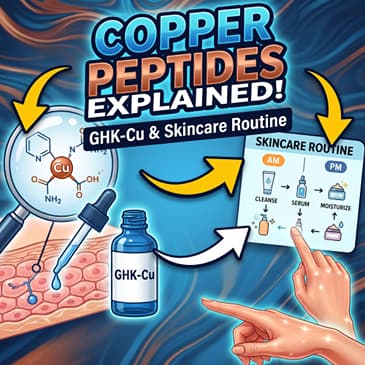
Explore the science of trace minerals and advanced cosmetic chemistry in this extensive guide to copper's internal and topical applications.
What You'll Learn: The Biological Role of Copper: How this essential trace mineral supports cellular energy metabolism, normal nervous system function, and natural pigmentation via melanin production.
The Oligodynamic Effect: The scientific phenomenon explaining how specific copper surfaces demonstrate antimicrobial activity under certain environmental conditions.
Advanced Cosmetic Peptides: The mechanisms of skin-conditioning tripeptides like GHK-Cu (the Blue Copper Peptide) and AHK-Cu, formulated to improve the appearance of skin hydration, texture, and scalp health.
Skincare Routine Mastery: Step-by-step guidance on layering cosmetic ingredients safely, including navigating formulation conflicts with direct acids (AHAs/BHAs), zinc, and vitamin C derivatives.
Health & Safety Regulations: Distinguishing cosmetic skin-conditioning benefits from therapeutic claims, navigating Health Canada guidelines, and understanding safety warnings for exosomes and unauthorized injectables.
Environmental Sustainability: The critical importance of recycling copper to meet growing technological demands while minimizing the ecological impact of mining.
Disclaimer: This material is provided for general educational and informational purposes only. It is not intended to diagnose, treat, cure, or prevent any disease, disorder, or medical condition, and it is not a substitute for individualized advice from a qualified health professional. Scientific research discussed in this material is provided as educational background and should not be interpreted as evidence that a particular cosmetic product produces a therapeutic, pharmacological, or systemic effect. Evaluate cosmetic ingredients and technologies based on their formulation, intended use, evidence, representations, and applicable legal requirements. Descriptions of biological mechanisms are included to explain the science behind an ingredient or technology and should not be interpreted as claims that a cosmetic product modifies, repairs, restores, or treats an underlying biological condition.
Contact Ida Fanelli
Link in Bio
#CopperPeptides #GHKCu #SkincareScience #CosmeticChemistry #SkinConditioning #CopperBiology #SkincareRoutine #AHKCu #PeptideSkincare #SustainableCopper
00:00:00 --> 00:00:03 Welcome to Where Science Meets Self -Care with
00:00:03 --> 00:00:06 Ida Fanelli. With over 30 years in beauty and
00:00:06 --> 00:00:09 wellness and a background in medical science,
00:00:09 --> 00:00:12 Ida blends clinical knowledge with holistic care.
00:00:13 --> 00:00:16 Each week, she and her guests share insights
00:00:16 --> 00:00:19 to help you achieve healthier skin, balanced
00:00:19 --> 00:00:23 energy, and empowered self -care. Now, here's
00:00:23 --> 00:00:32 your host, Ida Fi anelli. Today, we're taking a
00:00:32 --> 00:00:36 closer look at an element many people just see
00:00:36 --> 00:00:41 as hardware. A shiny penny or old pipes. But
00:00:41 --> 00:00:44 copper is actually an essential trace mineral
00:00:44 --> 00:00:47 that plays a key role in many biological and
00:00:47 --> 00:00:51 biochemical reactions, including those important
00:00:51 --> 00:00:55 for healthy skin. When most people hear the word
00:00:55 --> 00:00:58 copper, they think back to chemistry class and
00:00:58 --> 00:01:02 the periodic table. Even though elements make
00:01:02 --> 00:01:06 up everything around us, many people don't realize
00:01:06 --> 00:01:10 that copper is an essential piece of metal. I
00:01:10 --> 00:01:13 observed something similar during a manicure.
00:01:13 --> 00:01:16 A client told me she felt more comfortable when
00:01:16 --> 00:01:19 it comes into contact with air and moisture.
00:01:20 --> 00:01:22 Everyone's experience is different and this supports
00:01:22 --> 00:01:27 many metabolic and physiological processes in
00:01:27 --> 00:01:31 nearly all tissues. This quick change made her
00:01:31 --> 00:01:33 want to drink it where the body stores copper.
00:01:34 --> 00:01:37 Again, her experience is individual and does
00:01:37 --> 00:01:39 not show a guaranteed effect. You might be surprised
00:01:39 --> 00:01:43 by how it's distributed. Copper is found throughout
00:01:43 --> 00:01:47 the body, especially in the liver, muscles, bones,
00:01:47 --> 00:01:52 and brain. Adults only need a small amount each
00:01:52 --> 00:01:56 day, and the recommended intake depends on age
00:01:56 --> 00:02:00 and sex. And this small amount supports some
00:02:00 --> 00:02:03 of the body's most important cellular functions.
00:02:04 --> 00:02:07 Let's talk about how copper helps your cells.
00:02:07 --> 00:02:11 Copper is an essential trace mineral that works
00:02:11 --> 00:02:15 as a helper for several enzymes involved in normal
00:02:15 --> 00:02:20 cellular energy metabolism. ATP is the main energy
00:02:20 --> 00:02:23 carrying molecule that cells use throughout the
00:02:23 --> 00:02:28 body. Copper sports normal body functions in
00:02:28 --> 00:02:31 several ways. While electrolytes like sodium
00:02:31 --> 00:02:35 and potassium help with nerve signalling, copper
00:02:35 --> 00:02:39 acts as a cofactor for enzymes involved in many
00:02:39 --> 00:02:43 biological processes, including cellular energy
00:02:43 --> 00:02:48 metabolism. Getting enough copper supports normal
00:02:48 --> 00:02:51 function and supports maintaining connective
00:02:51 --> 00:02:55 tissue, iron metabolism, the nervous system,
00:02:55 --> 00:02:59 and immune health. Copper is needed for the normal
00:02:59 --> 00:03:04 function of some antioxic enzymes, such as copper
00:03:04 --> 00:03:09 containing superoxide dismutase, which is a part
00:03:09 --> 00:03:13 of the body's antioxidant defence system. Copper
00:03:13 --> 00:03:15 also supports normal nervous system function.
00:03:16 --> 00:03:19 Copper plays a role in normal pigmentation. It
00:03:19 --> 00:03:24 acts as a cofactor for tyrosinase. an enzyme
00:03:24 --> 00:03:27 that helps produce melanin, the natural pigment
00:03:27 --> 00:03:32 in your skin, hair and eyes. Tyrosinase helps
00:03:32 --> 00:03:36 specialized cells called melanocytes make melanin
00:03:36 --> 00:03:40 from the amino acid tyrosinine. Melanin gives
00:03:40 --> 00:03:44 your skin its tint, your eyes their colour, and
00:03:44 --> 00:03:47 determines your natural hair colour. having enough
00:03:47 --> 00:03:50 copper supports the normal activity of enzymes
00:03:50 --> 00:03:54 like tyrosinase showing copper's importance in
00:03:54 --> 00:03:59 pigmentation copper complexes and copper peptides
00:03:59 --> 00:04:03 are also used in cosmetics depending on the products
00:04:03 --> 00:04:06 they may help condition the skin and improve
00:04:06 --> 00:04:09 its texture smoothness and overall appearance
00:04:10 --> 00:04:13 to understand how vitamin C works it's helpful
00:04:13 --> 00:04:15 to look at both natural wellness and clinical
00:04:15 --> 00:04:19 science in holistic health vitamin c is seen
00:04:19 --> 00:04:23 as part of a mix of plant compounds including
00:04:23 --> 00:04:29 bioflavonoids and coenzymes with copper also
00:04:29 --> 00:04:33 playing a role scientifically pure vitamin C
00:04:33 --> 00:04:37 is called alloscorbic acid Both vitamin C and
00:04:37 --> 00:04:41 copper support important biological processes,
00:04:41 --> 00:04:45 such as connective tissue formation, but they
00:04:45 --> 00:04:48 have different roles and vitamin C does not require
00:04:48 --> 00:04:52 copper to work. However, getting this chemical
00:04:52 --> 00:04:56 balance right on the skin can be tricky. L -ascorbic
00:04:56 --> 00:05:00 acid needs a very acidic pH between 2 .5 and
00:05:00 --> 00:05:05 3 .5 to be absorbed through the skin. Topical
00:05:05 --> 00:05:09 vitamin C products must be carefully made with
00:05:09 --> 00:05:12 the right pH concentration, packaging and ingredients.
00:05:14 --> 00:05:17 Whether vitamin C and copper -containing products
00:05:17 --> 00:05:19 work well together depends on their specific
00:05:19 --> 00:05:23 formulas. What if you want to get this through
00:05:23 --> 00:05:26 your diet? You'll find high concentrations of
00:05:26 --> 00:05:30 essential dietary copper in shellfish, seeds
00:05:30 --> 00:05:35 and nuts, organ meats. wheat bran cereal whole
00:05:35 --> 00:05:40 grain products and dark chocolate chocolate and
00:05:40 --> 00:05:43 shellfish are both popular foods and good sources
00:05:43 --> 00:05:46 of copper but copper's benefits go beyond what
00:05:46 --> 00:05:51 happens in our bodies as we'll see next the antimicrobial
00:05:51 --> 00:05:56 shield and the oligodynamic effect Now that
00:05:56 --> 00:05:59 we have looked at copper's biological role, let's
00:05:59 --> 00:06:01 explore the antimicrobial properties studied
00:06:01 --> 00:06:05 in copper -containing materials. This is due
00:06:05 --> 00:06:08 to a scientific phenomenon called the oligodynamic
00:06:08 --> 00:06:12 effect. In simple terms, the oligodynamic effect
00:06:12 --> 00:06:15 means that small amounts of certain metal ions,
00:06:16 --> 00:06:19 including copper and silver, have demonstrated
00:06:19 --> 00:06:23 antimicrobial activity under specific conditions.
00:06:24 --> 00:06:27 These outcomes relate to specific materials and
00:06:27 --> 00:06:29 exposure conditions and should not automatically
00:06:29 --> 00:06:33 be interpreted as evidence of a health benefit
00:06:33 --> 00:06:36 from every copper containing consumer product.
00:06:36 --> 00:06:40 Historically, humans recognized this long before
00:06:40 --> 00:06:44 modern medical science even knew what a virus
00:06:44 --> 00:06:47 or bacteria was. Early traditional practices
00:06:47 --> 00:06:51 used basic cupric carbonate derived from dark
00:06:51 --> 00:06:55 green malachite crystals. That dark green color
00:06:55 --> 00:07:00 is a classic sign of oxidized copper. If you
00:07:00 --> 00:07:04 look at the periodic table, copper, Cu, silver
00:07:04 --> 00:07:09 Ag, and gold Au sit in the same vertical group
00:07:09 --> 00:07:13 and share some chemical characteristics. Although
00:07:13 --> 00:07:16 their chemical reactivity differs, copper is
00:07:16 --> 00:07:19 widely recognized for its electrical conductivity
00:07:20 --> 00:07:24 and its ability to participate in oxidation reduction
00:07:24 --> 00:07:27 reactions. Metal alloys like brass and bronze
00:07:27 --> 00:07:33 inherit the same oligodynamic effects. However,
00:07:33 --> 00:07:36 there's an important detail to remember if you
00:07:36 --> 00:07:40 want to use this in real life. The antimicrobial
00:07:40 --> 00:07:43 activity reported for certain copper containing
00:07:43 --> 00:07:46 surfaces depends on the material, surface condition,
00:07:46 --> 00:07:50 and environmental conditions. A coating can substantially
00:07:50 --> 00:07:53 change the interaction between the metal surface
00:07:53 --> 00:07:56 and the environment. The interaction between
00:07:56 --> 00:07:59 copper containing surfaces, air, moisture and
00:07:59 --> 00:08:02 microorganisms can influence surface chemistry
00:08:02 --> 00:08:06 and the availability of copper ions. If you look
00:08:06 --> 00:08:09 in the background, you'll see some copper chimes
00:08:09 --> 00:08:13 I made. They are simulating this exact oxidation
00:08:13 --> 00:08:16 process, showing how copper naturally tarnishes
00:08:16 --> 00:08:20 when exposed to the elements. If the metal is
00:08:20 --> 00:08:23 covered with a clear seal or lacquer, the effect
00:08:23 --> 00:08:26 is blocked. Now what about silver? The saying,
00:08:26 --> 00:08:29 born with a silver spoon in their mouth, isn't
00:08:29 --> 00:08:33 about wealth. It refers to health. Silver has
00:08:33 --> 00:08:36 a long history of use in household and medical
00:08:36 --> 00:08:40 contexts. and silver ions have well documented
00:08:40 --> 00:08:45 antimicrobial properties in specific conditions
00:08:45 --> 00:08:49 however historical practices should not be seen
00:08:49 --> 00:08:53 as evidence that silver containing products prevent
00:08:53 --> 00:08:56 illness health canada has specifically advised
00:08:56 --> 00:09:00 that colloidal silver and silver salts products
00:09:00 --> 00:09:03 are not authorized to make health claims and
00:09:03 --> 00:09:06 has warned consumers about unsubstantiated marketing
00:09:07 --> 00:09:11 of these products today we know that studies
00:09:11 --> 00:09:14 have investigated combinations of copper and
00:09:14 --> 00:09:18 silver ions for antimicrobial activity under
00:09:18 --> 00:09:21 specific experimental conditions let's look at
00:09:21 --> 00:09:25 how copper ranks in biocidal strength cuprous
00:09:25 --> 00:09:29 c plus and cupric c 2 plus copper are different
00:09:29 --> 00:09:33 oxidation states with different chemical properties.
00:09:34 --> 00:09:36 Researchers have studied their antimicrobial
00:09:36 --> 00:09:39 activity under a range of experimental conditions.
00:09:40 --> 00:09:44 Here is a simulated petri dish simulation showing
00:09:44 --> 00:09:48 that cupric oxide, cuprous oxide and metallic
00:09:48 --> 00:09:52 copper can demonstrate different levels of antimicrobial
00:09:52 --> 00:09:56 activity. their effectiveness can vary depending
00:09:56 --> 00:09:59 on the form of copper surface characteristics
00:09:59 --> 00:10:03 the concentration or availability of copper ions
00:10:03 --> 00:10:06 the microorganism involved and environmental
00:10:06 --> 00:10:11 conditions copper actively fights bacteria cupric
00:10:11 --> 00:10:15 ions offer moderate resistance cuprous copper
00:10:15 --> 00:10:19 shows the highest effectiveness metallic copper
00:10:19 --> 00:10:22 which is monovalent copper is the least effective
00:10:23 --> 00:10:25 How is this applied in actual products right
00:10:25 --> 00:10:29 now? Storing water in copper vessels is an ancient
00:10:29 --> 00:10:32 practice. Researchers have studied copper surfaces
00:10:32 --> 00:10:36 for their interactions with microorganisms, although
00:10:36 --> 00:10:39 results depend on conditions and the specific
00:10:39 --> 00:10:42 vessel. However, copper vessels should not be
00:10:42 --> 00:10:46 viewed as a substitute for proper water treatment,
00:10:46 --> 00:10:49 sanitation, or safe drinking water practices.
00:10:50 --> 00:10:53 What about textiles and healthcare settings?
00:10:53 --> 00:10:56 Researchers have studied copper -containing alloys
00:10:56 --> 00:11:00 for their antimicrobial activity on frequently
00:11:00 --> 00:11:04 touched surfaces in healthcare settings. Research
00:11:04 --> 00:11:06 has studied whether these materials may reduce
00:11:06 --> 00:11:10 microbial contamination under specific conditions.
00:11:10 --> 00:11:13 Consumer textiles and wearables have exploded
00:11:13 --> 00:11:16 in popularity. Metal surfaces interact with the
00:11:16 --> 00:11:18 air, moisture, and the surrounding environment.
00:11:19 --> 00:11:22 and copper -containing materials can release
00:11:22 --> 00:11:25 ions under certain conditions. Throughout history,
00:11:25 --> 00:11:29 specialized copper and bronze alloy tools have
00:11:29 --> 00:11:33 been used in cosmetic massage practices. When
00:11:33 --> 00:11:36 used for gentle surface massage, these tools
00:11:36 --> 00:11:38 can help condition the skin and improve the appearance
00:11:39 --> 00:11:43 of uneven texture while massage can feel soothing
00:11:43 --> 00:11:47 on areas with uneven skin or old blemishes cosmetic
00:11:47 --> 00:11:50 massage tools are intended to improve the outward
00:11:50 --> 00:11:53 appearance of the skin not to medically treat
00:11:53 --> 00:11:57 break down or remodel underlying scar tissue
00:11:57 --> 00:12:00 and now we'll take time for commercial break
00:12:00 --> 00:12:06 welcome back These material properties have contributed
00:12:06 --> 00:12:09 to the development of a variety of consumer products
00:12:09 --> 00:12:14 incorporating copper or other metals. Some consumer
00:12:14 --> 00:12:17 products using copper and silver containing textile
00:12:17 --> 00:12:21 fibers because these metals have been studied
00:12:21 --> 00:12:24 for antimicrobial properties and odor control
00:12:24 --> 00:12:28 applications. Some copper -containing insoles
00:12:28 --> 00:12:32 are marketed for their odor control and antimicrobial
00:12:32 --> 00:12:37 properties. Grounding or earthing shoes use copper's
00:12:37 --> 00:12:40 electrical conductivity to connect you to the
00:12:40 --> 00:12:44 earth. You can also support earthing by walking
00:12:44 --> 00:12:48 barefoot on grass, sand, soil, bare dirt, unsealed
00:12:48 --> 00:12:51 concrete or brick, and even by swimming in natural
00:12:51 --> 00:12:55 bodies of water. Health Canada does not establish
00:12:55 --> 00:12:58 claims that grounding or earthing produces a
00:12:58 --> 00:13:02 health benefit and should not be presented as
00:13:02 --> 00:13:06 therapeutic. Copper containing compression garments
00:13:06 --> 00:13:10 are marketed for athletic and everyday use. I
00:13:10 --> 00:13:13 visited me for reflexology because he was dealing
00:13:13 --> 00:13:17 with foot pain. The treatment gave him some short
00:13:17 --> 00:13:20 -term relief. While I was working on his feet,
00:13:20 --> 00:13:24 I noticed they looked a bit bluish. Because this
00:13:24 --> 00:13:27 can happen for many reasons, I suggested he check
00:13:27 --> 00:13:30 with his health care provider about possible
00:13:30 --> 00:13:34 circulation problems. I suggested he try copper
00:13:34 --> 00:13:37 compression socks. Later, he told me the socks
00:13:37 --> 00:13:41 eased his foot pain, but the pain returned when
00:13:41 --> 00:13:44 he took them off at night. This was just his
00:13:44 --> 00:13:47 experience and everyone is different. His story
00:13:47 --> 00:13:51 does not prove that copper socks or similar products
00:13:51 --> 00:13:55 treat foot pain. or improve circulation. Some
00:13:55 --> 00:13:57 specialized dressings and healthcare materials
00:13:57 --> 00:14:01 incorporate copper -containing components. Wearing
00:14:01 --> 00:14:04 unsealed raw copper bracelets keeps your skin
00:14:04 --> 00:14:08 in steady contact with copper ions. I wear these
00:14:08 --> 00:14:11 bracelets myself and have noticed they help with
00:14:11 --> 00:14:14 my hand joint discomfort. This is just my own
00:14:14 --> 00:14:17 observation and does not mean copper bracelets
00:14:17 --> 00:14:20 relieve joint pain or treat any medical condition.
00:14:22 --> 00:14:25 The manicure bowl and copper gloves. I observed
00:14:25 --> 00:14:28 something similar during the manicure. A client
00:14:28 --> 00:14:31 told me she felt more comfortable while her hands
00:14:31 --> 00:14:35 soaked in a raw copper bowl. Everyone's experience
00:14:35 --> 00:14:38 is different and this does not prove copper release
00:14:38 --> 00:14:41 joint pain. As soon as she took her hands out,
00:14:41 --> 00:14:44 her pain and stiffness came back. This quick
00:14:44 --> 00:14:47 change made her want to try copper infused gloves
00:14:47 --> 00:14:50 at night. Again, her experience is individual
00:14:50 --> 00:14:55 and does not show a guaranteed effect. It might
00:14:55 --> 00:14:58 seem like magic, but it's really just chemistry.
00:14:59 --> 00:15:03 When copper meets air and moisture, it can oxidize
00:15:03 --> 00:15:06 and release copper ions depending on the material
00:15:06 --> 00:15:10 and environment. Copper acts as a cofactor for
00:15:10 --> 00:15:13 several enzymes involved in normal biological
00:15:13 --> 00:15:17 processes, including antioxidant defense. However,
00:15:17 --> 00:15:21 just because dietary copper has these roles does
00:15:21 --> 00:15:24 not mean that using copper on the skin will have
00:15:24 --> 00:15:28 the same systemic antioxidant effect. Industrial
00:15:28 --> 00:15:32 and everyday copper formulations. We've covered
00:15:32 --> 00:15:35 internal health and ancient antimicrobial history.
00:15:35 --> 00:15:39 Still day -to -day life in the 21st century relies
00:15:39 --> 00:15:42 on dozens of specialized chemical forms of copper
00:15:42 --> 00:15:46 that most people interact with without ever realizing
00:15:46 --> 00:15:51 it. Let's look at some common copper compounds.
00:15:51 --> 00:15:55 Certain Copper containing compounds and pigments
00:15:55 --> 00:15:59 have been used in coloring applications, including
00:15:59 --> 00:16:02 some cosmetic formulations, depending on the
00:16:02 --> 00:16:05 specific ingredients and pertinent legal requirements.
00:16:06 --> 00:16:10 Next, copper silicate is utilized heavily in
00:16:10 --> 00:16:14 high -accuracy optical devices, specialized agricultural
00:16:14 --> 00:16:17 fertilizers, and industrial -grade paint pigments.
00:16:18 --> 00:16:21 Different forms of copper show varying levels
00:16:21 --> 00:16:25 of anti -material effectiveness when disinfecting
00:16:25 --> 00:16:28 surfaces. Copper oxides are used in a variety
00:16:28 --> 00:16:32 of industrial and technical applications. They
00:16:32 --> 00:16:36 exist in two different chemical states, cuprous
00:16:36 --> 00:16:41 oxide and cupric oxide. They are used as rich
00:16:41 --> 00:16:45 pigments, agricultural fungicides, and anti -fouling
00:16:45 --> 00:16:49 marine paints. Furthermore, copper's exceptional
00:16:49 --> 00:16:53 electrical conductivity makes copper oxides essential
00:16:53 --> 00:16:57 for semiconductors, solar energy panels, and
00:16:57 --> 00:17:02 even color -producing fireworks. Next up is copper
00:17:02 --> 00:17:06 sulfate. which has many uses. Copper sulfate
00:17:06 --> 00:17:09 has applications in agriculture, animal nutrition,
00:17:09 --> 00:17:13 and diverse industrial processes. Its property
00:17:13 --> 00:17:16 and uses depend on the specific formulation and
00:17:16 --> 00:17:20 application. In the textile and leather industries,
00:17:20 --> 00:17:24 copper sulfate acts as a color stabilizer during
00:17:24 --> 00:17:28 dyeing, ensuring fabrics maintain vibrant, durable
00:17:28 --> 00:17:33 colour over time. However, a major warning for
00:17:33 --> 00:17:37 builders, active copper causes severe galvanic
00:17:37 --> 00:17:40 corrosion when it contacts standard metals. Copper
00:17:40 --> 00:17:43 chloride appears as a brownish yellow powder.
00:17:43 --> 00:17:47 It is widely used in petroleum refinery, textile
00:17:47 --> 00:17:52 manufacturing, metallurgy, photography, agricultural
00:17:52 --> 00:17:56 chemical production, animal feed, fortification,
00:17:56 --> 00:18:00 and wood preservation. Copper carbonate is used
00:18:00 --> 00:18:04 for bronze electroplating in aquarium products
00:18:04 --> 00:18:07 to control algae and may have applications in
00:18:07 --> 00:18:11 coloring and industrial processes depending on
00:18:11 --> 00:18:15 the specific compound. Copper gluconate is used
00:18:15 --> 00:18:18 in dietary supplements and may also be found
00:18:18 --> 00:18:22 in some cosmetic formulations. In cosmetics,
00:18:22 --> 00:18:24 its intended role depends on the formulation
00:18:24 --> 00:18:30 and may include skin conditioning. As for medical
00:18:30 --> 00:18:33 devices inside the human body, metallic copper
00:18:33 --> 00:18:37 is used in traditional dental amalgams. Copper
00:18:37 --> 00:18:40 is also included in certain authorized medical
00:18:40 --> 00:18:44 devices, including copper-containing intrauterine
00:18:44 --> 00:18:48 devices. These products are regulated separately
00:18:48 --> 00:18:52 from cosmetics. Beyond internal devices, topical
00:18:52 --> 00:18:56 cosmetic formulations containing copper ingredients
00:18:56 --> 00:19:00 may be formulated. to condition the skin and
00:19:00 --> 00:19:03 improve the appearance or feel of dry, rough,
00:19:03 --> 00:19:07 or uneven skin texture. So it's important to
00:19:07 --> 00:19:09 know the difference. Different copper compounds
00:19:09 --> 00:19:13 have different properties and safety characteristics.
00:19:13 --> 00:19:16 Cosmetic ingredients must be evaluated in the
00:19:16 --> 00:19:20 context of their specific formulation, concentration,
00:19:20 --> 00:19:25 and planned use. The Skin Care Science of Peptides
00:19:25 --> 00:19:28 now we are entering the cutting -edge domain
00:19:28 --> 00:19:32 of cosmetic chemistry peptides people hear the
00:19:32 --> 00:19:35 word peptide thrown around in beauty commercials
00:19:35 --> 00:19:39 all the time but what is a peptide chemically
00:19:39 --> 00:19:43 speaking At its core, a peptide is simply a short
00:19:43 --> 00:19:46 chain of amino acids linked together by peptide
00:19:46 --> 00:19:50 bonds. There is no universally applicable biological
00:19:50 --> 00:19:55 cutoff at which every peptide automatically becomes
00:19:55 --> 00:19:59 a protein. Terminology varies by scientific context.
00:19:59 --> 00:20:03 Peptides are commonly used in cosmetic formulations
00:20:03 --> 00:20:06 intended to condition the skin and improve its
00:20:06 --> 00:20:09 appearance. Peptides are used in a wide variety
00:20:09 --> 00:20:13 of cosmetic formulations and are often selected
00:20:13 --> 00:20:17 for their skin conditioning properties. Individual
00:20:17 --> 00:20:20 products can differ in formulation and tolerability
00:20:20 --> 00:20:24 so sustainability depends on the finished product
00:20:24 --> 00:20:27 and the individual. Peptides have been evaluated
00:20:27 --> 00:20:31 in cosmetic and scientific literature but the
00:20:31 --> 00:20:33 safety and performance of a finished cosmetic
00:20:33 --> 00:20:37 depends on its complete formulation. concentration,
00:20:38 --> 00:20:42 exposure, and planned use. Let's break down four
00:20:42 --> 00:20:46 classes of peptides. Signal peptides, carrier
00:20:46 --> 00:20:50 peptides, neurotransmitter inhibitor peptides,
00:20:50 --> 00:20:54 enzyme inhibitor peptides. Let's tackle signal
00:20:54 --> 00:20:59 peptides first. Signal peptides are used in cosmetic
00:20:59 --> 00:21:02 formulations marketed to improve the appearance
00:21:02 --> 00:21:05 of fine lines and other visible signs of skin
00:21:05 --> 00:21:08 aging. two of the absolute rock -star signal
00:21:08 --> 00:21:12 peptides in modern formulations are palmitoy
00:21:12 --> 00:21:14 tripeptide one and palmitoy tripeptide seven
00:21:14 --> 00:21:19 palmitoy tripeptide one consists of three amino
00:21:19 --> 00:21:24 acid sequences glycine histidine lysine bound
00:21:24 --> 00:21:27 to a fatty acid chain known as palmitic acid
00:21:29 --> 00:21:32 Attaching a fatty acid can alter a peptide's
00:21:32 --> 00:21:35 formulation and skin interaction properties.
00:21:36 --> 00:21:39 Palmitoyl peptides are commonly used in cosmetic
00:21:39 --> 00:21:43 formulations intended to condition the skin and
00:21:43 --> 00:21:46 improve the appearance of fine lines and skin
00:21:46 --> 00:21:51 texture. Palmitoyl tripeptide 7 features a sequence
00:21:51 --> 00:21:56 of four amino acids, glycine, glutamine, proline,
00:21:57 --> 00:22:00 arginine attached to palmitic acid researchers
00:22:00 --> 00:22:03 have studied palmitoy peptides for their effects
00:22:03 --> 00:22:07 on skin related pathways these peptides are used
00:22:07 --> 00:22:10 in cosmetic formulations intended to condition
00:22:10 --> 00:22:13 the skin and improve the appearance of firmness
00:22:13 --> 00:22:17 smoothness and fine lines A peptide's ability
00:22:17 --> 00:22:19 to reach different layers of the skin depends
00:22:19 --> 00:22:23 on its chemical properties, formulation, and
00:22:23 --> 00:22:25 delivery system. Cosmetic benefits should be
00:22:25 --> 00:22:28 described according to the evidence available
00:22:28 --> 00:22:32 for the specific product. Now let's jump into
00:22:32 --> 00:22:36 enzyme inhibitor peptides. Some peptides have
00:22:36 --> 00:22:39 been studied for interactions with enzymes involved
00:22:39 --> 00:22:43 in skin biology and are used in cosmetic formulations
00:22:43 --> 00:22:45 to improve the appearance and feel of the skin.
00:22:46 --> 00:22:49 Claims about decreasing irritation, redness,
00:22:49 --> 00:22:51 or other skin conditions should be supported
00:22:51 --> 00:22:55 by evidence appropriate to the specific product.
00:22:55 --> 00:22:59 Where do we source natural peptides? Soybean
00:22:59 --> 00:23:02 peptides. Some cosmetic formulations use soy
00:23:02 --> 00:23:05 derived peptides as skin conditioning ingredients.
00:23:06 --> 00:23:09 Silk peptides derived from silkworm proteins
00:23:09 --> 00:23:13 are used in some cosmetic formulations as skin
00:23:13 --> 00:23:17 conditioning ingredients. Rice peptides extracted
00:23:17 --> 00:23:20 from grain proteins; rice-derived peptides are
00:23:20 --> 00:23:23 used in some cosmetic formulations as skin conditioning
00:23:23 --> 00:23:27 ingredients. combining different cosmetic peptides
00:23:27 --> 00:23:30 can provide complementary skin conditioning benefits
00:23:30 --> 00:23:33 including improved appearance of smoothness firmness
00:23:33 --> 00:23:36 and fine lines and now we'll take time for a
00:23:36 --> 00:23:40 commercial break welcome back revolutionary copper
00:23:40 --> 00:23:47 peptides ghkcu and ahkcu Understanding the difference
00:23:47 --> 00:23:50 between biology and cosmetic use is important.
00:23:50 --> 00:23:53 Copper has essential roles within the human body,
00:23:53 --> 00:23:57 but those physiological roles should not automatically
00:23:57 --> 00:24:00 be credited to a topical cosmetic containing
00:24:00 --> 00:24:05 a copper ingredient. Cosmetic formulations are
00:24:05 --> 00:24:07 designed for effects such as cleansing, conditioning,
00:24:08 --> 00:24:10 moisturizing, and improving the appearance of
00:24:10 --> 00:24:14 the skin. Laboratory or systemic research can
00:24:14 --> 00:24:17 provide useful scientific backgrounds. However,
00:24:17 --> 00:24:20 it does not by itself establish that the same
00:24:20 --> 00:24:23 effect occurs when an ingredient is applied topically
00:24:23 --> 00:24:27 in a cosmetic product. As a simplified analogy,
00:24:27 --> 00:24:31 GHKCU is a copper containing peptide complex
00:24:31 --> 00:24:36 in cosmetic formulations. It is used as an ingredient
00:24:36 --> 00:24:39 associated with skin conditioning and a healthier
00:24:39 --> 00:24:43 looking appearance. It is a well -studied naturally
00:24:43 --> 00:24:48 occurring tripeptide, short for glycol L -histidyl
00:24:48 --> 00:24:53 L -lysine. Dr. Lauren Pickett isolated it in
00:24:53 --> 00:24:57 1973. GHK is a naturally occurring tripeptide
00:24:57 --> 00:25:02 present in human blood plasma, saliva, and urine.
00:25:02 --> 00:25:07 When GHK binds with a divalent copper ion, Cu2
00:25:07 --> 00:25:12 +, it forms GHK -Cu. Laboratory research has
00:25:12 --> 00:25:16 studied GHK -CU and its interactions with cells
00:25:16 --> 00:25:20 associated with hair follicles. In cosmetic products,
00:25:20 --> 00:25:23 copper peptides may condition the scalp and improve
00:25:23 --> 00:25:27 the appearance and feel of hair. Here's an interesting
00:25:27 --> 00:25:30 fact. Pure copper metal looks reddish yellow,
00:25:30 --> 00:25:35 but when a copper ion, Cu2 +, dissolves in a
00:25:35 --> 00:25:39 water -based peptide solution, it turns bright
00:25:39 --> 00:25:43 blue. That's why GHK -Cu is often called the
00:25:43 --> 00:25:46 blue copper peptide. But what happens to our
00:25:46 --> 00:25:49 natural GHK -Cu levels as we grow older? Some
00:25:49 --> 00:25:52 research has reported age -related differences
00:25:52 --> 00:25:57 in circulating GHK -related peptide levels. Reported
00:25:57 --> 00:26:00 values vary among studies and populations, so
00:26:00 --> 00:26:03 these outcomes should be considered research
00:26:03 --> 00:26:06 observations rather than MESAs for predicting
00:26:06 --> 00:26:09 an individual's skin condition or determining
00:26:09 --> 00:26:13 that topical GHK -Cu will reverse age -related
00:26:13 --> 00:26:17 changes. In preliminary test tube and laboratory
00:26:17 --> 00:26:20 research, scientists have observed remarkable
00:26:20 --> 00:26:26 cellular pathways associated with GHK -Cu. Researchers
00:26:26 --> 00:26:30 have investigated GHKCU interactions with various
00:26:30 --> 00:26:35 biological pathways. In a cosmetic context, these
00:26:35 --> 00:26:38 outcomes should not be interpreted as proof that
00:26:38 --> 00:26:41 a topical product produces the same systemic
00:26:41 --> 00:26:44 or cellular effects observed in laboratory research.
00:26:45 --> 00:26:49 GHKCU is used in some cosmetic formulations intended
00:26:49 --> 00:26:52 to condition the skin and improve the appearance
00:26:52 --> 00:26:58 of hydration, suppleness, and smoothness. Laboratory
00:26:58 --> 00:27:01 research has studied GHKCU in relation to matrix,
00:27:02 --> 00:27:06 metalloproteinase, and other processes associated
00:27:06 --> 00:27:09 with the skin's extracellular environment. These
00:27:09 --> 00:27:12 findings deliver scientific context which should
00:27:12 --> 00:27:15 not be presented as proof that a cosmetic product
00:27:15 --> 00:27:19 prevents collagen or elastin breakdown in people.
00:27:19 --> 00:27:22 Copper is involved in antioxidant enzyme systems
00:27:22 --> 00:27:26 in the body, while GHKCU has also been investigated
00:27:26 --> 00:27:30 in laboratory research related to oxidative processes.
00:27:31 --> 00:27:35 Research has studied GHKCU in cellular processes
00:27:35 --> 00:27:39 related to copper, iron, and oxidative biology.
00:27:40 --> 00:27:42 Laboratory research has studied interactions
00:27:42 --> 00:27:47 between GHKCU, ferritin, iron -related processes,
00:27:47 --> 00:27:51 and oxidative chemistry. These outcomes can help
00:27:51 --> 00:27:53 researchers understand the compound's biochemical
00:27:53 --> 00:27:57 properties. However, results observed in test
00:27:57 --> 00:28:00 tube or cellular studies should not be presented
00:28:00 --> 00:28:03 as evidence that a topical cosmetic protects
00:28:03 --> 00:28:06 human cells or tissues from oxidative damage.
00:28:07 --> 00:28:11 Research has assessed whether GHK -CU interacts
00:28:11 --> 00:28:14 with biological pathways associated with gene
00:28:14 --> 00:28:17 expression and tissue biology. These outcomes
00:28:17 --> 00:28:20 remain part of the research literature and should
00:28:20 --> 00:28:24 not be translated directly into claims that a
00:28:24 --> 00:28:27 cosmetic product repairs or regenerates tissue.
00:28:27 --> 00:28:31 Some animal and laboratory studies have investigated
00:28:31 --> 00:28:36 GHKCU in relation to nervous system and other
00:28:36 --> 00:28:39 biological processes. Finding from these studies
00:28:39 --> 00:28:42 should not be interpreted as evidence that a
00:28:42 --> 00:28:45 topical cosmetic provides pain relief or treatment
00:28:45 --> 00:28:49 of a health condition in humans. It is important
00:28:49 --> 00:28:52 to distinguish laboratory and biological research
00:28:52 --> 00:28:57 on GHKCU from the cosmetic use of a topical formulation.
00:28:58 --> 00:29:01 A cosmetic product is intended to provide effects
00:29:01 --> 00:29:04 such as cleansing, conditioning, moisturizing,
00:29:04 --> 00:29:08 or improving the appearance of the skin. Now
00:29:08 --> 00:29:13 what about its sister peptide, AHKCU? AHKCU is
00:29:13 --> 00:29:17 another copper -binding tripeptide made of alanine,
00:29:17 --> 00:29:21 histidine, and lysine bound to copper. It also
00:29:21 --> 00:29:25 ranges from bright blue to light blue. AHKCU
00:29:25 --> 00:29:28 has been studied in connection with hair and
00:29:28 --> 00:29:31 follicle biology and may be used in cosmetic
00:29:31 --> 00:29:34 formulations intended to condition the scalp
00:29:34 --> 00:29:36 and hair and improve their appearance and feel.
00:29:37 --> 00:29:40 Master class ingredient complex and safety warnings.
00:29:41 --> 00:29:45 Let's start by putting everything together. How
00:29:45 --> 00:29:48 to layer copper peptides? How to mix them with
00:29:48 --> 00:29:51 zinc? Ingredients you must avoid and crucial
00:29:51 --> 00:29:55 health regulatory warnings. Let's start with
00:29:55 --> 00:29:58 a rival ingredient that often confuses consumers.
00:29:58 --> 00:30:02 Argylline is a peptide commonly used in cosmetic
00:30:02 --> 00:30:05 formulations marketed to improve the appearance
00:30:05 --> 00:30:09 of expression lines and fine lines. Argylline,
00:30:09 --> 00:30:14 acetyl hexapeptide 8, belongs to the neurotransmitter
00:30:14 --> 00:30:18 inhibitor peptide class. It's a synthetic peptide
00:30:18 --> 00:30:22 composed of six amino acids. Now let's look at
00:30:22 --> 00:30:26 its mechanism. Argeline is used in subcosmetic
00:30:26 --> 00:30:29 formulations intended to improve the appearance
00:30:29 --> 00:30:33 of fine expression lines. Application. Apply
00:30:33 --> 00:30:36 it non -invasively as a daily topical cream or
00:30:36 --> 00:30:40 serum. Duration. The visible cosmetic effects,
00:30:40 --> 00:30:43 if any, depend on the formulation, directions
00:30:43 --> 00:30:46 for use, and the individual products supporting
00:30:46 --> 00:30:51 evidence. Results. Argilline may deliver a mild
00:30:51 --> 00:30:55 smoothing effect of fine expression lines. Now
00:30:55 --> 00:30:58 let's address zinc versus copper in both nutrition
00:30:58 --> 00:31:03 and skin care. Dietary competition. In your diet,
00:31:03 --> 00:31:07 zinc and copper compete for absorption. If you're
00:31:07 --> 00:31:09 considering supplementing either, speak with
00:31:09 --> 00:31:12 a health professional about an appropriate ratio
00:31:12 --> 00:31:17 for your needs. Depletion factors, certain dietary
00:31:17 --> 00:31:20 patterns, medications, or other factors may affect
00:31:20 --> 00:31:25 copper absorption or copper status. Anyone concerned
00:31:25 --> 00:31:28 about copper intake or nutritional status should
00:31:28 --> 00:31:31 discuss their individual circumstances with a
00:31:31 --> 00:31:34 qualified health care professional. Wilson's
00:31:34 --> 00:31:38 disease is a medical issue involving copper metabolism.
00:31:38 --> 00:31:42 People diagnosed with Wilson's disease must follow
00:31:42 --> 00:31:45 their health care professional's dietary and
00:31:45 --> 00:31:50 treatment recommendations rather than changing
00:31:50 --> 00:31:53 their copper intake on their own. Zinc and copper
00:31:53 --> 00:31:56 have different chemical properties and compatibility
00:31:56 --> 00:32:00 can vary between formulations. Rather than assuming
00:32:00 --> 00:32:03 that all zinc and copper peptide products are
00:32:03 --> 00:32:06 incompatible, follow the manufacturer's directions
00:32:06 --> 00:32:09 and consider the formulation as a whole. Here's
00:32:09 --> 00:32:12 one example of a cosmetic skincare layering routine.
00:32:13 --> 00:32:16 Morning Routine Cosmetic Skin Conditioning and
00:32:16 --> 00:32:21 Protection Cleanse your face. Start with a fresh
00:32:21 --> 00:32:24 canvas. Apply a zinc -containing cosmetic serum
00:32:24 --> 00:32:28 as directed by the manufacturer. depending on
00:32:28 --> 00:32:30 the formulation it may condition the skin and
00:32:30 --> 00:32:33 improve the appearance of texture and coloration
00:32:33 --> 00:32:37 pair with vitamin c or niacinamide vitamin c
00:32:37 --> 00:32:40 is commonly included in cosmetic formulations
00:32:40 --> 00:32:43 intended to improve the appearance of skin brightness
00:32:43 --> 00:32:48 and uneven whether it is appropriate to combine
00:32:48 --> 00:32:51 it with a particular zinc containing product
00:32:51 --> 00:32:55 depends on the individual formulation niacinamide
00:32:55 --> 00:32:58 is commonly used in cosmetic formulations to
00:32:58 --> 00:33:00 condition the skin and improve the appearance
00:33:00 --> 00:33:04 of texture and uneven tone moisturize and sunscreen
00:33:04 --> 00:33:08 lock it in Note that while peptide products are
00:33:08 --> 00:33:11 cosmetic and help condition and smooth the appearance
00:33:11 --> 00:33:15 of skin, they do not replace daily skincare and
00:33:15 --> 00:33:19 appropriate sun protection practices. Night Routine
00:33:19 --> 00:33:22 cleanse your face apply copper peptide serum
00:33:22 --> 00:33:27 ghkcu apply your ghkcu copper peptide serum as
00:33:27 --> 00:33:30 directed by the product manufacturer some cosmetic
00:33:30 --> 00:33:33 formulations use copper peptides to condition
00:33:33 --> 00:33:35 the skin and improve the appearance of texture
00:33:35 --> 00:33:39 and smoothness pair with niacinamide
00:33:39 --> 00:33:42 is widely used cosmetic formulations to support
00:33:42 --> 00:33:44 skin conditioning and improve the appearance
00:33:44 --> 00:33:48 of hydration uneven tone and visible skin texture
00:33:48 --> 00:33:52 lock it in with a barrier moisturizer the ultimate
00:33:52 --> 00:33:55 night routine advanced pairing cleanse your face
00:33:55 --> 00:34:00 always start with a completely fresh canvas apply
00:34:00 --> 00:34:04 copper peptide serum ghkcu after cleansing as
00:34:04 --> 00:34:07 directed by the product manufacturer Pair with
00:34:07 --> 00:34:11 hyaluronic acid or sodium hyaluronate. Hyaluronic
00:34:11 --> 00:34:14 acid is a humectant commonly used in cosmetic
00:34:14 --> 00:34:17 formulations to help increase and maintain the
00:34:17 --> 00:34:20 skin's surface hydration. Sodium hyaluronate
00:34:20 --> 00:34:23 is a form of hyaluronic acid used in cosmetic
00:34:23 --> 00:34:26 formulations to help improve the skin's moisture
00:34:26 --> 00:34:28 content and the appearance of suppleness and
00:34:28 --> 00:34:32 smoothness. Its behaviour in skin depends on its
00:34:32 --> 00:34:35 molecular characteristics and formulation. Cosmetic
00:34:35 --> 00:34:39 formulations containing sodium hyaluronate are
00:34:39 --> 00:34:41 commonly used for skin conditioning and moisturizing.
00:34:42 --> 00:34:45 Individual products should be evaluated according
00:34:45 --> 00:34:48 to their design, directions, and supporting safety
00:34:48 --> 00:34:54 information. GHKCU and sodium hyaluronate may
00:34:54 --> 00:34:57 be used together in a cosmetic routine intended
00:34:57 --> 00:35:00 to condition the skin and improve the appearance
00:35:00 --> 00:35:04 of surface suppleness and hydration. Pair with
00:35:04 --> 00:35:09 niacinamide, vitamin B3. Niacinamide is a multifunctional
00:35:09 --> 00:35:12 cosmetic ingredient commonly used in formulations
00:35:12 --> 00:35:14 intended to improve the appearance of skin texture,
00:35:14 --> 00:35:19 tone, plus visible signs of aging. Pair with
00:35:19 --> 00:35:22 plant -based retinoid alternatives. Bakchual
00:35:22 --> 00:35:25 is a plant -derived cosmetic ingredient commonly
00:35:25 --> 00:35:28 used in formulations intended to improve the
00:35:28 --> 00:35:31 appearance of fine lines, texture, and other
00:35:31 --> 00:35:34 visible signs of skin aging. Rosehip seed oil
00:35:34 --> 00:35:37 additionally nourishes the skin barrier. Both
00:35:37 --> 00:35:41 are common in cosmetic formulations, but compatibility
00:35:41 --> 00:35:45 depends on the specific products and their formulations.
00:35:45 --> 00:35:50 Salon -based electroporation support. Some professional
00:35:50 --> 00:35:53 cosmetic devices use electrical energy as part
00:35:53 --> 00:35:58 of topical product application procedures. and
00:35:58 --> 00:36:01 extent of effect depends on the specific device
00:36:01 --> 00:36:05 settings formulations and manufacturer's directions
00:36:05 --> 00:36:09 any representation about the device should remain
00:36:09 --> 00:36:12 consistent with its proposed use and applicable
00:36:12 --> 00:36:16 authorization and should be used according to
00:36:16 --> 00:36:19 the manufacturer's directions. Electroporation
00:36:19 --> 00:36:22 devices are designed to influence the skin's
00:36:22 --> 00:36:25 surface properties temporarily and may be used
00:36:25 --> 00:36:28 in subcosmetic settings as a topical application
00:36:28 --> 00:36:33 technique when used as intended it is a noninvasive
00:36:33 --> 00:36:36 cosmetic procedure without needles or intentional
00:36:36 --> 00:36:40 skin wounding If LED or another cosmetic device
00:36:40 --> 00:36:44 is incorporated into a skincare routine, follow
00:36:44 --> 00:36:46 the manufacturer's directions for the specific
00:36:46 --> 00:36:50 device and products being used. And now we'll
00:36:50 --> 00:36:53 take time for a commercial break. Welcome back.
00:36:54 --> 00:36:57 Light -based technology can be discussed from
00:36:57 --> 00:37:02 both a scientific and cosmetic perspective. But
00:37:02 --> 00:37:04 those two perspectives should not be confused.
00:37:05 --> 00:37:10 Red light in... the approximately 630 to 660
00:37:10 --> 00:37:14 nanometer range is commonly discussed in cosmetic
00:37:14 --> 00:37:17 light based applications in a cosmetic context
00:37:17 --> 00:37:21 claims should focus on visible skin appearance
00:37:21 --> 00:37:24 unless a specific device has authorized therapeutic
00:37:24 --> 00:37:29 indications near-infrared (NIR) light 800 to 850
00:37:29 --> 00:37:33 nanometers can interact with tissue differently
00:37:33 --> 00:37:36 from visible light Research has assessed various
00:37:36 --> 00:37:39 biological effects, but cosmetic representations
00:37:39 --> 00:37:42 should remain focused on the appearance and conditioning
00:37:42 --> 00:37:45 of the skin unless the device has an authorized
00:37:45 --> 00:37:50 therapeutic indication. Flu light, 450 nanometers,
00:37:50 --> 00:37:53 has been studied for its interactions with skin
00:37:53 --> 00:37:57 -associated microorganisms. Claims that a device
00:37:57 --> 00:37:59 treats blemishes or another skin condition are
00:37:59 --> 00:38:03 therapeutic claims and should only be made were
00:38:03 --> 00:38:06 supported by the device authorized indication.
00:38:07 --> 00:38:11 Green light, 525 nanometers. Wavelengths are
00:38:11 --> 00:38:14 sometimes discussed in cosmetic light -based
00:38:14 --> 00:38:16 approaches to the appearance of uneven skin tone.
00:38:16 --> 00:38:20 Any claim that a device treats a pigment disorder
00:38:20 --> 00:38:24 or condition would require an appropriate authorized
00:38:24 --> 00:38:28 therapeutic indication. Yellow or amber light,
00:38:28 --> 00:38:32 590 nanometers have been studied in various light
00:38:32 --> 00:38:36 based applications in cosmetic contacts descriptions
00:38:36 --> 00:38:39 should focus on supported effects on skin's appearance
00:38:39 --> 00:38:42 rather than claims about treating inflammation
00:38:42 --> 00:38:46 or promoting wound healing a quick note led session
00:38:46 --> 00:38:50 durations and frequency vary by device follow
00:38:50 --> 00:38:54 the manufacturer's directions for use in a cosmetic
00:38:54 --> 00:38:57 context any claim benefit should be supported
00:38:57 --> 00:39:01 by evidence appropriate to the specific device
00:39:02 --> 00:39:06 CoQ10, ubiquinone, and copper are involved in
00:39:06 --> 00:39:09 different biological processes. In cosmetic formulations,
00:39:10 --> 00:39:13 products containing these ingredients may condition
00:39:13 --> 00:39:16 the skin and support the appearance of smoothness
00:39:16 --> 00:39:20 and firmness. Astaxanthin is a carotenoid with
00:39:20 --> 00:39:22 antioxidant properties that has been studied
00:39:22 --> 00:39:27 in cosmetics and nutritional context. C. buckthorn
00:39:27 --> 00:39:31 oil contains various fatty acids including palmitic
00:39:31 --> 00:39:35 acid, toluic acid, omega -7, as well as other
00:39:35 --> 00:39:37 naturally occurring compounds and is used in
00:39:37 --> 00:39:40 some cosmetic formulations to condition the skin.
00:39:41 --> 00:39:46 Apply lipid -soluble actives. Because COQ10,
00:39:46 --> 00:39:49 astaxanthin, and sea buckthorn oil are naturally
00:39:49 --> 00:39:52 fat-soluble; they are often formulated into
00:39:52 --> 00:39:55 rich facial serums or botanical oils. You can
00:39:55 --> 00:39:59 incorporate them into your skincare routine according
00:39:59 --> 00:40:02 to the formulation's directions. after your water
00:40:02 --> 00:40:07 -based GHKCU and electroporation steps. Finish
00:40:07 --> 00:40:09 with a moisturizer appropriate for your skin
00:40:09 --> 00:40:12 and the manufacturer's directions. Now, what
00:40:12 --> 00:40:14 should we keep in mind when combining copper
00:40:14 --> 00:40:18 peptides and other skincare ingredients? Let's
00:40:18 --> 00:40:20 look at some commonly discussed formulations
00:40:20 --> 00:40:23 and routine considerations. Vitamin C derivatives.
00:40:24 --> 00:40:28 Vitamin C is another good example of why an ingredient's
00:40:28 --> 00:40:32 chemical form matters. Pure vitamin C, also known
00:40:32 --> 00:40:36 as L -ascorbic acid, is biologically active but
00:40:36 --> 00:40:40 can be relatively unstable in cosmetic formulations.
00:40:40 --> 00:40:43 For this reason, skincare products may use different
00:40:43 --> 00:40:47 vitamin C derivatives such as sodium ascorbyl
00:40:47 --> 00:40:51 phosphate, magnesium ascorbyl phosphate, ascorbyl
00:40:51 --> 00:40:55 glucoside, ethyl ascorbic acid, or tetrahexidyl
00:40:55 --> 00:40:59 ascorbate. These derivatives have different chemical
00:40:59 --> 00:41:02 properties including differences in water or
00:41:02 --> 00:41:07 oil solubility and formulation stability. Depending
00:41:07 --> 00:41:10 on the derivative and formulation, some may convert
00:41:10 --> 00:41:14 or contribute to vitamin C-related activity in
00:41:14 --> 00:41:17 the skin. This is why we shouldn't assume that
00:41:17 --> 00:41:20 every ingredient with vitamin C in its name behaves
00:41:20 --> 00:41:24 exactly like pure L -ascorbic acid. Some vitamin
00:41:24 --> 00:41:27 C derivatives are formulated at different pH
00:41:27 --> 00:41:31 levels and may be compatible with copper peptides.
00:41:31 --> 00:41:34 Always follow the directions and compatibility
00:41:34 --> 00:41:38 guidance provided by the manufacturers. Using
00:41:38 --> 00:41:41 retinol in the same routine. Retinol is a vitamin
00:41:41 --> 00:41:44 A derivative used in cosmetic and dermatological
00:41:44 --> 00:41:47 products. Depending on the specific product formulation
00:41:47 --> 00:41:52 and ethical and legal requirements, it may be discussed
00:41:52 --> 00:41:54 in relation to the appearance of fine lines,
00:41:54 --> 00:41:57 texture, and other visible signs of skin aging.
00:41:58 --> 00:42:01 If irritation occurs, consider alternating products
00:42:01 --> 00:42:05 or following the manufacturer's recommended routine.
00:42:05 --> 00:42:10 Split routine, AM -PM. Apply your GHKCU copper
00:42:10 --> 00:42:14 peptide serum as directed by the product manufacturer.
00:42:14 --> 00:42:17 Some cosmetic formulations use copper peptides
00:42:17 --> 00:42:20 to condition the skin and improve the appearance
00:42:20 --> 00:42:23 of textures and smoothness. Alternate nights
00:42:23 --> 00:42:26 rotate your products by using your copper peptides.
00:42:27 --> 00:42:29 serum one night and your retinol the next night
00:42:29 --> 00:42:35 strong direct acids: AHAs and BHAs
00:42:35 --> 00:42:39 are exfoliating ingredients used in various cosmetic
00:42:39 --> 00:42:42 formulations to help improve the appearance and
00:42:42 --> 00:42:46 texture of the skin some products containing
00:42:46 --> 00:42:48 these ingredients may fall under different regulatory
00:42:48 --> 00:42:52 requirements depending on their composition and
00:42:52 --> 00:42:56 claims. Strong direct acids, including some AHAs
00:42:56 --> 00:42:59 and BHAs, may not be compatible with every copper
00:42:59 --> 00:43:02 peptide formulation because product formulations
00:43:02 --> 00:43:05 vary. Follow the manufacturer's directions and
00:43:05 --> 00:43:08 consider separating products if recommended.
00:43:08 --> 00:43:12 Pro tip. If you accidentally use an acidic toner
00:43:12 --> 00:43:16 before your copper peptide, don't worry. If you
00:43:16 --> 00:43:19 are using products with different pH ranges,
00:43:19 --> 00:43:22 follow the manufacturer's directions rather than
00:43:22 --> 00:43:26 relying on a universal waiting period. Enzyme
00:43:26 --> 00:43:29 -based exfoliation options, including bromelain
00:43:29 --> 00:43:33 from pineapples and papain from papaya, can help
00:43:33 --> 00:43:35 loosen and remove surface corneocytes, leaving
00:43:35 --> 00:43:38 skin smoother and improving the appearance of
00:43:38 --> 00:43:42 surface texture. Because mature or reactive skin
00:43:42 --> 00:43:44 can be more sensitive, select and use enzyme
00:43:44 --> 00:43:47 exfoliants according to the product directions.
00:43:48 --> 00:43:51 Enzyme -based cosmetic formulations help improve
00:43:51 --> 00:43:54 the appearance and feel of surface texture, but
00:43:54 --> 00:43:57 individual tolerance differences. I'm not recommending
00:43:57 --> 00:44:01 applying a concentrated enzyme topically as it
00:44:01 --> 00:44:04 can be aggressive. Only a properly formulated
00:44:04 --> 00:44:08 product. Whether a formulation changes the delivery
00:44:08 --> 00:44:11 or stability of another product depends on the
00:44:11 --> 00:44:14 specific formulation. The regulatory reality.
00:44:14 --> 00:44:18 When navigating skincare, separate marketing
00:44:18 --> 00:44:23 buzzwords from regulatory facts, labels like
00:44:23 --> 00:44:26 medical grade or cosmeceutical are not officially
00:44:26 --> 00:44:31 recognized categories under Health Canada. Topical
00:44:31 --> 00:44:34 copper peptides may be used in cosmetic formulations
00:44:34 --> 00:44:38 for purposes such as skin conditioning and improving
00:44:38 --> 00:44:41 the appearance of the skin. However, a particular
00:44:41 --> 00:44:44 product is not classified solely because it contains
00:44:44 --> 00:44:48 a copper peptide. Health Canada takes into account
00:44:48 --> 00:44:50 the product's composition, purpose, intended
00:44:50 --> 00:44:54 use, and representation or claims. Therapeutic
00:44:54 --> 00:44:57 representations may result in a product being
00:44:57 --> 00:45:00 classified under a different regulatory framework.
00:45:00 --> 00:45:06 Cosmetic copper peptides such as GHKCU and AHKCU
00:45:06 --> 00:45:10 may be used in cosmetic formulations for skin
00:45:10 --> 00:45:13 conditioning purposes. Whether a particular product
00:45:13 --> 00:45:17 qualifies as a cosmetic depends on its composition,
00:45:17 --> 00:45:21 intended use, and the claims made about it. When
00:45:21 --> 00:45:24 a product is appropriately classified and marketed
00:45:24 --> 00:45:28 as a cosmetic, its intended function should remain
00:45:28 --> 00:45:31 within the cosmetic scope. For example, cleansing,
00:45:31 --> 00:45:33 moisturizing, conditioning, or improving the
00:45:33 --> 00:45:37 appearance of the skin. Claims involving a therapeutic
00:45:37 --> 00:45:40 effect or systemic action can change the regulatory
00:45:40 --> 00:45:44 classification. Topical exosome regulations.
00:45:45 --> 00:45:49 exosomes are extracellular vesicles that are
00:45:49 --> 00:45:51 being investigated for a range of biological
00:45:51 --> 00:45:56 applications the regulatory classification of
00:45:56 --> 00:45:58 a topical product containing exosomes relies on
00:45:58 --> 00:46:02 factors including the source composition representation
00:46:02 --> 00:46:06 and intended level of action in exosome research
00:46:06 --> 00:46:09 includes investigations into biological pathways
00:46:09 --> 00:46:13 associated with the skin and tissue biology These
00:46:13 --> 00:46:16 research findings should not be presented as
00:46:16 --> 00:46:18 proof that a topical cosmetic regenerates tissue
00:46:18 --> 00:46:22 or stimulates collagen in people. Health Canada
00:46:22 --> 00:46:26 has specific regulatory considerations for topical
00:46:26 --> 00:46:29 products containing human -derived exosomes,
00:46:29 --> 00:46:33 human extracellular vesicles, or human cells
00:46:33 --> 00:46:37 conditioned media. Their classification relies
00:46:37 --> 00:46:40 on factors including the source, composition
00:46:40 --> 00:46:45 representation and intended level of action and
00:46:45 --> 00:46:48 cannot be determined simply by describing a product
00:46:48 --> 00:46:52 as cosmetic injectable peptides and prescription
00:46:52 --> 00:46:56 status injectable peptides products are not the
00:46:56 --> 00:46:59 same regulatory category as topical cosmetic
00:46:59 --> 00:47:03 peptide products In Canada, injectable peptide
00:47:03 --> 00:47:06 products may be regulated as prescription drugs
00:47:06 --> 00:47:09 and require appropriate Health Canada authorization
00:47:09 --> 00:47:14 before sale. Authorized drug products in Canada
00:47:14 --> 00:47:17 are assigned the applicable Health Canada authorization
00:47:17 --> 00:47:20 identifier, such as a drug identification number,
00:47:20 --> 00:47:25 DIN, where required. Do your due diligence and
00:47:25 --> 00:47:27 note that injectable peptide products have different
00:47:27 --> 00:47:30 regulatory acceptance in different countries.
00:47:31 --> 00:47:34 the research only loophole warning calling a
00:47:34 --> 00:47:37 product for research only does not by itself
00:47:37 --> 00:47:41 determine its regulatory classification Health
00:47:41 --> 00:47:44 Canada examines the product's composition purpose
00:47:44 --> 00:47:48 intended use and representation A label or disclaimer
00:47:48 --> 00:47:51 should not be relied upon as a substitute for
00:47:51 --> 00:47:55 appropriate regulatory classification. Consumers
00:47:55 --> 00:47:58 should be cautious about unauthorized injectable
00:47:58 --> 00:48:01 products because their identity, purity, sterility,
00:48:01 --> 00:48:05 concentration, and quality may not be adequately
00:48:05 --> 00:48:08 established. To move through this space safely,
00:48:09 --> 00:48:11 always consult a certified healthcare provider
00:48:11 --> 00:48:15 and source authorized products through regulated
00:48:15 --> 00:48:19 pharmacies. Do not use unauthorized injectable
00:48:19 --> 00:48:22 products. Seek advice from a qualified healthcare
00:48:22 --> 00:48:25 professional or pharmacist regarding appropriate
00:48:25 --> 00:48:30 handling and disposal. Copper has played an important
00:48:30 --> 00:48:33 role in our lives, from ancient coins used to
00:48:33 --> 00:48:37 keep water clean to hospital surfaces. to modern
00:48:37 --> 00:48:40 blue peptide serums for smoother skin copper
00:48:40 --> 00:48:43 is important in biochemistry and materials science
00:48:43 --> 00:48:47 and cosmetics its properties and uses depend
00:48:47 --> 00:48:50 on its chemical form concentration environment
00:48:50 --> 00:48:55 and application the value of copper sustainability
00:48:55 --> 00:48:59 and recycling now we need to talk about the physical
00:48:59 --> 00:49:03 reality of copper in our modern world as technology
00:49:03 --> 00:49:05 advances especially with more electrical vehicles
00:49:05 --> 00:49:09 solar panels and smart electronics the global
00:49:09 --> 00:49:12 demand for copper has increased making raw materials
00:49:12 --> 00:49:17 more expensive at the same time people in governments
00:49:17 --> 00:49:20 are more aware of how mining affects water soil
00:49:20 --> 00:49:23 and habitats these issues make the copper we
00:49:23 --> 00:49:27 already have even more valuable One amazing thing
00:49:27 --> 00:49:30 about copper is that it can be recycled again
00:49:30 --> 00:49:33 and again without losing its important properties
00:49:33 --> 00:49:37 like electrical conductivity or strength. Because
00:49:37 --> 00:49:40 copper is valuable and environmentally friendly
00:49:40 --> 00:49:43 mining is limited, it's important to reuse what
00:49:43 --> 00:49:46 we already have. We should think about the full
00:49:46 --> 00:49:50 life of items that contain copper. This means
00:49:50 --> 00:49:53 repairing and reusing things like electrical
00:49:53 --> 00:49:56 tools, electronics, and small appliances whenever
00:49:56 --> 00:50:00 possible instead of throwing them away. Proper
00:50:00 --> 00:50:03 disposal is also important when things like batteries,
00:50:04 --> 00:50:07 old wires, or broken tools can't be used anymore.
00:50:07 --> 00:50:11 They shouldn't go in the regular trash. Most
00:50:11 --> 00:50:14 cities have special recycling centers for metals
00:50:14 --> 00:50:17 and electronic waste to safely recover and reuse
00:50:17 --> 00:50:20 copper. By recycling, we reduce the environmental
00:50:20 --> 00:50:23 impact of the mining and help keep copper available
00:50:23 --> 00:50:26 for future generations, whether for building
00:50:26 --> 00:50:30 infrastructure or making new skincare products.
00:50:30 --> 00:50:34 Conclusion. Copper is much more than a common
00:50:34 --> 00:50:37 industrial metal. It is important in human biology,
00:50:37 --> 00:50:40 historical sanitation, and modern cosmetic science.
00:50:40 --> 00:50:44 Copper supports cellular energy and normal pigmentation.
00:50:45 --> 00:50:47 and it has well -studied chemistry and antimicrobial
00:50:47 --> 00:50:51 properties under certain conditions. In skincare,
00:50:51 --> 00:50:56 copper peptides like GHKCU and AHKCU are used
00:50:56 --> 00:50:59 in some products to condition the skin and improve
00:50:59 --> 00:51:03 hydration, smoothness, and firmness. Understanding
00:51:03 --> 00:51:06 copper chemistry and cosmetic formulations helps
00:51:06 --> 00:51:09 us make better choices about ingredients and
00:51:09 --> 00:51:13 skincare products. Always consider products compatibility,
00:51:14 --> 00:51:17 directions for use, and cosmetic claims in the
00:51:17 --> 00:51:20 context of the specific product. Disclaimer.
00:51:20 --> 00:51:23 This material is provided for general educational
00:51:23 --> 00:51:27 and informational purposes only. It is not intended
00:51:27 --> 00:51:29 to diagnose, treat, cure, or prevent any disease,
00:51:30 --> 00:51:33 disorder, or medical condition and is not a substitute
00:51:33 --> 00:51:37 for individual advice from a qualified health
00:51:37 --> 00:51:40 professional. scientific research discussed in
00:51:40 --> 00:51:43 this material is provided as educational background
00:51:43 --> 00:51:46 and should not be interpreted as evidence that
00:51:46 --> 00:51:49 a particular cosmetic product produces a therapeutic
00:51:49 --> 00:51:53 pharmacological or systemic effect Evaluate cosmetic
00:51:53 --> 00:51:56 ingredients and technologies based on their formulation,
00:51:56 --> 00:52:00 intended use, evidence, representations, and
00:52:00 --> 00:52:03 applicable legal requirements. Descriptions of
00:52:03 --> 00:52:06 biological mechanisms are included to explain
00:52:06 --> 00:52:09 the science behind an ingredient or technology.
00:52:09 --> 00:52:12 They should not be interpreted as claims that
00:52:12 --> 00:52:16 a cosmetic product modifies, repairs, restores,
00:52:16 --> 00:52:19 or treats underlying biological conditions. You
00:52:19 --> 00:52:23 can view this episode on many platforms. Thank
00:52:23 --> 00:52:26 you for tuning in to Where Science Meets Self
00:52:26 --> 00:52:29 -Care with Ida Finelli. Ida bridges clinical
00:52:29 --> 00:52:32 science with holistic wisdom, guiding you toward
00:52:32 --> 00:52:36 radiant skin, balanced energy, and lasting well
00:52:36 --> 00:52:39 -being. Don't forget to subscribe, share the
00:52:39 --> 00:52:43 show. And join us next time for more inspiration
00:52:43 --> 00:52:46 and practical tools to help you live beautifully
00:52:46 --> 00:52:50 inside and out. To connect with Ida, visit linktr.ee
00:52:50 --> 00:52:55 /idafanelli. Until then, take good care of yourself.
00:52:56 --> 00:52:59 And remember, self -care is where science and
00:52:59 --> 00:53:00 soul meet.