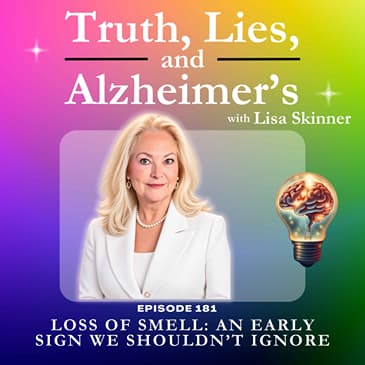
Loss of Smell: An Early Sign We Shouldn’t Ignore
In this episode of The Truth, Lies & Alzheimer’s Show, Lisa Skinner explores an often-overlooked symptom that may provide an early clue to neurological changes: loss of smell, also known as hyposmia.
A reduced sense of smell is commonly associated with Parkinson’s disease and can sometimes appear years, or even decades, before a diagnosis. While losing your sense of smell does not mean that you will develop Parkinson’s disease, it is a symptom worth paying attention to, especially when it occurs alongside other neurological changes.
Lisa discusses why our sense of smell matters, how changes in smell can affect taste, appetite, nutrition, and quality of life, and why subtle changes in the body should not always be dismissed as simply part of aging.
This episode is an important reminder to notice changes, ask questions, and talk with a healthcare provider when something feels different.
Learn More
For additional information about loss of smell and Parkinson’s disease, visit the Parkinson’s Foundation:
https://www.parkinson.org/understanding-parkinsons/non-movement-symptoms/loss-of-smell
Hashtags
#TruthLiesAndAlzheimers #MindingDementia #LisaSkinner #ParkinsonsDisease #ParkinsonsAwareness #LossOfSmell #Hyposmia #NeurologicalHealth #BrainHealth #DementiaAwareness #EarlyWarningSigns #CaregiverEducation #HealthyAging #PersonCenteredCare
The Parkinson’s Foundation notes that hyposmia is a common early Parkinson’s symptom, although not everyone who experiences reduced smell will develop Parkinson’s disease. (parkinson.org)
[00:00:03] Are you caring for a loved one with dementia? You don't have to figure this out all on your own. Welcome to Truth, Lies & Alzheimer's, the show that helps you reimagine a new relationship with your loved one. A relationship a little more free of stress and anxiety. Join host Lisa Skinner and her 30 plus years of experience as she guides you on a new path to a better relationship with those you care for.
[00:00:33] Here's Lisa. Hey everybody, welcome to another brand new episode of the Truth, Lies & Alzheimer's show. I'm Lisa Skinner, your host. Every once in a while, I don't know if you guys have picked up on this or not, but I am actually a compulsive researcher.
[00:00:54] I love to stay on top of all the research and all the current news related to Alzheimer's disease and dementia. Trust me, it changes on a dime. So, I've recently done some digging and come up with some really interesting new information that I think you would all be extremely interested in.
[00:01:22] It all pertains to brain disease, neurodegenerative diseases, and it's an update on three or four different topics. So, I'm going to share that with you all today. Now, this first bit of research that I've done, this article was actually written by a gentleman by the name of Dr. Tim Patel.
[00:01:46] He happens to be an emergency doctor and in his 30 years of practicing, he has seen and treated over 100,000 patients. And what he is sharing with us is that most people think Parkinson's disease begins with tremors.
[00:02:11] We all associate Parkinson's disease with people having tremors, but he's saying it actually may begin in our nose. Scientists now believe the proteins linked to Parkinson's and Alzheimer's may appear in the smell system years before movement or memory symptoms begin.
[00:02:36] And the reason why this article really caught my attention, and it's fascinating because I have heard so many times over the three decades that I've been working with families. Some have shared with me that, you know, when we think back about it, the very first symptom that my husband or whomever noticed was he lost his sense of smell, or at least it was diminished from what it had been.
[00:03:05] So there is a correlation that has surfaced between loss of smell and the beginning stages of Alzheimer's disease and some of the other neurodegenerative diseases that attack our brains. Now, what he says this means is that smell loss may not be a harmless or just a harmless aging symptom.
[00:03:34] It may be one of the earliest neurological warning signs that we can detect. And the medical community is actually now starting to pay much closer attention to this loss of smell theory. So he goes on to say, how is the damage spread?
[00:03:59] Well, researchers believe the disease may move through connected smell pathways into deeper parts of our brain. The proposed sequence looks something like abnormal proteins appear in the olfactory bulb. Smell processing neurons begin to fail. Familiar smells become weaker or disappear altogether.
[00:04:26] The damage spreads through connected neural pathways and movement and memory centers become impacted and affected. So this is the reason why smell loss is getting so much attention in neurology research. Stands to reason.
[00:04:46] Because in some people, the nose may show the disease years before the rest of the brain does. Now, what an interesting statement that is. And here's the evidence to support what he's saying.
[00:05:03] So as far as the pathology goes, Parkinson's related protein deposits often appear in smell regions before the brain's movement centers. Early decline. Studies show smell scores can begin failing years before cognitive symptoms appear.
[00:05:29] He continues saying poor smell function has been linked to significantly higher Parkinson's and dementia risk over time. This doesn't mean that every person with smell loss does have a neurodegenerative disease that's causing it. But it does mean persistent smell loss deserves more attention than it has in the past.
[00:05:59] Especially when it appears alongside other neurological changes. Smell loss still gets dismissed as normal aging far too often. So the nose framework. N-O-S-E. N stands for notice when smells fade.
[00:06:25] Coffee, perfume, or food aromas begin becoming dull. This can matter. Pay attention to that. Don't ignore persistent changes. It's not, it's possibly not your imagination. O stands for olfactory training daily. Smell training may help stimulate fading smell pathways. Common protocol.
[00:06:55] Roses, lemons, eucalyptus, and cloves twice a day. The S stands for screen it if it's persistent. Persistent smell loss can be tested objectively. Upset and sniff and sticks are commonly used assessments. And then the E stands for escalate early.
[00:07:23] The earlier neurological changes are investigated. The earlier the neurological changes are investigated, the better. Especially if smell loss appears with memory, sleep, or movement change. So what is changing? Some neurology and memory clinics are now paying much closer attention to smell testing during early assessments.
[00:07:52] Early cognitive assessments. Because the goal is no longer just treating an obvious disease. It's identifying neurodegeneration before major brain damage appears. And smell may just be one of the earliest windows that we have.
[00:08:17] That we can, you know, that really does raise our eyebrows that something may be going on there. So his advice. Don't automatically dismiss a diminished sense of smell as normal aging. So thanks Dr. Patel for sharing that really fascinating information with us.
[00:08:42] I think it's, you know, just another advancement into the research of what is happening to us when a neurodegenerative disease is developing inside our brain. Just one more thing to pay attention to. So this update has to do with some new research that I think you'd all be very interested in.
[00:09:10] And this is provided by Life Science Insights 360. Some brains do not surrender to Alzheimer's disease. They actually fight back. New research has uncovered something that challenges everything we thought we knew about how Alzheimer's disease progresses. While the disease relentlessly destroys neurons in most patients,
[00:09:40] some brains appear to mount a natural defense against it. Rather than allowing damaged cells to die. These brains help immature neurons survive the assault. Remember what I've talked about in previous episodes of the nun study? You know, this is related to that.
[00:10:08] Preserving memory function long after it should have been lost. And this isn't just curiosity, he says. This is a roadmap for us. For decades, Alzheimer's research has focused almost entirely on what goes wrong. The amyloid plaques, the tau tangles, neuroinflammation, synaptic loss.
[00:10:34] The underlying assumption has been that the brain is passive in face, in the face of this destruction. But the research is telling us something different. Some brains have a natural resilience mechanism.
[00:10:53] And if we can understand exactly how that works, which signals trigger it, which proteins enable it, which genes govern it. We may actually be able to replicate it pharmacologically in our brains that don't naturally possess it.
[00:11:17] So we are definitely making some inroads to figuring how our brains actually work and defend itself against neurodegenerative diseases. I have one more to share with you. But before I move into that one, let's pause for a second and take a quick break. But don't go away. I will be right back.
[00:11:43] This podcast is brought to you by Minding Dementia LLC. We encourage you to check out their website for resources, checklists, extra content and more. Visit MindingDementia.com today. Hi, everybody. You are watching and listening to the Truth, Lies & Alzheimer's show with me, Lisa Skinner, your host.
[00:12:04] Today's episode, I am giving you an update on the intensive research that I have done and continue to do with updates for you with pertaining to Alzheimer's disease and the other brain diseases that cause dementia. Because things change all the time. It's hard to keep up with everything. It's hard to keep up with everything. They change so rapidly.
[00:12:32] So today's episode, I'm talking about a few really significant updates that are promising and hopefully just one step closer to figuring these diseases out. Because so far we have not been able to pinpoint even exactly what causes it. So this article is provided by Dr. Mittal. Dr. Mittal.
[00:13:01] And he is the owner, CEO and associate professor of Innovative Thinker. So he's sharing with us the question, what stage of dementia is it? I can't tell you how many family members have shared that with me over the years and say, oh, my mother's in stage seven or mid stage.
[00:13:30] Or whatever. And it's true. And it's true. Families do often ask or tell, where are we now? And what comes next? But dementia staging is not just about memory and some of the other symptoms that we see. Modern Alzheimer's research increasingly separates two things. The biology. The biology.
[00:13:57] And that includes the amyloid tau and the neurodegeneration that happens to our brain as a result of the damage being done by these brain diseases. And then the function is the second piece. And that really relates to what a person can still do in daily life. And that distinction, he says, really matters.
[00:14:26] It matters that we understand that. Now, amyloid can begin building years before symptoms appear. This we know. Tau tends to spread later and is often more closely related to the symptomology, the brain shrinkage or atrophy, and the functional decline.
[00:14:49] So a person may have Alzheimer's biology long before they have dementia, which are all the signs, symptoms, and behaviors that show up as a result of the changing brain. And he says, once symptoms begin, the stage is often determined less by a scan and more by how the person is functioning on a day to day basis.
[00:15:17] This has been what I've observed in the last 30 years. So a practical way to think about it is preclinical Alzheimer's first. The biology may be changing, but there are no symptoms yet. Biomarker positive stage. Biology or amyloid may be positive. Tau may be low.
[00:15:46] And the person may still feel pretty normal. For mild cognitive impairment, memory or thinking changes are measurable, but independence is still mostly preserved. In mild dementia, complex tasks become harder.
[00:16:09] Finances, medication management, appointments, driving, cooking are still manageable. Moderate to severe dementia, the focus now shifts towards safety, daily assistance, comfort, dignity, and strong caregiver support. So why does this matter?
[00:16:39] Well, this is what he explains. In the early stages, we need to have a confirmed diagnosis and review the biomarkers and imaging and all the tests that were probably done. Discuss treatment options with the doctors. Discuss treatment options with the doctors. And very important, start planning finances, driving safety and future care. In the middle stage.
[00:17:08] Now it's all about preventing the crises that happen very frequently. We need to simplify the routines, support our caregivers, and reduce falls, medication errors, watering, and scams, he says.
[00:17:29] And then in the later stages is really where we need to be focused on preserving their dignity, managing their comfort, and supporting proper nutrition, sleep mobility, and family decisions.
[00:17:47] So what he's telling us here, the most important lesson to be aware of and to consider is that dementia is not a single moment. It's actually a long, long, long journey for everybody. And the earlier we understand the stage, the more choices patients and families have. Now there are two stage models.
[00:18:15] That have been around for decades. There's three stage model. Mild, moderate, and severe. And then there's a seven stage model, which really kind of condenses the behaviors and the symptoms into smaller buckets.
[00:18:38] But what I've seen and learned and been told by the medical community and the science community as there's such a diverse, there's such diversity in how people progress through the disease as an individual, that it's very difficult to just put somebody into a particular stage.
[00:19:07] And so I think that's a good rationale for, you know, kind of pigeonholing people into stages because everybody's different. So, yeah. So, but I do totally agree with the earlier we understand these stages, the more choices the patients and the families will have.
[00:19:33] And that we really should not be pigeonholing people into a particular stage because a person could be displaying symptomology that you might look into the stages and go, oh, this person's definitely in stage eight. But maybe they're not.
[00:19:50] Maybe they're just experiencing the dementia differently than somebody else who is in a higher stage, but or a more severe stage, but they're not showing as severe symptoms. This is a real thing.
[00:20:08] So I always want people to be conscious of that because, you know, that saying that we have in my world, if you've met one person living with dementia, you really only met one person living with dementia. And that is a very, very true statement. So we have to look at each person and not just the overall symptoms and behaviors and signs that go along with what we call dementia.
[00:20:36] So that is what I have for everybody today. When you have a minute, please stop by and visit my website mindingdementia.com. I hope this information has been really useful and promising for everybody.
[00:20:54] And it is for me, I'm feeling hopeful and optimistic that we are definitely getting closer and closer to figuring these brain diseases out and how we can manage them better or treat them better. And we're still not there.
[00:21:15] So that's why it's so important for me to really continue to do extensive research and to keep everybody up to date on the information that I find. And these are all, you know, evidence and scientific backed facts that I am bringing to you. So anyway, hope you enjoyed this episode today.
[00:21:40] I will be back next week with another new episode of the Truth, Lies and Alzheimer's show. I'm Lisa Skinner, your host. And what I wish for everybody is that first of all, you have a wonderful rest of your week. And then even more importantly, try to stay happy and healthy as best you can.
[00:22:09] So I'll be back next week and I look forward to seeing everybody then. Bye for now. Thank you for listening to Truth, Lies and Alzheimer's. We hope you found something in today's episode that helps. We understand that caring for a loved one with dementia can be the challenge of a lifetime, but you don't have to do it alone.
[00:22:32] If you're ready for exclusive access to even more great content and resources, head on over to Facebook and join Lisa's Minding Dementia Support Group. We're a community of like-minded caregivers and we're here to help.