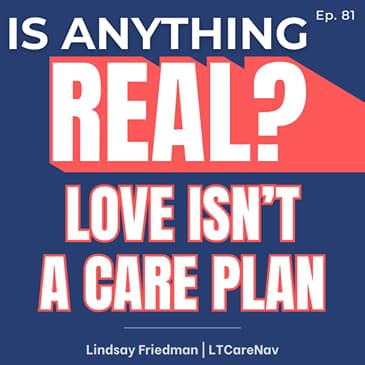
Love is not proven by running yourself into the ground.
But too many families are handed an impossible myth: If you really love someone, you should be able to care for them yourself.
That sounds noble until someone is exhausted, unsafe, resentful, financially overwhelmed, medically confused, and Googling long-term care options at midnight while pretending they are fine.
In this episode of Is Anything Real?, Adam W. Barney sits down with Lindsay Friedman, founder of LTCareNav and host of The Care Compass, for a deeply human conversation about long-term care, caregiving, family guilt, provider trust, and why needing outside help does not mean you failed your family. It may mean you are finally telling the truth soon enough to protect them.
Lindsay is working on one of the most human, broken, and under-discussed systems in the country: long-term care. Through LTCareNav, she helps families connect with vetted care providers. Not random listings, not pay-to-play lead-gen chaos, but real support when families are overwhelmed, scared, and trying to make high-stakes decisions quickly.
This episode is about care planning. But it's also about leadership under pressure. Because a family navigating care suddenly becomes a leadership team. There are stakeholders, emotions, constraints, money, medical needs, sibling dynamics, old history, safety concerns, and guilt...often with one person quietly carrying too much while calling it love.
Adam and Lindsay explore why the language of care partner matters, how caregiving can become one-sided when the relationship disappears, and why the well-being of the person providing care must be part of the care plan. They also unpack what is broken in the way many families are matched with long-term care providers. When families are in crisis, they do not need more phone calls, confusing directories, or visibility disguised as quality. They need clarity, trust, and vetted support.
This conversation is especially relevant for anyone caring for aging parents, supporting a spouse, navigating home care or assisted living decisions, preparing for long-term care planning, or quietly realizing their family may need help sooner than they wanted to admit.
In this episode:
- Why love is not a care plan
- Why needing outside help is not failure
- Why many families misunderstand who pays for long-term care
- Why caregiving is more than physical care
- Why families usually wait until crisis to plan
- Why care partner is a better frame than caregiver
- How self-sacrifice can damage the relationship you are trying to preserve
- Why care decisions go sideways under emotion and urgency
- What is broken about pay-to-play care matching and lead-generation directories
- Why vetted provider introductions matter
- Why care partner wellbeing must be included in the care plan
- The Care Partner Reset families can use this week
The big takeaway: Love needs infrastructure.
Not because love is weak. Because love is too important to be left unsupported.
Guest: Lindsay Friedman
Founder, LTCareNav
Host, The Care Compass
LTCareNav: https://ltcarenav.com/
The Care Compass + resources: https://ltcarenav.com/podcasts
LinkedIn: https://www.linkedin.com/in/lfriedman1/
Email: lindsay@ltcarenav.com
Host: Adam W. Barney
Transition Leadership Coach
Author of Make Your Own Glass Half Full
Creator of EnergyOS
👉 Book your 20-min Exploration Call: https://calendly.com/adamwbarney/explorationplugin-20min
Subscribe to Is Anything Real?: https://isanythingreal.adamwbarney.com/
00:00:05
Here's a myth that quietly wrecks families.
00:00:08
If you really love someone,
00:00:10
you should be able to care for them yourself.
00:00:13
Not really.
00:00:14
That sounds noble.
00:00:16
Until someone is exhausted, unsafe, resentful,
00:00:20
financially overwhelmed, medically confused,
00:00:23
and Googling long-term care options at midnight
00:00:26
while pretending they're fine.
00:00:29
Love is actually not proven
00:00:30
by running yourself into the ground.
00:00:32
And sometimes the most loving thing you can do
00:00:35
is just simply admit we need help,
00:00:37
and we need help we can actually trust.
00:00:41
Welcome back to "Is Anything Real?",
00:00:42
the reality-first leadership show
00:00:44
where we test advice,
00:00:45
publish the receipts,
00:00:46
and ship what actually works under pressure.
00:00:49
I'm Adam W. Barney,
00:00:50
transition leadership coach,
00:00:52
author of Make Your Own Glass Half Full,
00:00:55
and builder of a platform where I help leaders
00:00:57
rebuild their operating system
00:00:59
when the tools that got them here stop working.
00:01:02
Today's guest is Lindsay Friedman,
00:01:05
founder of LTCareNav
00:01:06
and host of "The Care Compass".
00:01:09
Lindsay is working on one of the most human,
00:01:12
broken, and under-discussed systems in this country,
00:01:15
long-term care.
00:01:17
Her work helps families connect with vetted care providers.
00:01:21
Not random listings,
00:01:22
not pay-to-play lead-gen chaos,
00:01:25
but real support in moments where families are usually
00:01:29
overwhelmed, scared, and simply moving fast.
00:01:32
And what I love about Lindsay's philosophy is this:
00:01:35
She doesn't just talk about caregiving as heroic martyrs.
00:01:39
She talks about care partners.
00:01:41
Because the person needing care matters
00:01:44
and the person giving care matters too.
00:01:47
Lindsay, welcome to the show.
00:01:49
Thank you so much for having me
00:01:51
and for that fantastic introduction.
00:01:53
I'm excited, Lindsay.
00:01:55
And I knew this conversation would truly matter
00:01:57
when you said outside help is not failure.
00:02:00
It actually might be
00:02:01
the only way to keep everyone safe and human.
00:02:04
Absolutely.
00:02:06
All right, let's start with the myth here.
00:02:09
Lindsay, what's the myth about caregiving or long-term care
00:02:13
that makes you want to flip a table,
00:02:15
let's say gently,
00:02:16
because we both have pets and aging parents nearby.
00:02:20
So I think the first myth,
00:02:22
and this is where the whole system collapses,
00:02:26
is that some system, some insurance, Medicare,
00:02:30
something will pay for long-term care.
00:02:34
And then every myth that comes after that
00:02:37
all comes back to the fact that our system
00:02:40
is not meant to give us support
00:02:42
and long-term care is very costly to bring in outside care.
00:02:48
And then when you don't,
00:02:50
it ends up impacting the family
00:02:52
even more than the care recipient.
00:02:54
Yeah, yeah.
00:02:56
And I think it's because most families
00:03:00
don't meet the long-term care system calmly, also.
00:03:03
Right?
00:03:04
They meet in a crisis:
00:03:05
diagnosis lands, a parent falls,
00:03:08
the spouse declines,
00:03:09
hospital discharge is suddenly coming,
00:03:12
and then everyone has to become an expert
00:03:15
in home care, assisted living,
00:03:17
insurance, medical equipment,
00:03:19
family dynamics, provider quality, transportation,
00:03:23
let's say medication, finances,
00:03:25
and also emotional guilt by, let's say, Thursday.
00:03:28
And that's absolutely absurd.
00:03:30
And yet we act like families should just figure it out.
00:03:33
And Lindsay, I know I mentioned I lived
00:03:35
a version of this in my own family.
00:03:37
You know, my mom passed away from bulbar-onset ALS
00:03:40
about 12 years ago,
00:03:42
and we were very lucky,
00:03:43
and I use that word very intentionally,
00:03:46
because her best friend from college, my uncle,
00:03:49
moved from Illinois to Massachusetts
00:03:51
to help my father care for her at home.
00:03:53
That was a huge gift.
00:03:55
Right?
00:03:55
She was able to remain in the house I grew up in.
00:03:58
She moved from the upstairs bedroom to a family room downstairs.
00:04:02
She passed at home in her chair in a familiar place.
00:04:05
And that's what many families would want.
00:04:08
But not many have that kind of support system.
00:04:11
And if they don't, I truly know it doesn't mean they failed.
00:04:16
It just means they need a system
00:04:17
that doesn't punish them for being human.
00:04:20
That said, though, what are families
00:04:23
usually least prepared for
00:04:24
when long-term care suddenly does become real?
00:04:28
I think one of the things that you just mentioned
00:04:30
about all of the tasks that go with it
00:04:32
is I think people,
00:04:33
when they're thinking about caregiving,
00:04:36
goes back to the,
00:04:37
oh well, what are you doing?
00:04:38
You're sitting with the person,
00:04:40
you're making sure they get their medication.
00:04:42
And people who haven't had true deep caregiving experiences
00:04:45
think very peripherally of, like,
00:04:47
oh, what does this possibly mean?
00:04:51
And even as somebody who worked as a caregiver,
00:04:54
I often talk about it,
00:04:56
that I worked years as a professional caregiver,
00:04:59
and I truly didn't understand what it meant
00:05:02
to be a family caregiver until I did it myself.
00:05:06
Because you are not just providing physical care,
00:05:09
which is much more personal and invasive
00:05:13
than you're even thinking.
00:05:15
Most people think, oh, I'll give them medication, right.
00:05:17
You're not thinking about the toileting,
00:05:19
the incontinence, the showering,
00:05:21
what it's like to actually
00:05:23
help people move and keep along through their day.
00:05:27
That is only one piece of caregiving.
00:05:29
When you are a family caregiver, like you said,
00:05:32
insurance, doctor's appointments, driving,
00:05:35
managing somebody else's life and finances,
00:05:39
and every bit that goes on it,
00:05:41
you become a little bit of wearing a million hats.
00:05:45
And the truth is,
00:05:47
not one person is prepared to do it all
00:05:50
because we don't have all those skill sets.
00:05:52
We're not supposed to.
00:05:54
And now all of a sudden we're taking on something
00:05:56
that is bigger than we could ever imagine.
00:05:58
And we are not trained to do that,
00:06:00
nor should we be expected
00:06:02
to be able to juggle so many things.
00:06:04
Yeah, yeah.
00:06:05
And I think that's, that's the first receipt here, right?
00:06:09
Care planning.
00:06:10
It's not a niche issue.
00:06:12
Right.
00:06:12
It's actually maybe surprisingly
00:06:14
one of the most predictable crises
00:06:16
most families still pretend
00:06:18
will somehow be spontaneous and manageable.
00:06:23
You used a phrase, rather.
00:06:26
I want to make the center of this episode, right.
00:06:28
Care partner.
00:06:30
And that language matters
00:06:32
because the traditional caregiver story
00:06:34
can become dangerous.
00:06:35
It praises self-sacrifice
00:06:37
until the person giving care
00:06:39
has no body left,
00:06:41
no patience left,
00:06:42
no identity left,
00:06:44
and no resentment-free relationship left.
00:06:47
And then everyone acts surprised
00:06:49
when they flame out or burn out.
00:06:52
Right.
00:06:52
So, define this for us.
00:06:55
Let's say what changes when we think
00:06:57
in terms of care partner
00:06:59
instead of caregiver.
00:07:01
So when we hear the word give, right.
00:07:04
What we're doing is
00:07:05
we're giving, we're giving, we're giving, we're giving,
00:07:08
which means somebody is taking.
00:07:11
Right.
00:07:12
And it sounds very one-sided.
00:07:15
And I think a lot of caregivers get to the point
00:07:20
where they're just giving and that they forgot that
00:07:23
the person that they're giving this care to
00:07:27
is their mom, their friend, their husband, their spouse.
00:07:31
They were a person that you had a relationship with
00:07:35
prior to this care journey.
00:07:38
And when we start to rethink it
00:07:40
as a partner in a relationship.
00:07:43
Right.
00:07:43
The person receiving the care who needs a hand
00:07:47
does not want this from you.
00:07:50
They don't, in most cases.
00:07:52
Right.
00:07:53
I know there's going to be people who are listening
00:07:54
that are like,
00:07:55
Oh no, my mom would do that.
00:07:56
Right.
00:07:56
I get that.
00:07:57
Right.
00:07:58
I just had a conversation with someone.
00:08:00
Some people are takers, right.
00:08:03
So let's just take it on average,
00:08:04
the person that you're providing care for
00:08:06
doesn't really want the care.
00:08:08
They wish they could do this on their own.
00:08:10
And what you need to look at it is,
00:08:13
I love you,
00:08:14
and I'm going to help you pick up the pieces.
00:08:17
I'm going to partner with you.
00:08:19
I'm going to give you the ability to do what you can
00:08:23
and then the things you can't do,
00:08:25
I'm going to step in and help you,
00:08:28
but make sure there's still a relationship
00:08:31
and that the person you're giving care to,
00:08:34
or you're providing care for, and with,
00:08:36
is able to give you something in return.
00:08:38
It could be conversation,
00:08:40
it could be a relationship.
00:08:42
So making sure core pieces
00:08:44
of what was there prior staying in place
00:08:47
will allow you to be a partner with them
00:08:50
in this care journey
00:08:52
versus somebody who's giving
00:08:53
and then at some point will feel like
00:08:55
they have dumped everything they have
00:08:57
and are getting nothing in return
00:08:59
except that point of exhaustion,
00:09:01
and as you said, resentment.
00:09:04
Well, and that distinction is huge because care,
00:09:07
no matter what it is,
00:09:08
but especially in that sense,
00:09:10
is relational.
00:09:11
Right.
00:09:11
It's not one human
00:09:13
becoming the infrastructure for another human.
00:09:16
And I think maybe a lot of families actually
00:09:18
confuse love with over-functioning.
00:09:20
But care without that support
00:09:22
becomes a debt
00:09:23
and the bank eventually collects,
00:09:25
whether it's that burnout, flame out,
00:09:27
resentment, unsafe decisions, or family fracture.
00:09:32
And also, I would say plainly, for anyone listening,
00:09:35
you and I both agree using outside care is not failure.
00:09:41
And I think that's, I think actually
00:09:44
failure is pretending everything is fine
00:09:47
because guilt has the steering wheel
00:09:50
and that's where a lot of emotional damage help,
00:09:52
you know, happens.
00:09:55
How do you help families
00:09:57
release the shame around needing outside support?
00:10:04
I think it's really hard to get them there.
00:10:07
Once you have guilt, if that's who you are,
00:10:09
it's going to be a hard process.
00:10:12
But I think it's almost, I like to look at it,
00:10:15
it's like when we raise children, right?
00:10:17
Most of us are sending our kids away to school to be educated.
00:10:24
We send them to a babysitter, or grandma and grandpa,
00:10:28
so we can take time for ourselves.
00:10:32
We do all of these different things,
00:10:34
I mean, to allow other people
00:10:37
to take part in raising and helping
00:10:41
bring up our children
00:10:42
so we have moments to ourselves.
00:10:46
Why wouldn't we do that for the person we're caring for?
00:10:48
These are our children that were like,
00:10:50
we will send you away for eight hours a day
00:10:53
because I do not have the skill set
00:10:55
to teach you, to do all these things during the day,
00:10:57
to make you a better person.
00:10:59
But for our loved ones, our parents were like,
00:11:02
oh, I can't possibly have anyone help me.
00:11:06
I think we just need to be very practical
00:11:08
about what we're doing.
00:11:09
And everybody just has to understand
00:11:12
that you are entitled to take care of you first.
00:11:15
The oxygen mask thing, right?
00:11:18
That is there for a reason.
00:11:20
Because if you don't take care of you,
00:11:23
which could mean bringing in somebody else
00:11:25
so you can do something
00:11:27
as simple as watch a television show.
00:11:29
and sit down,
00:11:32
then you're not going to be able to care for the person.
00:11:34
So the best thing for them
00:11:36
is taking care of yourself in the process, as well.
00:11:40
Yeah, yeah.
00:11:41
The question isn't
00:11:42
can we keep pretending we can handle this.
00:11:45
The question really is
00:11:47
what setup protects dignity, safety, and relationship.
00:11:51
The relationship for everyone involved.
00:11:55
But I'd also love to get into the provider sidebecause
00:11:57
this is where my old marketing brain
00:12:00
starts really twitching.
00:12:02
You told me that a lot of the matching and lead generation sites
00:12:06
say they vet providers,
00:12:07
but when you actually look under the hood,
00:12:10
many are just pulling from Google places
00:12:12
or functioning as pay-to-play directories.
00:12:16
You know, it's not like when a family is searching for care,
00:12:19
they're casually shopping for a blender.
00:12:21
They're often, as we said earlier,
00:12:23
scared, tired, navigating a crisis.
00:12:26
They might not know what good looks like.
00:12:29
And if the platform they trust is ranking based on payment,
00:12:32
that's not guidance, it's monetized confusion.
00:12:36
What's broken about the way families are matched
00:12:38
with long term care providers right now?
00:12:42
I think one of the bigger issues with the systems is that
00:12:47
when you go to a lot of them
00:12:49
and you put your name in to get some help,
00:12:52
you're going to get bombarded
00:12:55
by lots and lots of people who do the same thing.
00:12:59
You're already tired,
00:13:00
your phone's already ringing,
00:13:01
you're already confused of what's happening.
00:13:03
So really the phone calls aren't helpful.
00:13:07
And their phone calls.
00:13:09
Really understanding what you need.
00:13:11
Right?
00:13:13
What do you actually need in your situation?
00:13:17
Is home care the answer?
00:13:19
Is it really a senior care advisor
00:13:21
who can help you understand your situation better?
00:13:26
Is it assisted living?
00:13:27
But really having somebody who can help understand that,
00:13:30
which is what we really do
00:13:31
with our matching system and our introductions,
00:13:34
is identifying what you actually need.
00:13:36
Because that's a big part of it is
00:13:37
families don't understand what they even need.
00:13:39
And because there's so much going on,
00:13:42
so you're not sure what the right option is.
00:13:45
And so getting a lot of different phone calls isn't helpful.
00:13:50
Figuring out what you need is the first step.
00:13:52
And then having somebody who's actually vetted
00:13:55
who's a good match for you,
00:13:56
having somebody who calls who sounds amazing,
00:13:58
and they may be amazing, but you can't afford them.
00:14:02
Right.
00:14:03
It is more discouraging than helpful.
00:14:06
So we wanted to really take an approach of
00:14:10
truly vetted, one on one matches
00:14:13
that make sense for you, your family, your situation.
00:14:17
And we typically start with a senior care advisor as your match
00:14:21
who can help you for free
00:14:23
because it's really important
00:14:24
that you understand where you are
00:14:26
and I understand caregiving and care in general is expensive.
00:14:30
So we really try to be a nice place
00:14:33
where you can learn about your options
00:14:34
and make your decisions without having to pay for anything.
00:14:38
And, I mean, I will add in there, Lindsay,
00:14:41
of course, a plug for your podcast,
00:14:43
"The Care Company",
00:14:44
because it's super important.
00:14:49
You bring providers on
00:14:50
and let families hear from them directly
00:14:52
and that's trust building, it's transparency,
00:14:55
and it's a way to move from marketing claim to real signals here.
00:14:59
Because I think if the business model rewards
00:15:01
whoever pays to be seen,
00:15:03
families need to know that
00:15:04
before they actually mistake visibility for quality.
00:15:09
And I want to connect this to leadership
00:15:11
because people may not think of long term care
00:15:13
as leadership, but it absolutely is.
00:15:16
A family navigating care
00:15:18
is suddenly a leadership team.
00:15:20
It's the stakeholders, those emotions,
00:15:23
the constraints, the money, the history,
00:15:26
the sibling conflicts with different levels of availability.
00:15:31
Maybe a parent who doesn't actually want help.
00:15:33
There could be a spouse
00:15:34
who is exhausted and still insisting they're fine.
00:15:39
That's leadership under pressure
00:15:41
in so many different lenses.
00:15:46
And I have to say also,
00:15:48
my father had hydrocephalus a couple years ago.
00:15:50
We very quickly had to navigate into this world
00:15:54
and we're a family with resources and capable people,
00:15:58
and it still was truly overwhelming.
00:16:01
So, what do you see time and time again maybe
00:16:04
makes a family care decision go sideways?
00:16:07
Emotion and crisis.
00:16:12
And actually those things make decisions
00:16:14
in every aspect of our lives go sideways.
00:16:17
Right.
00:16:18
And so it's no different here.
00:16:20
When there is an emergency,
00:16:22
when there's a lot of fear feelings,
00:16:25
we're going to make decisions out of feelings,
00:16:27
whether instead of logic.
00:16:30
That's the one thing that's interesting
00:16:31
about long term care planning is that
00:16:33
it doesn't have to happen this way.
00:16:37
We are all guaranteed to age or to get sick.
00:16:41
And if not, the alternative is less appealing,
00:16:43
I'm telling you, than aging.
00:16:45
Right.
00:16:47
There's two choices,
00:16:49
and we don't have the conversations early enough.
00:16:52
We don't have to have these moments of crisis.
00:16:55
Well, obviously you've had your experiences,
00:16:57
but you probably are talking to friends now who are going,
00:17:00
oh my gosh, you should have seen what my mom did the other day.
00:17:03
Or, man, my dad just told me that same story for the 50th time.
00:17:08
I think he's getting confused.
00:17:10
We have these conversations with ourselves
00:17:13
so early in the aging process.
00:17:16
That first moment you see something as,
00:17:19
that is the moment to plan,
00:17:21
you're probably already too late.
00:17:25
The plans before that.
00:17:27
Right?
00:17:27
Where you could have really great conversations about it
00:17:30
is what avoids the crisis and the emotion.
00:17:33
Because emotion comes
00:17:34
when you already feel the aging,
00:17:36
when you already see yourself changing for the parent.
00:17:40
It's when you can have it before that
00:17:42
you can have more logical conversations.
00:17:44
Right.
00:17:45
And that's just human nature.
00:17:47
And that's what long term care planning is,
00:17:50
fighting against human nature.
00:17:51
But it's, it's such an easy.
00:17:54
Well, it's not easy to do the planning,
00:17:56
but it's the solution that is there
00:17:59
in front of all of us.
00:18:00
Yeah, yeah.
00:18:02
And that gets into one answer,
00:18:03
I imagine there where, you know,
00:18:05
families avoid that hard conversation
00:18:07
until urgency makes the decision for them.
00:18:10
And that's so true in business as well, right?
00:18:13
Avoided conversations become expensive conversations.
00:18:16
But in care, they actually become
00:18:18
potentially catastrophic conversations, right?
00:18:23
Absolutely.
00:18:24
And costly.
00:18:28
There's an emotional messiness here also.
00:18:31
Right.
00:18:31
You know, there can be love and frustration mixed together,
00:18:35
gratitude and resentment,
00:18:37
tenderness and anger.
00:18:40
You know, people feel terrible, I guess,
00:18:42
maybe admitting that, you know,
00:18:44
But the feelings are not the failure.
00:18:46
It's creating a care situation where
00:18:48
nobody is allowed to tell the truth
00:18:50
until they break.
00:18:52
What emotions do you see care partners
00:18:55
most often feel actually ashamed of?
00:18:59
So I help, admin a caregiver group
00:19:02
and we have a lot of people who post anonymously
00:19:07
these feelings that they feel horrible about.
00:19:10
But it's almost some of them are truly saying,
00:19:13
I just wish this was over.
00:19:16
Well, we all know
00:19:17
that there's only one way of over, right?
00:19:20
And these are things that anonymously,
00:19:22
we're really trying to say,
00:19:24
these are okay feelings to have, right?
00:19:26
Don't act on them.
00:19:28
But these are,
00:19:29
the type of overwhelm that can hit a care partner
00:19:32
is so extreme that we're seeing people say things of,
00:19:36
I need this to be over.
00:19:37
I'm done with this.
00:19:38
I don't even like my mom.
00:19:40
Or I feel like a parent.
00:19:42
And I think that's always really an interesting one
00:19:45
when you say I feel like a parent, your parent,
00:19:47
you've just said you've lost your relationship.
00:19:50
Yep, yep, yep and yep.
00:19:54
Well, human feelings, you know, don't cancel love.
00:19:57
They usually tell us
00:19:58
where the care system needs more support.
00:20:00
Right.
00:20:02
I want to get, you know, quickly, Lindsay,
00:20:05
into maybe one move our listeners can run this week,
00:20:07
and I would call it, let's say,
00:20:09
The Care Partner Reset.
00:20:11
And this is for anyone currently in care,
00:20:14
anticipating care,
00:20:15
or pretending this conversation is for other families
00:20:18
while quietly realizing it's not.
00:20:21
And it just starts with four simple questions.
00:20:24
The first one:
00:20:25
what are we assuming one person will carry?
00:20:27
Make sure you name it.
00:20:29
Right.
00:20:29
What is it?
00:20:30
The second question:
00:20:32
is that actually safe and sustainable?
00:20:35
We don't need to be heroic,
00:20:36
it doesn't need to be ideal.
00:20:37
There's nothing perfect in this world.
00:20:39
That needs to be safe and sustainable.
00:20:42
The third being, where do we need outside help
00:20:44
before resentment or risk becomes the forcing function?
00:20:49
That could be home care, transportation,
00:20:52
or simply a vetted provider conversation.
00:20:55
And then the fourth:
00:20:56
what do we do if we treated
00:20:58
the care partner's well being
00:21:00
as part of the care plan
00:21:01
simply because it is.
00:21:02
But Lindsey, what would you add to that simple reset there?
00:21:08
Have an honest conversation with yourself.
00:21:12
And it kind of goes back to your second question.
00:21:15
But really it is okay to say, I can't do all of this.
00:21:19
There should be no guilt.
00:21:20
There should be no shame.
00:21:21
That is a really great thing to say,
00:21:24
I need to take this off of my plate.
00:21:27
What can I take off of my plate to make everything better?
00:21:31
And then figure out
00:21:32
who that person in your life is
00:21:35
that can do that.
00:21:36
And I know, I hear a lot of families go,
00:21:38
well, my sister will never help, I've asked her.
00:21:41
Figure out what that one thing is.
00:21:44
And there are resources you are probably not available,
00:21:47
social services, nonprofits.
00:21:49
And figure out what you can do because
00:21:53
if you don't take care of you, you'll break.
00:21:55
And then what happens to the person you're caring for?
00:21:58
Right, right.
00:21:59
You know, and that is so essential
00:22:02
because if your only care plan
00:22:04
protects the person receiving the care,
00:22:06
it's actually incomplete.
00:22:08
Right.
00:22:08
The care partner or partners are part of the system there.
00:22:13
But Lindsey, I think you how we end,
00:22:15
you know, after all of this,
00:22:16
whether it's broken care systems, provider vetting,
00:22:19
you know,
00:22:20
care partners, family guilt,
00:22:21
safety and just dignity,
00:22:23
is anything real in this space?
00:22:28
I think the love that we have
00:22:29
that makes us want to care for the person
00:22:32
that we are caring for
00:22:34
is what we have to go back to,
00:22:37
and really understanding why we've chosen
00:22:40
to be a care partner or taken that role on,
00:22:44
and realizing that everybody deserves care,
00:22:48
and everyone deserves kindness,
00:22:50
including the care partner.
00:22:52
Yep.
00:22:53
And, and what feels real to me is the fact that, you know,
00:22:57
love needs that infrastructure.
00:22:59
Right?
00:22:59
And it's not because love is weak.
00:23:01
It's because love is too important to be left unsupported.
00:23:04
But, you Lindsay, where can folks find you,
00:23:07
learn more about LTCareNav,
00:23:09
and listen to "The Care Compass"?
00:23:12
If you go to
00:23:13
ltcarenav.com/podcasts
00:23:15
with an S at the end,
00:23:17
you can actually find "The Care Compass"
00:23:19
and you can find other episodes that I've been on,
00:23:22
plus giving away free ebooks.
00:23:25
And it's a great way to just kind of engage.
00:23:27
And you can send me a message, as well,
00:23:29
because we are here to support you.
00:23:32
That's fantastic.
00:23:33
Well, of course, link to those in the show notes below.
00:23:36
But, you know,
00:23:37
for anyone listening who's navigating this now,
00:23:40
needing help does not mean you failed your family.
00:23:44
It actually just may finally mean
00:23:46
you're finally telling the truth
00:23:47
soon enough to protect them.
00:23:49
So, you know, if this episode hit,
00:23:51
I would challenge you to send it to someone
00:23:54
who's quietly carrying too much
00:23:56
and calling it love.
00:23:57
And, of course,
00:23:58
if you're navigating a leadership transition,
00:24:00
whether it's through caregiving pressure,
00:24:02
the moment where simply your old tools just stop working,
00:24:07
there's also a 20-minute foundation call with me
00:24:09
linked in the show notes below.
00:24:10
But Lindsay, thank you for doing this work.
00:24:14
This one is deeply real.
00:24:16
And for our listeners, until next time,
00:24:18
stay grounded,
00:24:19
stay human,
00:24:20
and keep questioning the noise.
00:24:22
But thanks, Lindsay.
00:24:23
Thank you.